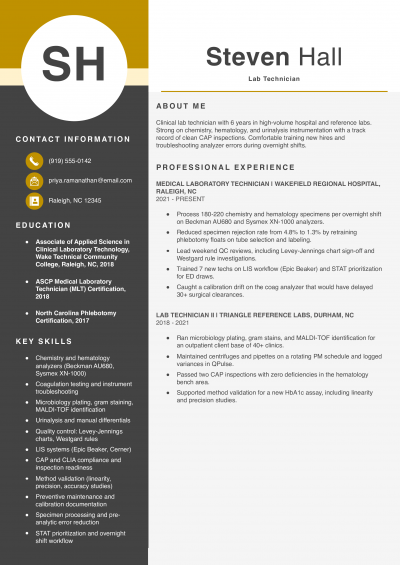
Lab Technician Resume Examples
Lead the summary with daily specimen volume and the complexity tier you handled. Lab managers read that line as your readiness to cover a bench from day one. Name your certification, the CLIA complexity (waived,…
Every resume example is written and reviewed by our team of Certified Professional Resume Writers to ensure top-quality content and formatting.
Your site monitoring record is the proof that sets you apart. A clinical research associate resume should show protocol deviations caught and query resolution rates. Include on-time site closeouts as well.
Clinical operations managers and sponsor recruiters look for hands-on ICH-GCP knowledge and a track record of clean audit findings.
Credentials like the CCRA or CCRP signal that you meet industry standards. Pair them with real numbers from your monitoring visits and FDA inspection outcomes. The examples below show you how to build each section for this kind of role. To compare layouts before you start, browse our resume templates.
A visible CCRA or CCRP credential is what gets Clinical Research Associate resumes past the initial credentialing screen from clinical operations managers; protocol counts and monitoring visit metrics are what make them readable enough to advance.
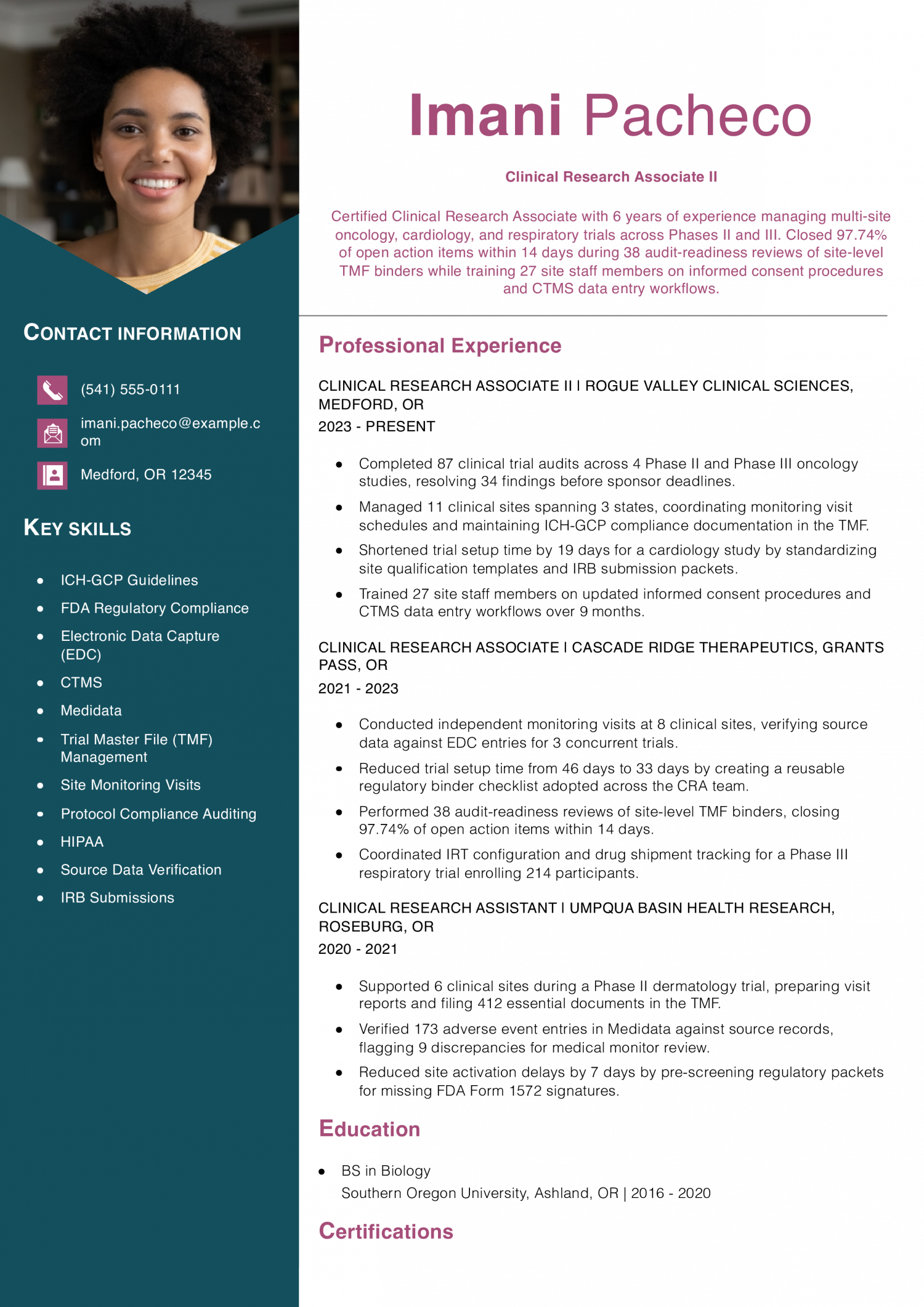
Consider this resume if you are a mid-level Clinical Research Associate with about six years of site management and monitoring experience across multiple therapeutic areas. Lead with audit completion counts and setup-time reductions tied to specific trial phases the way this resume does.
Training site staff on updated consent procedures and data entry workflows over several months shows both the headcount and the time investment. A sponsor can see that training covered the process over several months. State how many people you trained, what you taught, and over what period.
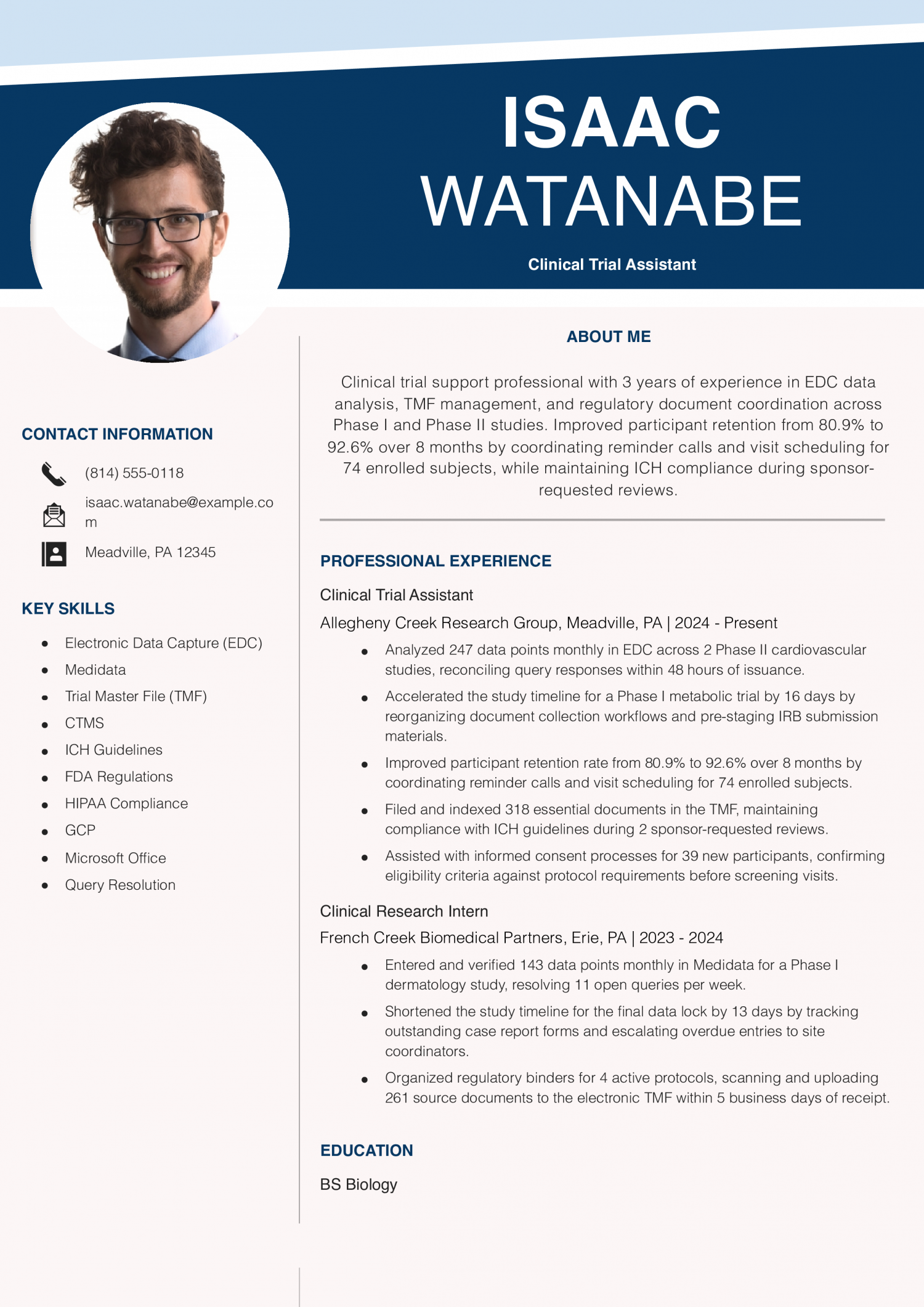
Use this resume if you are an entry-level clinical trial assistant moving from an internship into your first full-time research support role. Lead with retention and timeline figures rather than listing routine filing or scheduling tasks.
Filing and indexing essential documents alongside a count and an audit reference is the order that matters. A quality reviewer sees how many records were handled and under which regulatory standard. Put your document volume first, then name the compliance event that tested your filing.
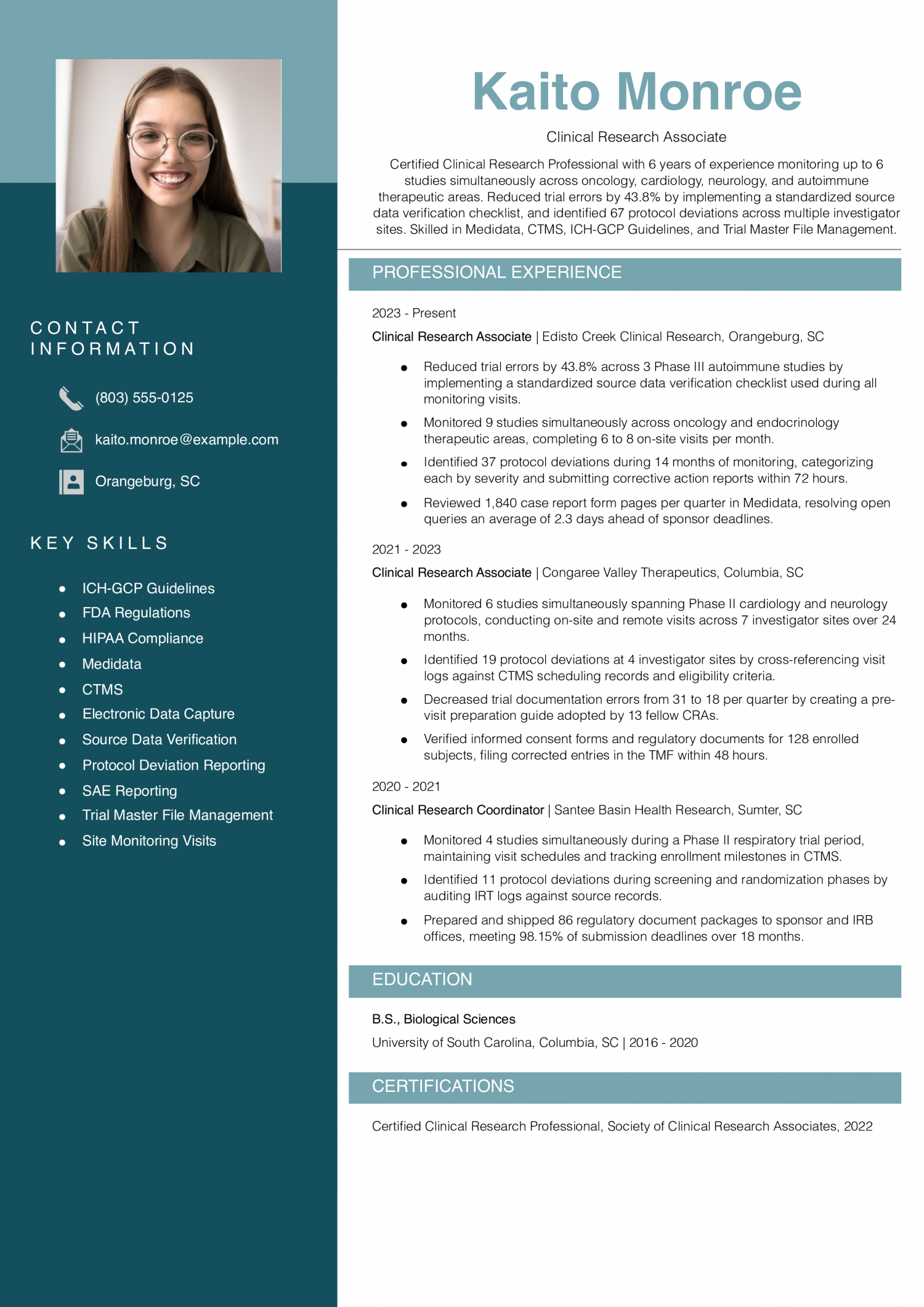
Try this resume if you are a mid-level Clinical Research Associate with about 6 years of monitoring experience and a CCRP credential. Lead with deviation counts and corrective action turnaround times the way this resume pairs each finding with a response window.
Resolving queries ahead of the sponsor deadline, time after time, shows a steady work pace across site visits. A project manager sees margin built into every turnaround, not a last-minute push. State how far ahead you typically close queries and against whose timeline you measure.
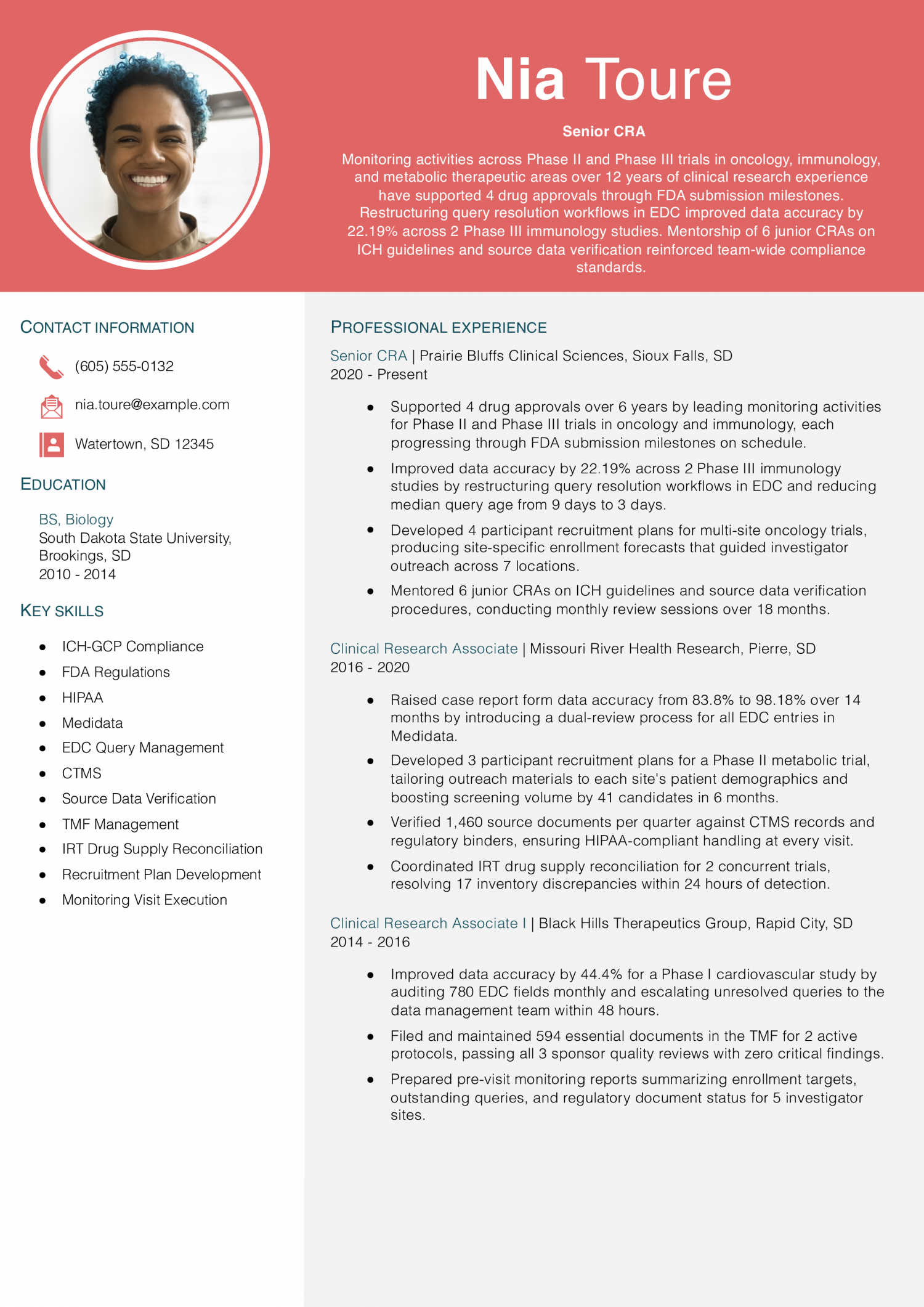
Lean on this resume if you are a senior CRA with about 12 years spanning multiple therapeutic areas and phases. Lead each bullet with the query, recruitment, or approval outcome rather than the monitoring visit itself.
Inventory discrepancies resolved within a tight time window show both the count and the response speed. Naming the IRT system connects the reconciliation work to the specific tool that tracks it. Say which system you used, how many discrepancies you found, and how fast you closed each one.
Bringing 6 years of clinical research experience across Phase I through Phase III trials in respiratory, oncology, endocrinology, and pharmacokinetic therapeutic areas, with hands-on proficiency in EDC, CTMS, Medidata, and Trial Master File management. Increased patient enrollment by 29.07% in a Phase III respiratory trial by redesigning pre-screening workflows and coordinating with referring physician offices. Skilled in informed consent processes, source data verification, IRB regulatory submissions, and ICH/GCP/FDA compliance across multi-study site environments.
Clinical operations managers and CRO recruiters can request verification of your CCRA or CCRP status through the issuing organization. Your summary line needs something they cannot confirm that way. Name the therapeutic area you know best, such as oncology or rare disease.
Pair it with a second detail like a language skill or remote monitoring background. A line like “CRA with Phase II, III oncology experience across 12 sites, fluent in Mandarin” tells a reader two things fast. It shows your trial phase depth and your site coverage range.
That combination is hard to replicate from a credential directory alone. Keep this opener to two lines so it stays above the fold on screen.
Strong CRA resumes tend to carry numbers in most bullets. Start each one with the count of sites you monitored. Add the number of subjects enrolled across those sites.
Cycle times matter too, so note days saved on query resolution. You might write “Monitored 14 sites across three countries, enrolling 420 subjects in 18 months.” Audit results also read well as metrics. State how many findings your pre-audit prep reduced.
If a bullet has no figure, it tends to read as a duty list. CRO recruiters scan for volume and speed first. Even a rough figure like “cut monitoring visit backlog by 30%” adds weight.
Pair one outcome metric with one scope metric per bullet when you can.
Break your experience into clusters that match how trials run. Site monitoring is the first group: initiation visits, interim visits, and close-out visits. Source data verification fits here too.
The second group is regulatory document management. Cover how you maintained the investigator site file and tracked IRB approvals. Safety reporting is a third cluster.
Describe how you processed adverse events and serious adverse event narratives. A fourth group covers data quality. Note query resolution, edit check review, and CRF completion rates.
Listing work in these clusters helps clinical operations managers scan your scope fast. It also keeps your bullets from blending into one long block of tasks. Each cluster can hold two or three bullets, which gives the section a clean visual rhythm on the page.
List your CCRA from ACRP or CCRP from SOCRA in a credentials block on page one. Put it right below your name and contact line. Clinical operations managers and CRO recruiters often filter resumes by certification before reading further.
Keeping it high on the page clears that filter early. After your credentials, add a line for the software you use. Name the CTMS and EDC platforms you have used, such as Medidata Rave or Oracle InForm.
Include IVRS and eTMF systems on the same line. If you hold a GCP certificate, place it with the CCRA or CCRP entry. Do not bury tools or certifications in a bullet halfway down the second page.
List your degree with the institution name and graduation year. Life science degrees in biology, nursing, or pharmacy align with most CRA postings. If your degree is in a different field, add any clinical coursework on a separate line.
A GCP training line with the provider and completion date belongs here too. For a conference poster or published abstract, add a short publications section after education. Keep each entry to one line with the citation and year.
Volunteer roles on data safety monitoring boards or ethics committees can fill a final section. These details show clinical operations managers that your interest in research extends beyond paid site visits. End the page there to keep it to one or two pages.
Your resume goes through an automated screen before a person reads it. Look through each list for terms the posting also uses. Protocol terms clear the first cut.
Soft-skill phrases like attention to detail decide the next round. Clinical operations managers and CRO recruiters weigh hard skills first. They screen for monitoring visit terms.
They also look for FDA regulation knowledge. Soft skills then shape the interview call. Strong written communication signals you can draft clear trip reports.
Time management shows you can handle multi-site travel schedules. Critical thinking proves you can spot data gaps during visits.
Pull exact terms into your bullet points. Treat soft skills as proof that backs each result you list. Swap any term that does not appear in the posting for one that does.
| Soft Skills | AI-estimated % |
|---|---|
| Investigator site rapport | 66% |
| Detail-oriented observation | 56% |
| Cross-functional collaboration | 50% |
| Deadline management | 36% |
| Ethical judgment | 27% |
And here are the top hard skills showing up most often.
| Hard Skills | AI-estimated % |
|---|---|
| Clinical trial monitoring | 74% |
| Protocol deviation management | 55% |
| Informed consent review | 50% |
| Regulatory document collection | 40% |
| Site qualification visits | 29% |
Skill names and rankings come from an AI model grounded in U.S. Department of Labor occupation data for clinical research associates, not from a count of clinical research associates’ resumes built on ResumeTemplates.com.
Compliance training comes first.
HIPAA rules shape how you handle participant data. Clinical operations managers and recruiters check for this. Show that you protect health information at every visit.
Why HIPAA Training Matters for CRAs
List HIPAA training in your certifications or education section. Note the year you completed it. Pair it with GCP training for stronger context.
A CCRA from ACRP signals you know these standards well. Describe how you applied HIPAA rules during monitoring. Name the system you used to store protected data.
Keep each bullet focused on one compliance action.
You could claim to be an AI-driven monitor, which clinical operations managers doubt. You could leave AI off and answer questions later.
Or you could describe the real workflow you follow. Clinical operations managers and sponsor recruiters can verify that approach. Name the tool you used and the task it helped with.
State what you reviewed or corrected in the output. Sponsors care about data integrity, not buzzwords. A clear, honest line beats a vague claim every time.
Keep each entry tied to a monitoring or compliance task.
What AI is actually changing for this role
Query management: AI flags data discrepancies across EDC fields faster, but CRAs still write and resolve each query.
Site selection: Predictive models score potential sites by enrollment history, though CRAs verify feasibility on the ground.
Protocol deviation tracking: Natural language tools scan visit notes for deviations, yet CRAs confirm severity and report to sponsors.
Document review: AI scans regulatory binders for missing or expired documents, and CRAs confirm accuracy before audits.
AI tools to name
How to phrase AI on your resume
Do
Skip
Clinical operations managers and recruiters read this list as a map of where your work is heading. The credentials you hold tell them which trial phases and site types you know best. They also show how far you have gone past entry-level monitoring.
Not every posting asks for a credential, but many sponsors prefer one. Some employers list it as a strong plus for senior roles. Others weight it when they pick who covers complex studies.
Give each credential its own line with the issuing organization and the year.
Resume Templates offers HR approved resume templates to help you create a professional resume in minutes. Choose from several template options and even pre-populate a resume from your profile.
Communication tops the list because CRAs talk to site staff, sponsors, and review boards every day. Problem-solving and time management also rank high with hiring managers.
Volunteer work at a research site or hospital also counts as hands-on exposure.
Pull terms from the job posting first, then add words like site monitoring and source document review. Name the drug area listed in the posting, such as oncology or cardiology.
Clinical operations managers and CRO recruiters often filter by these terms before reading a full resume.
Most CRO and sponsor companies in the United States expect a one- to two-page resume. A full CV is more common in academic medical centers or government research roles. Check the posting, and if it does not specify, a targeted resume is the safer choice.
List each contract assignment as its own entry with the sponsor name in parentheses. Include the therapeutic area, the trial phase, and how many sites you monitored. This format lets clinical operations managers see your range without confusing short tenures for job hopping.
Open your summary with the transferable skill that fits the CRA role, such as nursing assessment or lab data review. Map each prior job bullet to a monitoring task, like verifying patient records or flagging safety events.
A line noting your GCP training or CCRA progress signals that you are building toward the role.
One page works well if you have fewer than five years of monitoring experience. Two pages are reasonable when you have led studies across several therapeutic areas or phases. Keep the second page focused on earlier roles and publications rather than repeating details from page one.
An ATS-friendly template organizes your certifications and work history under separate headings. A basic template works too.
Clinical Research Associate Resume
4.7/5 stars with 192 reviews

Executive Resume Writer and Career Coach
Andrew Stoner is an executive career coach and resume writer with 17 years of experience as a hiring manager and operations leader at two Fortune 500 Financial Services companies, and as the career services director at two major university business schools.
© 2026 Resumetemplates.com All rights reserved.