Electrical Engineer Resume Examples
Lead with the one signal an engineering director cannot pull from a state PE lookup. That might be a specific design portfolio, a code-committee seat, or fluency in a stack the posting names. Concrete openers…
Every resume example is written and reviewed by our team of Certified Professional Resume Writers to ensure top-quality content and formatting.
Your strongest proof is a shipped product or a board-level design that cut cost or latency. Hardware managers and technical recruiters scan for that kind of output first. They want to see FPGA or embedded systems work tied to real specs.
List the tools you used, such as Verilog, VHDL, or MATLAB. Name the chip families or bus protocols you worked with. The examples below show how to frame each project so your resume leads with the work that matters most. To compare layouts before you start, browse our resume templates.
A clear list of target architectures and design tools is what gets computer engineering resumes past the ATS keyword screen; quantified project outcomes in silicon or firmware are what make them readable enough for hardware managers to advance.
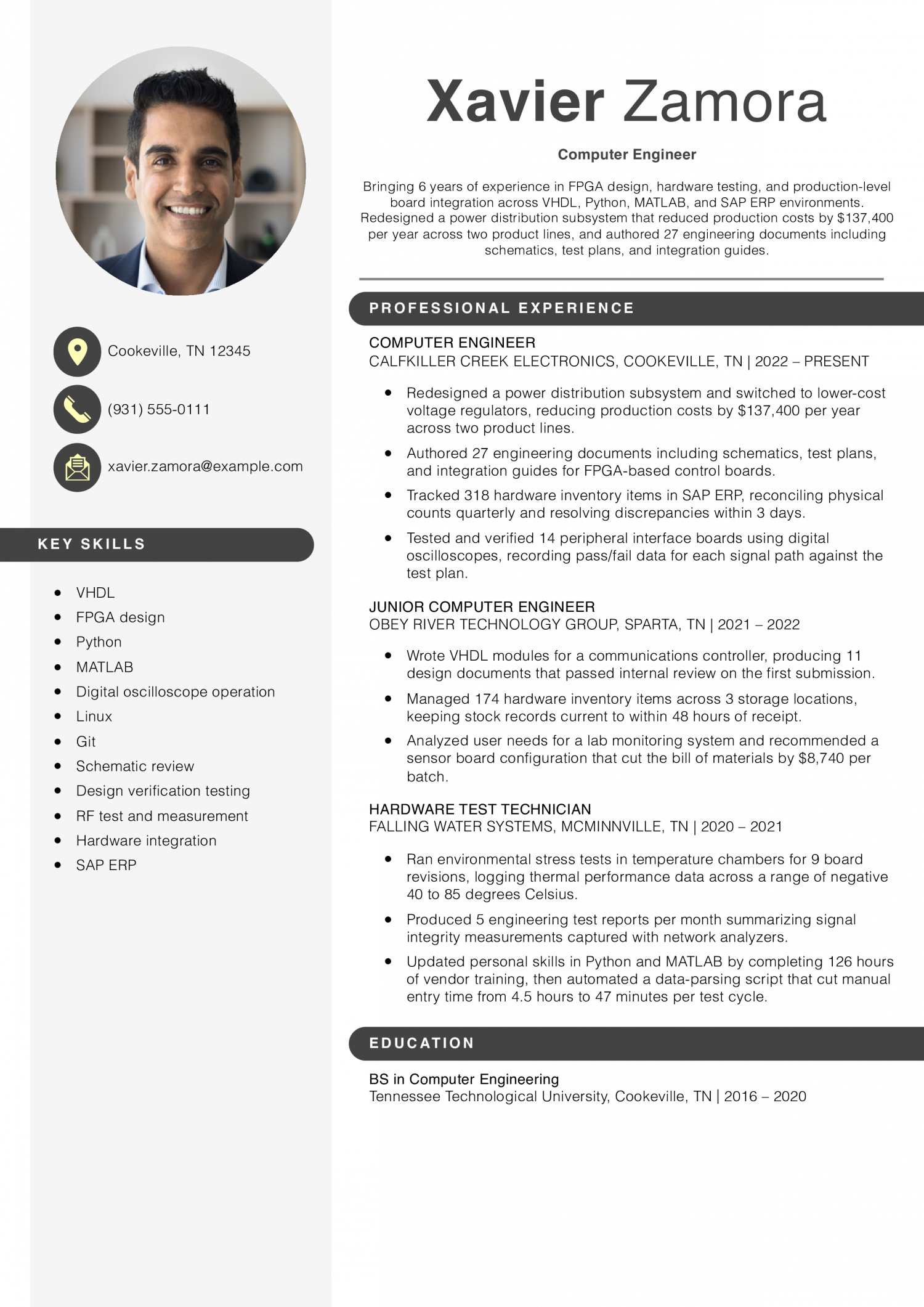
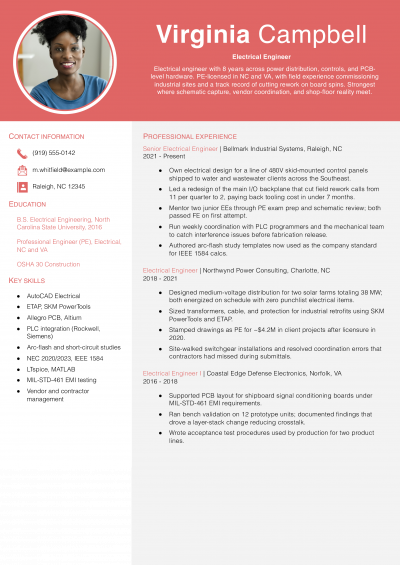
Pick this resume if you are a mid-level computer engineer with about six years of experience moving toward a lead hardware design role. Drop vague task descriptions and instead attach a dollar or inventory figure to every engineering action you list.
The cost-savings bullet works because it names the component swap behind the number. That tells a reviewer which component choice cut costs. For your own cost-reduction bullets, name the design choice that saved the money.
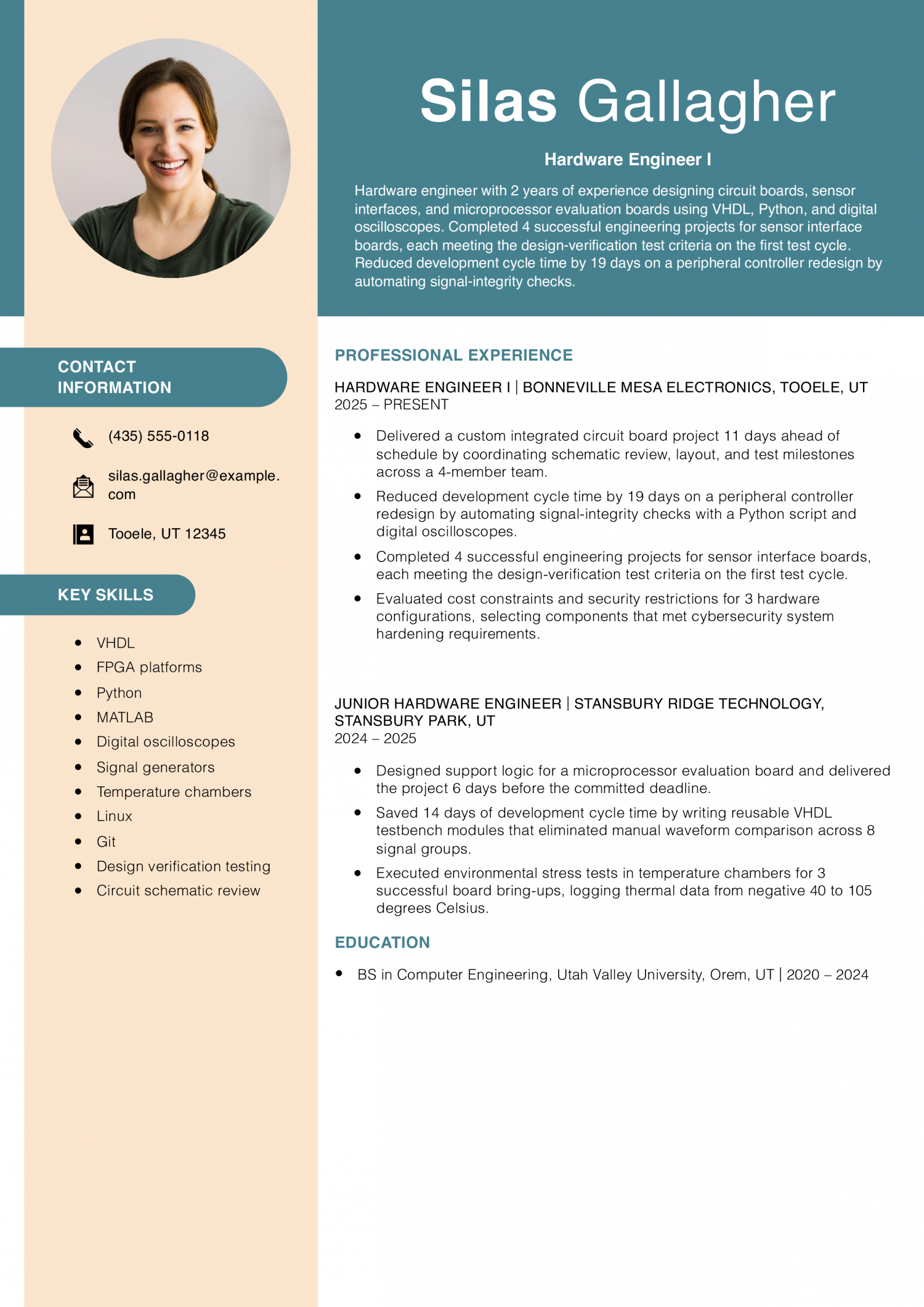
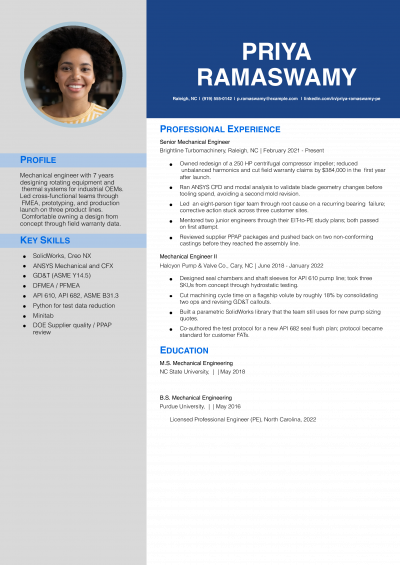
Start with this resume if you are an entry-level hardware engineer beginning a first or second role in board-level design and testing. Fit each bullet around a concrete day count or pass rate tied to the method you used.
This resume names the manual work its VHDL testbench modules replaced: waveform comparison across multiple test groups. That tells a reviewer what the tool does and what problem it solved. In your own bullets, say what was done by hand before and what your code handles now.
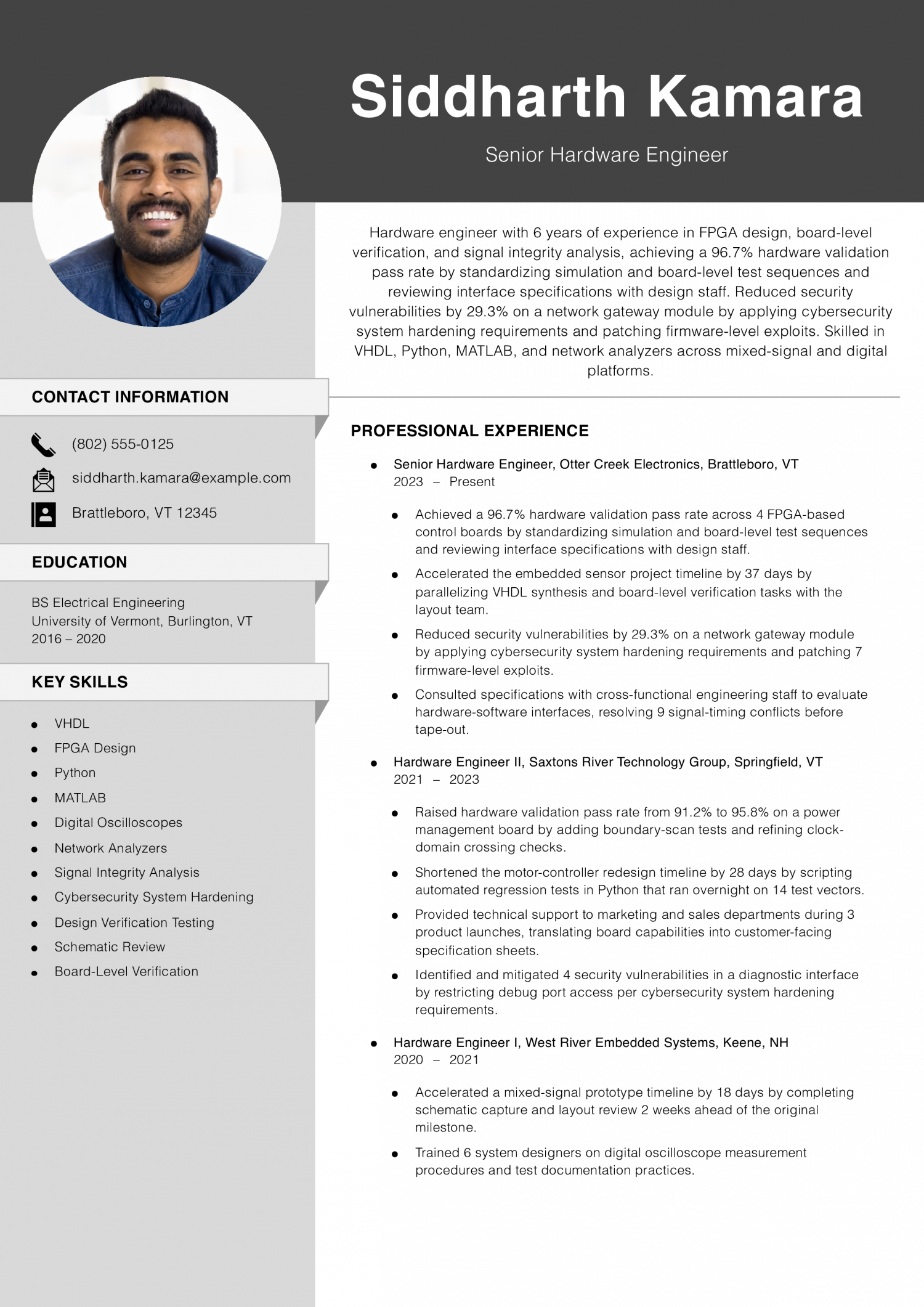
Try this resume if you are a mid-level hardware engineer with about six years of board and FPGA work stepping into a senior design role. Hand each bullet a named security or validation method so reviewers see both the gain and the engineering discipline behind it.
Giving a single pass rate hides the improvement. Here, the validation bullet names the tests added as the rate rose, and a reader can see which changes made the difference. Lay out the starting point, the ending point, and what you changed.
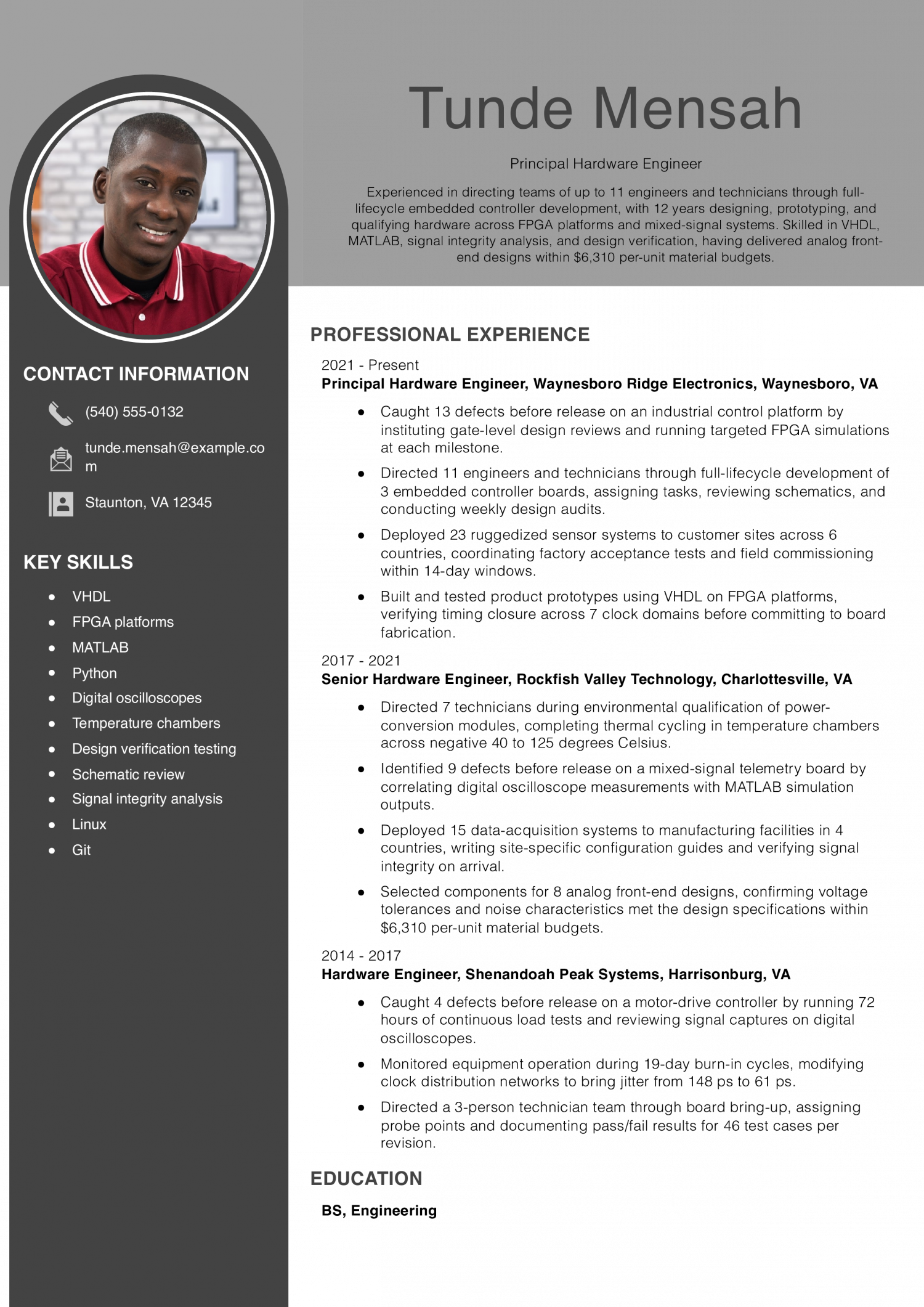
Lean on this resume if you are a senior hardware engineer ready to step into a principal-level role leading multi-board programs. Insert the exact defect count your review method caught before each product release.
Weekly design audits and schematic reviews show how this leader checked the boards as the team built them. A supervisor can see the oversight behind the results. Say how many people you led, what they built, and how often you reviewed the work.
Skilled in FPGA platforms, VHDL, C++, MATLAB, and Python with 6 years of experience spanning embedded systems analysis, power supply specification, and functional specification writing. Improved integration speed by 15.8% on a sensor-fusion platform by restructuring bus architecture and writing detailed interface specifications. Completed 8 prototype iterations across real-time data acquisition and peripheral interface projects, with hands-on use of digital oscilloscopes, Microsoft Access, Linux, and Git.
Your degree and LinkedIn profile establish your background, but they do not show the projects you have delivered. Stand out by leading with a single line that names your niche. That might be FPGA prototyping for edge devices.
It could be ASIC design at 7 nm or below. A bilingual skill set that covers both firmware development and PCB layout also works well here. Place this line right under your name and contact block.
Keep it to one sentence, not a full paragraph. Hardware managers and technical recruiters skim the top third of page one in about six seconds. If your opener reads like every other resume, they move on.
A sharp, specific tagline gives them a reason to keep reading your work history.
Most strong computer engineering resumes tie each bullet to a metric. Percentages and counts both work well for this purpose. You might cite a 30 percent drop in power draw after a board redesign.
You could note 12 product revisions shipped on schedule. Throughput gains, defect rates, and cycle time cuts all translate well. Bullets without a number tend to read as duties, not results.
Even rough figures help. If you cut test time from four hours to 90 minutes, write that. If your driver code ran on 50,000 shipped units, say so.
Technical recruiters compare candidates side by side. Numbers give them a fast way to rank your work against the next resume in the stack.
Organize your bullets under the type of work you did. Hardware design is one group: schematic capture, signal integrity, and thermal analysis. Embedded software is another: bare-metal C, RTOS porting, and bootloader development.
A third category covers verification and test. Include things like writing test benches, running regression suites, and documenting coverage metrics. You can add a fourth group for cross-functional work, covering vendor sourcing, DFM reviews, and compliance testing.
A fifth group might be project leadership, which you should scope to sprint planning, stakeholder communication, and release coordination. Clean grouping helps hardware managers scan your experience fast. It also keeps your resume from reading like a long, flat task list.
Create a credentials block on page one, right below your tagline. List your degree first: a BS or MS in computer engineering, electrical engineering, or a related field. Then name your primary tools.
Cadence Allegro and Altium Designer are common picks for PCB work. Xilinx Vivado and Intel Quartus matter for FPGA roles. For embedded work, cite your toolchains and debuggers.
Add version control tools like Git. If you hold a relevant certification, place it on the same line as your degree. Hardware managers and technical recruiters filter resumes by tool name before they read bullets.
Burying a key tool on page two means a recruiter may never see it at all during their initial review.
If you have fewer than three years of professional work experience in computer engineering, move your education section above your experience. List your degree, your GPA if it is 3.2 or higher, and one or two capstone projects. Describe each project the same way you would describe a job.
Name the problem, the tools you used, and the outcome. A senior design project that built a working prototype counts as real work. Include relevant coursework only when it maps to the posting.
Digital signal processing, embedded systems, and VLSI design are strong choices. Skip general education courses. Keep this section to four or five lines so it stays tight and scannable.
Five years ago, a Computer Engineering resume read like a parts list. The mix has shifted toward full-stack firmware skills. Cloud-connected hardware now appears on most postings.
Hardware managers and technical recruiters weigh hard skills first. They want proof you can own a full design cycle. Then they check soft skills to gauge cross-team work. Both categories carry weight in ATS scoring.
Read each table below before you edit your resume. Compare every item to the target job posting. Add the terms that appear in both places. Drop any term the posting never mentions.
Treat soft skills as results you weave into bullets. Show where collaboration cut a review cycle short. Show where problem solving saved a board revision. Each bullet should pair a soft skill with a metric.
| Soft Skills | AI-estimated % |
|---|---|
| Cross-functional collaboration | 67% |
| Analytical problem-solving | 54% |
| Technical documentation clarity | 43% |
| Deadline-driven focus | 35% |
| Design iteration adaptability | 32% |
And here are the top hard skills showing up most often.
| Hard Skills | AI-estimated % |
|---|---|
| Circuit board design | 72% |
| Hardware prototyping | 55% |
| Embedded systems development | 49% |
| Logic design verification | 40% |
| Performance benchmarking | 30% |
Skill names and rankings come from an AI model grounded in U.S. Department of Labor occupation data for computer engineers, not from a count of computer engineers’ resumes built on ResumeTemplates.com.
The items below are what separate a computer engineering resume from one that gets put back in the pile.
What hardware managers and technical recruiters expect has shifted. Listing only hand-coded design files or manual test benches reads as incomplete. Naming the AI tools you use for synthesis or verification shows a current workflow.
It also tells reviewers you still check every output against timing specs. Power and area specs matter too. The list below names what to add.
Focus on tools you have used in a real project. State what the tool did and what you verified by hand. Keep each line tied to a measurable result.
That structure gives recruiters a clear read on your actual skill level.
What AI is actually changing for this role
HDL design: AI code assistants draft Verilog or VHDL modules faster, but engineers still review timing and logic correctness.
Verification: Machine learning models now generate test vectors that reach corner cases manual suites often miss.
Physical layout: AI-driven place-and-route tools cut iteration cycles, though sign-off still requires human review of design rule checks.
Power analysis: Predictive models flag thermal hotspots earlier in the design flow, reducing late-stage respins.
Bug triage: Natural language tools classify and prioritize silicon bug reports across large regression databases.
AI tools to name
How to phrase AI on your resume
Do
Skip
Your tech stack tells recruiters what you can build. Group tools by category for easy scanning. Hardware managers want to match your skills to projects. A clear list helps them do that in seconds.
BLS data covers all computer hardware engineers, a broader group that includes computer engineering roles. The 10th-percentile floor sits roughly 43 percent below the median. The top-decile ceiling lands about 39 percent above it.
That gap is wide. Chip design focus, firmware depth, and work location all play a role. Openings tend to cluster in certain metro areas and industries.
Put your best technical skill near the top of your resume so hiring teams can spot it on first read.
| # | State | Median Annual |
|---|---|---|
| 1 | California | $185,180 |
| 2 | Washington | $169,120 |
| 3 | Massachusetts | $167,600 |
| 4 | New Mexico | $165,350 |
| 5 | Texas | $163,860 |
| 6 | New York | $163,470 |
| 7 | District of Columbia | $163,360 |
| 8 | Hawaii | $159,880 |
| 9 | Arizona | $158,280 |
| 10 | Colorado | $156,080 |
| # | State | Workers | Median |
|---|---|---|---|
| 1 | California | 19,820 | $185,180 |
| 2 | Texas | 7,390 | $163,860 |
| 3 | New Mexico | 5,260 | $165,350 |
| 4 | Florida | 3,290 | $134,160 |
| 5 | Massachusetts | 3,150 | $167,600 |
Resume Templates offers HR approved resume templates to help you create a professional resume in minutes. Choose from several template options and even pre-populate a resume from your profile.
Start with a clear objective that names your target role and your strongest skill area. Below it, list coursework, lab projects, and any internship work with hardware or embedded systems.
A senior capstone project counts as real experience on your resume. Describe the problem you solved and the result you measured.
Yes, it belongs on your resume because it shows you completed a full design cycle. Write it under a Projects heading with the platform and your role.
Include one measurable outcome, such as latency reduced or power draw cut by a percentage. Hardware managers and technical recruiters treat capstone work as proof you can deliver a real build.
Pull keywords from the posting itself, then match them with terms common across the field. FPGA, VHDL, firmware validation, and embedded C appear in many computer engineering postings.
Place these terms in your skills section and repeat them inside your bullet points. That way an applicant tracking system can find each keyword in context.
Name the exact role and the company, then state one or two skills you bring to it. Keep the objective to two lines and cut vague phrases like "seeking a challenging opportunity."
A strong example reads: "FPGA design engineer seeking to apply three years of Verilog development at Northrop Grumman." That sentence tells the reader your specialty, your depth, and your target.
List the gap period honestly and fill it with anything that kept your skills current. Open-source hardware contributions or personal FPGA builds both count as relevant work.
Hardware managers and technical recruiters care less about the gap itself than about your current skill level. Show that your technical knowledge stayed sharp during that time.
A computer engineering resume highlights hardware and firmware work alongside your software skills. Emphasize board-level design, signal integrity, and embedded systems over web frameworks alone.
If you hold both degrees, lead with the discipline that matches the posting. A hardware-heavy role expects to see circuits and protocols before it sees application code.
One page works for most candidates with fewer than ten years of experience. A second page is reasonable when you have extensive project lists or patent filings to show.
Keep every entry relevant to the target role so the extra length adds value. Cut older work that does not connect to the position you are applying for.
For a computer engineer, an ATS-friendly template is the safest pick, because it puts your certifications and experience where a hiring manager scans first. A basic template is a solid alternative. Whichever you choose, keep the formatting clean and easy to parse: clear section headings, a standard font, and no graphics a parser can choke on.
Computer Engineering Resume
4.7/5 stars with 231 reviews

Executive Resume Writer and Career Coach
Andrew Stoner is an executive career coach and resume writer with 17 years of experience as a hiring manager and operations leader at two Fortune 500 Financial Services companies, and as the career services director at two major university business schools.
© 2026 Resumetemplates.com All rights reserved.