
Engineering Resume Examples and Templates
Lead the summary with a verifiable number, not a scope statement. Name the budget you owned, the tolerance you held, or the uptime you delivered. An engineering manager reads the first line to gauge whether…
Hiring engineering directors look for the system you owned and the reliability or integration outcomes it produced on the first page, because that signals whether you can carry a subsystem from CONOPS through V&V without supervision.
The junior systems engineer profile covers zero to four years, often post-bachelor's or fresh from a rotational program. The resume needs to prove you can read an ICD, write a test procedure, and trace a requirement without hand-holding.
The senior systems engineer profile spans roughly five to twelve years with ownership of subsystems or full integration phases. The resume needs to prove you've shipped against a CONOPS, run V&V on hardware-software boundaries, and led integration across at least two domains.
The principal systems engineer profile carries twelve-plus years and chief architect scope across multi-system programs. The resume needs to prove you set the architecture, chair the CCB, and own the reliability and cost trades that program managers cite in reviews.
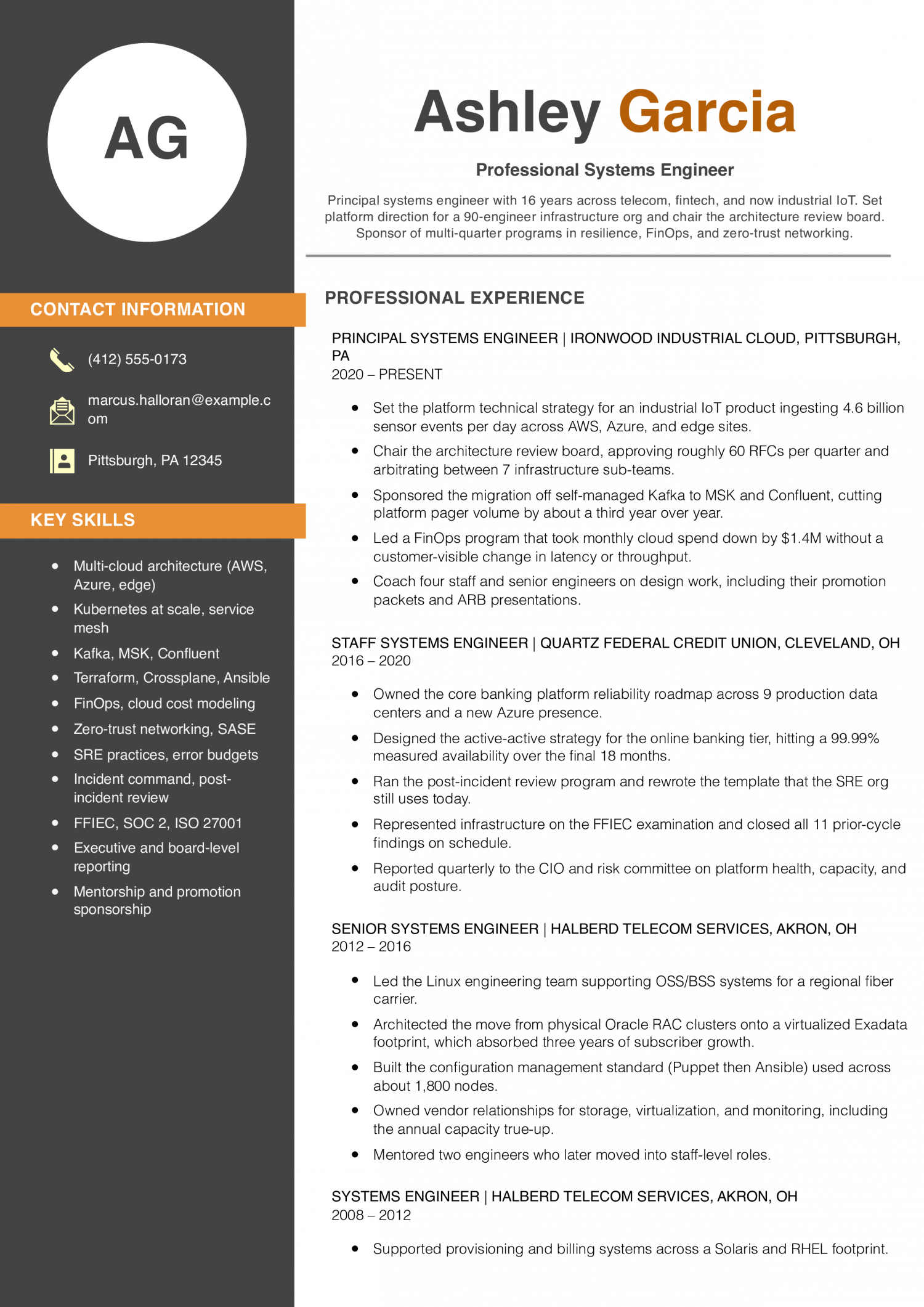
Elena Vasquez
Minneapolis, MN | (612) 555-0164 | [email protected] | linkedin.com/in/elenavasquez-se
Systems engineer with 11 years across retail, logistics, and SaaS infrastructure. Strong in Linux platform engineering, Kubernetes, and identity systems. Comfortable as the technical lead on multi-team migrations and the person who writes the runbook everyone ends up using.
Lead Systems Engineer
Northwind Mercantile Group | Minneapolis, MN | 2021-Present
Senior Systems Engineer
Cobalt Freight Systems | St. Paul, MN | 2018-2021
Systems Engineer
Cobalt Freight Systems | St. Paul, MN | 2016-2018
Systems Administrator
Birchline Software Co. | Madison, WI | 2014-2016
IT Systems Analyst
Birchline Software Co. | Madison, WI | 2013-2014
Add one line a LinkedIn skills scrape cannot show. Name the actual system you owned end-to-end and the domain boundary you crossed.
That might read as lead systems engineer on a Ka-band SATCOM payload, MBSE owner for a Class II infusion pump, or platform architect for a multi-region Kubernetes control plane. The point is specificity a recruiter cannot fake from a job title.
Engineering directors and infrastructure managers scan the top third for proof of ownership scope. A generic line about cross-functional collaboration tells them nothing they cannot infer from your title.
Bullets without a number tend to read as duties. Most strong systems engineer resumes carry two or three hard metrics per role.
Name uptime moved (99.5 to 99.95 percent), latency cut (p99 from 480ms to 120ms), or defect escape rate dropped at integration. Scope numbers work too: 1,200 requirements managed in DOORS, 14 ICDs authored, or a 47-node test bed.
Where you cannot cite a number under NDA, swap in scope language: subsystem count, vendor count, or program budget tier. Recruiters scan for numbers first and prose second.
Cluster bullets into the categories that match how systems engineering actually runs. A clean grouping helps technical screeners place you on their org chart.
Use four buckets: requirements and architecture (CONOPS, ICDs, SysML models), design and trades (analysis of alternatives, FMEA, reliability budgets), integration and verification (V&V plans, test procedures, ITAR sign-off), and sustainment (anomaly resolution, ECPs, obsolescence).
Within each cluster, lead with the artifact you produced, then the outcome. A bullet that names a deliverable and a result reads stronger than one that names only the activity.
Engineering directors need to confirm clearance status, INCOSE level, and tool fluency before they invest in a screen. Put those signals in a credentials strip under your summary, not buried on page two.
List active clearance level and adjudication date if you hold one, INCOSE ASEP or CSEP, and the MBSE platform you actually use (Cameo, Rhapsody, or Capella). Add DOORS, Jama, or Polarion if you’ve owned the toolchain.
Cloud platform engineers should mirror this with AWS or Azure architect-level certs and the IaC stack (Terraform, Pulumi) in the same strip.
At the senior and principal level, every line that reads like staff-engineer work pulls your level down. Most reviewers calibrate scope from the weakest bullet, not the strongest.
Cut script-writing one-liners, ticket counts, and tool installation bullets. Cut early-career roles past the 15-year mark unless they anchor a clearance or domain story.
Keep what shows architecture authority: CCB chair, technical review board lead, multi-program trade studies, and reliability budgets you defended to a program manager. Those are the bullets that move you from senior to principal in a calibration meeting.
Five years ago, a systems engineer resume read like a tools-and-frameworks inventory: DOORS, MATLAB, UML, agile. The skills below come from the resumes our users built in 2026. The mix has shifted toward MBSE fluency, cloud-native architecture, and named reliability outcomes.
Engineering directors weigh hard skills as gate-pass signals (clearance, SysML, V&V) and treat soft skills as evidence they expect your bullets to back up. A claim of stakeholder management without a CCB or IPT example reads as filler. Match this list against the posting you’re targeting, then make sure each soft skill shows up as a concrete bullet, not a standalone word.
| Soft Skills | % of resumes with this skill |
|---|---|
| Problem solving | 77% |
| Communication | 67% |
| Collaboration and teamwork | 47% |
| Analytical thinking | 35% |
| Time management | 30% |
And here are the top hard skills showing up most often.
| Hard Skills | % of resumes with this skill |
|---|---|
| System architecture design | 68% |
| Requirements analysis | 62% |
| Cloud platforms (AWS, Azure) | 48% |
| Automation and scripting | 38% |
| Systems integration and testing | 28% |
Based on data from thousands of systems engineers’ resumes built on ResumeTemplates.com, May 2026.
The items below are what separate a professional systems engineer resume from one that gets put back in the pile.
Engineering directors and infrastructure managers expect to see niche terms that match the program domain, not generic systems vocabulary. Group your keywords by the specialty your target posting names, then mirror the exact phrasing.
| Niche | Keywords ATS scans for |
|---|---|
| Defense and aerospace systems | system engineer resume, INCOSE CSEP, DOORS requirements management, ITAR compliance |
| MBSE and digital engineering | systems engineer resume example, SysML modeling, Cameo Systems Modeler, digital thread |
| Cloud and platform engineering | systems engineering resume, AWS solutions architect, Terraform IaC, Kubernetes platform |
| Verification and validation | systems engineer resume examples, V&V planning, FMEA analysis, integration test procedures |
| Program and lifecycle leadership | system engineer job description resume, CONOPS authoring, ICD development, technical review board |
AI use on a systems engineer resume can go three ways: lead with ‘AI-driven architect’ (which engineering directors screen out), leave it off entirely (which reads as out of touch in 2026), or describe the workflow as it actually runs. The third is what technical screeners can validate.
Teams use LLMs to draft initial requirement sets from CONOPS text, then engineers refine them against INCOSE rules manually.
AI tools generate first-pass analysis of alternatives matrices, but the trade rationale and weighting still come from the engineer.
LLMs convert verification matrices into draft test procedures, cutting V&V planning time without replacing the engineer's sign-off.
Copilot-style tools cross-reference anomaly reports against historical defect databases, surfacing patterns faster than manual log review.
The tools below show up across the resumes our users built and the postings they targeted. Mirror the names exactly as the target posting writes them, including version numbers when the posting cites a version.
A bachelor’s in engineering and tool fluency keep you eligible. The certifications below move a systems engineer resume from the qualified-but-typical stack into the engineering director’s shortlist. List the issuing body, level, and earned date on one line under your credentials strip.
Systems engineer sits in a mid-sized BLS bucket, which means the median pulls in a long tail of IT-support and junior infrastructure variants that share the SOC code. The spread between the 10th and 90th percentile is wide because clearance, MBSE depth, and platform scope move pay more than years alone.
To position above the median, lead the resume with the systems you architected end-to-end and the reliability or integration outcomes you owned, not the tools you’ve touched.
| # | State | Avg. Annual |
|---|---|---|
| 1 | California | $127,660 |
| 2 | Washington | $127,420 |
| 3 | Colorado | $124,010 |
| 4 | New Jersey | $123,640 |
| 5 | Massachusetts | $121,580 |
| 6 | District of Columbia | $114,110 |
| 7 | Virginia | $113,500 |
| 8 | Rhode Island | $112,980 |
| 9 | Oregon | $111,140 |
| 10 | Minnesota | $106,740 |
| # | State | Workers | Median |
|---|---|---|---|
| 1 | California | 55,460 | $127,660 |
| 2 | Texas | 48,150 | $104,970 |
| 3 | Florida | 35,660 | $100,770 |
| 4 | North Carolina | 25,350 | $104,940 |
| 5 | Virginia | 22,730 | $113,500 |
Resume Templates offers HR approved resume templates to help you create a professional resume in minutes. Choose from several template options and even pre-populate a resume from your profile.
Yes. List the level (Secret, TS, TS/SCI) and the adjudication date in your credentials strip.
Do not list the case number or investigation file ID. Recruiters at primes use clearance status as a hard filter, so burying it past page one costs you screens.
If your clearance is inactive but within the two-year reinstatement window, write inactive plus the date last held.
Pivot from specifics to scope language. Name the domain (radar, payload, ground station), the lifecycle phase you owned, and the scale.
Describe the artifact type rather than the system: 'authored 14 ICDs across two subsystems' or 'led V&V planning for a Class II payload program.'
Engineering directors with cleared backgrounds read this fluently. They know the redaction game and trust scope language more than vague impact claims.
Reframe your software work around the system boundaries you crossed. Lead with integration, interface design, and any MBSE or requirements work you touched.
Cut the language proficiency list down to one line and replace it with tool fluency in DOORS, Jama, SysML, or whatever the target posting names.
Add an INCOSE ASEP if you can earn it before applying. It signals the shift is intentional, not a layoff pivot.
Close enough usually clears the ATS, but list both names when they overlap. Cameo and MagicDraw are the same product post-rebrand; write both.
If the posting names Rhapsody and you've only used Capella, write your tool plus 'SysML modeling' as the parent skill.
Engineering directors care more about whether you can build a behavioral model than which IDE you opened it in.
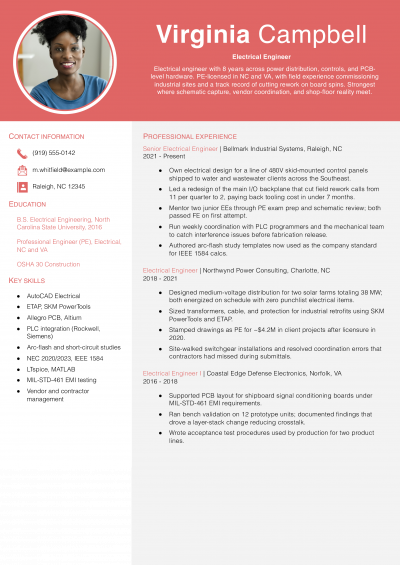
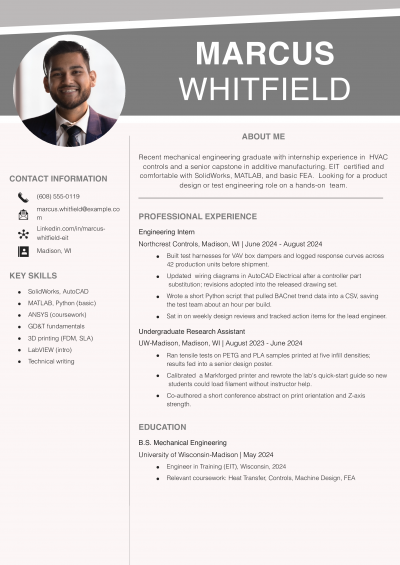
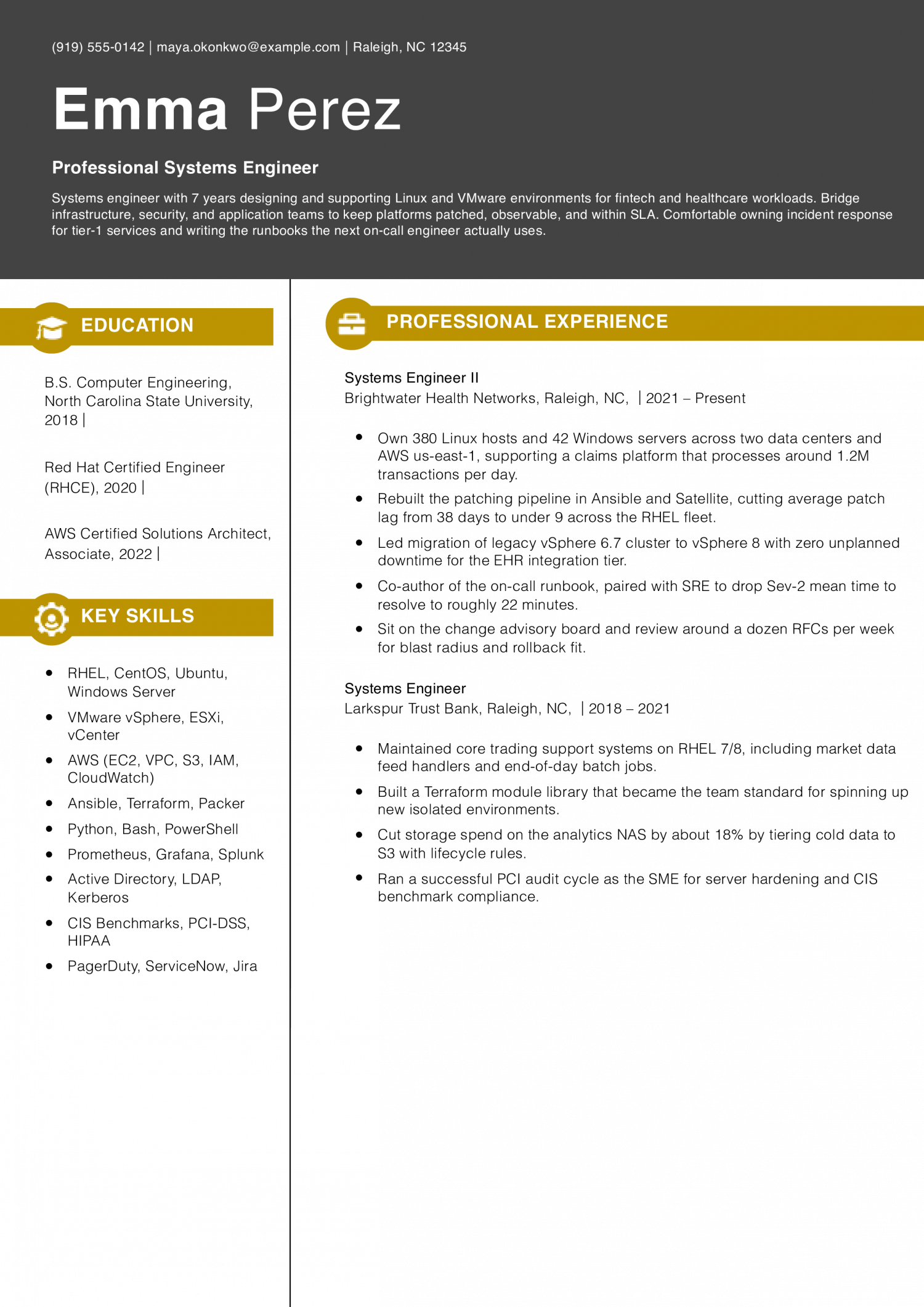
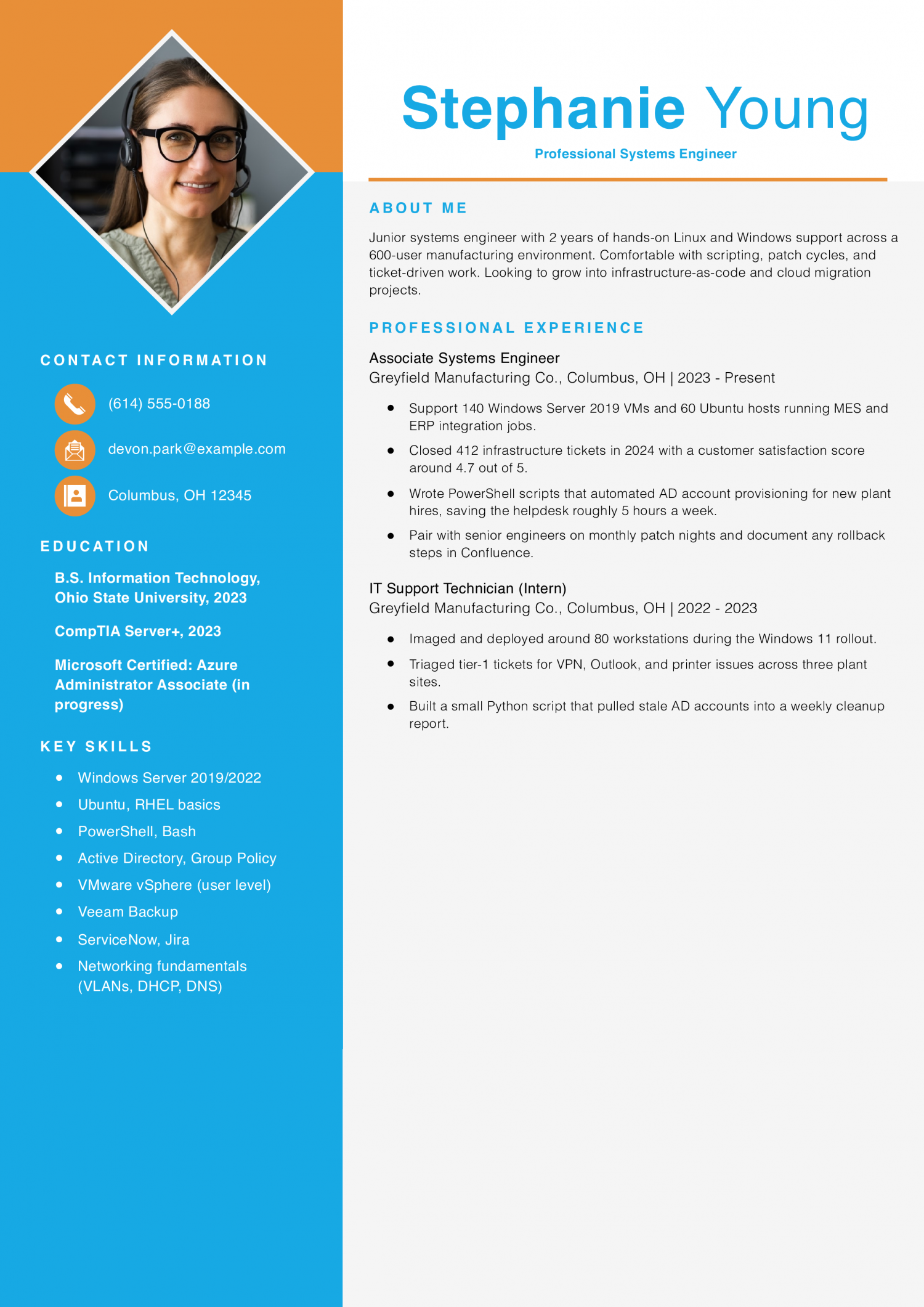
For a systems engineer, a tech template is the safest pick, because it keeps your stack, tools, and impact easy to scan. An ATS-friendly template is a solid alternative. Whichever you choose, keep the formatting clean and easy to parse: clear section headings, a standard font, and no graphics a parser can choke on.