College Resume Examples and Templates for 2026



Include a cover letter with your resume
Your graduate school application should always include a personalized cover letter. This is your opportunity to speak to the committee directly, conveying your enthusiasm for the opportunity. A cover letter also allows you to explore unique details about your background that you wouldn’t normally include on a resume. For instance, you might mention that your passion for autism research stems from your personal experiences supporting a family member with ASD.
Key takeaways:

Taylor’s resume is focused, relevant, and well-organized. It prioritizes academic depth while also showing initiative through two professional roles tied to civic education and engagement. By leading with impactful teaching and organizing experience, Taylor proves their ability to connect research and real-world outcomes. The academic projects section showcases independent research with measurable results—ideal for graduate school reviewers.
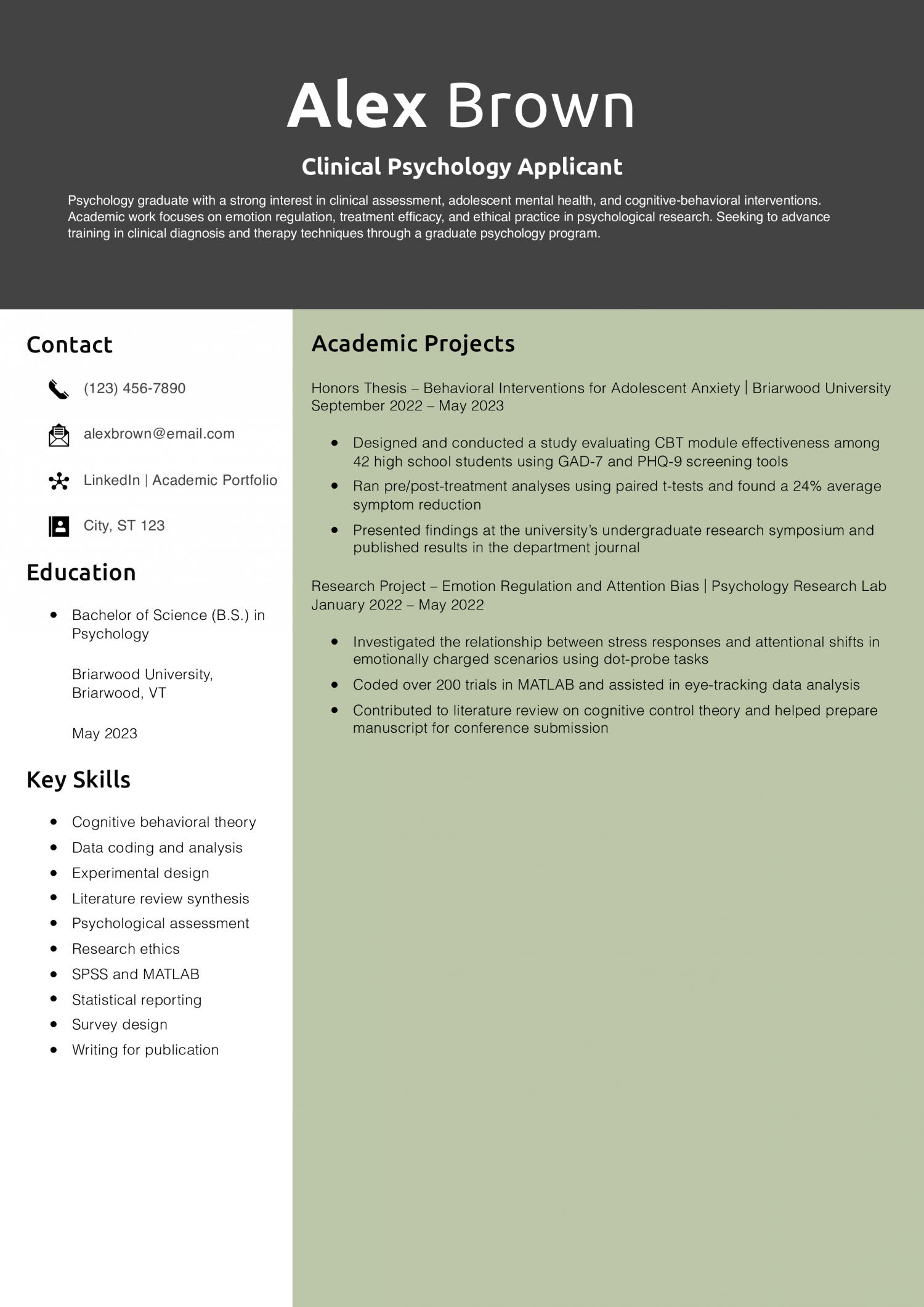
This resume shines with its emphasis on technical detail and analytical depth—qualities valued in clinical psychology. Both academic projects show ownership of research, from design to analysis. The student demonstrates intellectual maturity and readiness for advanced study.
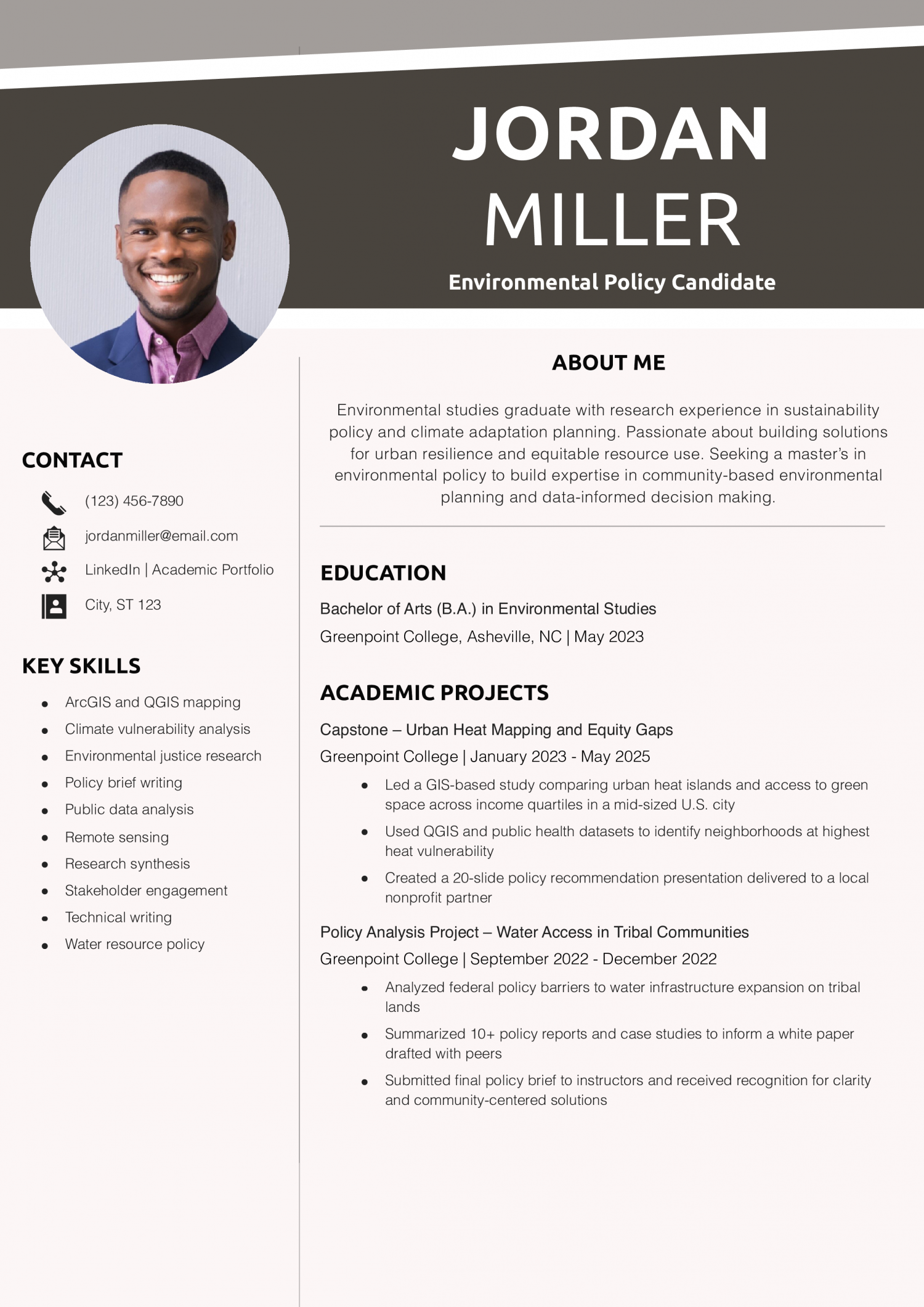
Jordan’s resume reflects how academic work can intersect with real-world community issues. The use of tools like GIS and the strong integration of equity concerns make this resume compelling to graduate programs focused on environmental justice.

Morgan’s resume offers clear examples of hands-on project work with advanced tools. They demonstrate initiative through an independent GitHub-published project and applied theory through machine learning. This balance is ideal for technical graduate programs.
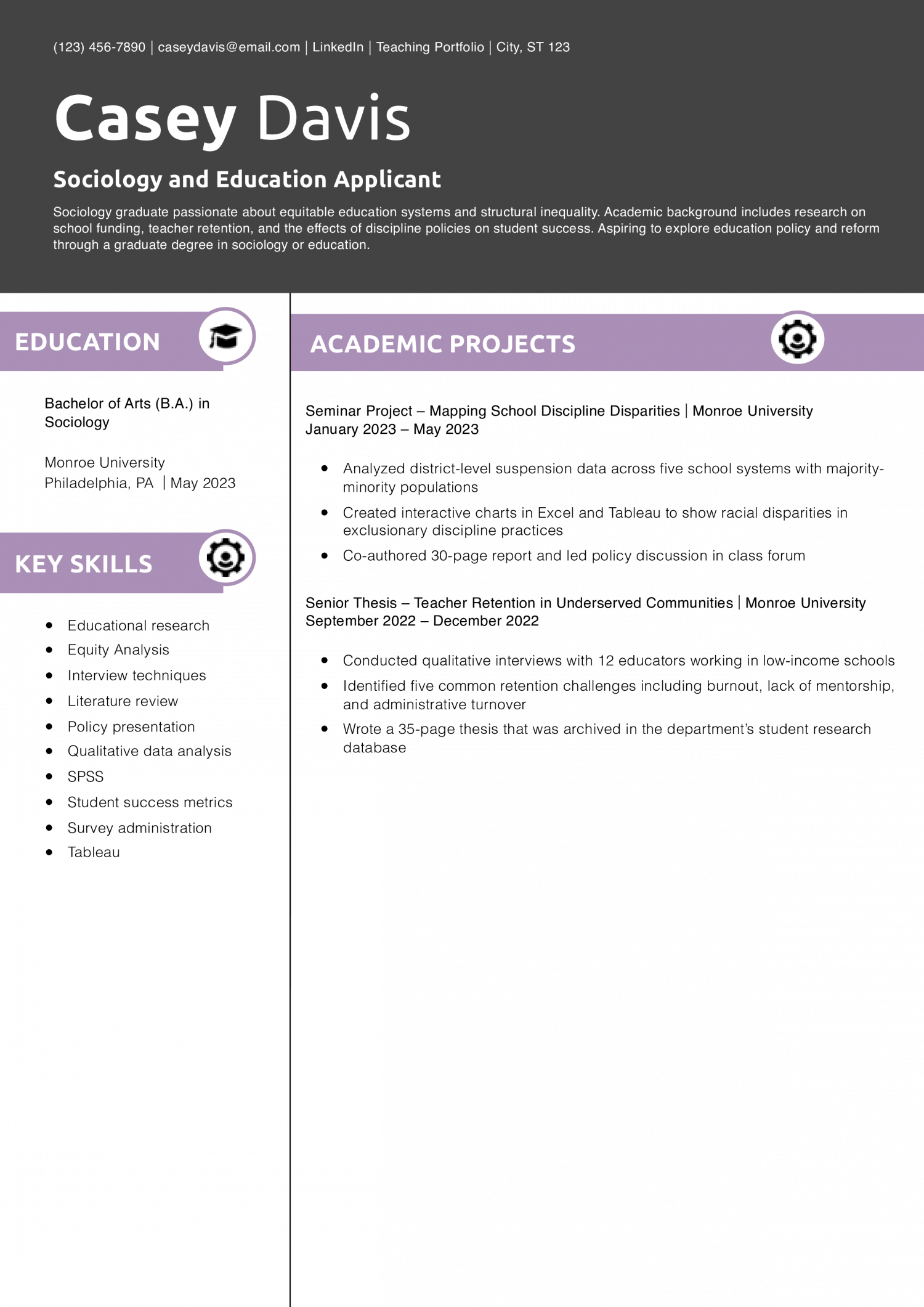
Casey’s resume takes on complex educational issues through data and lived experience. By pairing qualitative interviews with policy implications, they show depth and social awareness—both crucial for graduate work in education or sociology.

Jamie’s resume showcases technical mastery and practical application. It includes real tools used in academic bioinformatics and avoids vague claims. The clarity of their project summaries signals both capability and communication skills.



Morgan’s resume is a clear example of how to showcase coding and analytics experience through well-structured projects. The content explains what was done and why it mattered, with just the right amount of technical detail.

Casey’s resume balances data-driven research with emotional insight, making it ideal for a counseling program. Each project explains what was studied and how it relates to real-world applications.

Jamie’s resume highlights both research and real-world environmental education, making it stand out for programs that value applied science. The project descriptions give depth and purpose to the academic experience.
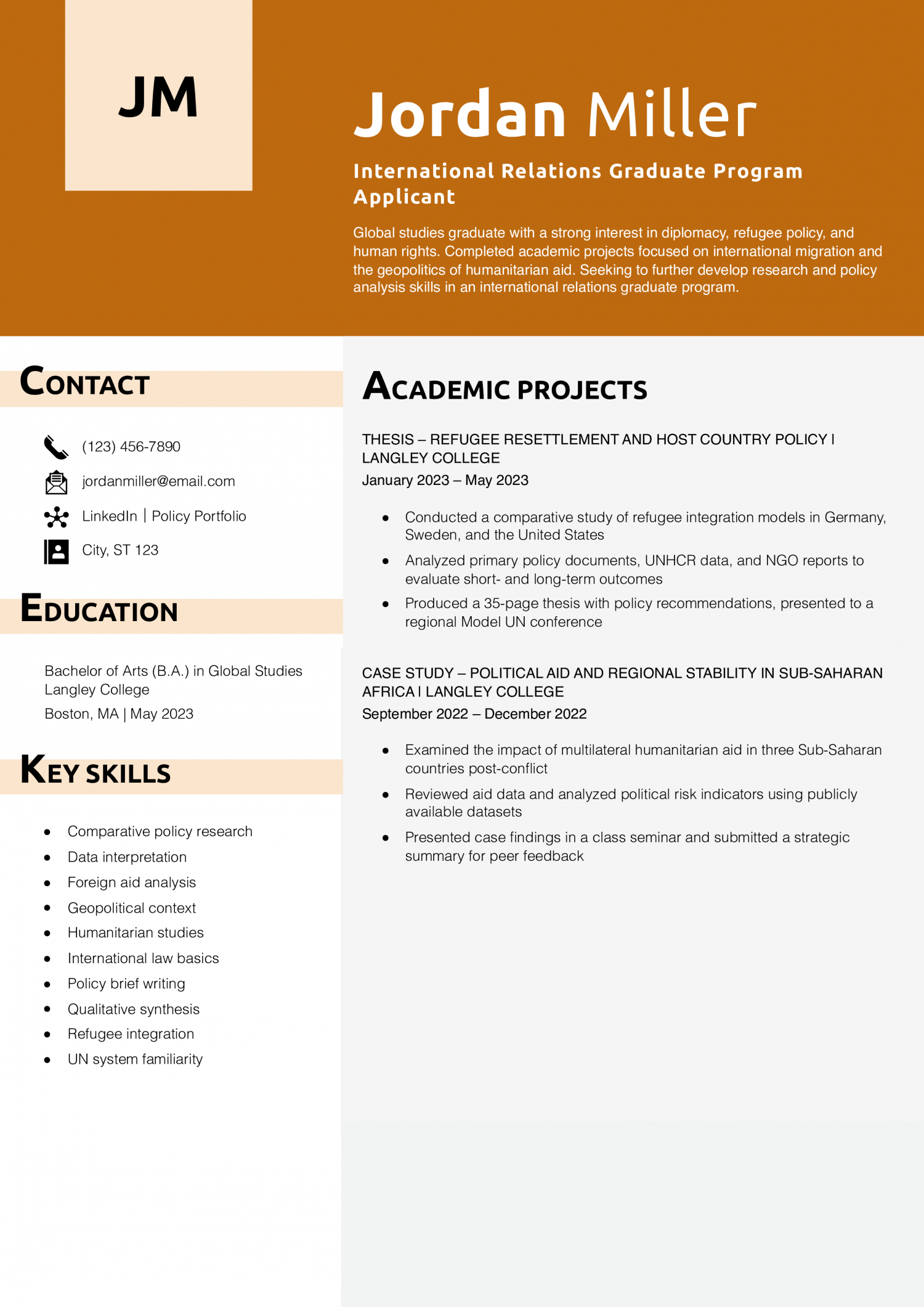
Jordan’s resume communicates a clear policy focus and thoughtful global perspective. With well-developed project bullets and defined outcomes, it’s a standout for graduate admissions.

Pat’s resume showcases a strong quantitative mindset and real-world application of models. Each project is clear about methodology, tools used, and meaningful outcomes—great for grad schools seeking evidence of statistical rigor.
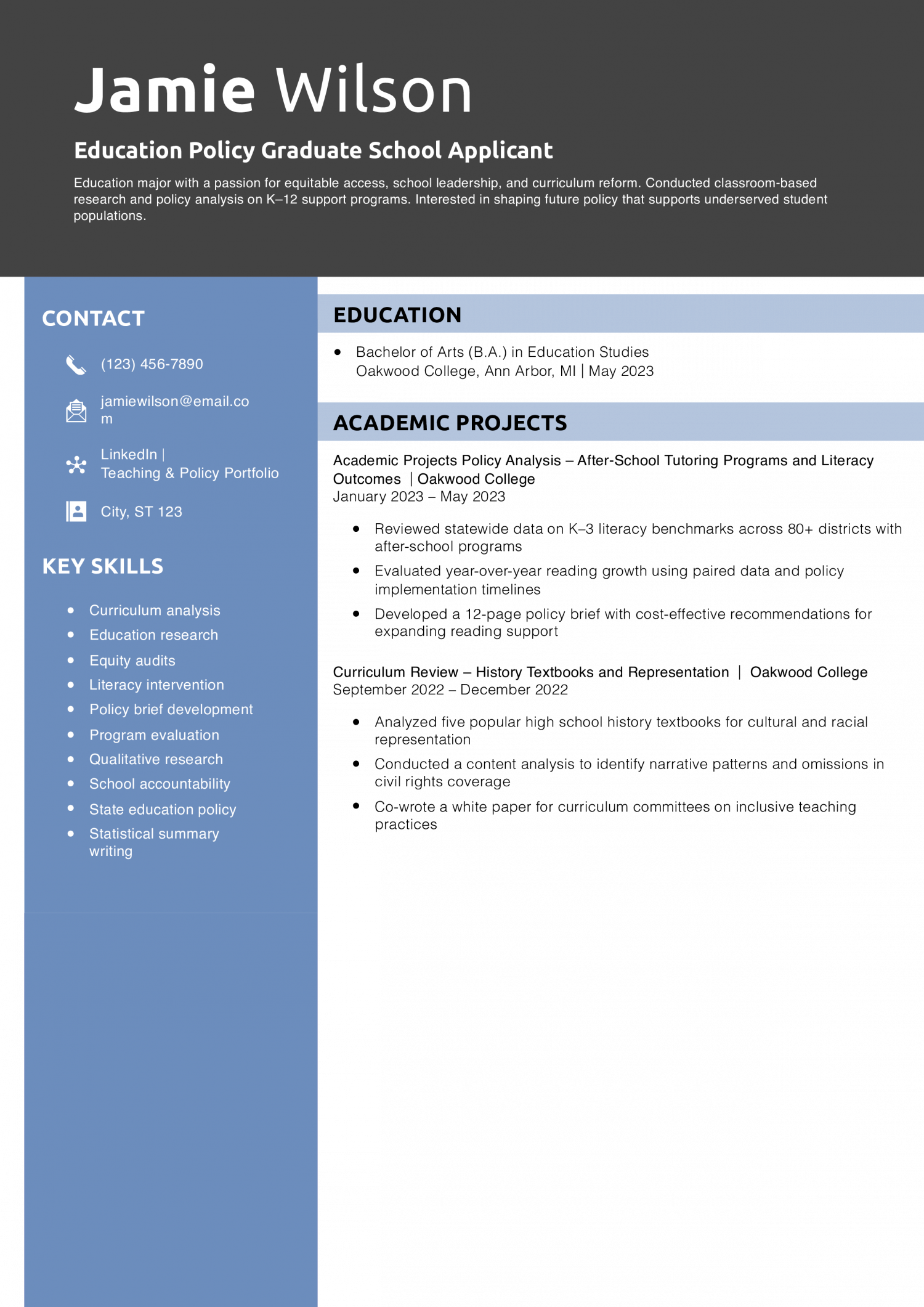
Jamie’s resume connects classroom realities to policy-level thinking, which is exactly what education-focused grad programs look for. Each project shows both depth and relevance in today’s educational climate.
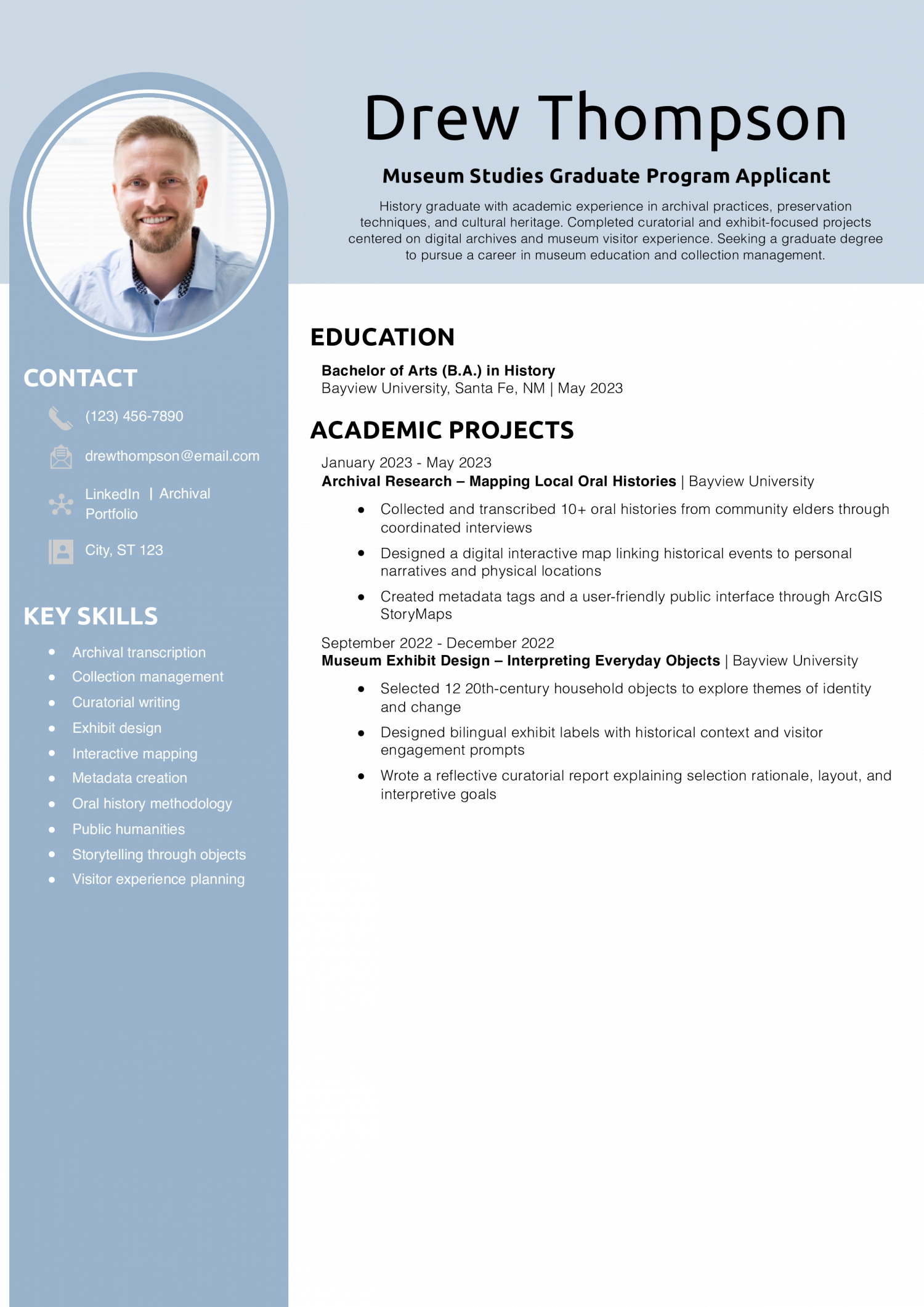
Drew’s resume offers a rich blend of storytelling and technical skill. It reads like a preview of the kind of engaged, thoughtful museum professional they aim to become—ideal for a competitive museum studies program.
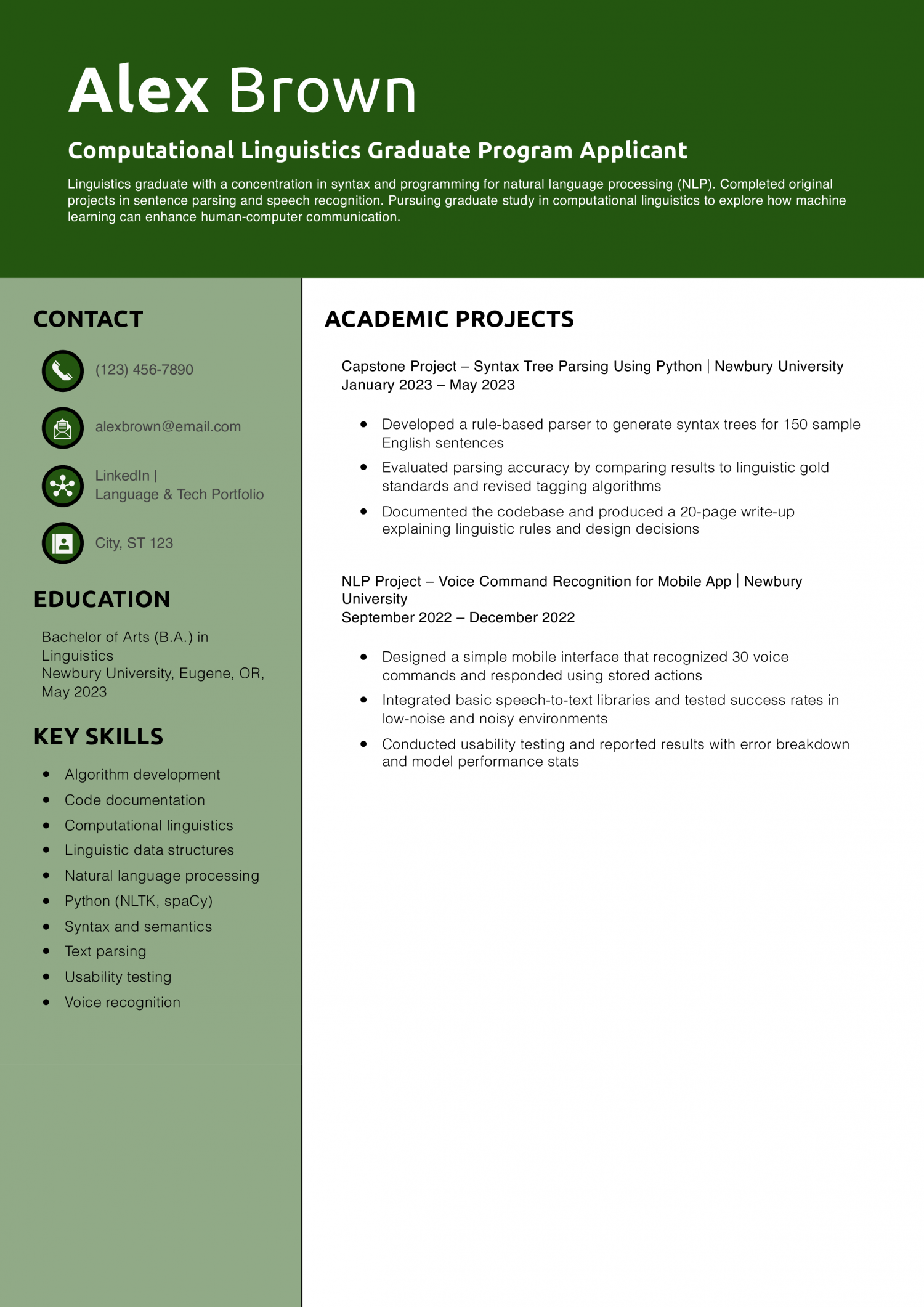
Alex’s resume captures both linguistic understanding and computational skill. The technical projects show creativity and capability without overwhelming the reader—perfect for programs bridging language and machine learning.

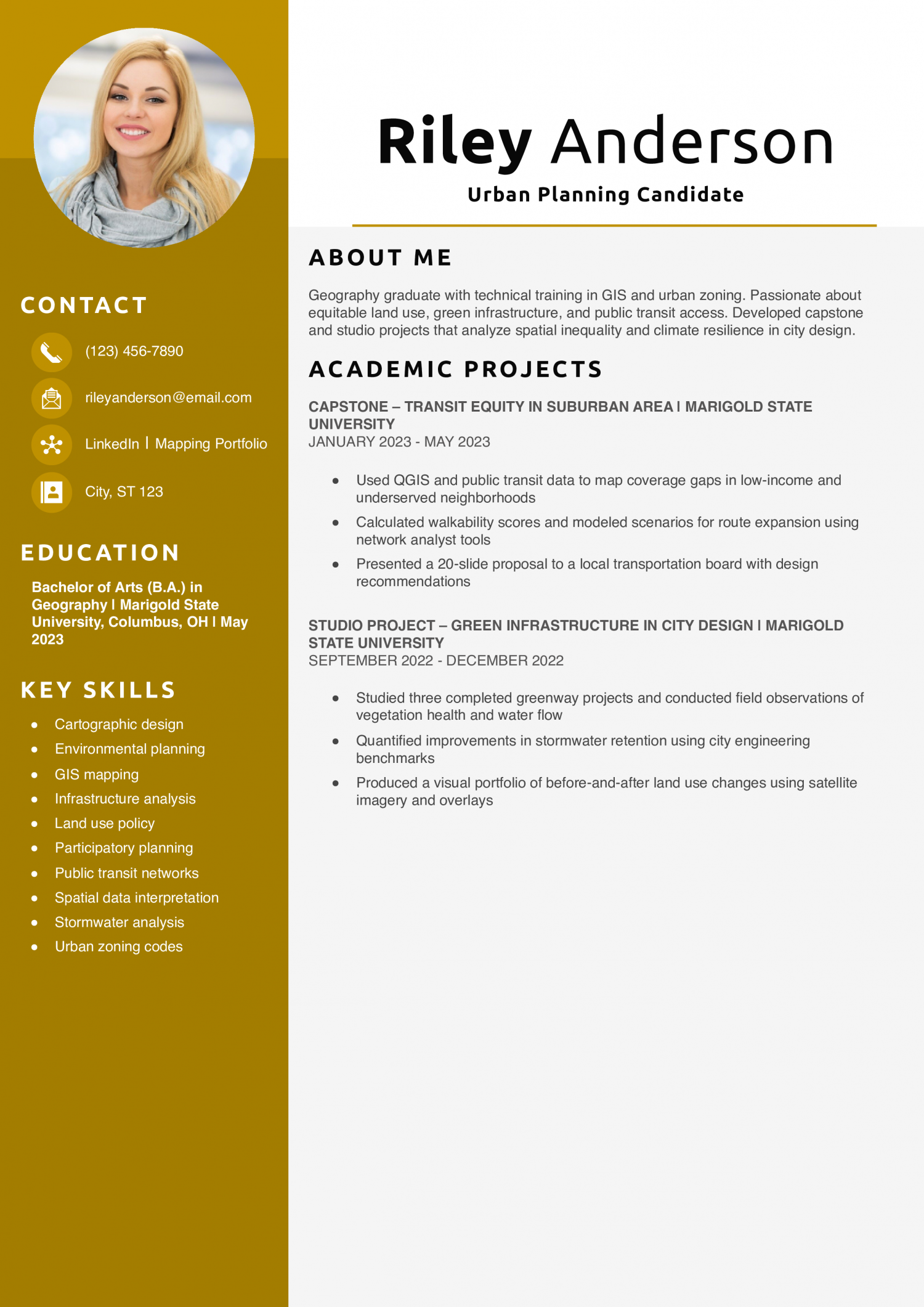
Riley’s resume makes a compelling case for their interest in sustainable and equitable city planning. The GIS and policy-oriented projects directly align with what top urban planning programs look for in applicants.
Taylor Smith | [email protected] | (555) 123-4567 | City, ST | LinkedIn | Academic Portfolio
Aspiring public policy analyst focused on social equity and community development. Recent political science graduate with a strong foundation in program evaluation, civic engagement, and applied research. Experienced in community partnerships, survey analysis, and drafting policy proposals. Seeking to develop advanced evaluation and policy design skills through graduate study in public policy.
Teaching Assistant – Introduction to American Government
Jamesburg University, Jamesburg, PA | September 2022 to May 2023
Campus Organizer
Student Voter Coalition, Jamesburg, PA | September 2021 to May 2022
Capstone Research – Evaluating Local Housing Assistance Programs
Jamesburg University | January 2023 to May 2023
Seminar Project – Urban Policy and Public Trust
Jamesburg University | September 2022 to December 2022
Bachelor of Arts (B.A.) in Political Science | May 2023
Jamesburg University | Jamesburg, PA
Alex Brown | [email protected] | (555) 243-1189 | City, ST | LinkedIn | Academic Portfolio
Psychology graduate with a strong interest in clinical assessment, adolescent mental health, and cognitive-behavioral interventions. Academic work focuses on emotion regulation, treatment efficacy, and ethical practice in psychological research. Seeking to advance training in clinical diagnosis and therapy techniques through a graduate psychology program.
Honors Thesis – Behavioral Interventions for Adolescent Anxiety
Briarwood University | September 2022 to May 2023
Research Project – Emotion Regulation and Attention Bias
Psychology Research Lab | January 2022 to May 2022
Bachelor of Science (B.S.) in Psychology | May 2023
Briarwood University | Briarwood, VT
Jordan Miller | [email protected] | (555) 941-9821 | City, ST | LinkedIn | Academic Portfolio
Environmental studies graduate with research experience in sustainability policy and climate adaptation planning. Passionate about building solutions for urban resilience and equitable resource use. Seeking a master’s in environmental policy to build expertise in community-based environmental planning and data-informed decision making.
Capstone – Urban Heat Mapping and Equity Gaps
Greenpoint College | January 2023 to May 2023
Policy Analysis Project – Water Access in Tribal Communities
Greenpoint College | September 2022 to December 2022
Bachelor of Arts (B.A.) in Environmental Studies | May 2023
Greenpoint College | Asheville, NC
Morgan Johnson | [email protected] | (555) 872-6614 | City, ST | LinkedIn | GitHub Portfolio
Computer science graduate with advanced coursework in data modeling, algorithm design, and machine learning. Completed multiple independent and team-based data science projects involving large datasets, predictive modeling, and real-time analytics. Looking to expand statistical and programming expertise through a graduate data science program.
Capstone – Predictive Analytics for Public Transit Delays
Riverside Institute of Technology | January 2023 to May 2023
Independent Project – Sentiment Analysis of Political Speeches
Riverside Institute of Technology | October 2022 to December 2022
Bachelor of Science (B.S.) in Computer Science | May 2023
Riverside Institute of Technology | Austin, TX
Casey Davis | [email protected] | (555) 553-4430 | City, ST | LinkedIn | Teaching Portfolio
Sociology graduate passionate about equitable education systems and structural inequality. Academic background includes research on school funding, teacher retention, and the effects of discipline policies on student success. Aspiring to explore education policy and reform through a graduate degree in sociology or education.
Seminar Project – Mapping School Discipline Disparities
Monroe University | January 2023 to May 2023
Senior Thesis – Teacher Retention in Underserved Communities
Monroe University | September 2022 to December 2022
Bachelor of Arts (B.A.) in Sociology | May 2023
Monroe University | Philadelphia, PA
Jamie Wilson | [email protected] | (555) 729-3320 | City, ST | LinkedIn | GitHub Portfolio
Biology graduate with academic research in genomics and statistical analysis. Strong foundation in data science applied to biological systems, including DNA sequence alignment and gene expression modeling. Interested in exploring molecular data analytics through a graduate program in bioinformatics.
Senior Project – Gene Expression Analysis Using RNA-Seq
Carson College | January 2023 to May 2023
Computational Biology Project – Protein Structure Prediction
Carson College | October 2022 to December 2022
Bachelor of Science (B.S.) in Biology | May 2023
Carson College | Sacramento, CA
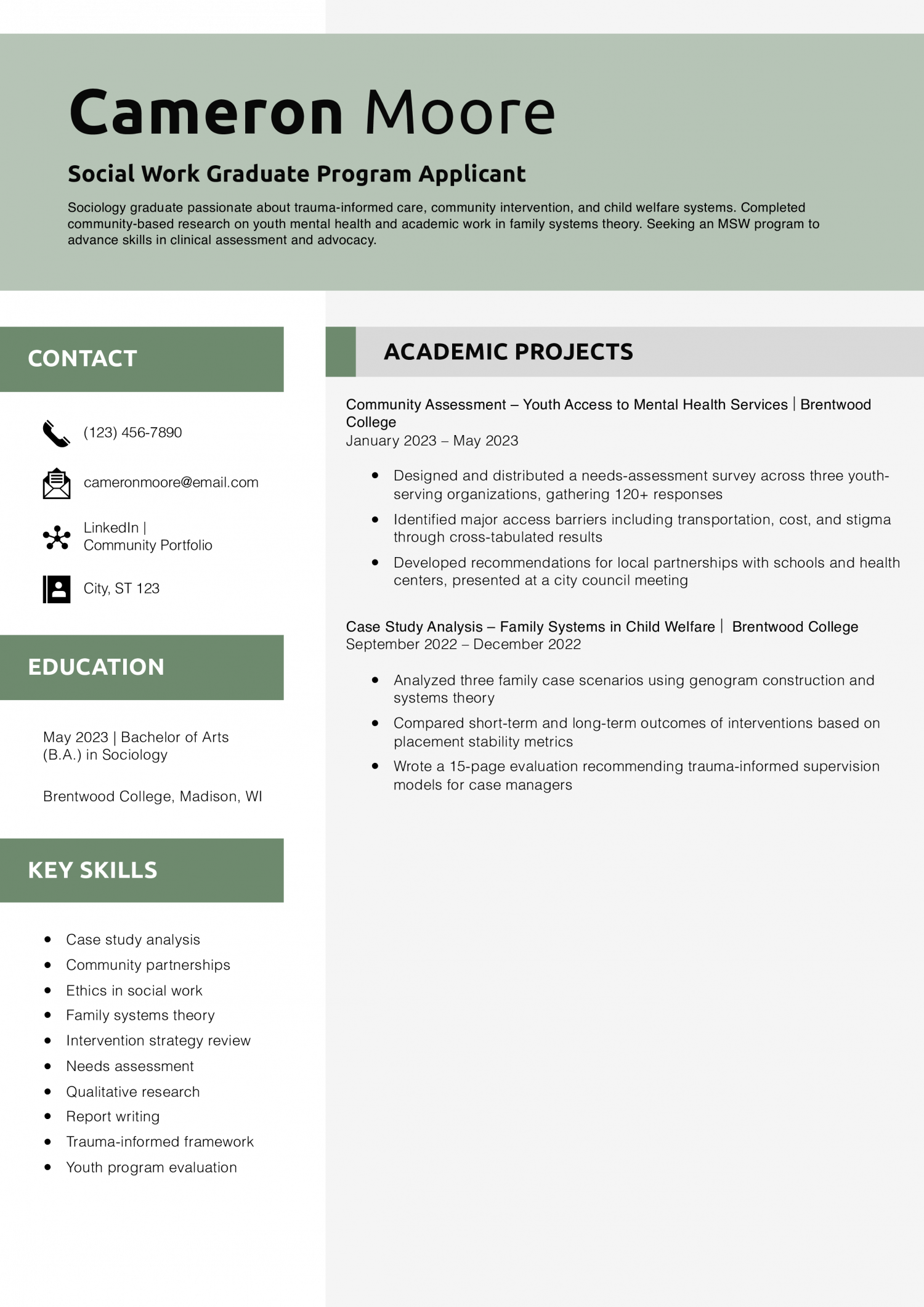
Cameron Moore | [email protected] | (555) 830-1842 | City, ST | LinkedIn | Community Portfolio
Sociology graduate passionate about trauma-informed care, community intervention, and child welfare systems. Completed community-based research on youth mental health and academic work in family systems theory. Seeking an MSW program to advance skills in clinical assessment and advocacy.
Community Assessment – Youth Access to Mental Health Services
Brentwood College | January 2023 to May 2023
Case Study Analysis – Family Systems in Child Welfare
Brentwood College | September 2022 to December 2022
Bachelor of Arts (B.A.) in Sociology | May 2023
Brentwood College | Madison, WI
Drew Thompson | [email protected] | (555) 480-9322 | City, ST | LinkedIn | Research Portfolio
Biology graduate focused on public health systems, disease prevention, and health equity. Conducted applied research in epidemiology and community nutrition. Looking to expand quantitative and policy skills in an MPH program with a global health concentration.
Epidemiology Project – Local COVID-19 Response Analysis
Civic University | January 2023 to May 2023
Community Health Project – Food Access and Nutrition
Civic University | September 2022 to December 2022
Bachelor of Science (B.S.) in Biology | May 2023
Civic University | Kansas City, MO
Riley Anderson | [email protected] | (555) 291-0054 | City, ST | LinkedIn | Mapping Portfolio
Geography graduate with technical training in GIS and urban zoning. Passionate about equitable land use, green infrastructure, and public transit access. Developed capstone and studio projects that analyze spatial inequality and climate resilience in city design.
Capstone – Transit Equity in Suburban Areas
Marigold State University | January 2023 to May 2023
Studio Project – Green Infrastructure in City Design
Marigold State University | September 2022 to December 2022
Bachelor of Arts (B.A.) in Geography | May 2023
Marigold State University | Columbus, OH
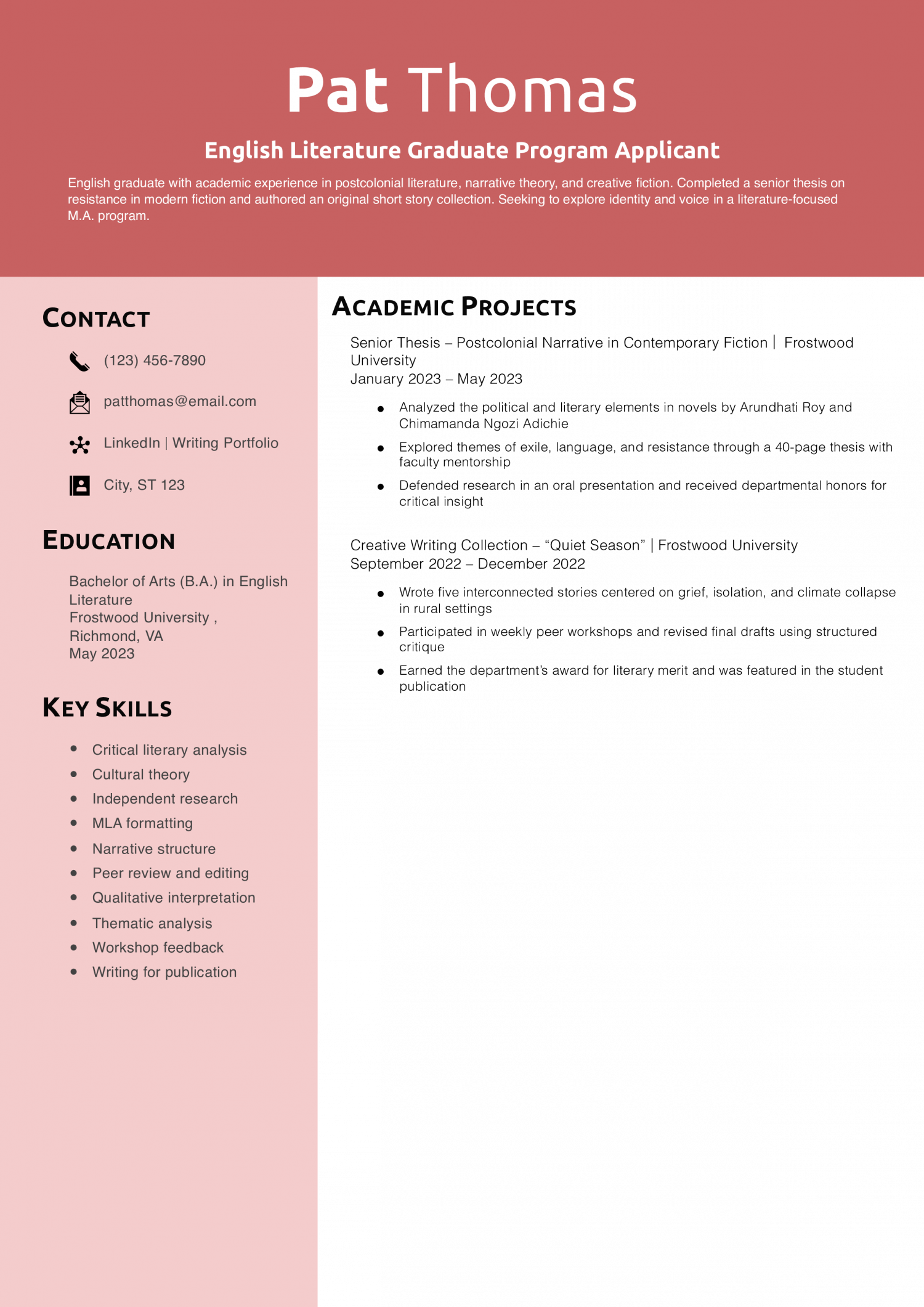
Pat Thomas | [email protected] | (555) 603-7788 | City, ST | LinkedIn |Profile
English graduate with academic experience in postcolonial literature, narrative theory, and creative fiction. Completed a senior thesis on resistance in modern fiction and authored an original short story collection. Seeking to explore identity and voice in a literature-focused M.A. program.
Senior Thesis – Postcolonial Narrative in Contemporary Fiction
Frostwood University | January 2023 to May 2023
Creative Writing Collection – “Quiet Season”
Frostwood University | September 2022 to December 2022
Bachelor of Arts (B.A.) in English Literature | May 2023
Frostwood University | Richmond, VA
Taylor Smith | [email protected] | (555) 112-8733 | City, ST | LinkedIn | Fieldwork Portfolio
Anthropology graduate focused on cultural identity, ritual, and qualitative methods. Completed fieldwork in urban communities and developed an ethnographic portfolio. Aiming to explore meaning-making practices and social belonging through graduate research in cultural anthropology.
Field Methods Project – Ritual Practice in Urban Communities
Dover College | January 2023 to May 2023
Comparative Analysis – Kinship Structures Across Cultures
Dover College | September 2022 to December 2022
Bachelor of Arts (B.A.) in Anthropology | May 2023
Dover College | Portland, OR
Morgan Johnson | [email protected] | (555) 391-2047 | City, ST | LinkedIn | Coding Portfolio
Recent computer science graduate with hands-on experience in data cleaning, predictive modeling, and Python-based analytics. Completed academic projects involving real-world data sets and statistical forecasting. Excited to build advanced modeling skills in a data science graduate program.
Machine Learning Project – Predicting Loan Defaults
Eastwood University | January 2023 to May 2023
Data Visualization Project – Public Transit Ridership Trends
Eastwood University | September 2022 to December 2022
Bachelor of Science (B.S.) in Computer Science | May 2023
Eastwood University | Raleigh, NC
Casey Davis | [email protected] | (555) 228-1345 | City, ST | LinkedIn | Research Portfolio
Psychology graduate committed to supporting youth mental health through applied research and future clinical practice. Completed multiple research projects on cognitive development, stress response, and emotional regulation. Preparing for graduate study in counseling psychology with a focus on adolescent support.
Senior Research – Coping Mechanisms in Adolescents Under Stress
Summit College | January 2023 to May 2023
Experimental Psychology Lab – Emotion and Attention Span
Summit College | September 2022 to December 2022
Bachelor of Arts (B.A.) in Psychology | May 2023
Summit College | Hartford, CT
Jamie Wilson | [email protected] | (555) 740-2991 | City, ST | LinkedIn | Environmental Portfolio
Environmental science graduate with academic fieldwork and lab research experience in climate change mitigation, soil health, and sustainability education. Interested in exploring the intersection of environmental justice and restoration ecology through graduate study.
Field Research Project – Soil Health and Regenerative Agriculture
High Plains University | January 2023 to May 2023
Environmental Education Campaign – Local School Outreach
High Plains University | September 2022 to December 2022
Bachelor of Science (B.S.) in Environmental Science | May 2023
High Plains University | Fort Collins, CO
Jordan Miller | [email protected] | (555) 920-1177 | City, ST | LinkedIn | Policy Portfolio
Global studies graduate with a strong interest in diplomacy, refugee policy, and human rights. Completed academic projects focused on international migration and the geopolitics of humanitarian aid. Seeking to further develop research and policy analysis skills in an international relations graduate program.
Thesis – Refugee Resettlement and Host Country Policy
Langley College | January 2023 to May 2023
Case Study – Political Aid and Regional Stability in Sub-Saharan Africa
Langley College | September 2022 to December 2022
Bachelor of Arts (B.A.) in Global Studies | May 2023
Langley College | Boston, MA
Pat Thomas | [email protected] | (555) 223-6174 | City, ST | LinkedIn | Analytics Portfolio
Mathematics graduate with coursework in probability theory, linear models, and multivariate statistics. Completed academic projects involving real-world data sets, focusing on sports analytics and predictive modeling. Seeking to deepen quantitative research skills in a statistics graduate program.
Capstone Project – NBA Shot Selection and Efficiency
North Ridge University | January 2023 to May 2023
Applied Statistics Project – Student Success Predictors
North Ridge University | September 2022 to December 2022
Bachelor of Science (B.S.) in Mathematics | May 2023
North Ridge University | Lexington, KY
Jamie Wilson | [email protected] | (555) 412-8892 | City, ST | LinkedIn | Teaching & Policy Portfolio
Education major with a passion for equitable access, school leadership, and curriculum reform. Conducted classroom-based research and policy analysis on K–12 support programs. Interested in shaping future policy that supports underserved student populations.
Policy Analysis – After-School Tutoring Programs and Literacy Outcomes
Oakwood College | January 2023 to May 2023
Curriculum Review – History Textbooks and Representation
Oakwood College | September 2022 to December 2022
Bachelor of Arts (B.A.) in Education Studies | May 2023
Oakwood College | Ann Arbor, MI
Drew Thompson | [email protected] | (555) 903-5561 | City, ST | LinkedIn | Archival Portfolio
History graduate with academic experience in archival practices, preservation techniques, and cultural heritage. Completed curatorial and exhibit-focused projects centered on digital archives and museum visitor experience. Seeking a graduate degree to pursue a career in museum education and collection management.
Archival Research – Mapping Local Oral Histories
Bayview University | January 2023 to May 2023
Museum Exhibit Design – Interpreting Everyday Objects
Bayview University | September 2022 to December 2022
Bachelor of Arts (B.A.) in History | May 2023
Bayview University | Santa Fe, NM
Alex Brown | [email protected] | (555) 334-2291 | City, ST | LinkedIn | Language & Tech Portfolio
Linguistics graduate with a concentration in syntax and programming for natural language processing (NLP). Completed original projects in sentence parsing and speech recognition. Pursuing graduate study in computational linguistics to explore how machine learning can enhance human-computer communication.
Capstone Project – Syntax Tree Parsing Using Python
Newbury University | January 2023 to May 2023
NLP Project – Voice Command Recognition for Mobile App
Newbury University | September 2022 to December 2022
Bachelor of Arts (B.A.) in Linguistics | May 2023
Newbury University | Eugene, OR
Riley Anderson | [email protected]| (555) 117-6734 | City, ST | LinkedIn | Planning Portfolio
Geography graduate with hands-on academic experience in GIS, land use mapping, and transportation equity. Completed research projects on sustainable city design and community mobility. Looking to deepen knowledge of equitable development practices through a master’s in urban and regional planning.
Senior Project – Transit Accessibility in Underserved Neighborhoods
Lakeview University | January 2023 to May 2023
Studio Course Project – Revitalizing Industrial Land Near the Riverfront
Lakeview University | September 2022 to December 2022
Bachelor of Science (B.S.) in Geography and Urban Studies | May 2023
Lakeview University | Portland, OR
As a graduate school applicant, you already understand what it takes to craft an academic essay or conduct a research experiment. These require careful planning and structure, which is also true for your resume. A professional template provides a clear layout that allows you to present your academic background and qualifications effectively. Opt for a straightforward design that prioritizes content over aesthetics, as you don’t want to distract the reader with unnecessary visual elements. Be sure that your resume includes the following sections:
Provide your full name, phone number, email address, city, state, and links to your LinkedIn or academic portfolio. Carefully review the accuracy of your information to ensure admissions committees can easily reach out to schedule a meeting.
Your Name
[email protected] | (123) 456-7890 | City, ST | LinkedIn | Portfolio
The opening summary is one of the most crucial parts of your resume. It needs to be engaging and impactful, providing a compelling glimpse into who you are as a graduate school candidate. In the first sentence, highlight your title, field of study, and key areas of expertise. Use the remainder of your paragraph to highlight your academic achievements and long-term goals. For example, if you’re pursuing a neuroscience program, you might emphasize your interest in performing research to develop new therapies for autism spectrum disorders.
Research-driven psychology graduate with three years of lab experience in cognitive neuroscience and strong academic performance in behavioral statistics and experimental design. Passionate about exploring memory and attention and pursuing doctoral study to contribute to early intervention strategies in educational settings.
Recent sociology graduate with a strong academic record and coursework in qualitative research methods, ethics, and social theory. Seeking admission to a graduate program to advance research on public policy and social inequality.
Whether you’ve worked as a research assistant for five years or recently completed a bachelor’s degree, your resume needs to be accomplishment-driven. Use your bullet points to provide engaging descriptions of your academic projects, essays, and research. If you have hands-on experience in your field, focus on highlighting the impact of your contributions. Explore unique aspects of your academic or professional career that will pique decision-makers’ interest.
Research Assistant, Center for Child Development, Philadelphia, PA | September 2021 to present
Peer Tutor, Academic Resource Center, Lancaster, PA | January 2022 to May 2023
Incorporate hard numbers and metrics whenever possible to add greater depth to your bullets. For example, if you taught in the classroom, include the number of students. If you supported a major research project, highlight the budget to establish a sense of scope for the reader.
To give yourself the best acceptance odds, you need to customize your resume for each graduate school application. Take time to carefully analyze the program’s description, incorporating keywords and academic terminology that align with the school’s focus. For instance, if you’re targeting a program centered around continental philosophy, you might emphasize your advanced knowledge of Wittgenstein and Kierkegaard.
You don’t need a research position or full-time job to build a strong graduate school resume. Demonstrate your passion and knowledge by exploring your most impressive academic projects. Highlight internships, extracurriculars, associations, and volunteer work to showcase your other unique qualities and interests.
Since education is the focal point for graduate applicants, this section should be detailed and placed near the top if you’re a current student or recent graduate. Include your academic honors, GPA, relevant coursework, theses, or capstone projects. If you have industry experience already, highlight your certifications in a separate section.
Template:
[Degree Name], [School Name], [City, ST]
Thesis/Capstone: [Project title] (if applicable)
Example:
Bachelor of Arts (B.A.) in Political Science | May 2025
University of Pittsburgh | Pittsburgh, PA
Capstone: “Media Influence on Voter Turnout Among First-Time Voters”
Template:
[Certification Name], [Awarding Organization] | [Completion Year]
Example:
Teaching English as a Foreign Language (TEFL) Certificate | International TEFL Academy | June 2023
Human Subjects Research Training | CITI Program | August 2022
Universities rely on applicant tracking systems (ATS) just like any other organization. To pass through the initial screening phase, you need a comprehensive list of skills that contains keywords from the program description. Highlight a wide variety of academic terms, coursework, and research types to show committees that you have a strong foundational knowledge of your field. Below, you’ll find examples of skills for your graduate school resume:
| Key skills | |
|---|---|
| Academic research | Academic writing |
| APA or MLA formatting | Biology |
| Data analysis | Data science |
| Grant writing | Interviewing techniques |
| Lab procedures | Literature reviews |
| Neuroscience | Project management |
| Psychology | Public speaking |
| Qualitative research | Quantitative research |
| SPSS | Statistical modeling |
| Survey design | Teaching assistance |
| Tutoring | |
Incorporating action verbs is a great way to add a dynamic and engaging element to your writing. Proactive language allows you to convey initiative and take ownership of your academic and professional achievements. For instance, say you worked with a team to execute a research project. You could say you were “responsible for analyzing data to assist the team during a pharmaceutical research project” but this feels passive and lacking. Stating that you “collaborated with a diverse laboratory team and performed complex data analysis to support a major pharmaceutical research project” feels much stronger.
| Action verbs | |
|---|---|
| Achieved | Analyzed |
| Collaborated | Composed |
| Conducted | Coordinated |
| Created | Designed |
| Developed | Drove |
| Evaluated | Facilitated |
| Identified | Implemented |
| Led | Managed |
| Organized | Performed |
| Presented | Researched |
| Synthesized | Taught |
| Wrote | |
Choose a simple, well-organized template that prioritizes readability and clarity. Graduate admissions readers spend just seconds scanning resumes. Use clear section headers, consistent formatting, and no distracting visuals. Academic and professional achievements should stand out—not the design.
Stick to the reverse chronological format to highlight your most recent experience and education. For programs emphasizing research, consider leading with education and academic projects.
Resume Templates offers HR approved resume templates to help you create a professional resume in minutes. Choose from several template options and even pre-populate a resume from your profile.
Findings from a study by the Council of Graduate Schools in 2023 showed an increase in graduate school applications. Data also showed a decrease in enrollments, which indicates that competition for these openings is incredibly high. To maximize your chances of being accepted into graduate school, it's essential to align your resume with the program description. Start by exploring the program curriculum, faculty biographies, and the university website to understand how your academic background and goals align with the school's priorities.
For example, say you're pursuing a doctoral degree in public health at a university that values diversity, equity, and inclusion (DEI). In this situation, you might emphasize your commitment to developing public health programs to support underserved communities.
If you already have industry experience, the reverse chronological format is the clear choice. This approach places your most recent work history towards the top of your document, allowing the reader to quickly view your career progression and accomplishments. For most graduate school applicants, a combination format is the better option, as it prioritizes your academic projects, research, and extracurriculars to compensate for a lack of hands-on experience.
Executive Resume Writer and Career Coach
Andrew Stoner is an executive career coach and resume writer with 17 years of experience as a hiring manager and operations leader at two Fortune 500 Financial Services companies, and as the career services director at two major university business schools.