Tip !

Medical directors look for NCCPA status, state license, and recent procedure volume on the first page, because that combination tells them whether a PA can take a panel without a long ramp.

Andrew Stoner , Executive Resume Writer and Career Coach

Why this resume works

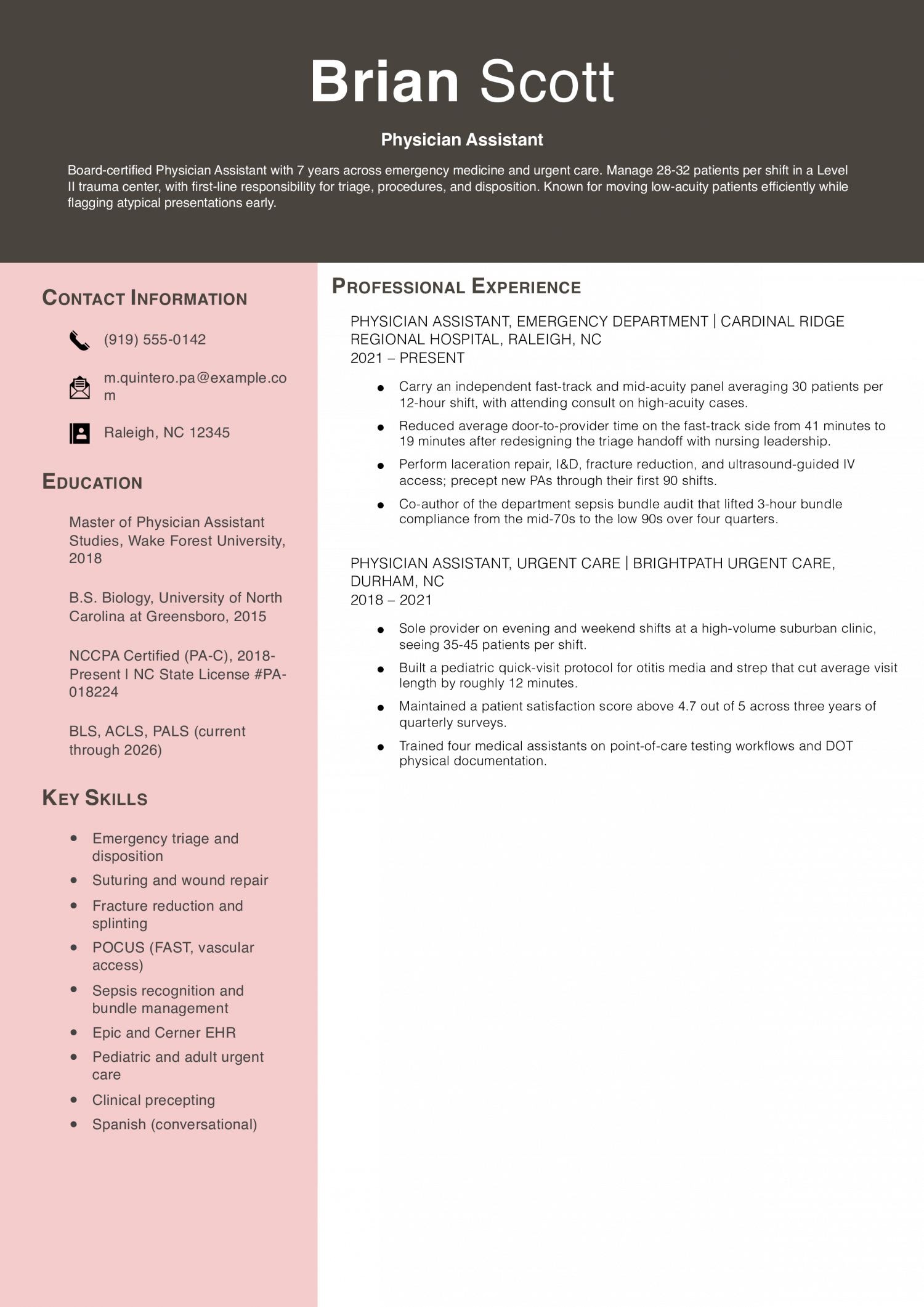
  • Shows real shift volume: Naming 28-32 patients per 12-hour shift gives hiring managers a concrete sense of pace and competence.
  • One sharp number per job: Door-to-provider dropping from 41 to 19 minutes is the standout metric, while other bullets stay descriptive instead of stuffing in fake figures.
  • Procedures listed plainly: Suturing, I&D, fracture reduction, and ultrasound-guided IVs tell a recruiter exactly which hands-on skills will transfer on day one.

Recent Graduate Example

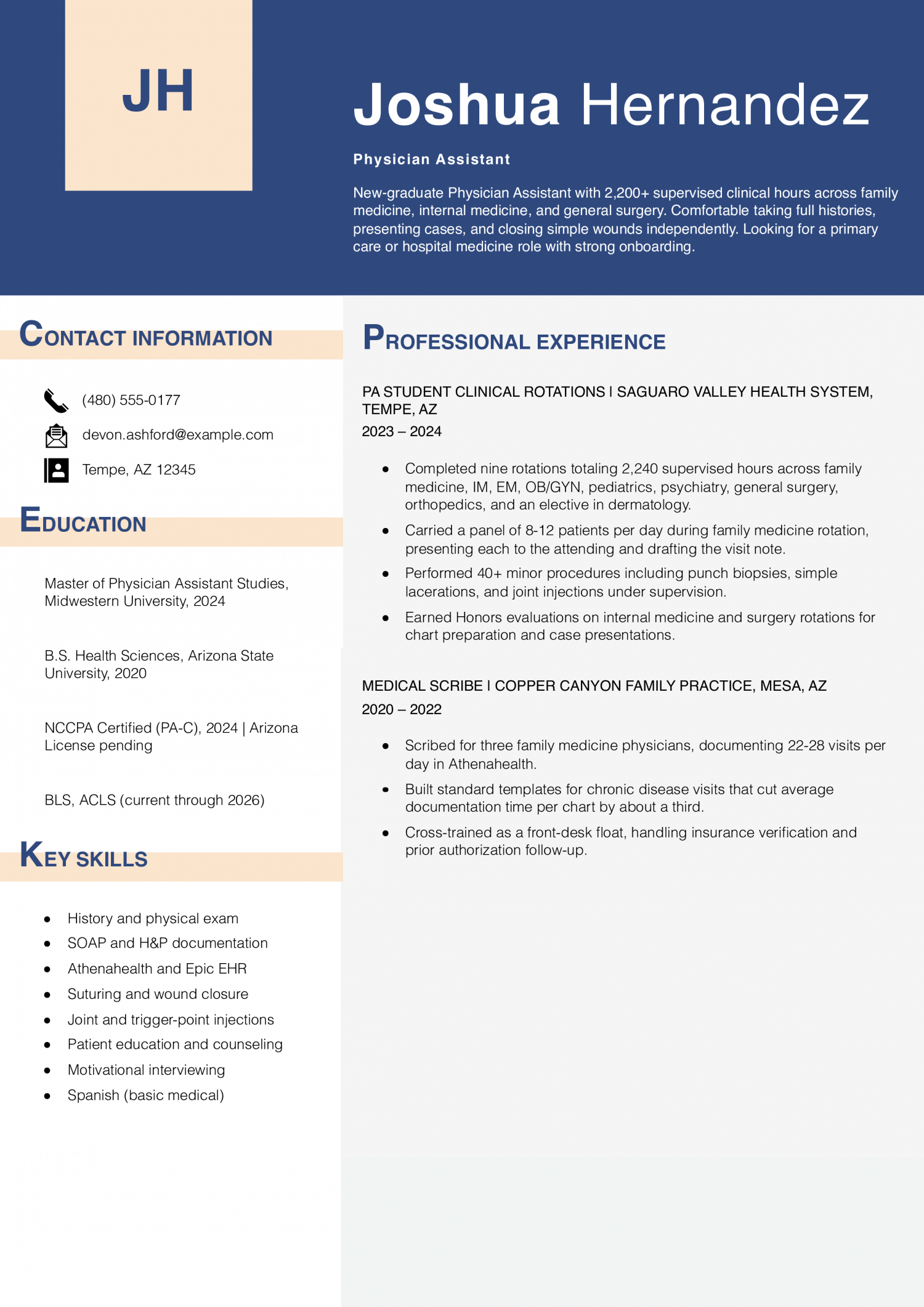
Recent graduate PAs are coming off rotations with a fresh NCCPA pass and no full-time clinical record yet. This resume needs to prove rotation depth, procedures logged, and the specialty interest you're recruiting into.

Why this resume works

  • Clinical hours stated up front: Hiring managers screening new grads want to see total supervised hours and the rotation mix before anything else.
  • Scribe work counts as real prep: Two years of scribing in family practice shows the candidate already knows clinic flow, documentation, and EHR habits.
  • Honors named where earned: Calling out Honors on IM and surgery specifically is more credible than a generic ‘top of class’ line.

Experienced PA Example

Experienced PAs have two to seven years in a defined specialty with autonomous patient management under physician supervision. This resume needs to prove patient volume per shift, procedure breadth, and the EMR you run unsupervised.

Why this resume works

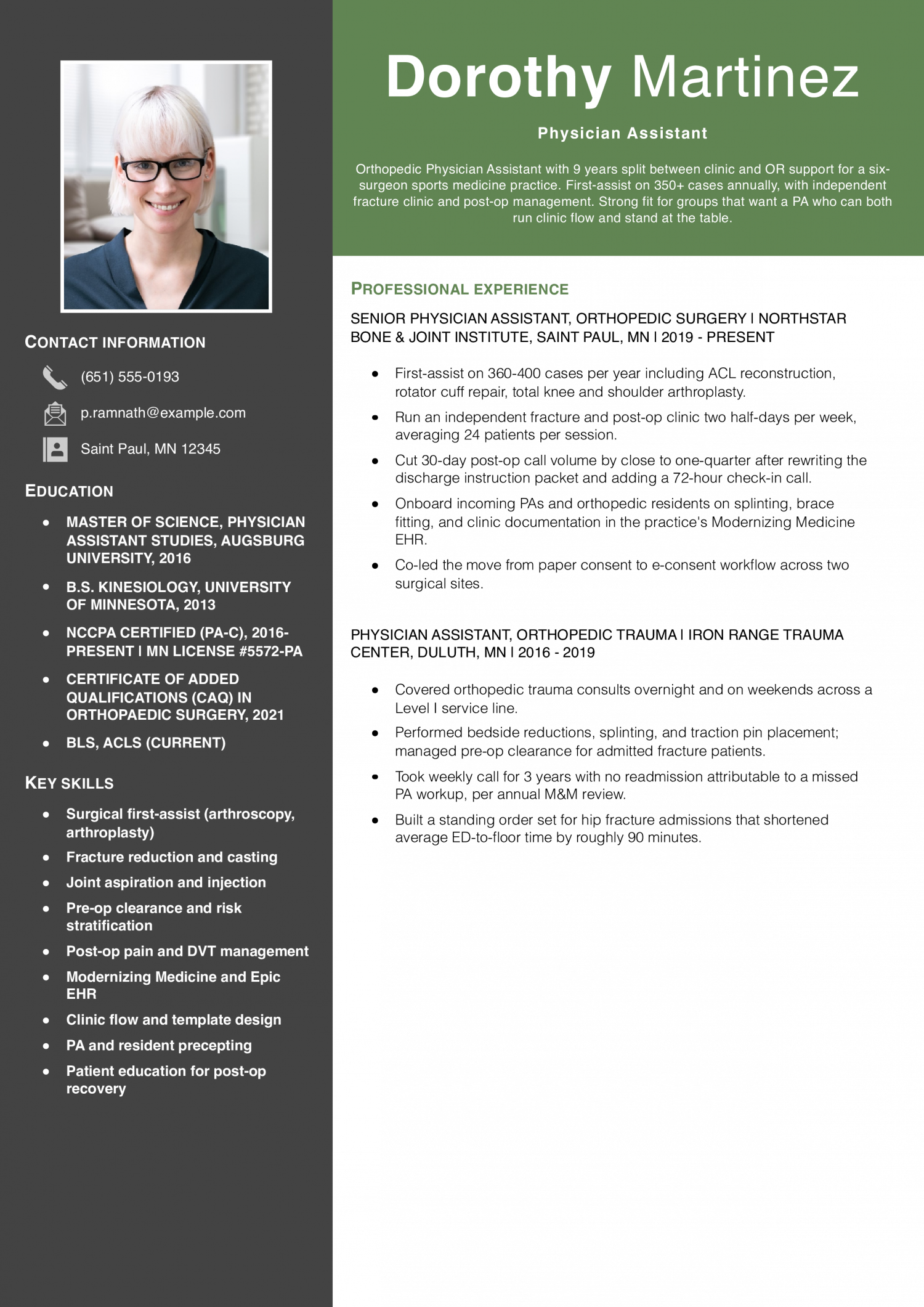
  • Case volume that surgeons recognize: ‘360-400 first-assist cases per year’ is exactly the number a hiring orthopedic group will scan for.
  • Specialty credential called out: The Orthopaedic CAQ signals committed specialty depth, not just years on a service.
  • Both clinic and OR shown clearly: Bullets separate fracture clinic work from operating room work so a reader can match each to their own job description.

Lead PA Example

Lead PAs supervise other advanced practice providers, run quality metrics, and sit in on hiring. This resume needs to prove the team size you direct, throughput gains you delivered, and protocol or pathway work you led.

Why this resume works

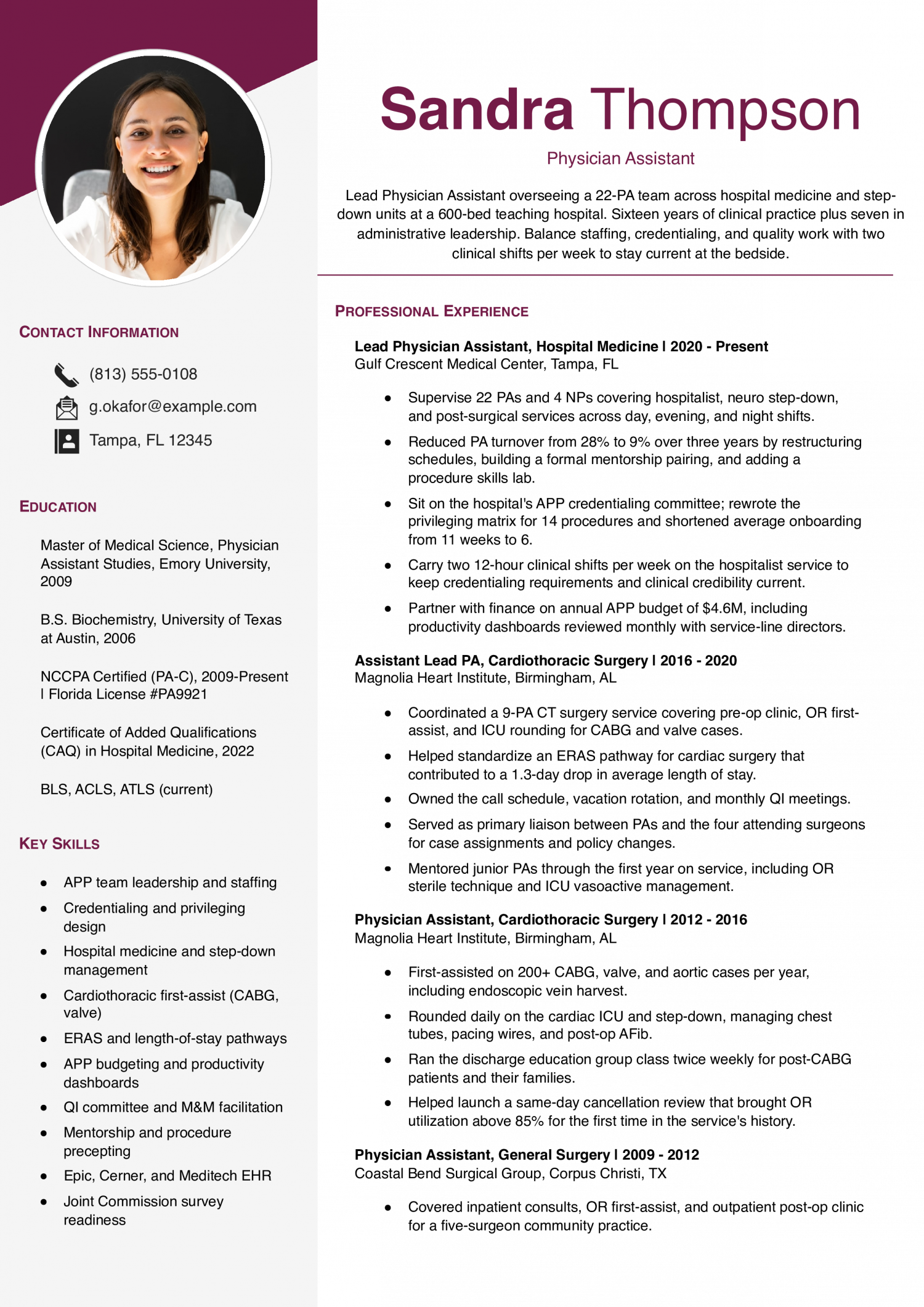
  • Leads and still sees patients: Naming two clinical shifts per week shows the candidate is a working lead, not a manager who has drifted away from patient care.
  • Turnover number is the standout: Cutting PA turnover from 28% to 9% is the kind of operational result a CMO or APP director cares about, and only one job leans on a hard percentage.
  • Career arc is easy to follow: Resume moves general surgery, to CT surgery PA, to assistant lead, to lead, telling a clean leadership story across 16 years.

How to Write a Physician Assistant Resume

01 Open with the metric a medical director would use to size you up

Lead your summary with patient volume per shift, the specialty setting, and your supervision model. A medical director reads that line as your readiness to carry a panel.

Name your years certified, your current specialty, and the acuity you handle. A line like “NCCPA-certified PA with five years in level II emergency medicine, 28 to 35 patients per shift” tells more than a paragraph of adjectives.

Drop the “compassionate provider” framing. Lead clinicians weigh census, acuity, and procedure independence first.

02 Quantify patient volume, procedures, and outcomes

Bullets without a number tend to read as duties, not capability. Name patients per shift, procedures per year, and the panel size you covered.

Strong PA bullets carry three metrics: volume, scope, and outcome. For example, “Managed 30 patients per shift in a 45-bed ED, performed 200+ lacerations and 60+ I&Ds annually, kept door-to-provider under 18 minutes.”

If you work in a clinic, swap shift volume for daily census and visit type mix. Recruiters scan for these numbers before they read your education.

03 Group your work by procedures, panels, and protocols

Cluster bullets into three or four buckets so a clinical lead can scan one section per question they have. Common buckets: autonomous patient management, procedures performed, diagnostic workup, and care coordination.

Under procedures, list the real skills: suturing, joint injections, lumbar puncture, central line placement, skin biopsies, incision and drainage, fracture reduction. Match the bucket vocabulary to the posting.

Under care coordination, name the handoff: ED-to-admit, derm-to-Mohs, ortho-to-PT. That tells a director you understand the downstream workflow.

04 Front-load license, NCCPA, and life-support cards

Put a credentials block in the upper right of page one with state license (state and “in good standing,” no number), NCCPA certification, and BLS, ACLS, or PALS as the role requires.

Credentialing teams verify these before a clinical reader sees the resume. If they’re buried on page two, you slow the file down.

Name the EMR you run unsupervised, Epic, Cerner, athenaOne, or eClinicalWorks, in the same block. Specialty PAs should add the registry or society membership, AAPA or a specialty academy, on the next line.

05 Close with education, rotations, and CME

End the resume with your PA program, graduation year, and clinical rotations if you’re within five years of graduation. New grads should list all rotations with site, weeks, and one outcome bullet each.

Add a CME line with hours logged in the current cycle and the topics, especially if you’re moving specialties. A director reading a derm-to-EM transition wants to see suture and airway CME.

Skip high school, GPA after year two, and shadowing hours once you have clinical employment.

The skills below come from physician assistant resumes our users built on ResumeTemplates.com. Medical directors and physician recruiters scan dozens of resumes a week, and these are the skills that show up most often. Clinical leads weight hard skills first: NCCPA status, EMR fluency, and the procedure list decide whether you get a callback.

Soft skills like patient communication carry weight when a bullet shows them in action. Match the tables against your target posting, then use the soft skills as evidence anchors inside your procedure and panel bullets.

Soft Skills % of resumes with this skill
Patient communication 79%
Empathy 68%
Clinical judgment 49%
Team collaboration 37%
Adaptability 32%

And here are the top hard skills showing up most often.

Hard Skills % of resumes with this skill
Patient assessment 66%
Clinical diagnosis 50%
EHR documentation 43%
Treatment planning 35%
Suturing and procedures 27%

Based on data from thousands of physician assistants’ resumes built on ResumeTemplates.com, May 2026.

Must Have on a Physician Assistant Resume

These are the must-haves hiring teams look for when scanning a physician assistant resume.

Licensure Requirements

Credentialing teams check licensure before a clinical reader sees your file. Make these lines easy to scan on page one.

Every PA role requires a state license issued by the medical board where you’ll practice. Compact licensure across states does not exist for PAs the way it does for nurses, so list each state you hold separately.

Do not publish your license number on the resume itself. State and “in good standing” is the standard line; the number goes on the application form.

  • State PA license: name the state and “in good standing,” no number
  • NCCPA certification (PA-C): list cert year and current recertification cycle
  • DEA registration: list as active, no number
  • State-controlled substance registration where required (CDS, CSR)
  • BLS, ACLS, PALS as the role requires, with expiration month

Continuing Medical Education

NCCPA requires 100 CME credits per two-year cycle, with at least 50 Category 1. Show the director you’re current and moving with intent.

List CME hours logged in the current cycle and the topics, especially if you’re moving specialties or adding a procedure to your scope. A short “recent CME” line with three or four topics carries more weight than a hidden line item.

If you’ve completed a residency or fellowship program for PAs, list it as its own block above CME with the host institution, specialty, and graduation date.

  • Postgraduate PA residency or fellowship (institution, specialty, year)
  • Category 1 CME hours in current cycle, with two or three topic anchors
  • Procedural CME: ultrasound-guided procedures, airway, suturing workshops
  • Specialty conference attendance: SEMPA 360, AAPA, specialty academy meetings

EMR Systems to Name on Your Resume

Clinical leads want to know which EMR you can run unsupervised on day one. Name the system, the version where it matters, and your scope inside it.

  • Epic (note specific modules: ASAP for ED, Stork for OB, Beacon for oncology)
  • Cerner PowerChart and FirstNet
  • athenaOne and athenaClinicals
  • eClinicalWorks
  • NextGen Healthcare
  • Meditech Expanse

HIPAA and OSHA Compliance

Your resume circulates by email, ATS portal, and recruiter forwards. Treat it like a public document when it comes to patient data.

Quick HIPAA check before you send

Never name a patient, family member, or identifying detail in a bullet, even with names changed. “Managed a 32-year-old with new-onset DKA” describes a real visit on a real day at a real hospital.

Use volume, acuity level, and condition category instead. “Managed 20+ DKA admissions annually in a level II ED” carries the clinical signal without the privacy risk.

Board Certification and Specialty Recognition

NCCPA certification (PA-C) is the floor. A Certificate of Added Qualifications (CAQ) signals specialty depth and moves your resume up the stack for specialty hiring.

  • PA-C, NCCPA (year certified, current recertification cycle)
  • CAQ in [specialty], NCCPA (year earned)
  • Specialty academy: SEMPA, AAPA, APSA, or specialty-aligned society

Physician Assistant Practice Credentials That Get You the Job

State licensure and current NCCPA certification keep you eligible. The certifications below are what move a physician assistant resume from the qualified-but-typical stack into a medical director’s shortlist. List each with issuing body, year earned, and expiration month.

  • Certificate of Added Qualifications (CAQ): NCCPA-issued specialty credential in EM, cardiovascular and thoracic surgery, hospital medicine, nephrology, orthopedic surgery, pediatrics, or psychiatry, signals tier-two expertise to a specialty director.
  • Advanced Cardiac Life Support (ACLS): Required for most inpatient, ED, and procedural roles; list expiration so credentialing knows you won't lapse mid-onboarding.
  • Pediatric Advanced Life Support (PALS): Mandatory for pediatric ED, urgent care, and family practice with pediatric panels; pairs with ACLS for general EM postings.
  • DEA registration: List as "Active DEA registration" without the number; signals you can prescribe controlled substances on day one of credentialing.

Latest BLS Statistics for Physician Assistants

The top-paying states for physician assistants cluster in low-supply markets where rural health systems and specialty groups compete for a thin candidate pool, not in the coastal metros most PAs target first. Reimbursement structures, supervision laws, and scope-of-practice rules shift the ceiling by state more than national tables suggest.

If you’re geographically flexible, lead your resume with multi-state licensure or a clear willingness to credential, and name the specialty acuity you carry so a rural medical director sees ramp time, not relocation friction.

$133,260 National median annual
$136,900 National mean annual
$95,240 Entry-tier floor (10th percentile)
$182,200 Top-decile ceiling (90th percentile)
155,540 Physician Assistants in the U.S.
Where you stand

Entry tier

$95,240 to $133,260 At the entry tier, lead with your PA program, NCCPA pass date, rotation list, and procedures logged with volume from clinical year.

Mid band

$133,260 to $182,200 At the mid band, your resume needs to show patient volume per shift, procedure breadth, EMR independence, and the supervision model you work under.

Top decile

$182,200+ At the top decile, lead with team size you direct, CAQ specialty credential, protocol or pathway work, and throughput or quality metrics you moved.

Top-paying states

# State Avg. Annual
1 Hawaii $163,020
2 California $161,080
3 Washington $156,990
4 New York $152,650
5 Oregon $149,130
6 Rhode Island $141,600
7 New Jersey $140,490
8 New Mexico $139,990
9 Minnesota $139,300
10 Missouri $139,200

Highest-employment states

# State Workers Median
1 New York 19,390 $152,650
2 California 13,570 $161,080
3 Florida 10,570 $127,200
4 Texas 10,030 $132,810
5 North Carolina 8,520 $128,540
Source: U.S. Bureau of Labor Statistics, OEWS 2024 release (SOC 29-1071).
Written by professional resume writers and loved by hiring managers

Resume Templates offers HR approved resume templates to help you create a professional resume in minutes. Choose from several template options and even pre-populate a resume from your profile.

Frequently Asked Questions

Do PA jobs ask for a resume or a CV?

Most clinical PA jobs in the US ask for a resume, not a CV. Academic medicine, research roles, and some teaching hospitals want a CV with publications, presentations, and grants.

If the posting says "CV," send a CV. If it says "resume" or doesn't specify, send a two-page resume.

New grads often submit a CV-style document with rotations listed in full. That's acceptable for the first two or three years out of program.

How do I list my PA license on a resume?

List the state and "license in good standing" without the license number. State boards advise against publishing license numbers on documents that circulate widely.

Put the line in your credentials block on page one, alongside NCCPA-C and your DEA registration status.

Provide the actual number on the employer application form or during credentialing when asked.

Should I include shadowing hours on my PA resume?

Include shadowing only on a new-grad resume, and only if it's relevant to the specialty you're applying to. Once you have your first PA job, drop shadowing entirely.

New grads should list shadowing under a "Pre-PA clinical experience" section with hours, setting, and what you observed.

Keep it separate from clinical rotations so a director reads the right experience as the right experience.

How long should a PA resume be?

Two pages for most experienced PAs. One page for new grads with a tight rotation list.

Three pages only for academic or research-heavy CVs. Medical directors will read page two if page one earns it.

Lead page one with credentials, summary, and current role. Push older roles and CME to page two.

How do I write a PA resume when switching specialties?

Rewrite your summary and procedure list to mirror the new specialty's vocabulary, even when the underlying skills transfer.

A derm-to-EM move should foreground suturing, I&D, and biopsy volume, plus any urgent care or moonlighting shifts.

Add a CME line showing recent coursework in the target specialty so the director sees you're already closing the gap.

Which resume template works best for a physician assistant?

For a physician assistant, an ATS-friendly template is the safest pick, because it puts your certifications and experience where a hiring manager scans first. A basic template is a solid alternative. Whichever you choose, keep the formatting clean and easy to parse: clear section headings, a standard font, and no graphics a parser can choke on.

Rate this article

Physician Assistant Resume

Average Rating

4.9/5 stars with 214 reviews

You have given 0 Star(s)
4.9/5 stars with 214 reviews
Andrew Stoner

Executive Resume Writer and Career Coach

Andrew Stoner is an executive career coach and resume writer with 17 years of experience as a hiring manager and operations leader at two Fortune 500 Financial Services companies, and as the career services director at two major university business schools.