4 Best Artist Resume Examples and Templates for 2026



Painting contractors decide whether to call by the top third of page one; if the OSHA card, RRP certification, and coating range aren't visible there, the resume gets set aside before the work history is read.
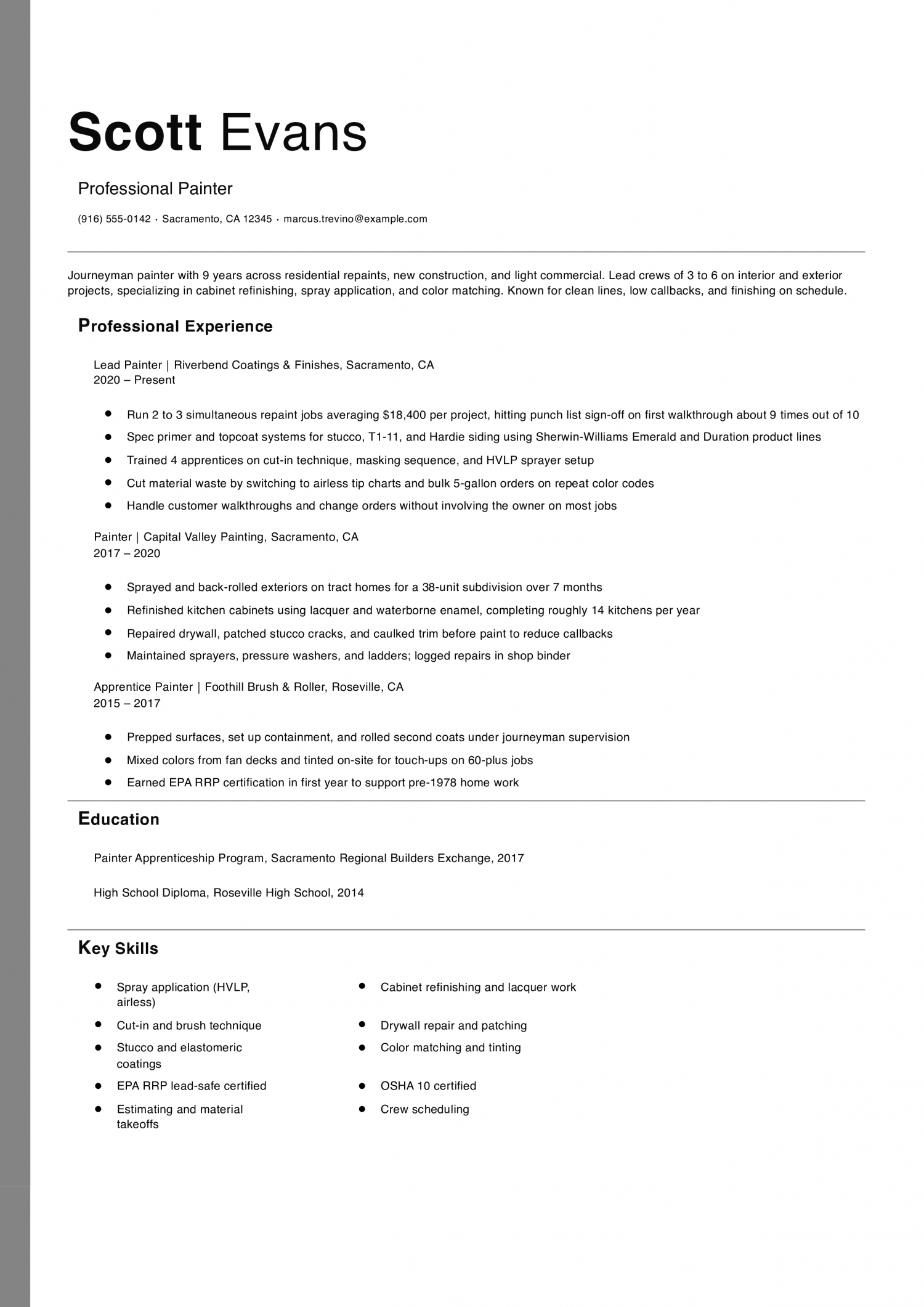
The apprentice tab fits painters in their first one to three seasons working under a journeyman. The resume needs to prove safe ladder and sprayer handling, surface prep skills, and that you show up on time every day.
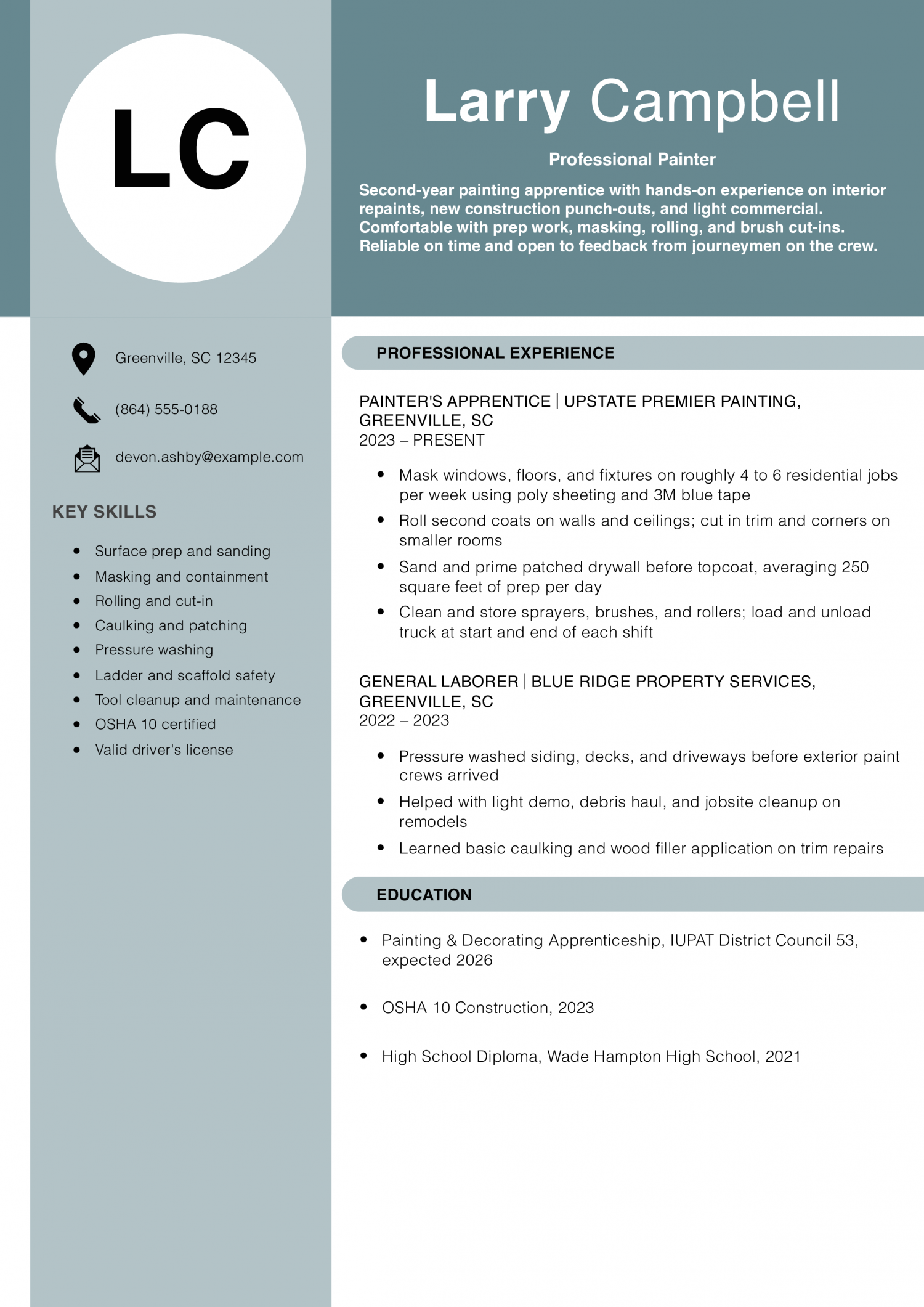
The journeyman tab fits painters running their own sections of a crew across residential and light commercial jobs. The resume needs to prove coating range, square footage shipped, and clean punch-list completion on bonded work.
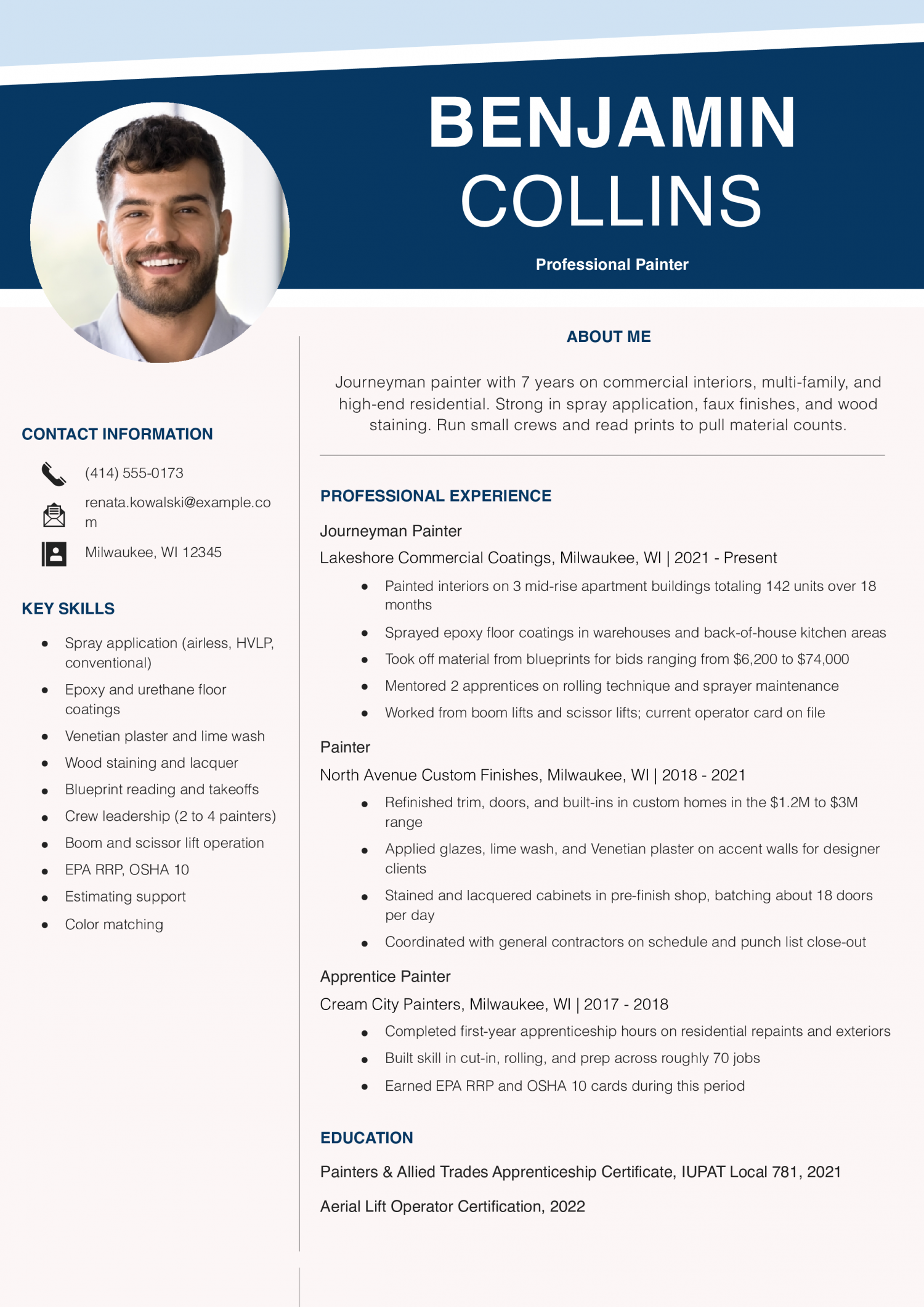
The master tab fits lead painters and foremen who bid jobs, run crews, and own client relationships. The resume needs to prove project values managed, OSHA compliance record, and the industrial or specialty coatings you spec.
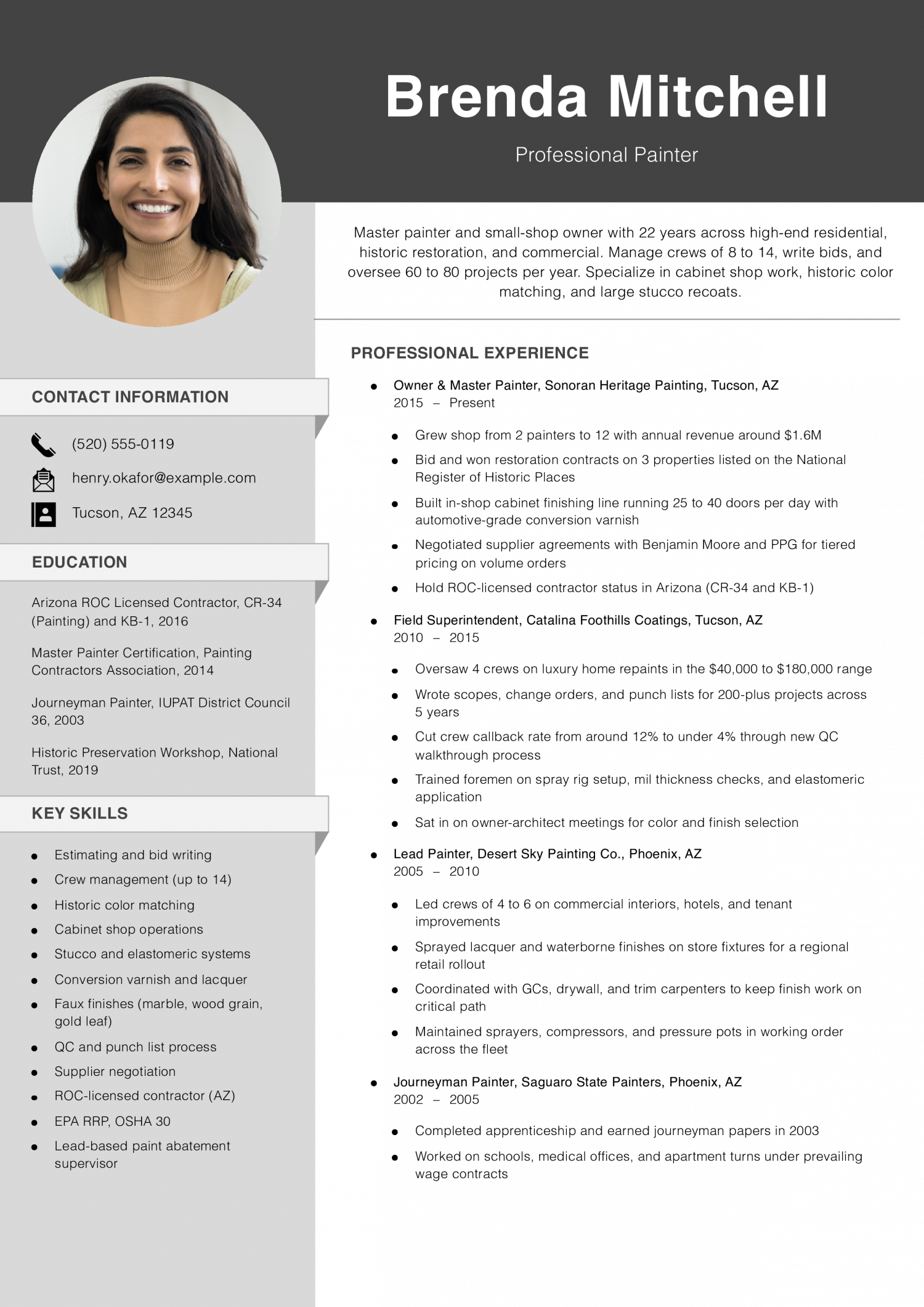
Journeyman painter with 11 years on residential repaints, new construction, custom cabinet finishing, and light commercial. Lead crews of 3 to 7, handle estimates, and run spray rigs from HVLP to large airless setups. Strong record on schedule, low callbacks, and clean jobsites.
Add one line a foreman cannot find on a generic credential check. Name the coating system you spec, the spray rig you run, or the substrate you specialize in.
Examples that move the needle: Graco airless and HVLP fluent, epoxy floor systems on warehouse decks, lead-safe RRP work on pre-1978 homes, or two-component urethanes on commercial steel.
This single line tells a painting contractor whether you fit the job before they read your work history. Make it the second line of your summary.
Painting bullets read flat without scope. Lead each bullet with the surface, the coating, and the volume you handled on that job.
Strong bullets name square footage, unit count, or building type: 18,000 sq ft of warehouse epoxy floor, 42 unit apartment turnover repaint, exterior repaint on a three-story Victorian.
Bullets without scope tend to read as duties, not work. Add coating type next to volume so a contractor can price your range at a glance.
Cluster bullets into three or four categories so a foreman reads your range fast. Common groupings work well for most painters.
Surface prep covers sanding, patching, caulking, priming, and masking. Application covers brush, roller, airless spray, and HVLP across latex, oil, lacquer, and epoxy.
Finish work covers cut-ins, faux, cabinet refinishing, and touch-ups. Site work covers staging, ladder and lift use, drop cloth setup, and end-of-day cleanup.
Painting contractors and general contractors need to see your cards before your work history. Build a credentials block under your summary on page one.
List your OSHA 10 or 30, EPA Lead-Safe RRP certification, any PDCA membership, scaffold and aerial lift tickets, and respirator fit-test status. Show state and year for each.
GCs cannot put you on a bonded job without these cards on file. Burying them on page two gets your resume passed over for a painter who put them up top.
Education sits at the bottom for trades resumes. List your apprenticeship program, the local you trained through, and any finished hours toward journeyman status.
Name the IUPAT local, the Finishing Trades Institute coursework, or the trade school program you completed. Include high school diploma or GED only if you have no apprenticeship.
Add a one-line references note saying foreman and contractor references are available on request. Most painting contractors will ask for two.
Painting contractors and property managers screen resumes by hand for tickets, coating range, and reliability before any software gets involved. Hard skills like airless spray and RRP carry the read; soft skills like punch-list discipline back the work history. The skills below come from our user-built professional painter resumes.
Match them against the posting you are chasing, and use soft skills as the evidence behind specific bullets, not as a separate brag list.
| Soft Skills | % of resumes with this skill |
|---|---|
| Attention to detail | 71% |
| Communication | 50% |
| Time management | 47% |
| Customer service | 39% |
| Teamwork | 34% |
| Hard Skills | % of resumes with this skill |
|---|---|
| Surface preparation | 77% |
| Brush and roller application | 66% |
| Spray painting | 44% |
| Color mixing and matching | 35% |
| Safety and OSHA compliance | 30% |
Based on data from thousands of professional painters’ resumes built on ResumeTemplates.com, May 2026.
The items below are what separate a professional painter resume from one that gets put back in the pile.
Most painters break in through a Finishing Trades Institute (FTI) apprenticeship run by the IUPAT, a non-union contractor in-house program, or a state-registered apprenticeship through a community college. The path you took matters less than how you show it.
List the apprenticeship program by name, the local or sponsor, the years enrolled, and the hours completed toward journeyman status. A foreman reads this block to gauge how close you are to running your own work.
If you finished the program, write the date and add Journeyman Painter as a credential. If you’re still in it, write Apprentice Painter, Year 2 of 4 and name the hours logged.
Commercial GCs cannot put a painter on a bonded site without current safety cards on file. List them in a credentials block under your summary, with state and year for each.
OSHA 10-Hour Construction (baseline)
OSHA 30-Hour Construction (lead painter or foreman track)
EPA Lead-Safe Certified Renovator (RRP)
Scaffold User and Erector certification
Aerial Lift (boom and scissor) certification
Respirator fit-test and medical clearance
Silica awareness (concrete and masonry prep work)
Fall protection (over six feet)
Name the brand and model class a foreman searches for. Generic phrases like ‘sprayer experience’ read as filler; ‘Graco 695 airless and Titan Capspray HVLP’ reads as a painter who can pick up a rig on day one.
Airless spray: Graco (390, 495, 695, Mark V), Titan, Wagner
HVLP and fine-finish: Graco FinishPro, Titan Capspray, Fuji
Prep tools: Festool sanders, Porter-Cable random orbit, dustless vacuums
Access: 6 ft to 40 ft extension ladders, baker scaffold, boom and scissor lifts
Coatings handled: Sherwin-Williams ProClassic and ProIndustrial, Benjamin Moore Advance, PPG, Tnemec industrial
Color tools: X-Rite or Pantone color matching, manufacturer fan decks
Painting contractors read this list as a map of where your work is heading. The certifications below tell them which track you’ve invested in: lead-safe residential, commercial spray, or industrial coatings. List the issuing body and the year completed next to each.
EPA Lead-Safe Certified Renovator (RRP): Required for paid work on pre-1978 housing; most residential contractors will not interview a painter without it.
OSHA 30-Hour Construction: Signals you can step onto a commercial site without slowing the GC down; OSHA 10 is the baseline, 30 is the differentiator.
NACE/AMPP Coating Inspector or Applicator: Tells industrial contractors you can spec and apply protective coatings on steel, tanks, and bridges; opens the higher-pay industrial track.
PDCA Craftsman Certification: Backs your residential and commercial finish quality with a third-party trade standard; useful for painters bidding higher-end repaint work.
For professional painters, the 10th-percentile floor reflects new apprentices on residential repaint, and the top-decile ceiling reflects industrial coatings specialists, union foremen, and owner-operators bidding their own work.
That spread tells you coating specialty, union affiliation, and the move from brush to bid move a painter from floor to ceiling more than tenure alone. Lead the resume with the coating systems, the certifications, and the project values you’ve run.
| # | State | Avg. Annual |
|---|---|---|
| 1 | Hawaii | $67,620 |
| 2 | Alaska | $65,610 |
| 3 | Illinois | $62,390 |
| 4 | Minnesota | $60,900 |
| 5 | New Jersey | $60,290 |
| 6 | District of Columbia | $59,810 |
| 7 | Washington | $58,520 |
| 8 | California | $57,450 |
| 9 | North Dakota | $57,390 |
| 10 | Maine | $56,270 |
| # | State | Workers | Median |
|---|---|---|---|
| 1 | California | 37,780 | $57,450 |
| 2 | Florida | 20,910 | $46,060 |
| 3 | Texas | 18,700 | $44,160 |
| 4 | New York | 14,670 | $56,020 |
| 5 | Washington | 8,820 | $58,520 |
Resume Templates offers HR approved resume templates to help you create a professional resume in minutes. Choose from several template options and even pre-populate a resume from your profile.
List the work that maps to the job ad. Surface prep, coating application, color matching, masking, and jobsite cleanup are the core duties contractors look for.
Pair each duty with scope so it reads as work, not a job description. Add square footage, unit count, building type, or coating system to every bullet.
Yes, especially when you bid larger commercial or property management work. Many GCs and management companies require a resume plus a W-9 before they put you on a vendor list.
List your business as the employer, name your scope per job, and attach a one-page project list with project values and references. Keep your insurance and bonding status on page one.
List the contractors you painted under, the years on each, and the rough hours you logged. Self-taught hours count when you can back them with a foreman reference.
Put OSHA 10, RRP, and any manufacturer training (Sherwin-Williams, Benjamin Moore) up top to offset the missing apprenticeship card. A journeyman reference letter helps on first contact.
Yes, but cluster them. Group residential repaint and new construction bullets separately from commercial and industrial bullets.
A residential contractor wants to see occupied repaint experience and customer communication. A commercial GC wants to see square footage, lift work, and OSHA compliance. Give both a clean section to scan.
For a professional painter, an ATS-friendly template is the safest pick, because it puts your certifications and experience where a hiring manager scans first. A basic template is a solid alternative. Whichever you choose, keep the formatting clean and easy to parse: clear section headings, a standard font, and no graphics a parser can choke on.
Executive Resume Writer and Career Coach
Andrew Stoner is an executive career coach and resume writer with 17 years of experience as a hiring manager and operations leader at two Fortune 500 Financial Services companies, and as the career services director at two major university business schools.

Customize this template in our builder in under 10 minutes.