Retail Associate Resume Examples
Your profile should state your years on a sales floor, the store format you’ve worked in (boutique, big-box, mall specialty, outlet), and the product category you know best. Name the POS systems you’ve run, your…
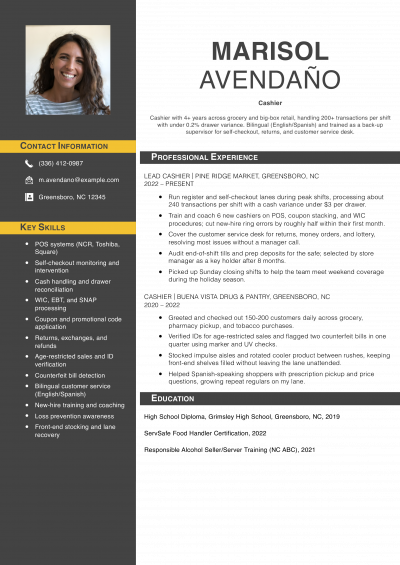
Every resume example is written and reviewed by our team of Certified Professional Resume Writers to ensure top-quality content and formatting.
Most stocker roles fill fast because the bar looks low. It is not. Store managers and inventory supervisors want proof you can move freight at pace without damaging product or missing planogram resets.
Your resume should lead with units stocked per hour and shrink numbers you helped cut. If you hold a Powered Industrial Truck (Forklift) Operator Certification, list it near the top. The examples below show how to frame stocking speed, inventory accuracy, and safety record so your resume stands out in the pile. To compare layouts before you start, browse our resume templates.
Measurable stocking rates per hour, forklift certification status, and inventory shrinkage reductions are what separate the Stocker resumes that store managers and inventory supervisors schedule for interviews from the rest.
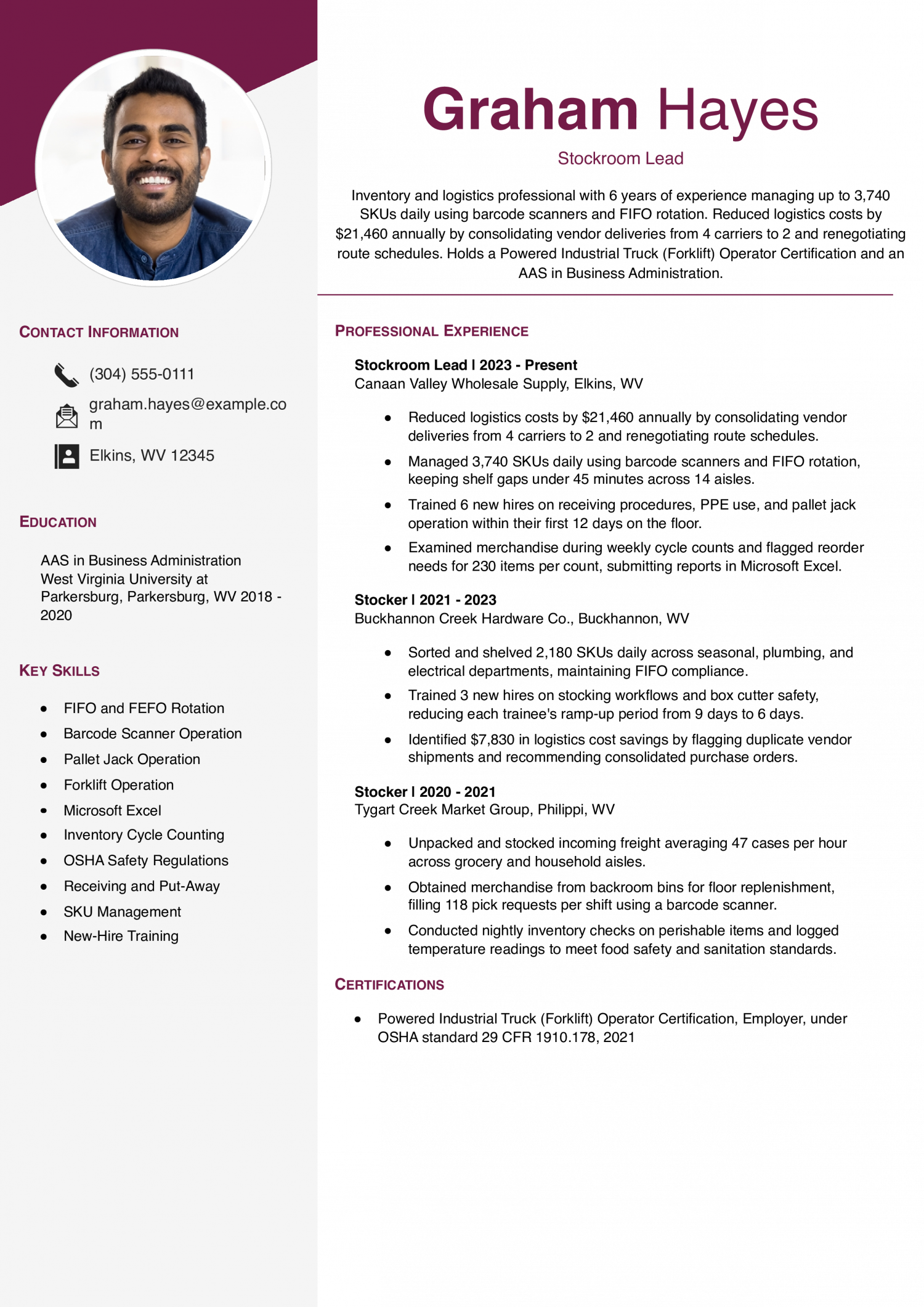
Pick this resume if you are a mid-level stockroom lead with about six years of warehouse experience and a recent step into supervisory work. Lead with vendor consolidation savings and new-hire training counts to separate yourself from duty-only stockroom resumes.
Training bullets here include the number of new hires, the topics covered, and the days it took to finish. A warehouse supervisor can picture the onboarding load at a glance. List your own trainee count, the skills you taught, and the timeline so the scope is clear.
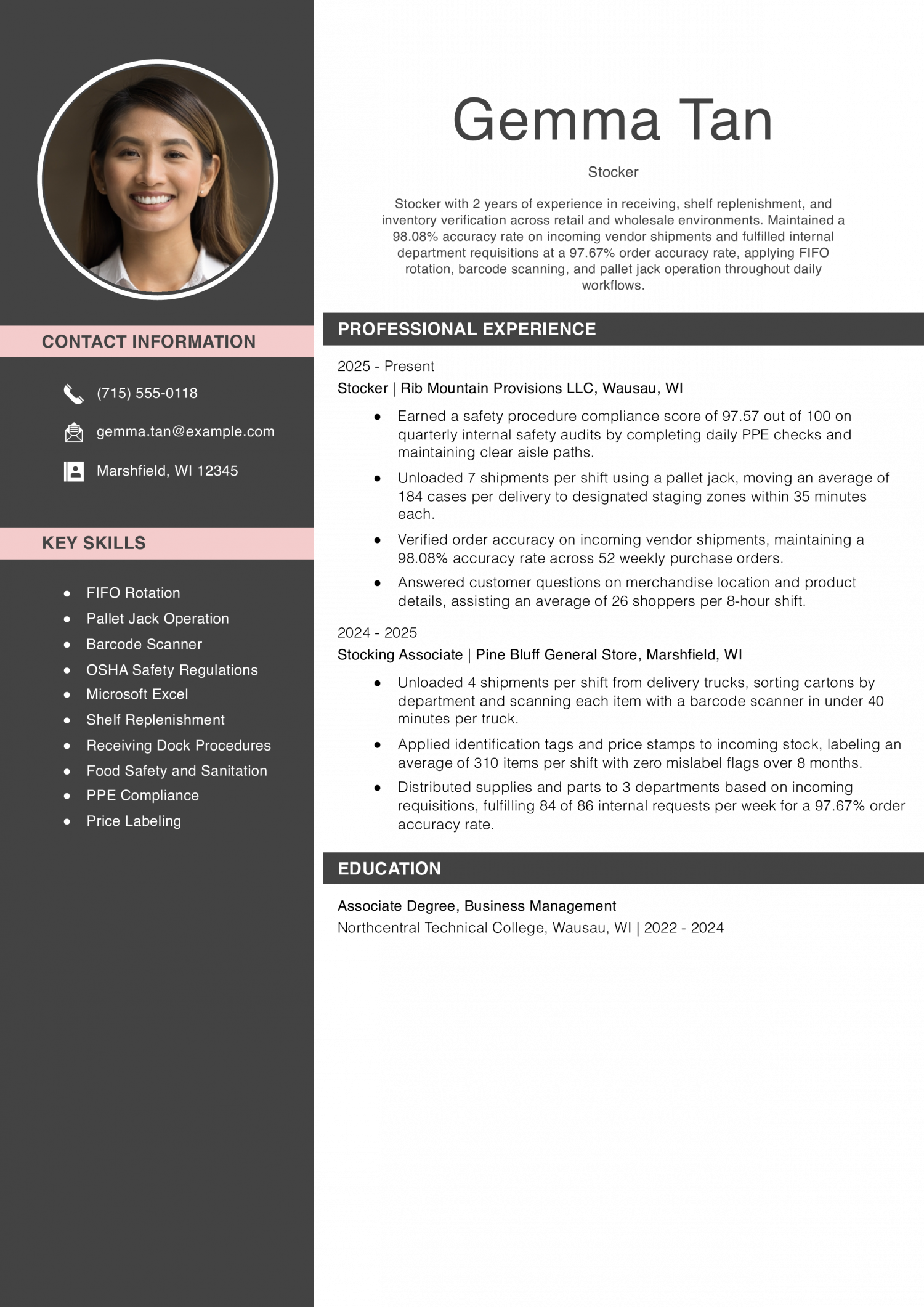
Start with this resume if you are an entry-level stocker with about two years of retail or warehouse stocking experience. Lead with shipment accuracy rates and per-shift volume counts that prove speed and precision on the receiving dock.
Labeling accuracy is backed by a per-shift count and a stretch of time with no mislabels. A floor manager can judge both speed and care from that one bullet. For your own repetitive tasks, pair the daily volume with your error record over a set time period.
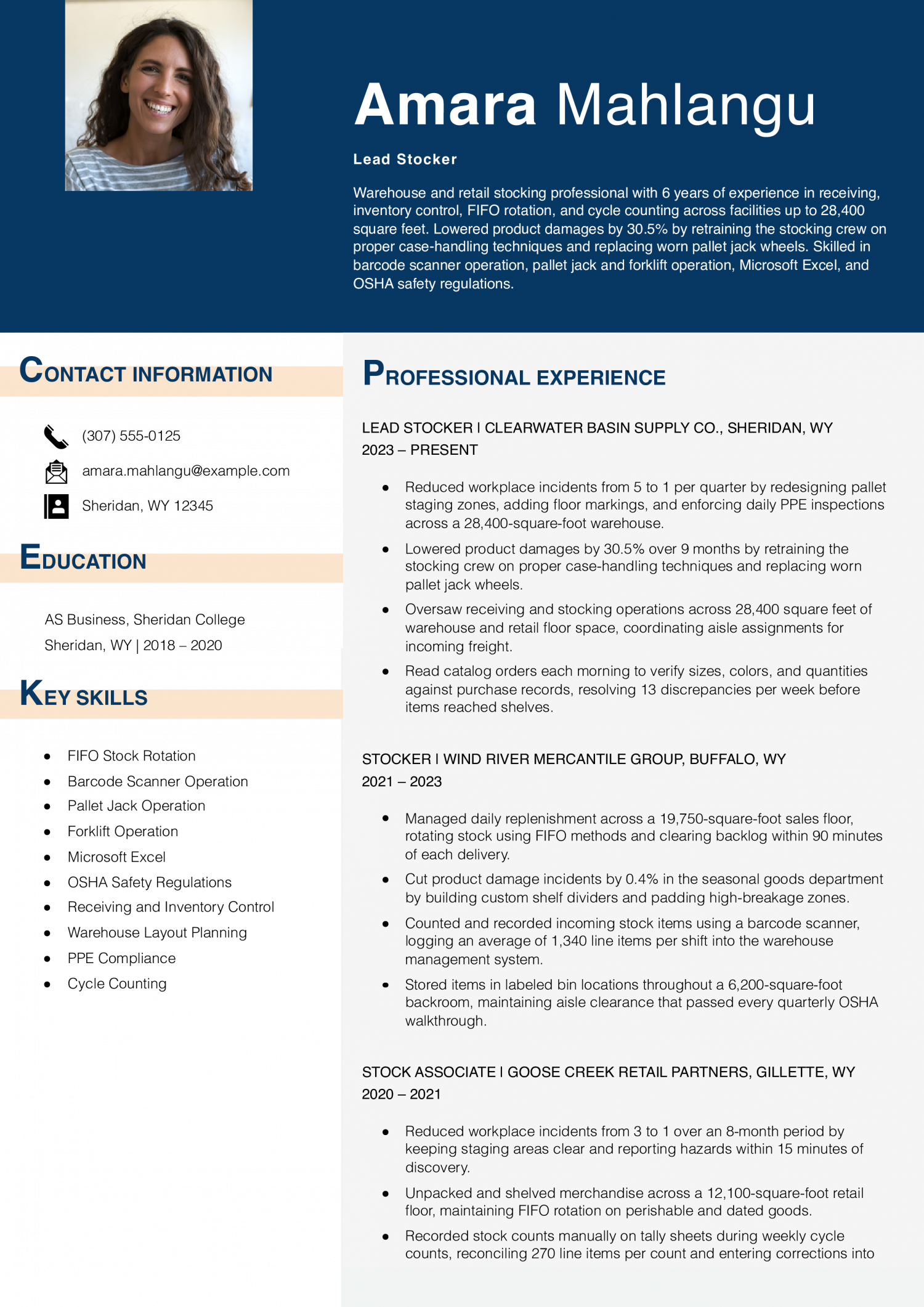
Try this layout if you have around six years of stocking experience and are stepping into a lead warehouse role. Lead with safety and damage-reduction numbers drawn from specific process changes you introduced.
Catching receiving errors weekly before products hit the floor shows the lead stocker checked every shipment, not some of them. A store manager sees a steady habit, not a one-time fix. State how often you caught problems and at what point in the process you stopped them.
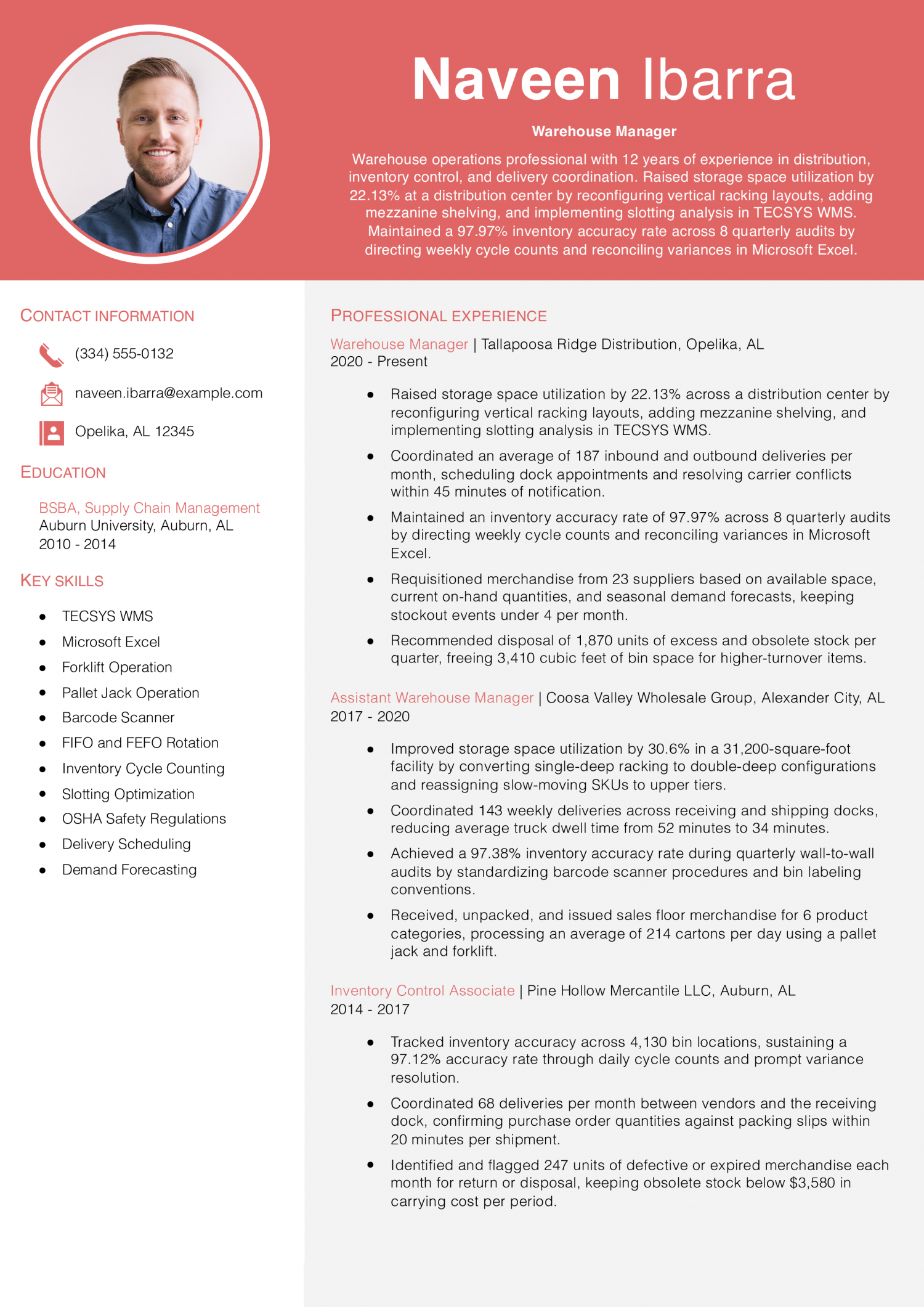
Rely on this resume if you are a senior warehouse manager with about 12 years of distribution and inventory control experience. Lead with space utilization gains tied to specific racking and slotting changes you introduced.
Supplier coordination here includes the number of vendors, the factors weighed for each order, and a stockout limit. A distribution director can see the manager balanced supply against demand for the stores counting on those deliveries. Name your vendor count and the conditions you tracked for each order.
Inventory coordinator with 6 years of experience supervising stocking teams of up to 11 associates across multiple shifts and departments while managing cycle counts, invoice verification, and OSHA-compliant storage operations. Reduced stock discrepancies by 38.7% by introducing twice-weekly cycle counts and updating bin labels with a barcode scanner. Skilled in FIFO stock rotation, pallet jack and forklift operation, shelf planogram execution, and Microsoft Excel.
State how many cases or pallets you stock per shift. Store managers and inventory supervisors will read that figure before anything else on the page.
It tells them your pace and stamina right away. A line like “stocked 50+ cases per hour across grocery and dairy” sets a clear picture. Follow it with the size of store you know.
Name the department or aisle count you handled. Add the shift type, such as overnight or mid-day. Skip vague, generalized claims about being a hard worker.
A real count per hour beats any soft phrase. Keep the summary to three or four lines total. Every word should carry a fact they can check.
Most strong stocker resumes show scale, not duties. Without a count or a time, your lines tend to look like a task list. Write how many pallets you unloaded per truck.
Note the square footage of your section. You can also state how fast you cleared an entire delivery. For example, “broke down and shelved a 12-pallet truck in under three hours” gives clear proof.
Mention the number of SKUs you rotated weekly. Note how many facings you maintained on a planogram. If you reduced shrink or damage, state the percent drop.
Store managers and inventory supervisors consistently scan for demonstrated speed and accuracy first. Pair each task with a count or a time frame. Two metrics per bullet is a strong target.
Break your bullet points into organized clusters that match real stocker tasks. Receiving and unloading is one group. Cover how you checked invoices against shipments.
Note any use of pallet jacks or hand trucks. Shelf stocking and rotation is a second group. Describe how you followed FIFO rules and adhered to planogram guides when merchandising products.
Inventory and backroom work forms a third group. State how you organized overstock in the backroom and ran cycle counts on a regular schedule. A fourth group can cover store safety and cleaning tasks.
This might include spill cleanup or aisle hazard checks. Grouping your bullets into these categories helps inventory supervisors find what matters fast. It also keeps your resume scannable in a quick review.
If you hold a Powered Industrial Truck Operator Certification, list it in a credentials block on page one. This forklift certification is issued by an employer under OSHA standard 29 CFR 1910.178(l). Store managers and inventory supervisors look for it early.
It signals you can operate equipment without extra training time. Place the cert name, the year earned, and the employer who trained you. Keep it above your work history so it is seen first.
If you know inventory software or handheld scanners, list those nearby. Name the exact tool or system you used. A short “Tools” or “Equipment” line works well.
Do not bury these important details inside a bullet point. Giving them their own line makes a quick scan easier.
A stocker role is frequently entry level, so your education section matters considerably. List your high school diploma or GED with the year. If you have college credits, name the school and dates attended.
Add any relevant coursework, such as logistics or supply chain basics. You can also list workplace training programs here. CPR or food safety training fits in this area too.
Keep each entry to one line when you can. If you held a student job with stocking duties, note it briefly. Store managers and inventory supervisors value steady attendance records.
A short “Additional Training” label can hold forklift or safety courses. End the resume here. Do not add hobbies or personal statements that take up space.
Retail stocking roles still see high turnover in 2026. Store managers and inventory supervisors want to fill spots fast with people who stay. That means your resume needs to match each posting’s keyword list right away.
Hard skills like pallet jack use and planogram setup show you can stock shelves on day one. Soft skills like teamwork and time management tell a supervisor how well you fit a crew. Both types carry weight when a store runs lean.
Scan the tables below and compare each term to the job posting you want. Pull matching words into your bullet points. Use soft skills as proof inside each work entry.
A bullet that names the skill and shows a result reads stronger than a bare keyword.
| Soft Skills | AI-estimated % |
|---|---|
| Physical stamina | 74% |
| Attention to detail | 57% |
| Team collaboration | 41% |
| Customer service | 35% |
| Time management | 29% |
And here are the top hard skills showing up most often.
| Hard Skills | AI-estimated % |
|---|---|
| Shelf stocking | 74% |
| Inventory management | 58% |
| Order fulfillment | 46% |
| Price tag application | 39% |
| Planogram compliance | 34% |
Skill names and rankings come from an AI model grounded in U.S. Department of Labor occupation data for stockers, not from a count of stockers’ resumes built on ResumeTemplates.com.
Name the registers you know.
Stockers often help at checkout during busy shifts. Store managers value workers who can step onto a register. Listing POS systems you have used shows that range.
Most stocking happens overnight or in early morning hours. Store managers need to know your open windows fast. A short callout near the top of your resume helps.
Shift Availability
State the exact shifts you can work. Include weekends and holidays if they apply. This small detail saves time for the store manager reviewing your file.
A clean work record and open schedule keep you eligible for most stocker roles. The credential below moves a stocker resume from the qualified stack into the shortlist. Store managers and inventory supervisors scan for it to gauge which tasks you can handle on day one.
Many stores need someone who can move pallets right away. That training flag tells them you are ready. Not every location asks for it, but the ones that do tend to fill those spots first.
List the issuing body and the year you finished training. Add the expiration date if your employer set one.
For stockers, the 10th-percentile floor and the top-decile ceiling sit closer together than in most fields. The gap between them is roughly 50 percent, not two or three times over. That narrow spread means geography and employer type shape where you land in the range more than years alone do.
National employment is large, so openings exist across most regions. Your resume should name the volume you handle and the tools you use on the floor. List pallet counts, inventory systems, and any forklift certification you hold.
Store managers and inventory supervisors scan for proof you can move freight safely and on schedule.
| # | State | Median Annual |
|---|---|---|
| 1 | Washington | $44,620 |
| 2 | Oregon | $43,480 |
| 3 | California | $42,870 |
| 4 | Colorado | $42,350 |
| 5 | Connecticut | $40,590 |
| 6 | Alaska | $40,310 |
| 7 | District of Columbia | $39,640 |
| 8 | Wyoming | $39,580 |
| 9 | Hawaii | $39,300 |
| 10 | Montana | $39,050 |
| # | State | Workers | Median |
|---|---|---|---|
| 1 | Texas | 322,710 | $36,840 |
| 2 | California | 310,870 | $42,870 |
| 3 | Florida | 171,380 | $36,400 |
| 4 | New York | 146,140 | $39,030 |
| 5 | Ohio | 129,760 | $37,130 |
Resume Templates offers HR approved resume templates to help you create a professional resume in minutes. Choose from several template options and even pre-populate a resume from your profile.
Replace "stocked shelves" with an action verb and a measurable result. Write something like "Replenished 200+ SKUs per shift while maintaining planogram accuracy." Adding a number gives store managers and inventory supervisors a clear picture of your pace.
Use the job title printed on your offer letter or pay stub, such as Grocery Stocker or Stock Associate. Match that title to the one in the posting you are applying for when they overlap. Below the title, list bullets that name the department and the freight volume you handled.
Yes, most large retailers accept or require a resume even for overnight shifts. A one-page document that lists your availability and past stocking experience sets you apart. It helps you stand out from applicants who submit only the online form.
Use specific verbs like "monitored," "rotated," or "replenished" instead of the vague phrase "kept things stocked." For example, write "Monitored shelf levels across four aisles and replenished product before peak hours." That phrasing shows initiative and gives a sense of the area you covered.
Lead with physical stamina, inventory rotation methods, and pallet jack operation. Then add teamwork and time management, since most stocking shifts run on tight schedules. Store managers and inventory supervisors look for proof you can move freight safely at a steady pace.
Open with a brief summary that names your physical ability and willingness to work varied shifts. List volunteer work, school projects, or personal tasks where you organized or moved materials. Even helping set up events or loading donations shows the lifting and sorting skills the role requires.
No, personal stock trading is not relevant to a shelf-stocking role and can confuse the reader. Store managers and inventory supervisors scan for warehouse or retail experience, not financial activity. Save that space for stocking duties, safety training, or equipment you have operated.
Choose an ATS-friendly template so your stocking speed and forklift training have their own sections. A basic template works too.
Stocker Resume
4.9/5 stars with 125 reviews

Executive Resume Writer and Career Coach
Andrew Stoner is an executive career coach and resume writer with 17 years of experience as a hiring manager and operations leader at two Fortune 500 Financial Services companies, and as the career services director at two major university business schools.
© 2026 Resumetemplates.com All rights reserved.