Certified Nursing Assistant Resume Examples and Templates for 2026



An active license line and current BLS or ACLS dates are what get nursing resumes past the credentialing screen in the first 60 seconds; patient-ratio and acuity detail are what make them readable to a nurse manager.
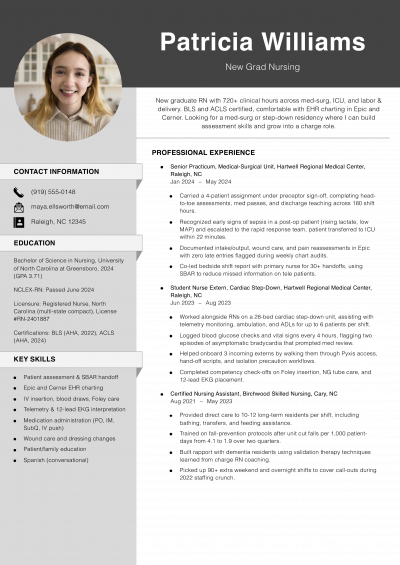
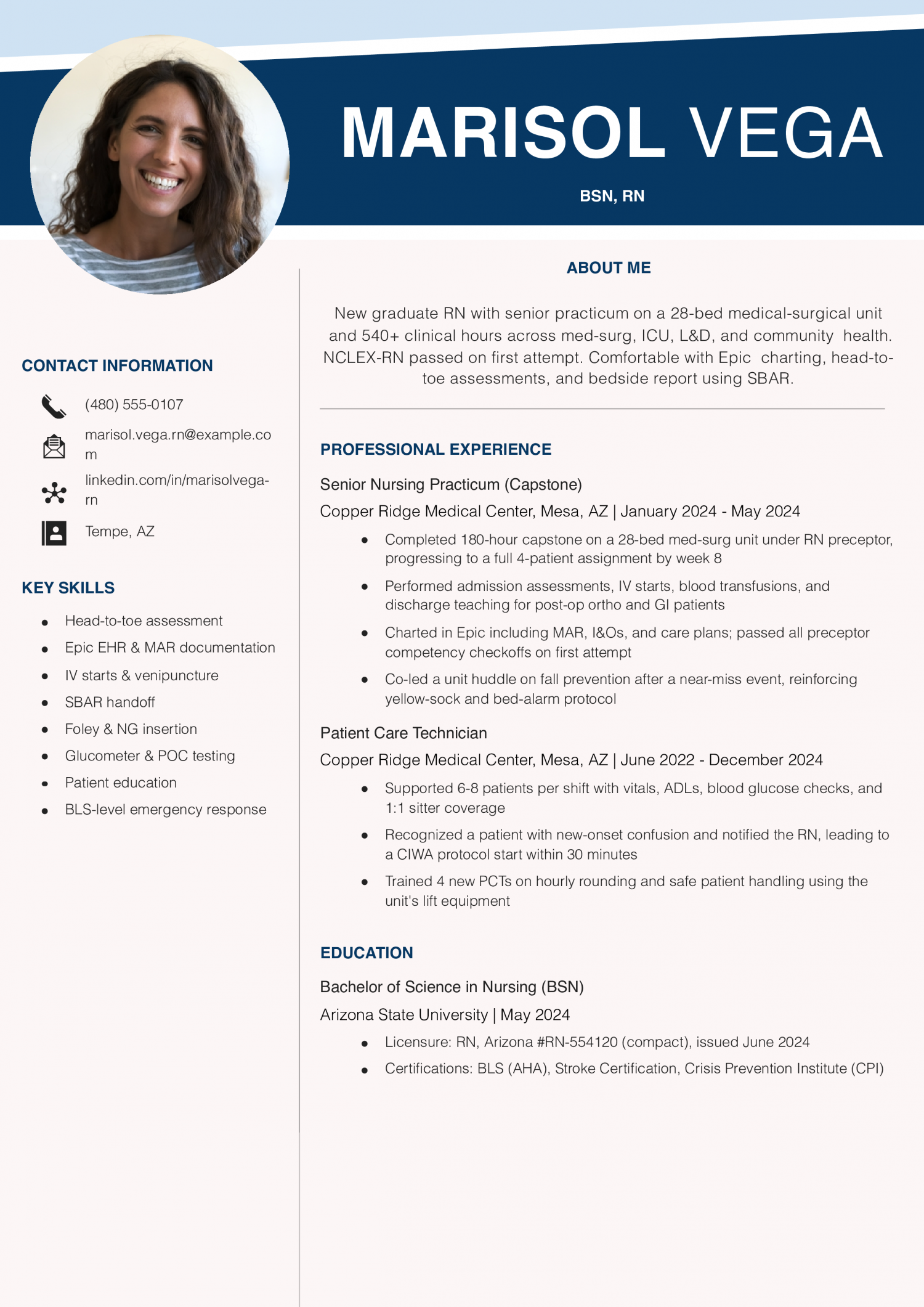
New grad RNs are recent BSN or ADN graduates who passed NCLEX-RN within the past year. Your resume needs to prove safe clinical reasoning through rotation hours, preceptor feedback, and the patient populations you cared for.
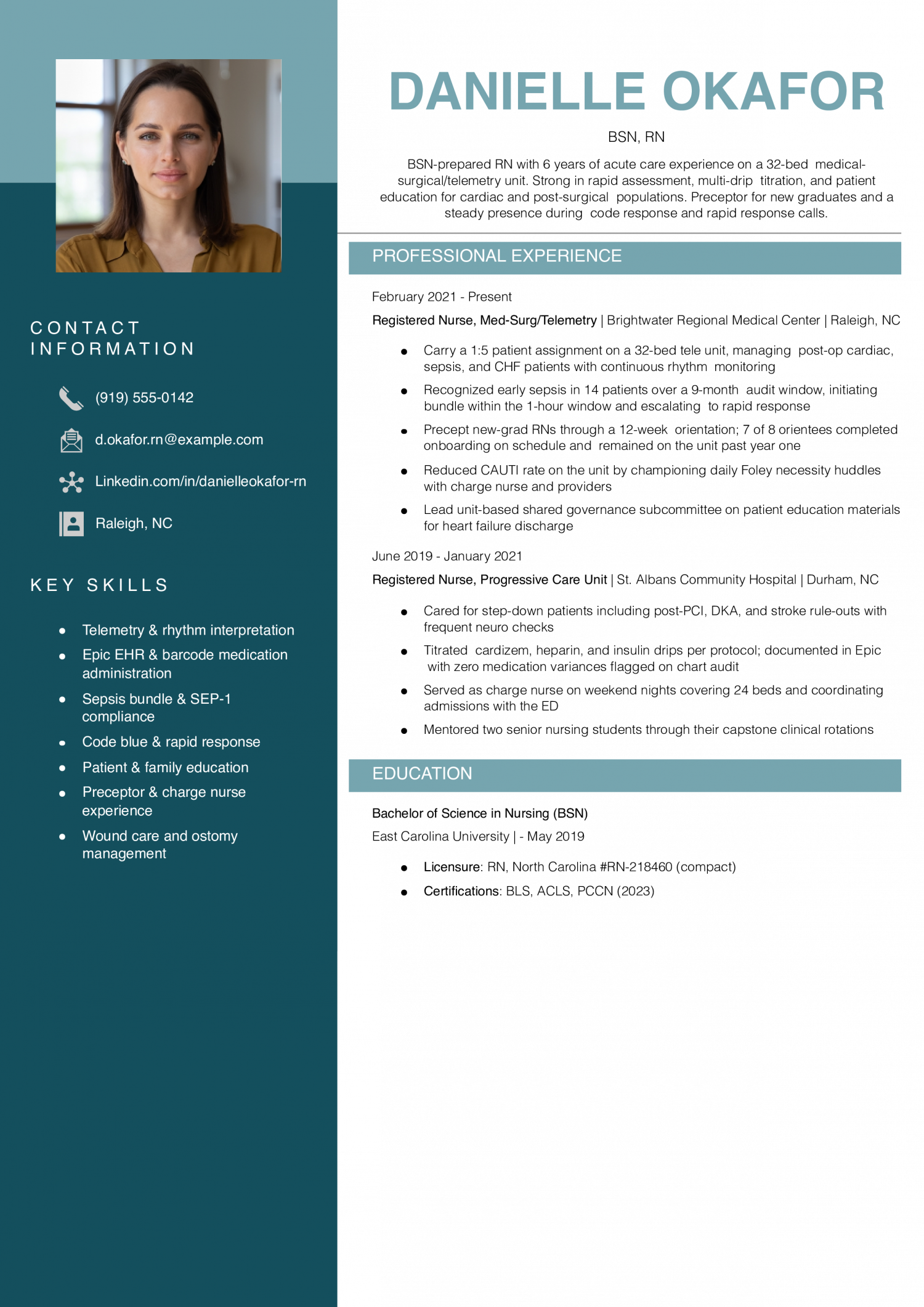
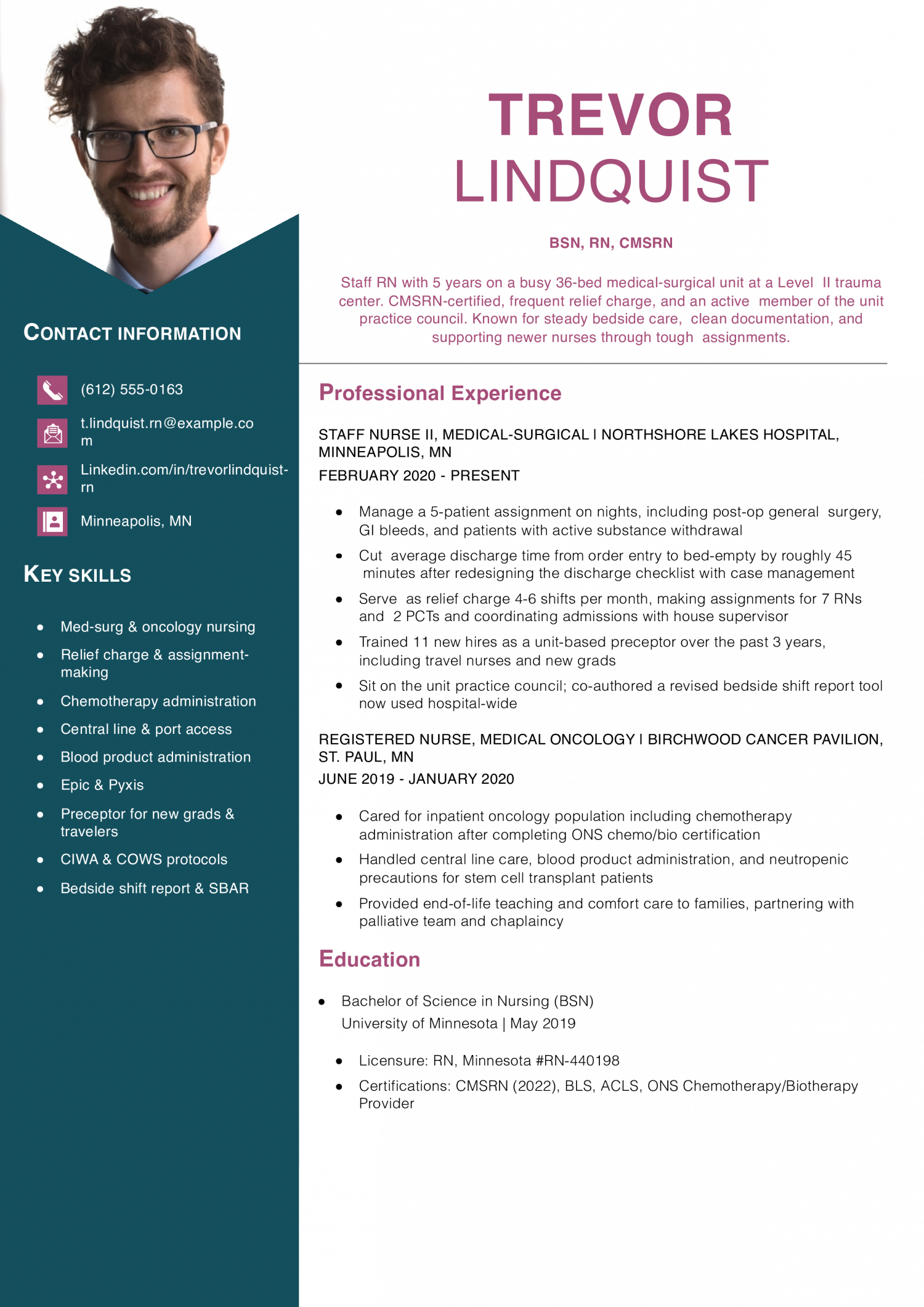
Staff nurses carry a full assignment on a defined unit with two or more years at the bedside. Your resume needs to prove ratio, acuity, and the specialty competencies that let a charge nurse trust you with a heavy team.
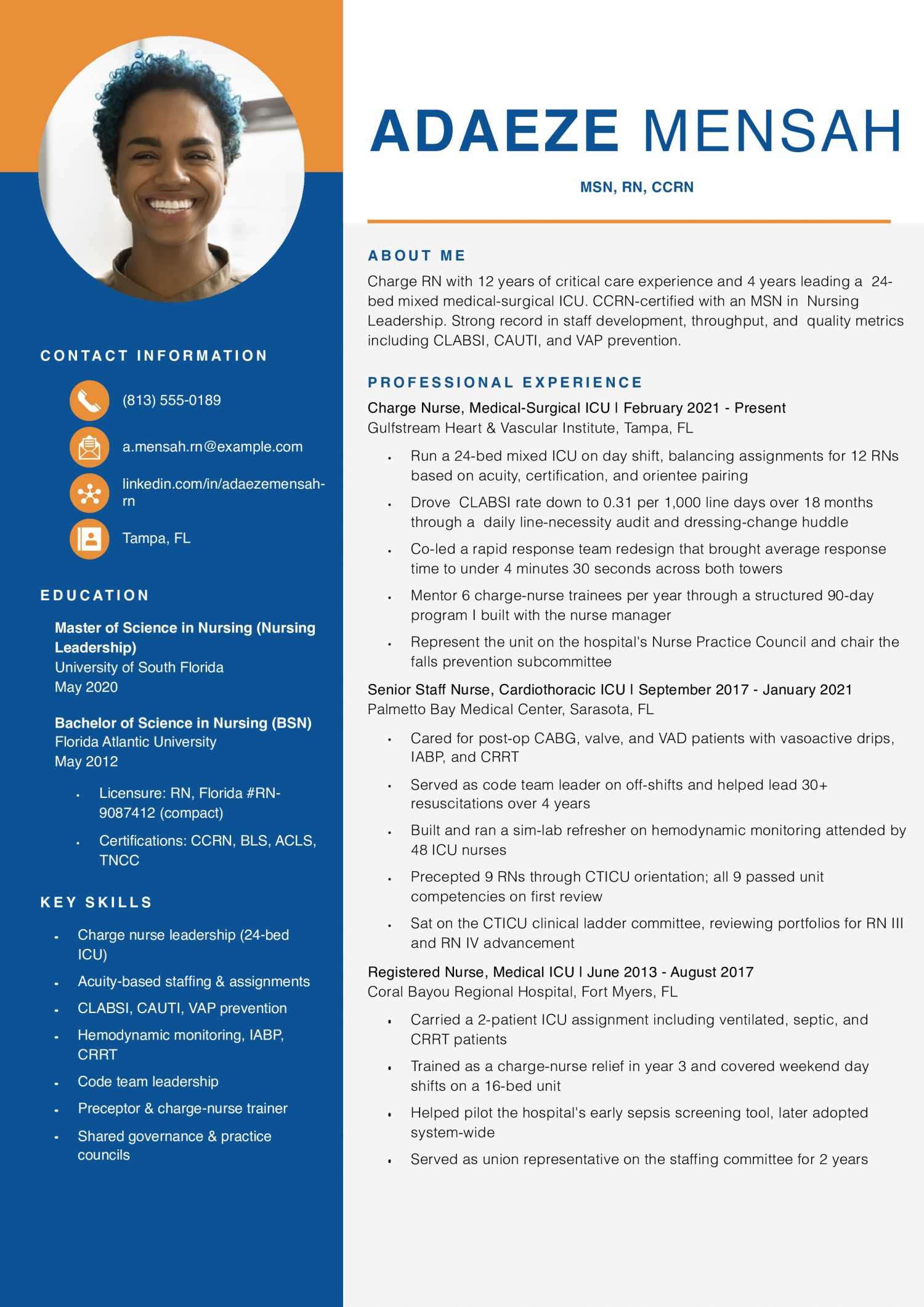
Charge nurses run shifts, make assignments, and back up newer staff during codes and rapid responses. Your resume needs to prove unit leadership, throughput metrics, and the clinical judgment that earns float pool and trauma assignments.
Priya Ramaswamy, BSN, RN, PCCN
Columbus, OH | (614) 555-0124 | [email protected] | linkedin.com/in/priyaramaswamy-rn
Registered nurse with 8 years of progressive care and step-down experience, including 3 years as a regular charge nurse on a 30-bed PCU. PCCN-certified with strong assessment skills, drip titration expertise, and a track record of mentoring new graduates. Comfortable owning unit-level quality projects from chart audit through staff education and re-audit.
Charge Nurse, Progressive Care Unit
Olentangy Methodist Hospital | Columbus, OH | 2022-Present
Staff Nurse, Progressive Care Unit
Olentangy Methodist Hospital | Columbus, OH | 2019-2022
Registered Nurse, Telemetry
Crestline Heart Hospital | Dublin, OH | 2017-2019
Graduate Nurse Resident, Medical-Surgical
Riverbend Community Hospital | Lancaster, OH | 2016-2017
Lead the summary with patient ratio, acuity, and unit type, not years at the bedside. Nurse managers read that line to predict whether you can hold a full assignment on their floor.
Name the ratio you carried (ICU 1:2, Med-Surg 1:5, Tele 1:4), the acuity mix, and your current specialty certification. A staff RN line that opens with “BSN, RN with three years on a 32-bed cardiac stepdown, 1:4 ratio, CMC-eligible” tells more in one sentence than a paragraph of soft adjectives.
Most strong nursing bullets carry a number. Without one, the bullet reads as a job duty rather than evidence of safe practice.
Name two or three real metrics per role: patients per shift, central line days without CLABSI, fall rate on your unit, discharge teaching completion, or HCAHPS bumps tied to your team. Bullets without a number tend to read as orientation checklists, so pair every verb with a count, percentage, or time window.
Cluster bullets into three or four buckets a charge nurse already thinks in: assessment and monitoring, medication and procedures, patient education and discharge, and team or preceptor work.
Under assessment, name what you titrated (vasopressors, insulin drips, heparin) and what you escalated. Under procedures, name foleys, NG tubes, IV starts, blood administration, and code participation. Mixing all of this into one paragraph buries the specialty signal that gets you shortlisted for ICU, ER, or L&D openings.
Build a credentials block under your name with RN license state and compact status, BLS expiration, ACLS or PALS if held, and specialty certs like CCRN, CEN, or RNC-OB. List the state and “license in good standing” without the license number.
Credentialing teams pull this block first. Burying it under work history slows the verification step and pushes your file behind cleaner resumes. Add EHR systems (Epic, Cerner, Meditech) in the same area so nurse recruiters see your charting fluency early.
End with your BSN or ADN, NCLEX-RN pass date, and any RN-to-BSN progress if you are mid-program. For new grads, expand clinical rotations: unit name, hospital, hours, and patient population for each rotation.
Add a short continuing education line with recent CE hours per your state board. Skip high school, GPAs under 3.5, and unrelated jobs older than five years. Charge nurses scanning the close want to see specialty fit, not a full work history.
The skills below come from nursing resumes our users built on ResumeTemplates.com. Nurse recruiters and directors of nursing scan dozens of resumes a week, and these are the skills that show up most often. Hard skills like Epic charting and ACLS are credential gates: miss them and the file stalls.
Soft skills like patient education and SBAR communication back up your bullets as evidence, not adjectives. Match this list against the specific job posting, and treat each soft skill as something you have to prove with a bullet, not just claim.
| Soft Skills | % of resumes with this skill |
|---|---|
| Communication | 67% |
| Critical thinking | 63% |
| Compassion and empathy | 50% |
| Teamwork | 40% |
| Time management | 29% |
And here are the top hard skills showing up most often.
| Hard Skills | % of resumes with this skill |
|---|---|
| Medication administration | 76% |
| Patient assessment | 68% |
| Vital signs monitoring | 44% |
| Electronic health records | 36% |
| Wound care | 33% |
Based on data from thousands of nurses’ resumes built on ResumeTemplates.com, May 2026.
The items below are what separates a nursing resume that clears credentialing from one that gets put back in the pile.
Credentialing teams check your license before a nurse manager ever reads your bullets. Place this block under your name and contact line so it is the second thing on the page.
List the state, the credential, and good-standing status. Do not print the license number on the resume itself; share it on the application form or credentialing portal when prompted.
If you hold a compact (NLC) license, name it. Multistate eligibility is a hard filter for travel and telehealth roles.
State boards set CE clock-hour requirements per renewal cycle. List recent CE that ties to your specialty so nurse recruiters see active growth, not just a renewed license.
Add a short “Continuing Education” section near the bottom of the resume. List the course title, provider, contact hours, and year.
Prioritize CE that maps to the unit you are applying to: dysrhythmia for tele, fetal monitoring for L&D, sepsis management for ICU and ER.
EHR fluency is a hard filter on most nursing job descriptions. Name the systems you have charted in, and note any super-user or trainer status.
Your resume can prove clinical scope without naming a patient, a date of service, or any detail that could identify a real person.
Use aggregate metrics, ratios, and unit-level outcomes. “Reduced CLABSI rate by 31% across a 24-bed MICU over six months” reads as strong nursing evidence and exposes no PHI.
Avoid case descriptions that name a diagnosis, procedure, and timeframe together. That combination can identify a patient, especially in small communities or rare presentations.
Nurse recruiters read the certifications list as a map of where your clinical work is heading. The list below tells them which specialty track, critical care, emergency, perinatal, or oncology, you have invested in. List the issuing body and the year earned next to each credential.
The 90th-percentile RN out-earns the median by a wide margin, which tells you the market rewards specialty, shift type, and geography more than years at the bedside. Critical care, OR, and L&D pay above floors that medical-surgical and clinic roles settle into. Geographic concentration matters too: a handful of high-cost metros pull the top of the distribution up.
Lead your resume with specialty, acuity, and shift differential eligibility, not a long tenure timeline.
| # | State | Avg. Annual |
|---|---|---|
| 1 | California | $140,330 |
| 2 | Hawaii | $136,320 |
| 3 | Oregon | $123,990 |
| 4 | Washington | $112,180 |
| 5 | Alaska | $110,690 |
| 6 | New York | $105,600 |
| 7 | District of Columbia | $104,550 |
| 8 | New Jersey | $102,730 |
| 9 | Nevada | $101,990 |
| 10 | Massachusetts | $101,970 |
| # | State | Workers | Median |
|---|---|---|---|
| 1 | California | 326,720 | $140,330 |
| 2 | Texas | 261,050 | $90,010 |
| 3 | Florida | 218,100 | $82,850 |
| 4 | New York | 204,120 | $105,600 |
| 5 | Pennsylvania | 146,840 | $87,610 |
Resume Templates offers HR approved resume templates to help you create a professional resume in minutes. Choose from several template options and even pre-populate a resume from your profile.
List your credentials in the order AACN recommends: degree, license, then certification. Write it as "Jane Doe, BSN, RN, CCRN" at the top of the page.
In your credentials block, name the state and compact status, for example "RN, California, license in good standing" or "RN, multistate compact." Do not print the actual license number on the resume. Provide it on the application form when the employer asks.
Use clinical rotations as your work history. For each rotation, list the hospital, unit, total hours, and the patient population you cared for.
Add a capstone or preceptorship as its own entry with bullets on patient ratio and procedures performed. Include CNA, PCT, or tech work, even if part-time, because nurse managers read it as bedside exposure.
Use ratios and unit descriptors, never patient names or identifiers. "1:2 in a 20-bed surgical ICU" tells a nurse manager everything they need to know.
Aggregate metrics are fine: fall rates, CLABSI days, HCAHPS scores tied to your team, or discharge teaching completion rates. Skip case-specific clinical details that could identify a real patient.
Group short contracts under one agency heading rather than listing each as a separate job. This keeps the work history readable and avoids triggering a job-hopper flag.
Under the agency, list each facility, unit, ratio, and dates. Note your compact license status at the top of the resume so credentialing teams see multistate eligibility right away.
For a nurse, an ATS-friendly template is the safest pick, because it puts your certifications and experience where a hiring manager scans first. A basic template is a solid alternative. Whichever you choose, keep the formatting clean and easy to parse: clear section headings, a standard font, and no graphics a parser can choke on.
Executive Resume Writer and Career Coach
Andrew Stoner is an executive career coach and resume writer with 17 years of experience as a hiring manager and operations leader at two Fortune 500 Financial Services companies, and as the career services director at two major university business schools.