

Acting Resume Examples
Add one line at the top a casting director cannot pull from your Actors Access or Casting Networks profile. That might be a verifiable accent, a fight choreography certification, a fluency in Mandarin, or stunt…
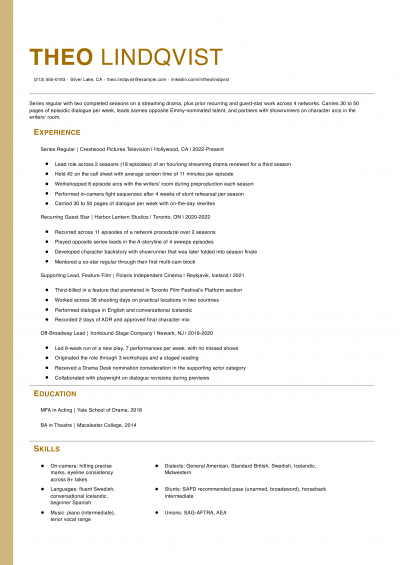
A tight credits block with role, production, director, and venue is what gets theater resumes past the casting screen; specific range and training signals are what make them readable enough for artistic directors to advance.
You are a new theater artist with school shows or a few regional credits. This resume has to show range, training, and the drive to show up ready for the people who cast the work.
You are a working theater actor with a steady run of regional or touring credits. This resume has to show that the people who cast the work can trust you with named roles across styles and stages.
You are a lead theater artist with title roles or long runs at major houses. This resume has to show ticket pull, strong reviews, and the range that keeps the people who cast the work coming back.
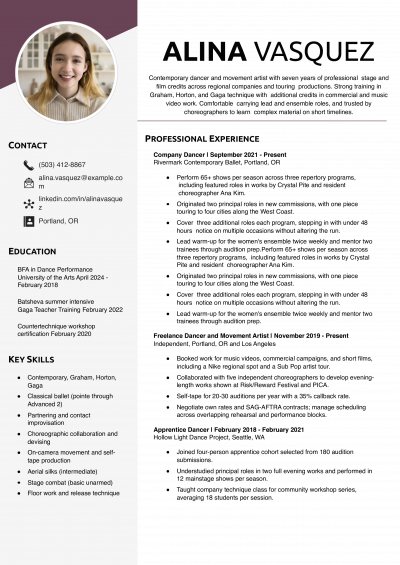
Union actor with 15 years of credits across Chicago storefront, large resident regional, and national touring houses. Strong classical and new-play chops, extensive dialect and combat training, and a steady on-camera book. Comfortable leading a company, covering multiple tracks, and workshopping new material from first reading through opening.
The first line of your summary should name the count and scale of your credits, not adjectives about your range. Lead with productions performed, houses played, or years of professional stage work. A casting director scans that opener to place you in a tier before reading further.
Name your strongest category early: union or non-union, regional or off-Broadway, musical or straight play. If you have signature roles at recognized theaters, put one in that first sentence. Skip the phrase ‘passionate performer.’ Say what you have booked.
A summary that opens with 32 professional credits across 11 regional houses lands harder than one that opens with a mission statement about storytelling.
Theater work resists hard metrics, but scope numbers still move the read. Name the count of productions, the house sizes, and the run lengths you have logged. A strong bullet reads: performed lead role for a 14-week run at a 900-seat regional house.
Bullets without a number tend to read as duties, not credits. Where audience size or ticket revenue is public, use it. For training, name the hours of technique work, the coaches, and the studios.
Understudy tracks count, and so do covers gone on. Recruiters scan for tier and volume first, then the roles themselves. Most strong theater resumes carry two or three concrete numbers in the summary and credits block.
Split your credits into clear sections so a reader can find the tier that matters to them. Standard categories are theater, musical theater, film and television, commercial, and training. Within theater, list role, production, theater or company, and director.
Put your strongest tier at the top, whether that is regional or off-Broadway. Musical theater rows should note vocal range if it fits the role you want. Keep dance and combat work in a separate skills row, not folded into credits.
Voiceover, cabaret, and workshop readings sit in their own subsections when volume warrants. A reader should scan the section headers and know your lane in under 10 seconds.
Training and special skills belong on page one, under credits or beside them, never buried at the bottom. Artistic directors and casting directors read training to gauge technique lineage and coach network. Name the school, the program, and the years, then list ongoing coaches by name.
Special skills should be honest and bookable: dialects you can perform on camera, instruments you can play on stage, stage combat work you have trained in. List union status clearly, whether union or non-union. Vocal range, height, and hair color sit in the header block near your contact line.
If you hold current training in unarmed or rapier work, name the studio and the year.
End the page with formal education, then a short tail for awards and press. Degree programs get a full line with school, degree, and year. Conservatory certificates sit here too, with the program name spelled out.
If you have festival awards, regional theater nominations, or named scholarships, list two or three at most. Press quotes can live in a two-line block if the outlets are recognizable, otherwise cut them. Keep the tail tight so the credits above stay the anchor of the page.
A reference line is not needed. One page is the standard for early and mid-career actors, and two pages read as reasonable once your credits fill the first page cleanly.
More theater resumes run through ATS filters than in past seasons. Read the casting or hiring notice closely, then see which terms in these two tables actually apply. Craft names like stage combat or dialect work clear the first cut.
Ensemble language decides whether the resume advances to a casting director. Artistic directors and casting directors read hard skills as proof you can do the role. They read soft skills as proof you can survive a rehearsal room.
Both matter, but the hard skills open the door first. Pull the exact terms from the audition notice, then back each soft skill with a bullet naming a show or director. Read the character breakdown twice before you edit the skills block.
Note every craft term the notice repeats, since repetition signals what the room cares about. Swap in those terms even if your prior resume used a close synonym. Keep the hard skills concrete and the soft skills tied to real productions.
| Soft Skills | AI-estimated % |
|---|---|
| Emotional intelligence | 75% |
| Adaptability | 56% |
| Team collaboration | 43% |
| Active communication | 36% |
| Professional resilience | 31% |
And here are the top hard skills showing up most often.
| Hard Skills | AI-estimated % |
|---|---|
| Voice projection | 65% |
| Script analysis | 63% |
| Improvisation | 44% |
| Accent mastery | 39% |
| Character development | 26% |
Skill names and rankings come from an AI model grounded in U.S. Department of Labor occupation data for theater professionals, not from a count of theater professionals’ resumes built on ResumeTemplates.com.
These are the must-haves hiring teams look for when scanning a theater resume.
Artistic directors and casting directors scan for role types they cast. They look for the training you hold and the houses you played. Group your keywords by the work you do on stage. Straight play credits sit apart from musical theater credits. Voice type and dance training belong with your musical work. Regional and touring credits show the scale of houses you know. Community and educational credits show early stage time and range. Special skills cover stage combat, dialects and instrument work. Each row below mirrors one of those buckets. Use the exact terms the trade prints on a program. Match the credit line format the house you want already uses.
| Niche | Keywords ATS scans for |
|---|---|
| Musical theater | musical theater credits, vocal range, dance training |
| Straight play | Shakespeare, contemporary drama, classical repertory |
| Regional and touring | regional theater, national tour, Equity contract |
| Community and educational | community theater, university productions, showcase performance |
| Special skills | stage combat, dialects, sight reading |
Resume Templates offers HR approved resume templates to help you create a professional resume in minutes. Choose from several template options and even pre-populate a resume from your profile.
Go back as far as the credits still hold up against the room you are auditioning for.
Drop high school shows once you have college or professional work to replace them. Keep the page to one side and trim the weakest title when a stronger one lands.
No, theater and musical theater resumes group credits by category rather than by date.
Order the shows inside each group by prestige, with the strongest role or best-known house on top. Casting directors read for range and level, not for timeline.
No, list the roles that show the range you are being seen for right now.
An ensemble track at a respected regional house beats a lead in a show no one has heard of. Cut anything that pulls attention away from the lane the audition sits in.
No, write the character name instead of "Lead" or "Supporting."
Artistic directors and casting directors know the show and can place the role themselves. If the play is obscure, add a one-line note about the part rather than a size label.
List community theater under the same theater section as your other stage work, with role, show, and theater name.
Do not label it "amateur" or hide it in a separate block. If your professional credits fill the page, community shows are the first to cut.
Put staged readings in their own subsection titled "Readings and Workshops" under your theater credits.
That signals the work was developmental rather than a full production, which matters to a casting director sizing up your run history. Include the role, the piece, and the company that hosted the reading.
Lead with the category that matches the room you are walking into.
Put theater first for stage auditions and film or television first for on-camera calls. Keep one master file for each lane rather than reshuffling a single resume every week.
An ATS-friendly template suits a theater resume best, since it keeps your credits and training where a casting director looks first. A basic template is a solid alternative. Whichever you choose, keep the formatting clean and easy to parse: clear section headings, a standard font, and no graphics a parser can choke on.