Artist Resume Examples and Templates for 2026



A clean training-and-credits block is what gets dance resumes past the artistic director's first-pass cut; named choreographers and specific repertoire are what make them readable enough to earn a callback slot.
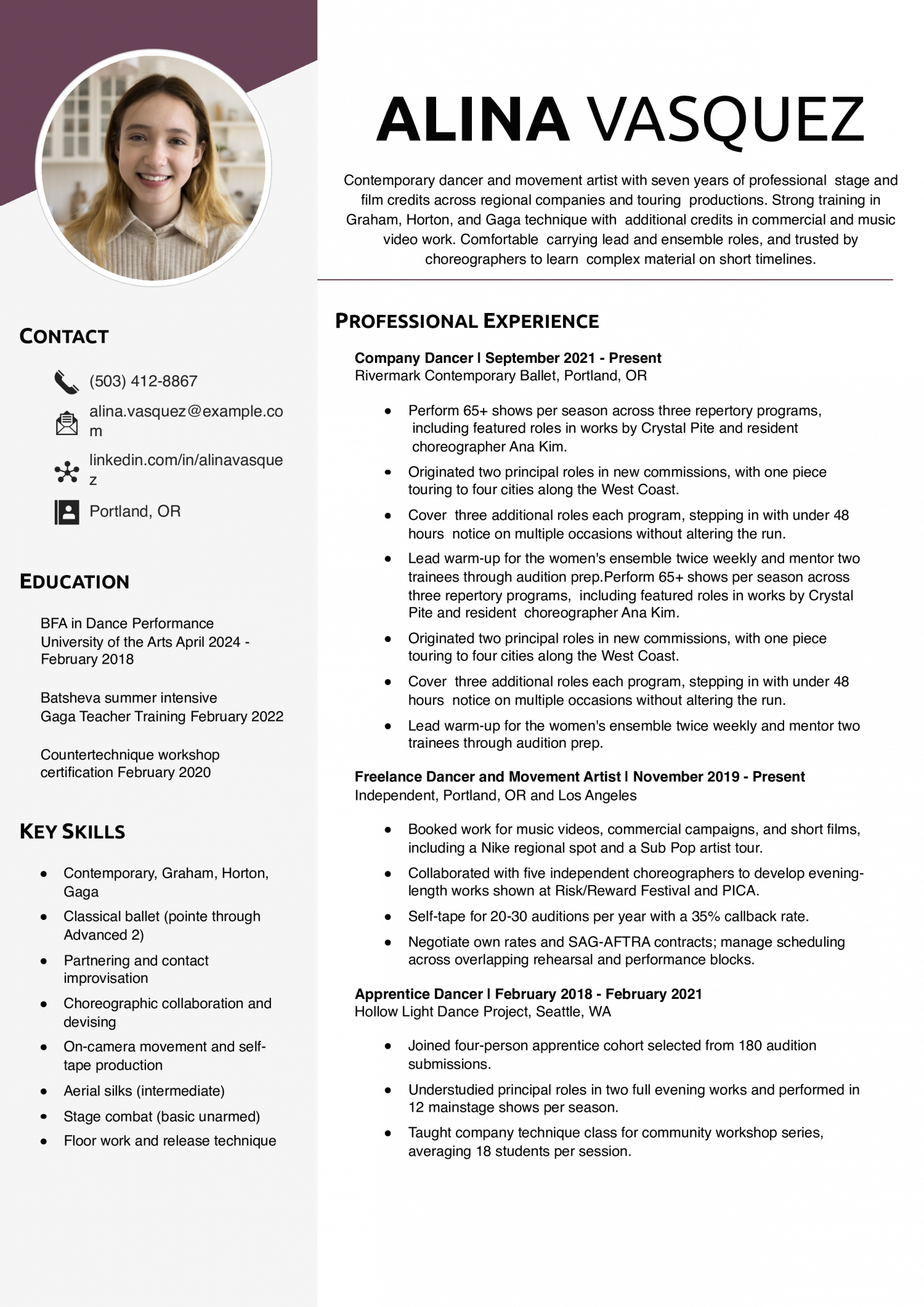
Pre-professional and recent conservatory grads with strong training but few paid credits. The emerging resume needs to prove technical range, training lineage, and the intensives that put you in front of working choreographers.
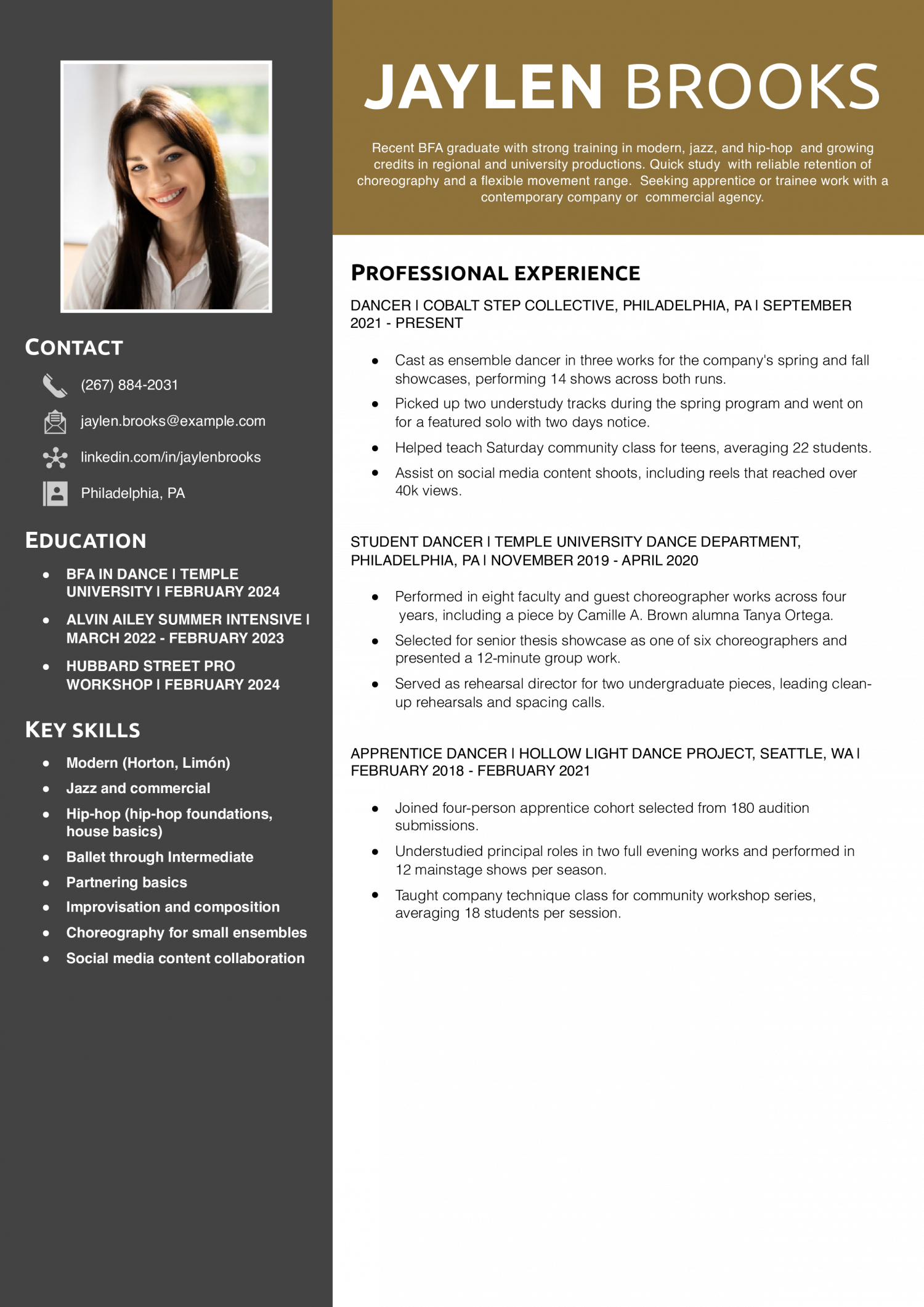
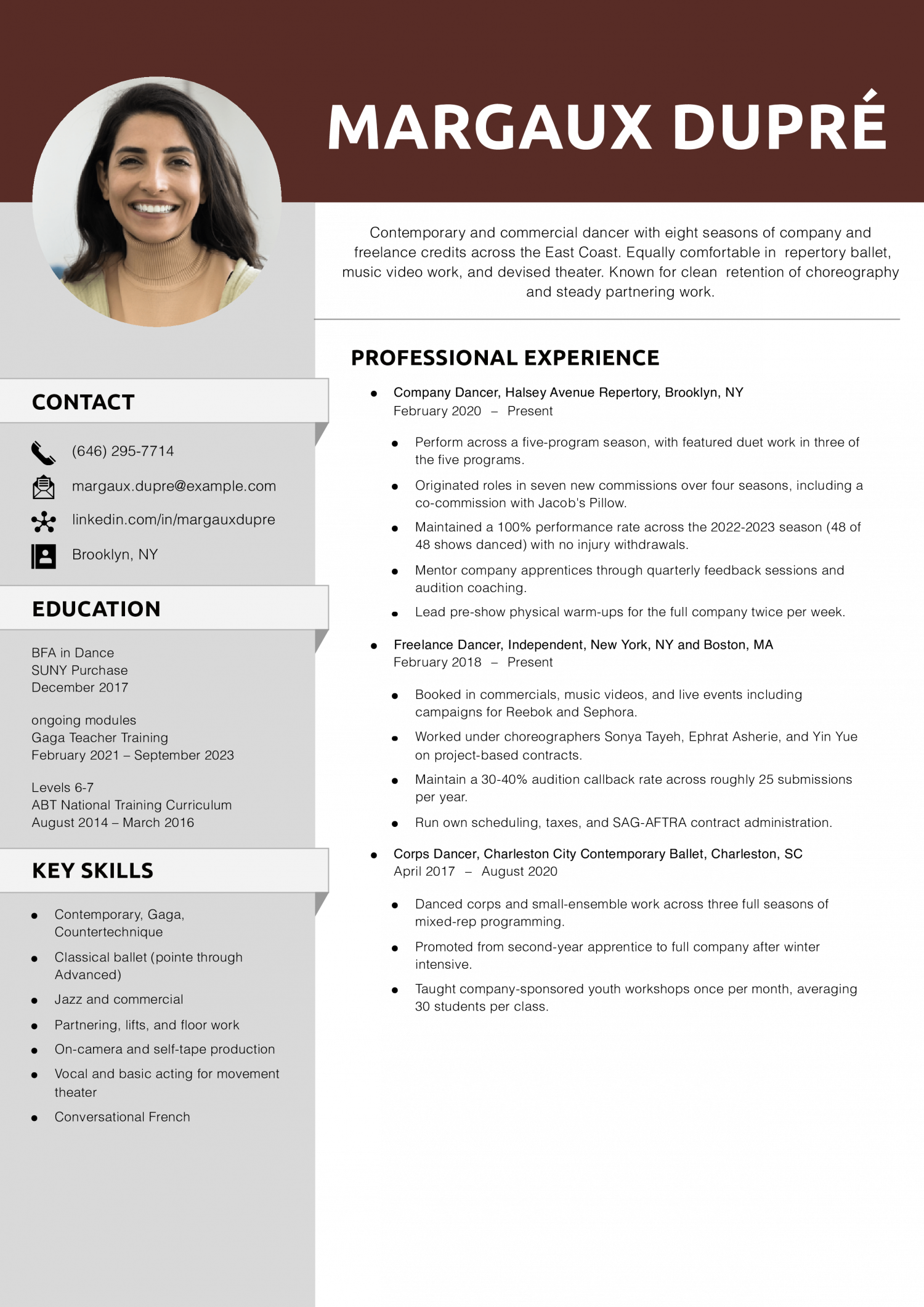
Working dancers with a multi-year credit list across companies, tours, or commercial gigs. The professional resume needs to prove repertoire depth, the choreographers who cast you, and the styles you book consistently.
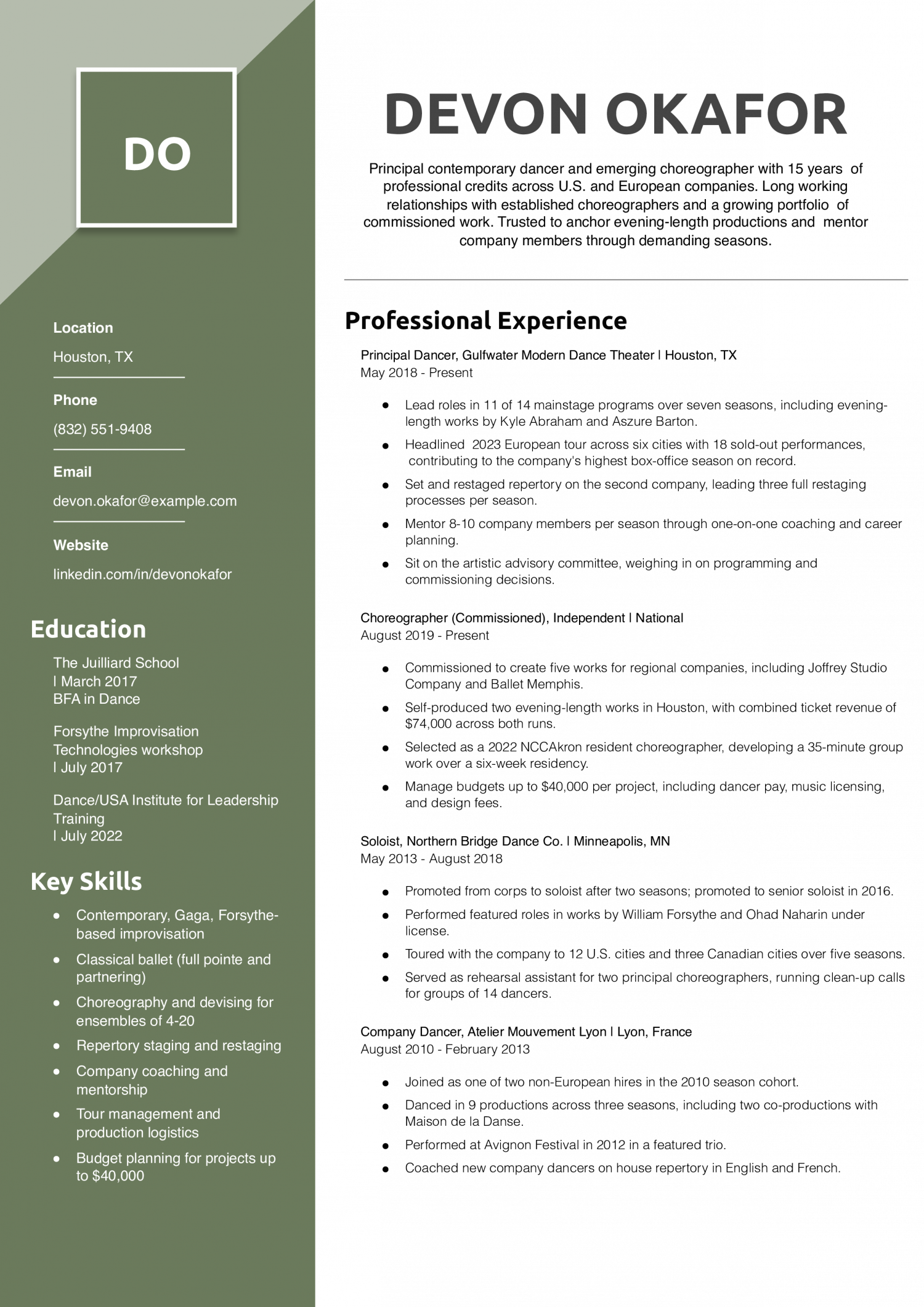
Senior dancers, soloists, and dance educators with national credits or program-leadership history. The principal resume needs to prove featured roles, choreography or teaching credits, and the artistic lineage that defines your work.
Contemporary dancer with 11 seasons of company, freelance, and commercial credits. Strong in repertory work and on-camera projects, with growing experience teaching and rehearsal directing. Looking for company contract or long-form project work with a contemporary or hybrid company.
Add a single line a company website cannot surface: a featured role in a Balanchine work, a credit under a named choreographer, an aerial silk certification, or fluent partnering at lift weight.
Put it directly under your name in a short positioning line. Artistic directors and choreographers read this line first to decide whether to keep reading or move to the next stack.
Dance hiring runs on volume and venue more than percentages. Strong resumes name the company, the work, the choreographer, and the run length.
Write “Performed corps and demi-soloist roles across 42 performances of Swan Lake, Nutcracker, and Giselle” rather than “strong classical performer.” Bullets without a venue or count tend to read as class work, not stage work.
Most strong dance resumes split credits into clear blocks: company or concert work, commercial and industrial, film and television, and teaching or choreography.
Inside each block, list the production, your role, the choreographer or director, and the company or venue. Add training as its own section with school, primary teachers, and years per style.
Page-one header carries height, hair, eyes, and union status (AGMA, AEA, SAG-AFTRA). Pointe, partnering weight, and aerial rigging certifications belong in a special skills block on page one.
Artistic directors and choreographers need these visible before they open the reel because they drive partnering, costuming, and casting decisions on the first scan.
Senior dancers carry years of recital and student-work credits that no longer earn callbacks. Cut pre-professional school performances once you have three or more paid company credits.
Trim competition placements after your second professional contract. Keep the resume to one page with a clean reverse-chronological credit list and a current headshot reference on file.
The skills below come from dance resumes our users built on ResumeTemplates.com. Artistic directors and choreographers scan dozens of resumes a week for each call, and these are the skills that show up most often. For company and concert work, technique terms like pointe, partnering, and contemporary floor work carry the most weight.
For teaching and studio roles, syllabus knowledge and choreography credits matter more. Match the list below against the actual call or job posting, and use soft skills as evidence behind a credit line rather than a standalone bullet.
| Soft Skills | % of resumes with this skill |
|---|---|
| Discipline | 51% |
| Collaboration | 63% |
| Creativity | 42% |
| Adaptability | 35% |
| Stage presence | 33% |
And here are the top hard skills showing up most often.
| Hard Skills | % of resumes with this skill |
|---|---|
| Dance technique | 76% |
| Choreography | 57% |
| Multiple dance styles | 40% |
| Improvisation | 36% |
| Data science | 63% |
| Partnering and lifts | 34% |
Based on data from thousands of dancers’ resumes built on ResumeTemplates.com, May 2026.
Before a dance resume gets a closer read, hiring teams check for a short list of essentials.
Studio owners and casting directors filter by style and setting before they look at credits. Match your niche keywords to the specific call so the resume surfaces in both ATS and casting database searches.
| Niche | Keywords ATS scans for |
|---|---|
| Classical ballet | pointe work, pas de deux, vaganova technique, balanchine repertoire |
| Contemporary and modern | graham technique, horton technique, floor work, contact improvisation |
| Commercial and stage | musical theater, jazz choreography, industrial dance, cruise ship contract |
| Studio teaching | dance instructor, abt national training curriculum, rad syllabus, competition choreography |
| Specialty and aerial | aerial silks, partnering and lifts, acrodance certified, character dance |
Dance hiring is a reel-first process. The resume gets you opened; the reel decides the audition slot. Treat the resume and reel as one package that loads from the same link.
Clean player, password-protectable, and the standard format casting directors expect for full-length reels.
Easier sharing for studio owners and parents; supports longer choreography reels and recital footage.
Casting for commercial, music video, and brand work browses pinned reels and tagged choreographer posts.
Holds reel, resume PDF, headshot, press, and choreography credits behind one custom URL.
Lead your reel with 15 to 30 seconds of your strongest technique, not the chronological start of a performance. Casting often stops watching after the first clip.
Caption every clip with the work, choreographer, and company. Untitled clips read as class footage and get skipped.
Keep a 60-second commercial cut and a two-minute concert cut ready. Audition notices specify which they want; sending the wrong length signals you don’t read calls carefully.
Performing arts hiring treats the resume, headshot, and reel as a single submission package. Mismatched assets are the fastest way to read as unprofessional.
Headshot: current within 12 months, neutral background, hair as it currently reads on stage
Reel: 60-second commercial cut and 2-minute concert cut, both available
Resume: 8x10 trim or matched to headshot dimensions for print submissions
Contact line: agent and union local first, personal email second, phone last
Credits are the body of a dance resume, not a side note. Casting reads this block to decide whether you match the work, the choreographer’s vocabulary, and the company’s level.
Swan Lake | Corps de Ballet | chor. Kevin McKenzie | Pacific Northwest Ballet
Hamilton (National Tour) | Ensemble, u/s Peggy | chor. Andy Blankenbuehler | Broadway Across America
Apple AirPods Pro (commercial) | Featured Dancer | chor. Parris Goebel | dir. Spike Jonze
Original Work: "Tideline" (12 min) | Choreographer | Premiered at Joyce SoHo, 2024
Active training and a clean credit list keep you eligible to audition. The certifications below are what move a dance resume from the qualified-but-typical stack into an artistic director or studio owner’s shortlist. List the issuing body, level, and year completed on one line.
ABT National Training Curriculum Certification: Signals you can teach ballet at a graded, examined standard. Required at many syllabus-driven studios and a strong signal for teaching roles.
Royal Academy of Dance (RAD) Registered Teacher Status: Marks you as a board-recognized ballet teacher with examined students. Carries weight at private studios that run RAD exams.
Progressing Ballet Technique (PBT) Certification: Shows you can teach the conditioning method many competitive studios use to build turnout, core, and partnering strength.
Acrobatic Arts or AcroDance Certification: Required at most competition studios offering acro classes. List the module level (1, 2, or master) and the year you certified.
The top-paying states for dancers concentrate in production hubs and cruise-departure markets, not the conservatory cities most emerging dancers cluster in. That gap reflects where paid contract work actually originates: theme parks, casino residencies, cruise lines, and film and commercial production. The employment-volume states tell a different story, anchored by tourism and live-entertainment infrastructure.
If you’re geographically flexible, the resume should foreground union status, the production credits that match those hub markets, and any cruise or theme park contracts you’ve held.
| # | State | Workers | Median |
|---|---|---|---|
| 1 | California | 2,880 | N/A |
| 2 | New York | 1,400 | N/A |
| 3 | Hawaii | 590 | N/A |
| 4 | Florida | 510 | N/A |
| 5 | Missouri | 450 | N/A |
Resume Templates offers HR approved resume templates to help you create a professional resume in minutes. Choose from several template options and even pre-populate a resume from your profile.
One page, single-sided. Casting reads dance resumes alongside a headshot, so the page has to match the headshot's 8x10 dimensions or close to it.
Trim the oldest credits first when the page runs over. Keep training, recent professional credits, and special skills; cut early student performances.
List height, hair color, and eye color in the header. These drive partnering and costuming decisions. Skip weight unless the call specifically requests it.
For partnering work, list your lift weight as a special skill ("partnering: comfortable lifting to 130 lbs"). That detail matters more than a static weight number.
A teacher resume leads with syllabus credentials, studios you've taught at, and the levels and styles you cover. A performer resume leads with credits, choreographers, and physical specs.
If you do both, keep two versions. The teaching resume foregrounds ABT NTC or RAD certification, student competition results, and choreography credits. The performance resume foregrounds company and production credits.
Yes for pre-professional and early-career resumes. Competition placements signal trained technique and stage stamina to studio owners and college programs.
Cut competition wins once you have a professional credit list. National titles can stay as a one-line credit; regional placements should drop off after your first paid contract.
For a dancer, an ATS-friendly template is the safest pick, because it puts your certifications and experience where a hiring manager scans first. A basic template is a solid alternative. Whichever you choose, keep the formatting clean and easy to parse: clear section headings, a standard font, and no graphics a parser can choke on.
Executive Resume Writer and Career Coach
Andrew Stoner is an executive career coach and resume writer with 17 years of experience as a hiring manager and operations leader at two Fortune 500 Financial Services companies, and as the career services director at two major university business schools.