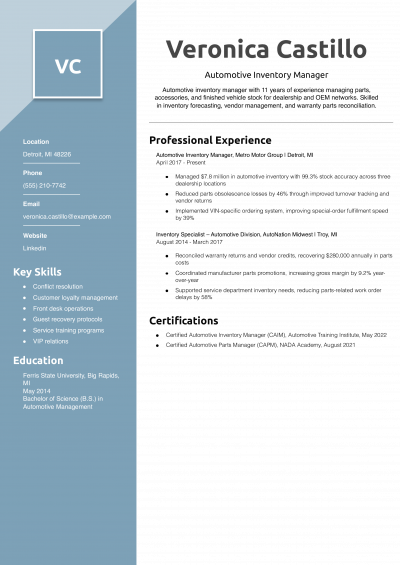
Inventory Manager Resume Examples
Add one line a generic profile lookup cannot reveal: the ERP or WMS you configure yourself, a Six Sigma Green Belt with a closed shrinkage project, or multi-site control across a named geography. Supply chain…
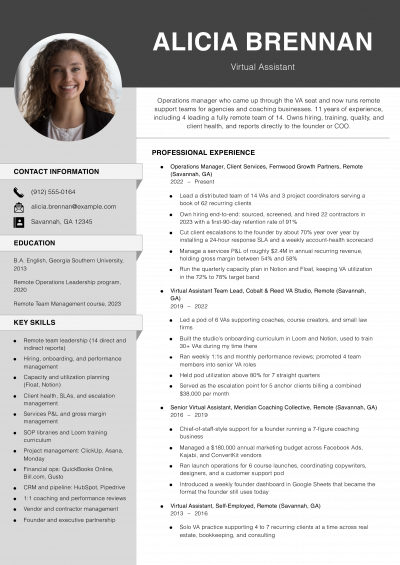
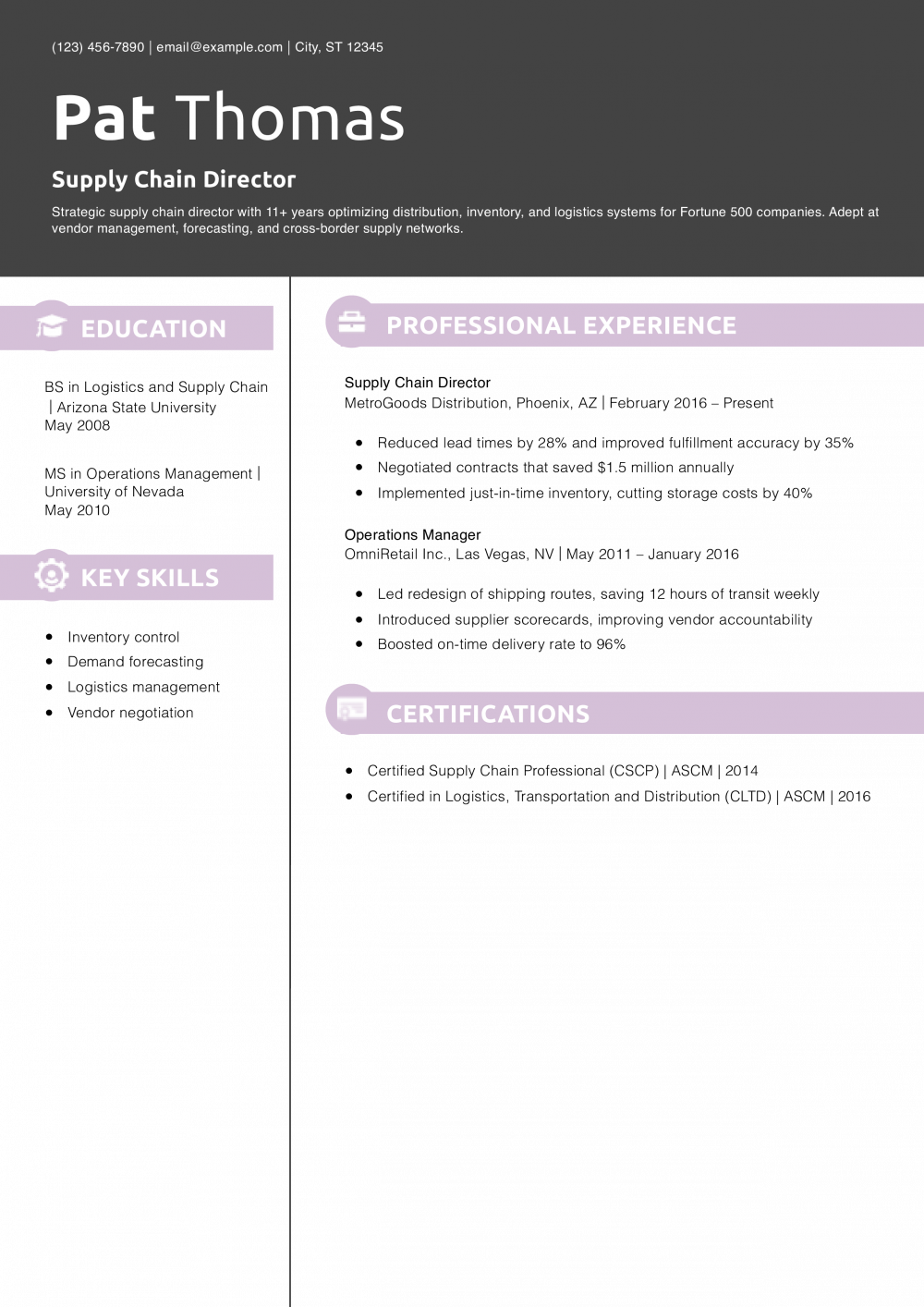
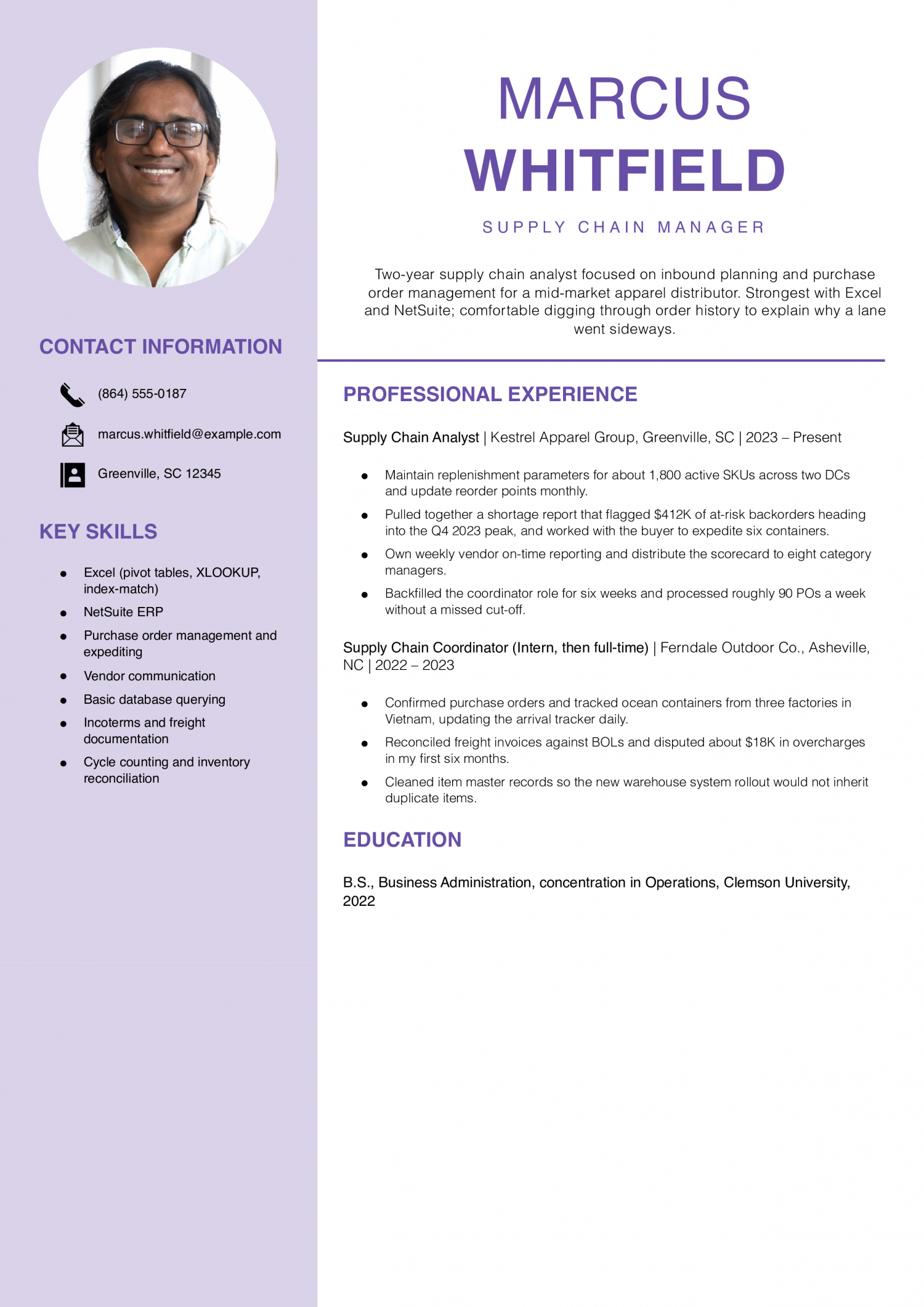
At the analyst or coordinator stage, you show you can own daily planning and vendor follow-up on your own. This resume needs clean numbers on fill rate, cycle time and cost savings you moved.
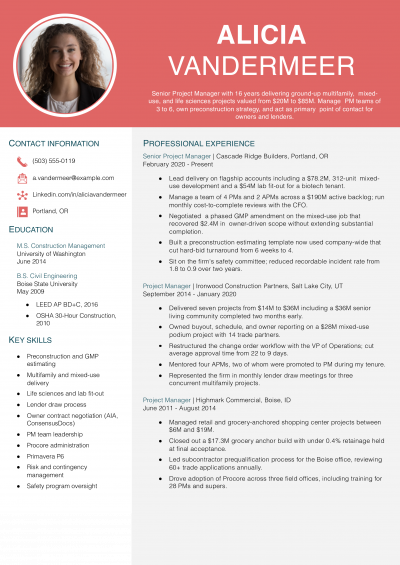
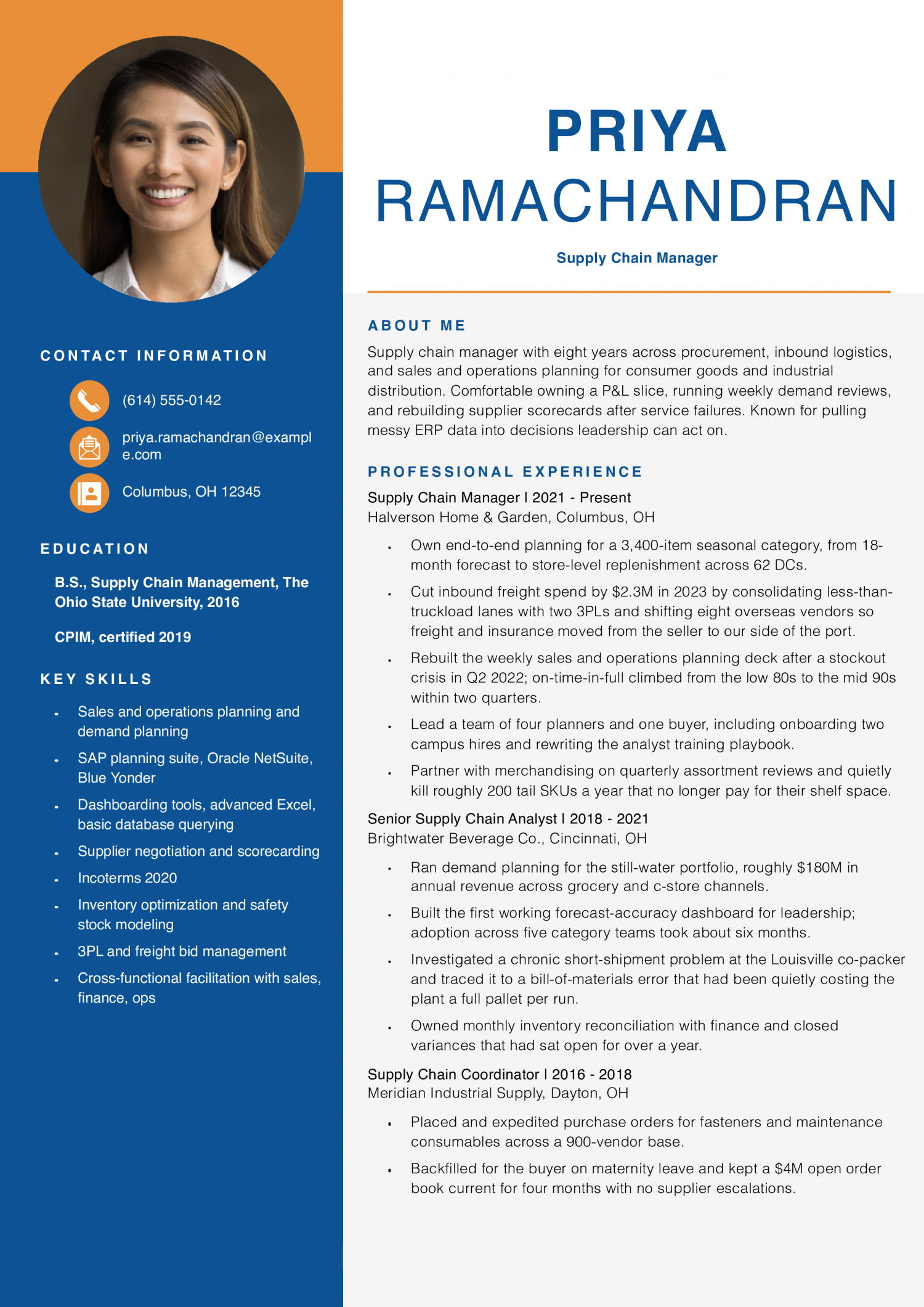
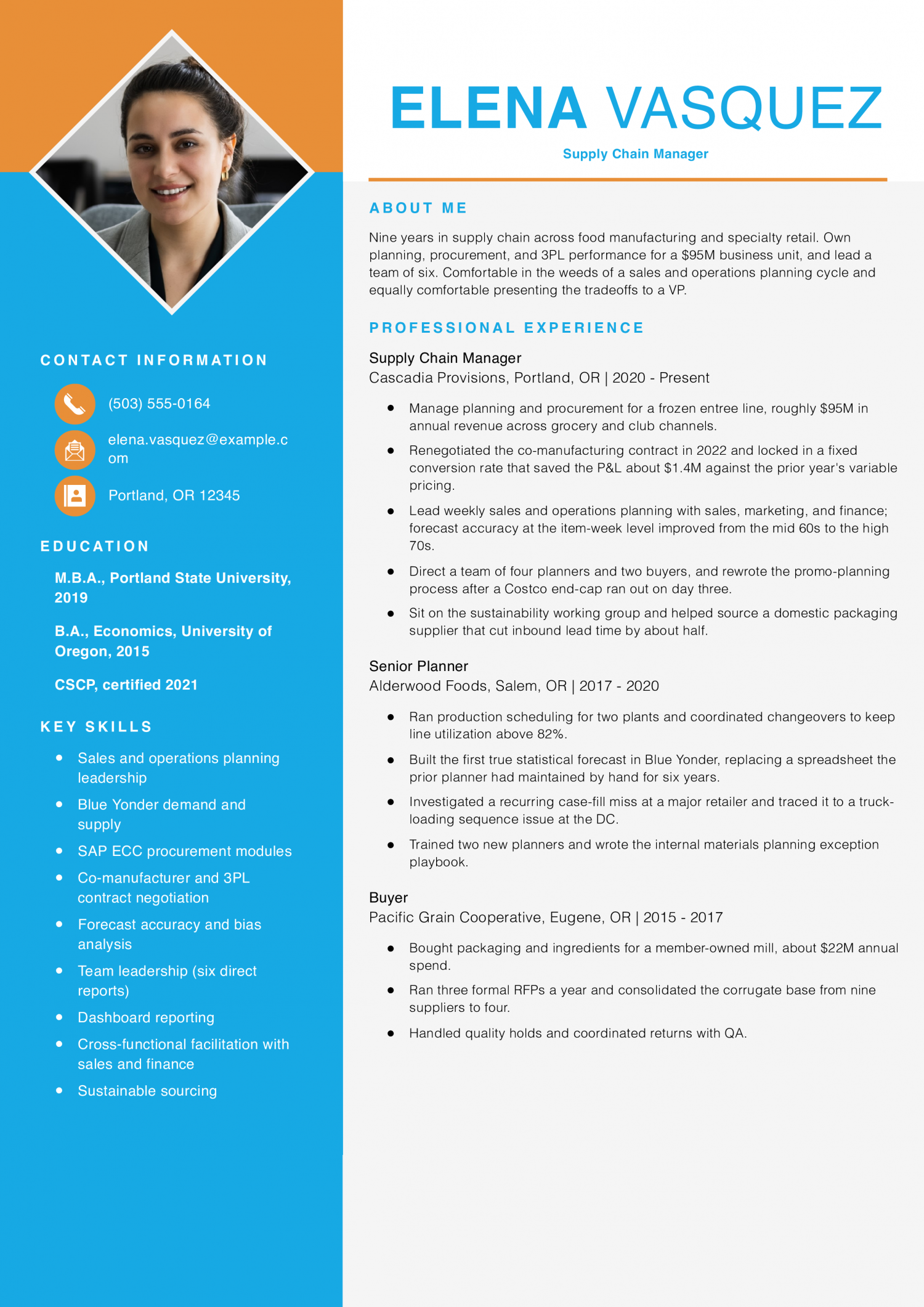
As a Supply Chain Manager, you own a plant network or regional flow and answer for its cost and service. This resume has to show budget scope, team size and named projects where you cut lead time.
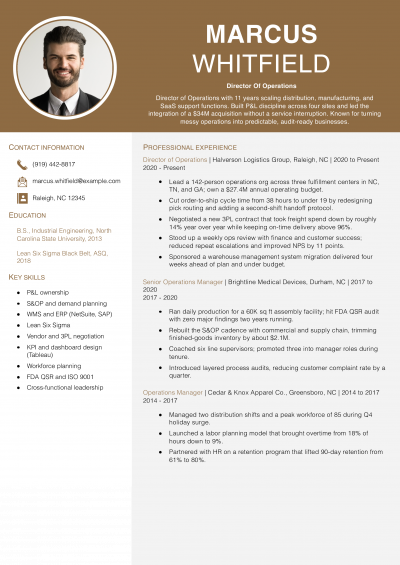
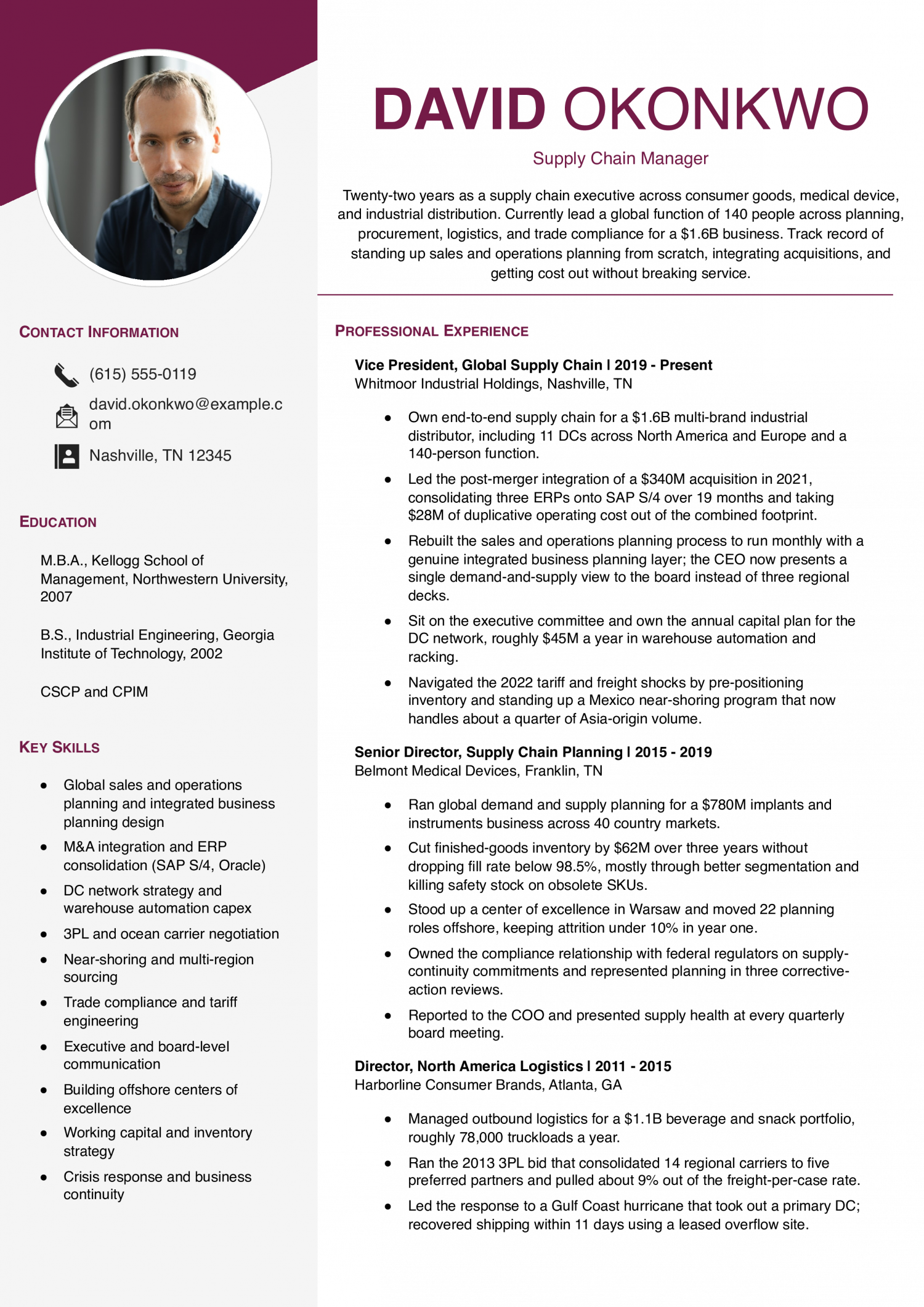
At the director or VP level, you report to COOs and shape sourcing and S&OP for the whole company. This resume needs cost figures, headcount under you and board-facing wins on working capital or margin.
Rachel Lindqvist
Minneapolis, MN | (612) 555-0173 | [email protected] | linkedin.com/in/rachellindqvist
Supply chain manager with eleven years across medical distribution, home goods, and third-party logistics. Owned planning and procurement functions from $40M to $310M in scope, led teams of up to nine, and rebuilt S&OP cycles at two different employers. Strongest at translating messy operational data into decisions a leadership team can act on within a quarter.
Supply Chain Manager
Northlake Home Goods | Minneapolis, MN | 2021-Present
Senior Supply Chain Analyst
Prairie Medical Distribution | St. Paul, MN | 2018-2021
Supply Chain Analyst
Copper Ridge Logistics | Duluth, MN | 2016-2018
Buyer
Lakeshore Building Products | Rochester, MN | 2014-2016
Your profile should state the scope of the network you run, at the top of page one. Name the number of years you have managed supply chains, and the industry setting you work in. Common settings include manufacturing, retail distribution, e-commerce fulfillment, third-party logistics, and pharma.
Say how many plants or distribution centers sit under you, and where they are. State the annual spend or revenue tied to your network, in dollars. VPs of supply chain and chief operating officers read this block first to route your resume.
A profile that opens with generic phrases like results-focused leader tends to get skipped. A profile that names spend and sites reads as a real operator.
Supply chain work is heavy with numbers, and bullets without a number tend to read as duties. Most strong resumes name two or three metrics per role, and vary them across bullets. Cost bullets should name annual spend managed and dollars or percent of savings delivered.
Service bullets should name on-time-in-full rate, fill rate, or perfect order rate, with the baseline you moved from. Inventory bullets should name days of supply, turns, or write-off dollars avoided. Project bullets should name scope, timeline, and dollar impact on landed cost.
Round when you must, and tie the number to a year or a scope. Recruiters scan for these figures first, and bullets that lead with them tend to advance further.
Sort your bullets so the resume reads as four blocks of work, not one long list. Planning and forecasting covers S&OP, demand planning, and inventory policy setting. Sourcing and supplier management covers RFPs, contract negotiation, supplier scorecards, and dual-sourcing plans.
Logistics and distribution covers carrier bids, warehouse operations, network design, and freight cost control. Systems and process covers ERP work in SAP or Oracle, warehouse system rollouts, and continuous improvement projects. Put two to four bullets in each category under each role, so the reader sees range.
If you own only part of the network, say so plainly rather than stretching the scope. Hiring managers respect a clear ownership line.
Put a short credentials and tools block on page one, under the profile. List any current certifications with the issuing body, such as Certified Supply Chain Professional from ASCM, Certified Professional in Supply Management from ISM, or Project Management Professional from PMI. Certification rules and value vary by employer and industry, so include what applies to your track.
Name the ERP and planning systems you have used in production, such as SAP, Oracle, Kinaxis, o9, or Blue Yonder. Add the analysis tools you work in daily, such as Excel, Power BI, or Tableau. VPs of supply chain and chief operating officers screen for system fit before they read bullets.
A page-one block saves them the search, and keeps your work history focused on scope and outcomes.
At the manager level, some content earns its space and some drags the resume down. Cut objective statements, and cut soft-skill lines like strong communicator or team player. Cut roles older than 15 years, unless they carry a name or scope the reader will recognize.
Cut coursework and graduation years from the education block. Cut duty-only bullets that name a task without a number, a scope, or a result. Trim tool lists to systems you have used in the last five years.
Keep the resume to two pages, and give page one to your current and most recent role. VPs of supply chain and chief operating officers spend under a minute on the first pass, so protect that page one real estate.
The Supply Chain Manager resumes that get callbacks share a specific skill mix. Check these lists against the posting you are chasing. VPs of supply chain and chief operating officers scan for these patterns first, not generic leadership platitudes.
Hard skills carry the most weight on the first scan. Readers want proof you can run a planning cycle and cut landed cost. Soft skills like cross-functional leadership only land once the hard skills are on the page.
Pull the five or six items from each table that match your target posting word for word. Put hard skills in a dedicated block near the top of page one. Weave soft skills into bullets as evidence, with the outcome and the number attached.
| Soft Skills | AI-estimated % |
|---|---|
| Cross-functional collaboration | 69% |
| Demand forecasting judgment | 53% |
| Vendor negotiation | 49% |
| Operational problem-solving | 35% |
| AI-estimated % | 33% |
The hard-skills table below rounds out the picture.
| Hard Skills | Stakeholder communication |
|---|---|
| Inventory optimization | 75% |
| Supply chain planning | 67% |
| Transportation route selection | 42% |
| Warehouse operations management | 40% |
| Supply chain KPI development | 30% |
Skill names and rankings come from an AI model grounded in U.S. Department of Labor occupation data for supply chain managers, not from a count of supply chain managers’ resumes built on ResumeTemplates.com.
The items below are what separate a supply chain manager resume from one that gets put back in the pile.
VPs of supply chain and chief operating officers scan for proof of specific work. The terms below map to real parts of the job. Procurement covers how you buy and score suppliers. Demand and inventory covers forecasts, safety stock and turns. Logistics covers freight, carriers and inbound flow. S&OP covers the monthly plan that ties sales to supply. Systems and analytics covers the tools you run the numbers in. Use the terms your last employer used on the shop floor. Mirror the posting when the wording matches your actual work. Skip a term you cannot defend in an interview. Add your CSCP, CPSM or PMP where it fits the role.
| Niche | Keywords ATS scans for |
|---|---|
| Strategic Sourcing | supplier scorecards, bid management, contract negotiation |
| Demand and Inventory | demand forecasting, safety stock, inventory turns |
| Logistics and Freight | 3PL management, carrier bids, inbound routing |
| S&OP Planning | S&OP cadence, capacity planning, production scheduling |
| Systems and Analytics | SAP ERP, Oracle SCM, Tableau dashboards |
Supply chain teams are split on AI right now. Some employers want demand forecasts and supplier scorecards run through machine learning tools. Others distrust the outputs and keep planners on spreadsheets and human review. Name the tools you actually use in your planning cycle. Describe the workflow with honest scope. Say who reviews the model output before a purchase order goes out. Do not claim you run AI forecasting if your real work is checking a vendor system and adjusting the numbers by hand. VPs of supply chain and chief operating officers want to see judgment, not a tools dump.
Planning systems now output baseline forecasts, and your job is judging where the model misses seasonality or promotions.
Risk platforms scan news and financial signals across your supplier base, and you triage which alerts warrant a call.
Solvers recommend reorder points and safety stock by item, and you sanity check the assumptions against real lead times.
Carrier systems suggest lanes and consolidation, and you own the tradeoff between cost, transit time, and service.
Most supply chain roles do not require a license to sit in the seat. So the credentials below are not a legal minimum. They are a signal. They tell VPs of supply chain and chief operating officers which parts of the flow you have studied in depth. They also hint at the tier of role you are ready to run. One name points to end to end planning. Another points to sourcing and supplier work. A third points to program and project rigor across plants. List each item on its own line. Give the full name, the issuing body, and the month and year you earned or renewed it. Keep the newest or most senior credential at the top of the group.
The Bureau of Labor Statistics does not publish a wage code for Supply Chain Manager specifically. The numbers below are a proxy: the closest published match is Transportation, Storage, and Distribution Managers (SOC 11-3071), so use them as an estimate for this role, not an exact figure.
Supply Chain Manager sits at moderate national employment in the BLS wage file, which means the market is neither crowded nor thin. The spread from tenth to ninetieth percentile is wide for the field. The top of the band earns close to double the median, and the floor sits well under it.
That shape rewards people who can show scope in dollars moved, nodes managed, or SKUs owned. To place above the median, lead the resume with the network you have run end to end and the ERP you have configured. Save the certifications and coursework for a short block below your work history, not the top of page one.
| # | State | Median Annual |
|---|---|---|
| 1 | Delaware | $145,000 |
| 2 | Washington | $136,500 |
| 3 | Colorado | $132,610 |
| 4 | District of Columbia | $132,180 |
| 5 | New Jersey | $130,610 |
| 6 | New Hampshire | $129,470 |
| 7 | New York | $127,180 |
| 8 | Massachusetts | $123,830 |
| 9 | California | $123,780 |
| 10 | Georgia | $123,330 |
| # | State | Workers | Median |
|---|---|---|---|
| 1 | California | 30,540 | $123,780 |
| 2 | Texas | 28,710 | $100,700 |
| 3 | Illinois | 11,030 | $120,250 |
| 4 | Ohio | 9,480 | $101,550 |
| 5 | New Jersey | 9,120 | $130,610 |
Resume Templates offers HR approved resume templates to help you create a professional resume in minutes. Choose from several template options and even pre-populate a resume from your profile.
Yes, and the resume proof is that job titles keep widening across planning, procurement, logistics, and operations.
Show that range on the page by naming two or three functions you have owned end to end. VPs of supply chain and chief operating officers read that breadth as readiness for a network role.
Use reverse chronological order with a short profile, then work history, credentials, education, and skills.
That order lets a reader see your last network scope inside 10 seconds of scanning. A functional format hides the plants, lanes, and spend levels that decide the interview.
Write the degree name in full, then the major, the school, and the graduation year on one line.
Add a concentration, capstone, or case competition only if it maps to the job posting. Drop class rank and coursework once you have five years of work history behind you.
Mirror the exact nouns in the posting, such as sales and operations planning, demand planning, procurement, and 3PL management.
Add the systems by name, meaning SAP, Oracle, Kinaxis, or Blue Yonder, wherever you actually used them. Do not stuff terms you cannot defend in the interview, since VPs of supply chain and chief operating officers test them.
Every bullet should carry a spend figure, a service metric, or an inventory result the reader can price.
Write the baseline, the action, and the outcome, such as cutting freight cost per unit by 12 percent on a $40M lane. Round to whole percentages and dollars, since false precision reads as invented.
One page works through your first manager role, and two pages fit once you have led multi-site or multi-region networks.
Do not stretch a thin history to fill page two, because empty white space signals a shallow scope. Cut anything older than 15 years unless it names a plant or system still in use.
The director version leads with network scope, meaning number of sites, total spend under management, and headcount reporting in.
Manager bullets stay close to the plant floor or lane level, where the wins are measured. Move from one to the other by rewriting the profile first, then rewording the top two roles.
For a supply chain manager, an ATS-friendly template is the safest pick, because it puts your certifications and experience where a hiring manager scans first. A basic template is a solid alternative. Whichever you choose, keep the formatting clean and easy to parse: clear section headings, a standard font, and no graphics a parser can choke on.