Assembler Resume Examples
Lead with one line that a shift lead cannot pull from a generic applicant search. Name the assembly type you run, not the label “assembler.” Options that read as specific: surface mount circuit board work…
Every resume example is written and reviewed by our team of Certified Professional Resume Writers to ensure top-quality content and formatting.
Most production worker roles fill fast, with over 251,000 positions across U.S. plants. A strong resume leads with output you can count.
List units per shift, scrap rate cuts, or machine uptime gains.
Production supervisors and plant managers want proof you follow SOPs and work safely on the line. Name the equipment you run, such as CNC machines or forklifts. The examples below show how to format these details, including credentials like an OSHA 10 card or a CPT from MSSC. To compare layouts before you start, browse our resume templates.
A clear safety credentials block is what gets production worker resumes past the plant manager's first cut; quantified output metrics per shift are what make them readable enough to advance to an interview.
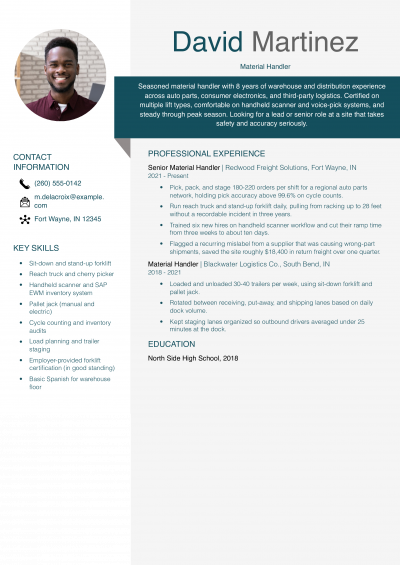
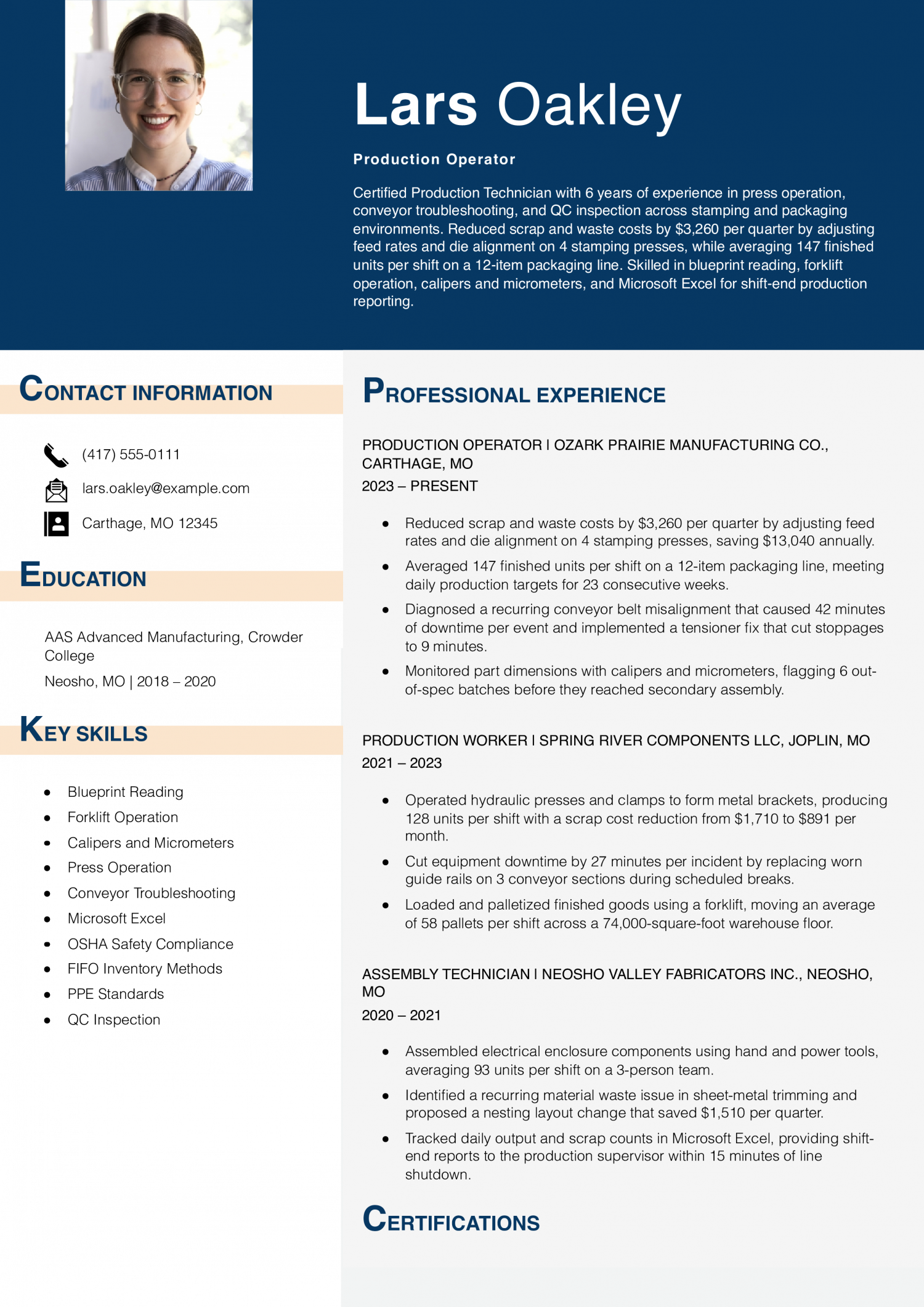
Pick this resume if you are a mid-level production operator with roughly 6 years on the floor and a mix of press, conveyor, and quality control experience. Lead with downtime diagnoses that name minutes saved per incident rather than listing troubleshooting as a general duty.
Catching defective batches before they reach the next stage of the line protects the workers and the product downstream. A quality manager sees someone who stopped a problem early, not someone who checked a box. Say what you caught and which step it never reached.
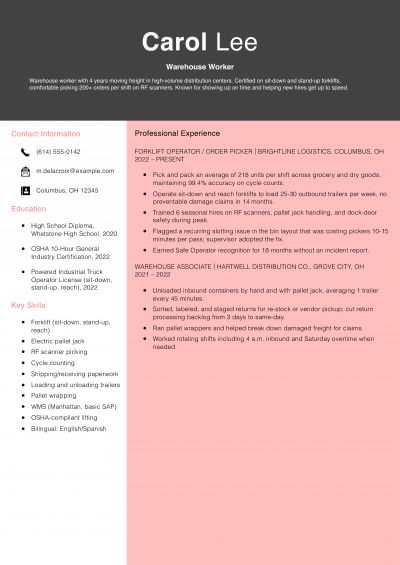
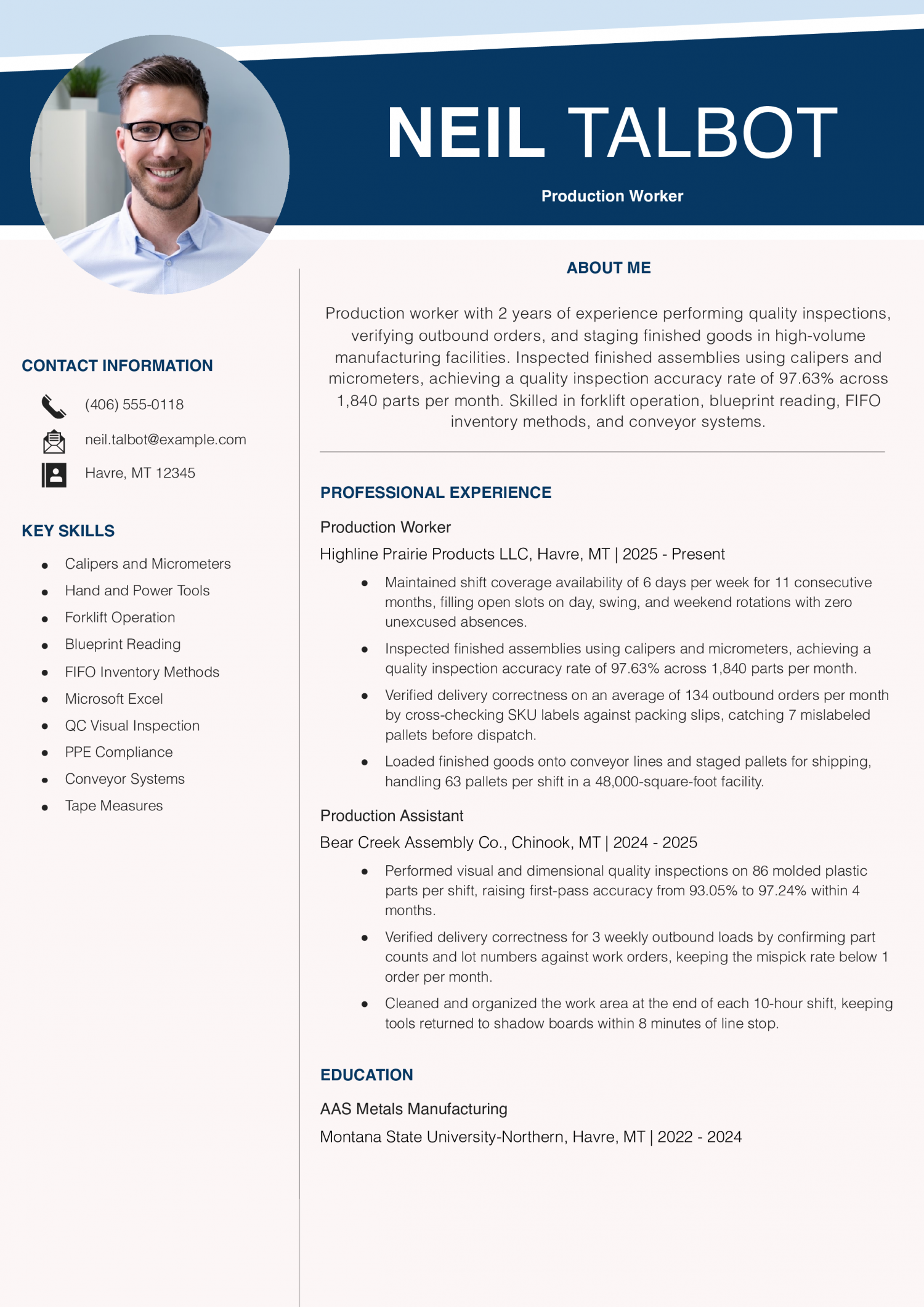
Start with this resume if you are entering production work with limited floor experience and a manufacturing degree. Skip broad duty lists and see how shift-level volume counts replace generic task descriptions.
Shift attendance over a long stretch shows a supervisor you will be there when the rotation needs you. Putting a day count and a month count side by side makes reliability feel real. If you have a strong attendance run, state the days per week and the months it lasted.
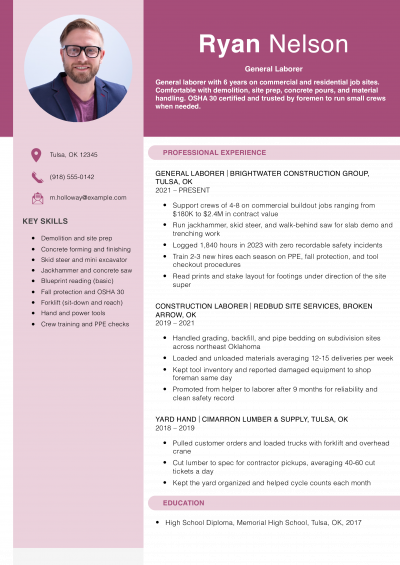
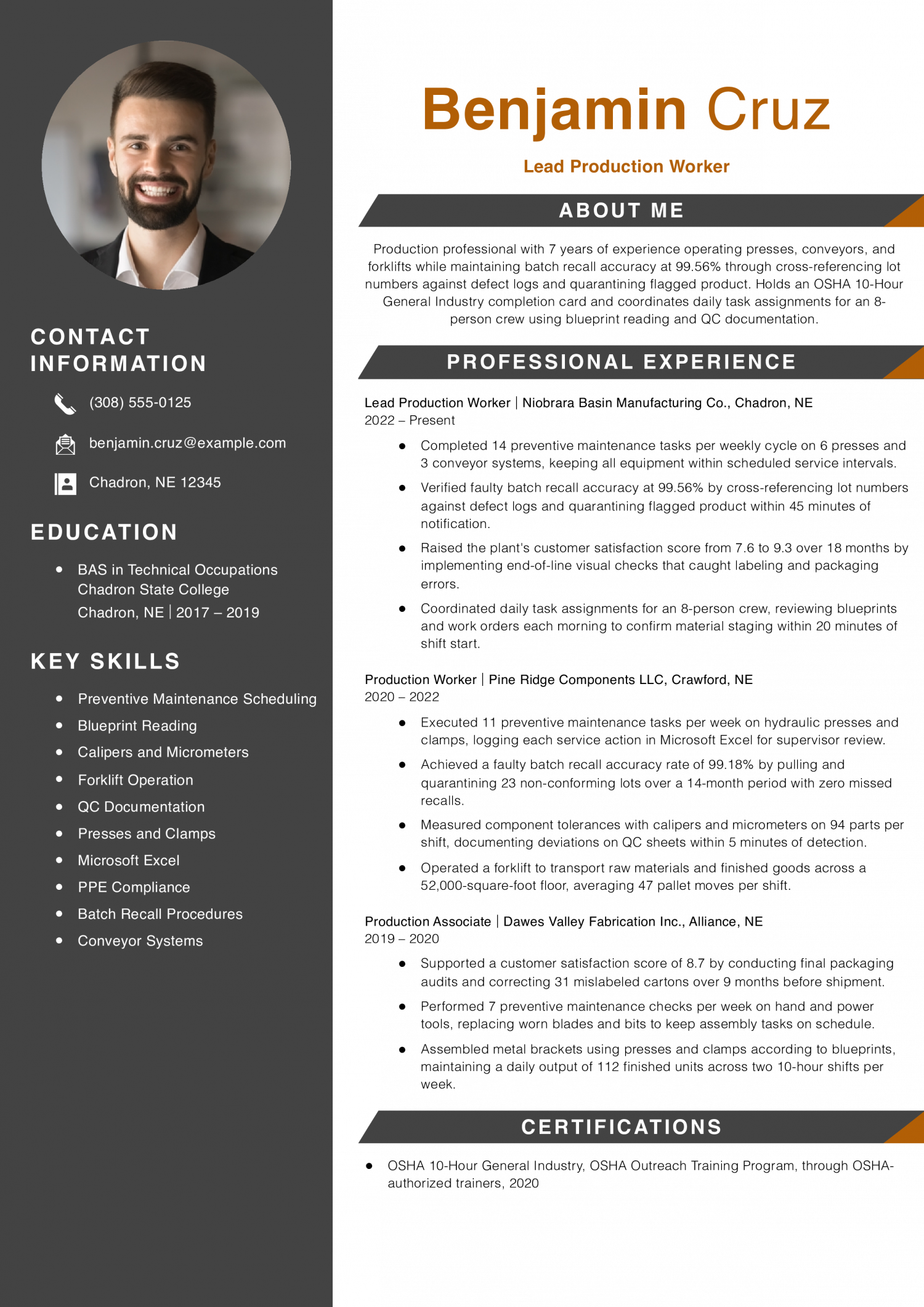
Try this resume if you are a mid-level production worker with lead crew responsibilities and a background in quality control. Lead your recall and inspection bullets with the exact accuracy rate and response time window.
Notice how the readiness time sits right after the morning routine. That order lets a production manager see the planning step and its result in one read. When you describe crew coordination, put the prep action first and the time to readiness right after it.
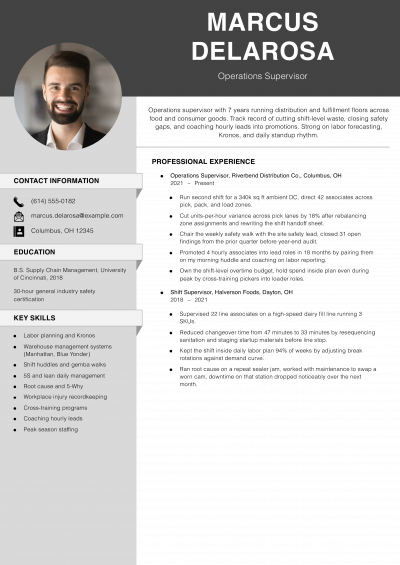
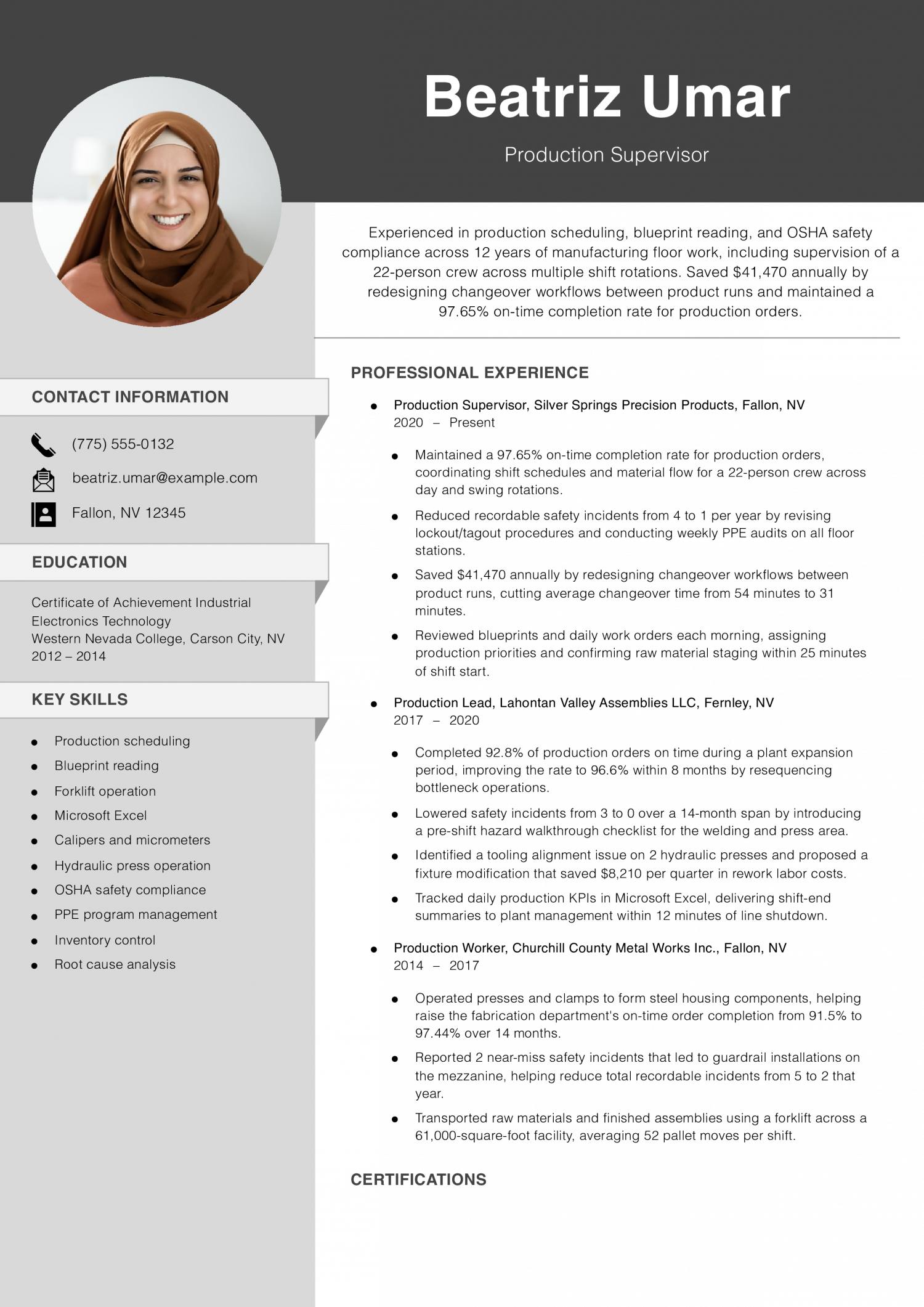
Lean on this resume if you are a senior production supervisor with over a decade of floor and leadership experience seeking your next role. Lead each safety bullet with the old incident count and the new one so the reduction reads as a measured outcome.
Changeover time before and after the fix tells a plant manager exactly how much production time came back. Without both numbers, any improvement claim is a guess. If you shortened a changeover, state the old time and the new time in the same bullet.
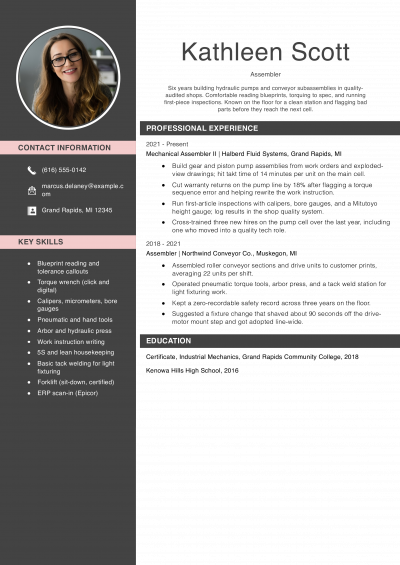
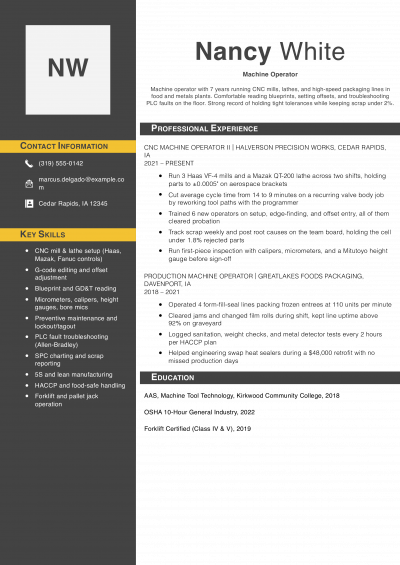
Production team lead with 6 years of manufacturing experience operating hydraulic presses, conveyors, and hand and power tools while training new hires and coordinating crew schedules using Microsoft Excel. Raised team productivity by 26.05% by restructuring task rotations and balancing workloads across a 9-person assembly crew. Trained 13 employees on press operation, forklift handling, and PPE requirements, and documented QC readings with calipers and micrometers.
Lead with the units you produce per shift or per day. Production supervisors and plant managers read that figure before anything else, because it tells them whether your throughput matches their line speed.
After that count, name the product type you ran. Then name the team size you worked in. A strong opener might read: “Production worker averaging 450 assemblies per 8-hour shift on a 12-person bottling line with a 99.2% quality pass rate.” That single line covers speed, scale, and accuracy.
Skip vague phrases like “hardworking team player.” A count of real output accomplishes more than any soft label ever could. Keep it to two lines at most.
Most strong production resumes pair speed with accuracy. Name your hourly or daily output count. Then add your scrap rate or first-pass yield.
These two figures demonstrate to a plant manager that you maintain velocity without sacrificing precision. Downtime matters too. If you helped cut changeover time, state the minutes saved.
If you reduced waste by a percentage, include it. You can also note how many SKUs or product lines you handled.
Batch sizes work well for food or chemical plants. Even a rough volume helps. Write “packed 200 cases per shift” instead of “responsible for packing.” The verb plus a count is always clearer.
Sort your bullets into clear work categories. Assembly and machine operation form one group. Include tasks like feeding raw materials and monitoring gauges.
Quality control is a second group. Cover visual inspections, caliper readings, and lot sampling. Material handling is a third group.
Note palletizing, staging, and forklift moves. Sanitation and safety form a fourth group. Mention line cleandowns, lockout-tagout steps, and PPE compliance.
Grouping helps production supervisors and plant managers scan your resume fast. They can match your demonstrated capabilities to their open station requirements. Avoid listing every duty in one long block.
Four organized clusters are easier to read than fifteen mixed bullets. This format also helps when a recruiter uses keyword filters to sort resumes by role type.
Place your certifications on page one, right below your summary. List your Forklift Operator Certification if your employer trained you under OSHA standard 29 CFR 1910.178(l). Add your OSHA 10-Hour General Industry card if you completed that outreach course.
Note that the OSHA 10 card is not a license but rather a course completion record that verifies your foundational safety knowledge. Employers still train on site-specific hazards. If you hold a Certified Production Technician credential from MSSC, place it here too.
Production supervisors and plant managers often filter resumes by these entries. Burying them on page two risks a quick rejection. Also list any ERP or MES software you have used.
SAP and Oracle are common in large plants.
A high school diploma or GED meets the requirement for most postings. Place it in a short education section near the bottom. If you finished any vocational courses, name the program and school.
Include the year of completion. Many plants run internal training on topics like GMP or SPC. List those in a separate training section below education.
Each entry needs the topic and the year. Skip the hour count unless the posting specifically requests that documentation. If you are new to production work, add a line about related experience.
Warehouse roles, food service, or retail stocking all build transferable skills. Name the task overlap, such as inventory counts or safety routines. Keep this section to four lines or fewer.
Production supervisors and plant managers look for both machine skills and floor habits on your resume.
Hard skills like machine operation and quality inspection prove you can run a line. Soft skills like teamwork and attention to detail show you fit the floor culture. Both types carry weight in an ATS scan.
Hard skills set the first filter in most tracking systems. Soft skills then shape how a reviewer reads your bullets. You need both tables covered to clear each stage.
Compare each table to your target posting before you write a single bullet. Pull the exact phrasing the posting uses so the ATS flags a match. Then turn every soft skill into a results-backed line on your resume.
Drop any skill you cannot support with a real example from your work history.
| Soft Skills | AI-estimated % |
|---|---|
| Physical stamina | 73% |
| Team coordination | 65% |
| Attention to detail | 48% |
| Shift adaptability | 39% |
| Reliable attendance | 30% |
And here are the top hard skills showing up most often.
| Hard Skills | AI-estimated % |
|---|---|
| Assembly line operation | 68% |
| Quality control inspection | 63% |
| Machine setup and changeover | 45% |
| Production quota fulfillment | 40% |
| Safety protocol compliance | 33% |
Skill names and rankings come from an AI model grounded in U.S. Department of Labor occupation data for production workers, not from a count of production workers’ resumes built on ResumeTemplates.com.
Start with your OSHA credentials and forklift certification.
Safety credentials signal readiness for a production floor. Production supervisors and plant managers screen for them early. List each one in a clear credentials section.
Many plants run second, third, or rotating shifts. Stating your availability removes a common screening question. Place it near the top of your resume.
Tip: Match Your Shift Line to the Posting
A short line below your contact details works well. Name the shifts you can work. Include weekend or overtime willingness if true.
Production supervisors and plant managers often filter by shift first. Being clear here saves time for both sides.
Beyond any site training your plant already gives, the credentials below tell production supervisors and plant managers how safe and skilled you are before your first shift. They signal that you sought out training on your own time. That effort stands out in a stack of resumes.
Many plants prefer these but do not require them. Others may list one or more in the job posting. Check each posting to see what applies.
List the issuing body and your completion or expiration date for each credential you hold.
About These Numbers
The Bureau of Labor Statistics does not publish a wage code for Production Worker specifically. The numbers below are a proxy: the closest published match is Production Workers, All Other (SOC 51-9199), so use them as an estimate for this role, not an exact figure.
For production workers, the entry-tier floor sits well below the median. The top-decile ceiling runs about 53 percent above it. That wide spread tells you shift type, facility size, and geographic region all shape where you land on the pay scale.
Credentials like a Certified Production Technician card or a forklift operator certification often appear in the upper bands. The field employs a large national workforce, so competition for higher-paying posts is real. Lead your resume with the output volumes you handled and the equipment you ran, then name the credential that fits the posting.
| # | State | Median Annual |
|---|---|---|
| 1 | District of Columbia | $109,470 |
| 2 | Indiana | $48,260 |
| 3 | Maryland | $47,640 |
| 4 | New Hampshire | $47,620 |
| 5 | Colorado | $47,200 |
| 6 | Oregon | $47,180 |
| 7 | Washington | $47,060 |
| 8 | Minnesota | $47,020 |
| 9 | Vermont | $46,570 |
| 10 | Maine | $46,470 |
| # | State | Workers | Median |
|---|---|---|---|
| 1 | California | 28,090 | $41,670 |
| 2 | Georgia | 22,440 | $39,900 |
| 3 | Tennessee | 20,150 | $40,130 |
| 4 | North Carolina | 18,350 | $38,790 |
| 5 | Texas | 18,340 | $38,850 |
Resume Templates offers HR approved resume templates to help you create a professional resume in minutes. Choose from several template options and even pre-populate a resume from your profile.
Lead with transferable skills such as equipment operation and physical stamina. Warehouse, construction, or food-service roles involve repetitive tasks and quality checks that map to production work. List those tasks with output numbers so supervisors can gauge your pace.
Name the specific machines, tools, and processes you have operated. Broad labels like 'machine operation' tell a plant manager very little. Include measurable skills such as blueprint reading and caliper measurement.
Safety skills like lockout/tagout and hazard communication also carry weight.
Yes, include it. Temp and contract roles are common in manufacturing, and supervisors expect to see them. List the staffing agency and the facility where you worked as separate lines.
Add the same metrics you would for a permanent role, such as units per shift.
One page covers most production worker roles. If you have more than ten years of experience across several facilities, a second page works. Keep older roles to one or two bullet points so the recent work stays prominent.
Use the job title the employer gave you, then describe duties with action verbs tied to output. Write lines like 'Loaded raw materials for a 12-station bottling line at 400 units per hour.' That format tells a production supervisor both the scale and speed of your work.
A reverse-chronological format works best for most factory roles. Production supervisors want to see your most recent line or machine first. Place a short skills section near the top so applicant tracking systems can scan for keywords.
Yes, list any lean or Six Sigma coursework in your training section with the year completed. Plant managers at facilities that run Kaizen events or 5S programs look for that background. If you led an improvement project, add the result as a bullet under that role.
An ATS-friendly template keeps your certifications and work history under their own headings. A basic template suits production work too.
Production Worker Resume
4/5 stars with 186 reviews

Executive Resume Writer and Career Coach
Andrew Stoner is an executive career coach and resume writer with 17 years of experience as a hiring manager and operations leader at two Fortune 500 Financial Services companies, and as the career services director at two major university business schools.
© 2026 Resumetemplates.com All rights reserved.