Caregiver Resume Examples
An HHA or CNA registry lookup confirms you are certified. It does not show the care you can actually run. Add a single line near your name that names the work an agency cannot verify…
Every resume example is written and reviewed by our team of Certified Professional Resume Writers to ensure top-quality content and formatting.
Most personal care assistant roles are filled through client safety records and hands-on skill checks. Your resume needs to show real ADL support, such as bathing, mobility transfers, and meal prep for special diets. Home care agency supervisors and care coordinators look for documented client counts and care plan follow-through.
List your state-approved aide training and any First Aid or CPR certification you hold. Include specific hours of direct care per shift and the types of conditions you have supported. The examples below show how to format each of these details on your resume. To compare layouts before you start, browse our resume templates.
Verified state training credentials and current First Aid or CPR certification are what get personal care assistant resumes past the compliance screen at home care agencies; clear client-outcome details are what make them readable enough to advance.
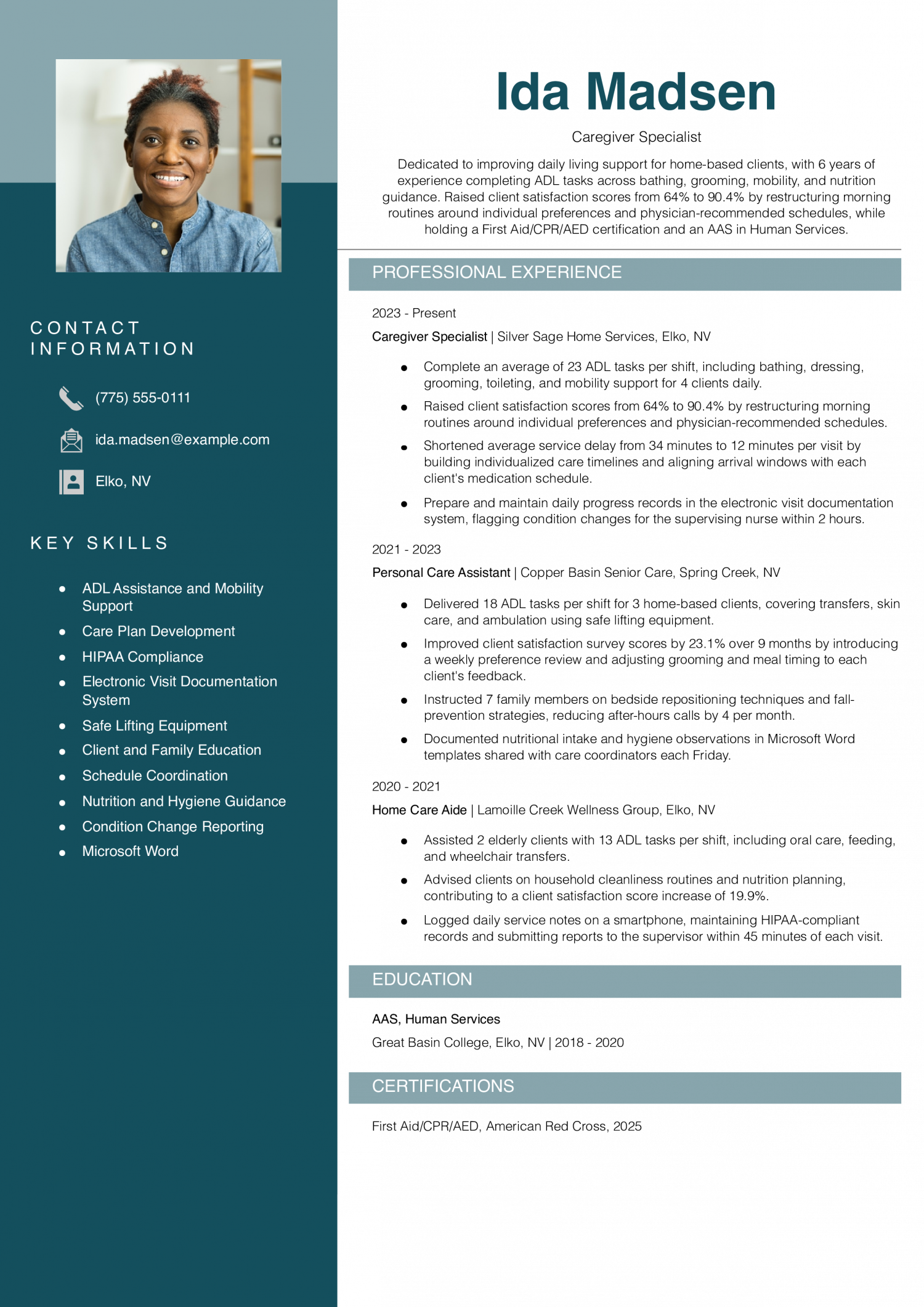
Consider this resume if you are a mid-level caregiver specialist with about six years of ADL-focused home care and rising satisfaction metrics to present. Add a service-delay reduction that names exact before-and-after minutes alongside the scheduling fix that caused it.
Many personal care assistant resumes mention teaching families without showing what that effort actually changed. This resume connects the two with “Instructed 7 family members on bedside repositioning techniques and fall-prevention strategies, reducing after-hours calls by 4 per month.” That line pairs a headcount of people trained with a measurable drop in calls, so a hiring manager can see the workload relief your teaching created. If you train families or caregivers, count the people you taught and link that number to a specific result like fewer emergency contacts or fewer incident reports.
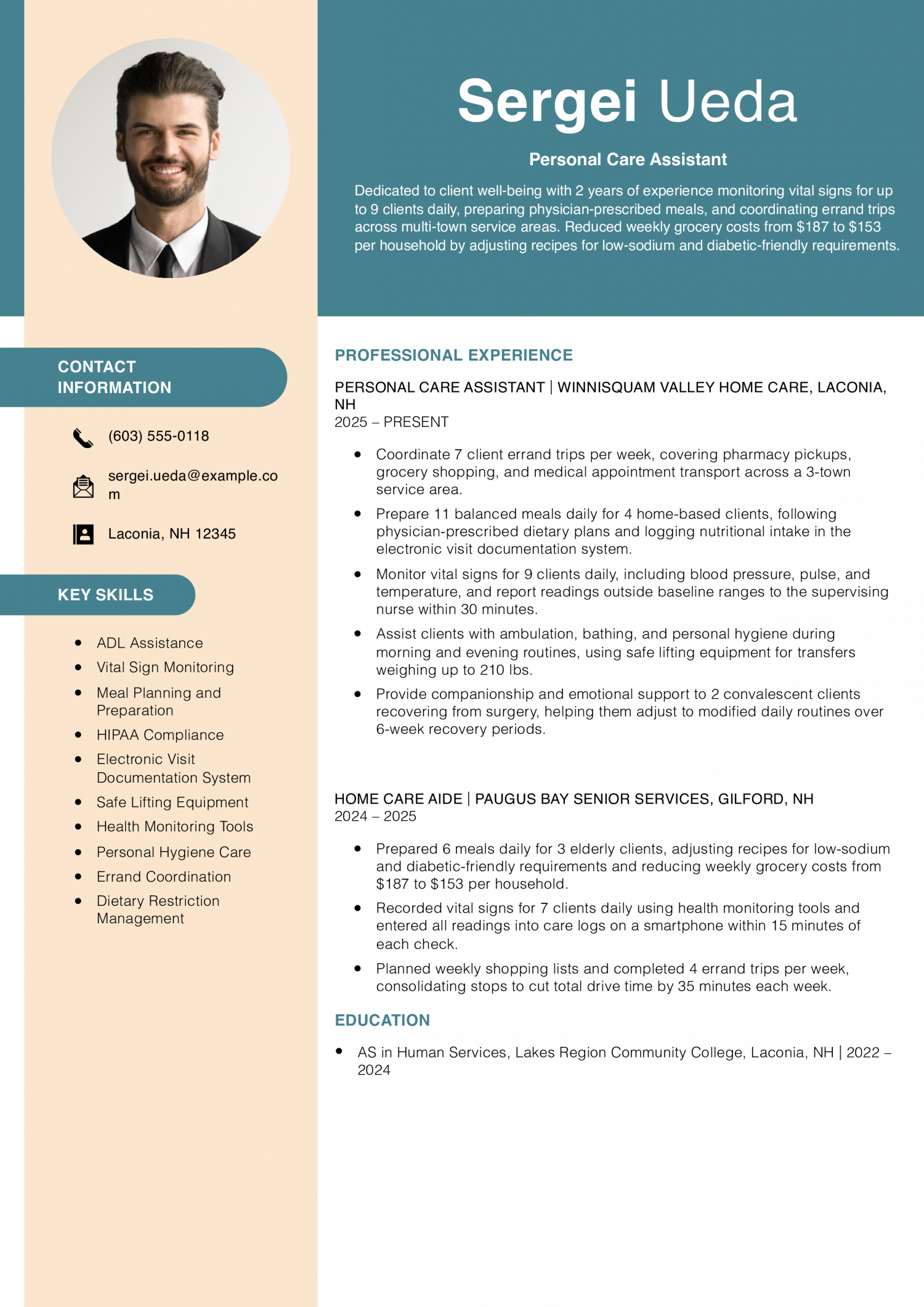
Start with this resume if you are an entry-level personal care assistant building your first year or two of home care experience. Connect each daily task to a specific client count so readers see the scope of your caseload at a glance.
Many personal care assistant resumes list errand duties without showing how they managed the logistics behind them. This resume adds route-level detail with “consolidating stops to cut total drive time by 35 minutes each week,” turning a routine chore into a measurable efficiency gain. When you describe errands or travel on your own resume, name the specific time or distance you saved by organizing your route, so the reader sees planning skill rather than a generic task.
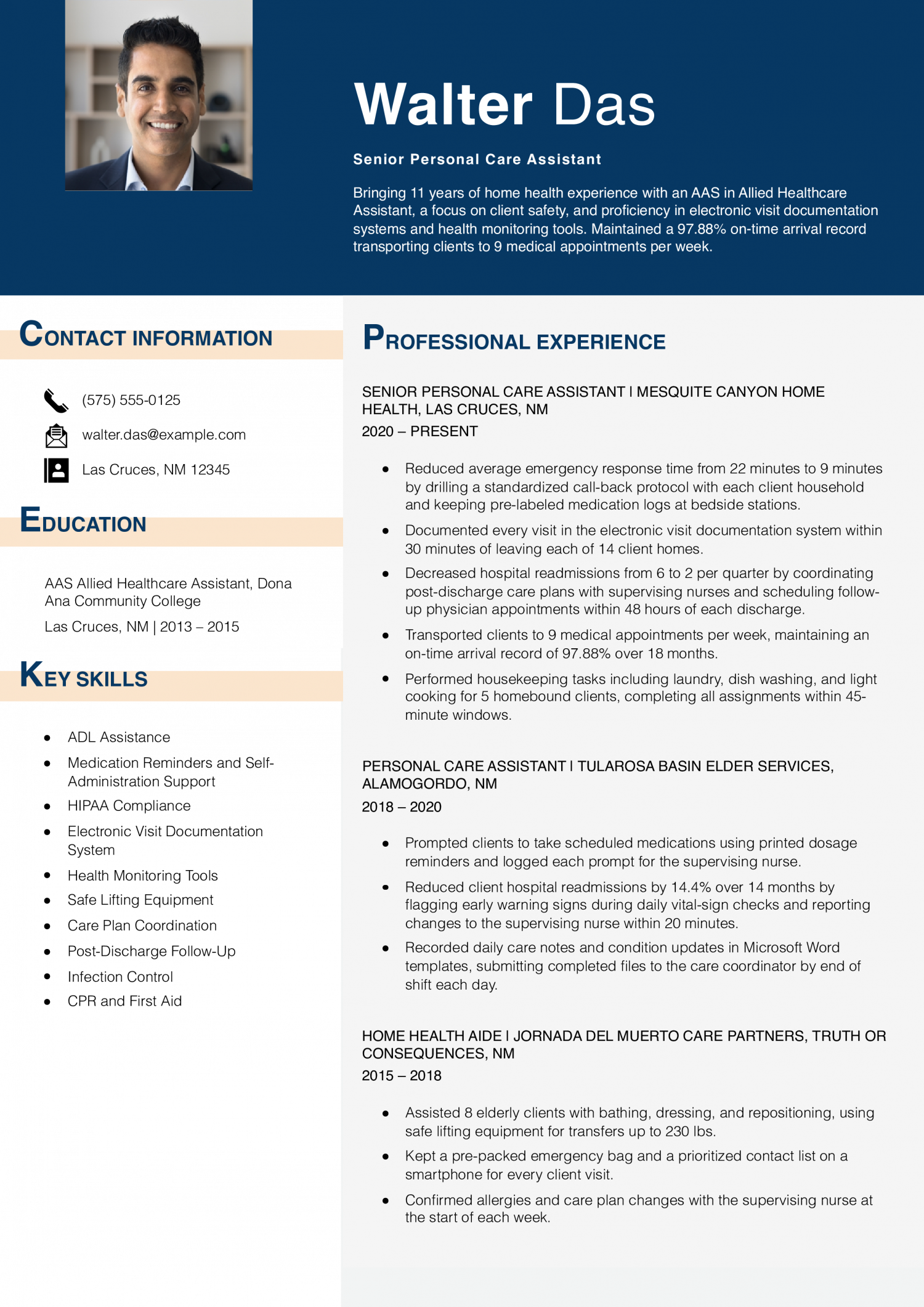
Try this resume if you are a senior personal care assistant with about a decade of direct client care and a record of reducing errors and readmissions. Move your emergency response improvements forward by pairing protocol changes with before-and-after minute counts the way this layout does.
Many personal care assistant resumes list housekeeping duties as a simple checklist without any sense of pace or workload. This resume adds a time constraint with “completing all assignments within 45-minute windows,” which tells the reader each visit had a defined pace and the work stayed on schedule. On your own resume, attach a time window or per-visit duration to routine tasks so hiring managers can see you manage a structured workload, not an open-ended to-do list.
Dedicated to raising client independence through structured coaching and adaptive care plans, having improved daily living task completion by 29.2% at Piedmont Hollow Home Services through graduated self-care checklists and weekly milestone reviews. Brings 6 years of experience managing rotating caseloads of up to 14 home-based clients, developing personalized care plans, and training new staff on HIPAA-compliant documentation and safe lifting equipment use.
Home care agency supervisors and care coordinators can verify your training record in minutes, but they cannot see the personal trait that sets you apart from other applicants. Lead your resume with one line that names your edge. That edge might be fluency in a second language spoken by local clients.
It could be documented experience with dementia care protocols or mobility transfers. A specialty in pediatric personal care also stands out. Place this line right below your name and contact details.
Keep it to one sentence that is specific to the population you serve best. This opener gives a reviewer a reason to keep reading and frames every bullet that follows around your strongest skill.
Skip vague labels like “compassionate caregiver” or “hard worker.” Name the exact service, client type, or language you bring.
Personal care work is hands-on, so quantifiable performance metrics are rare. Still, numbers help a reader picture your caseload. Note how many clients you served per week.
State the hours you covered in a typical shift. Mention the size of care teams you worked alongside. A strong bullet might read: “Assisted four clients daily with bathing, grooming, and meal prep.” Another could note you tracked vital signs for six home-bound adults.
You can also list the number of months you supported a single long-term client. Bullets without a number tend to read as duty lists. Even rough counts give your work real shape.
Pair each number with the task it describes.
Break your experience into clear groups so reviewers can scan fast. Start with daily living support: bathing, dressing, and toileting. Follow with mobility and transfer tasks.
A second group covers health monitoring, such as checking blood pressure and tracking medication schedules. A third group holds household duties like light cleaning and meal planning. If you helped with errands or transport, create a fourth group for community support.
Use short bullet points under each group heading. This organizational structure shows range without forcing a reader to hunt through dense paragraphs. It also mirrors the way formal care plans are typically written, which signals to supervisors that you understand the clinical workflow and documentation standards.
Keep each bullet to one line when possible.
Create a credentials block on page one, right below your summary line. List your State Personal Care Aide Training status and the state that issued it. If you completed Home Health Aide Training and Competency Evaluation, add it next.
Include your First Aid/CPR/AED certification from the American Red Cross. Home care agency supervisors and care coordinators frequently screen for these credentials before reviewing your detailed work history. Putting them near the top saves that reviewer a search.
Do not bury training in a section at the bottom of page two. If a posting names a specific state requirement, match that language exactly. Requirements vary by state, so check each posting.
Bold the credential names so they stand out during a quick scan.
A high school diploma or GED meets the education bar for most postings. List yours near the bottom of the resume with the year you finished. If you took college courses in health science or gerontology, add those too.
Community college certificates in nursing assistance or caregiving also belong here. Include any clinical hours or supervised practicum placements tied to your formal training program. Volunteer work with elderly or disabled populations can fill gaps in paid experience.
Name the organization, your role, and the dates you served. This closing section rounds out your background without repeating earlier bullets. Keep it short: three to five lines at most.
Every entry should connect back to client care in some clear way.
ATS filters catch more Personal Care Assistant resumes than ever in 2026. Match the lists below against the posting you want. ADL assistance terms clear the first cut.
Empathy signals decide whether the resume advances. Home care agency supervisors and care coordinators weigh hard skills to confirm you can do the daily tasks. They then look for soft skills like patience in your work bullets.
Both types need to appear on the page. Scan each table and circle the terms that show up in your target posting. Then weave soft skills into your bullet results as proof, not as a stand-alone list.
Treat the tables as a checklist, not a copy source.
| Soft Skills | AI-estimated % |
|---|---|
| Compassionate client care | 66% |
| Patience under stress | 65% |
| Family communication | 45% |
| Reliability and punctuality | 36% |
| Adaptability to needs | 35% |
And here are the top hard skills showing up most often.
| Hard Skills | AI-estimated % |
|---|---|
| Personal hygiene assistance | 70% |
| Medication reminders | 53% |
| Vital signs monitoring | 47% |
| Mobility and transfer support | 37% |
| Meal preparation and feeding | 30% |
Skill names and rankings come from an AI model grounded in U.S. Department of Labor occupation data for personal care assistants, not from a count of personal care assistants’ resumes built on ResumeTemplates.com.
These are the must-haves hiring teams look for when scanning a personal care assistant resume.
Personal care assistants handle protected health information daily. You may log medications, track vitals, or update care plans. HIPAA compliance matters in every home visit.
Home care agency supervisors look for HIPAA training on your resume. Note the year you completed your most recent course. Mention your practice of securing paper and digital records.
Most states require a criminal background check before hire. Many agencies also run abuse registry searches. These checks protect clients who receive care at home.
Home care agency supervisors often verify results before your first shift. A clear record speeds the onboarding timeline. Some states allow conditional hire pending final results.
Home care schedules often include evenings and weekends. Many clients need overnight or split-shift coverage. Stating your availability saves time for care coordinators.
Put Your Schedule Availability Near the Top of the Page
Add a short availability line near your contact details. Specify days, nights, weekends, or live-in readiness. Flexible hours can set you apart from other applicants.
State aide training keeps you eligible for most roles. The credentials below show home care agency supervisors and care coordinators that you can handle core tasks safely. They scan for these lines when matching you with clients who need bathing, transfers, or medication reminders.
Agencies that serve Medicare patients often set stricter credential requirements than private-pay employers do. List each credential on its own line with the issuing body and the date you earned it. Add the expiration date if one applies.
Keep your cards current so gaps never stall an offer. Renewing early gives you a buffer if classes fill up. Check your state’s renewal window, because some require annual updates while others allow two-year cycles.
Training rules vary by state for this role. List each credential with its status and expiration date. Care coordinators scan for current, valid training first.
About These Numbers
The Bureau of Labor Statistics does not publish a wage code for Personal Care Assistant specifically. The numbers below are a proxy: the closest published match is Home Health and Personal Care Aides (SOC 31-1120), so use them as an estimate for this role, not an exact figure.
For Personal Care Assistants, the entry-tier floor sits about 24 percent below the median. The top-decile ceiling sits only about 26 percent above it. That narrow spread tells you the pay range in this field is tighter than in most healthcare roles.
Note that BLS groups Personal Care Assistants with all Home Health and Personal Care Aides. The figures cover that broader category. Geographic cost of living and the care setting you work in shape where you fall within the band.
On your resume, lead with your state-approved training, the number of clients you have served, and the types of daily living tasks you perform.
| # | State | Median Annual |
|---|---|---|
| 1 | Washington | $47,730 |
| 2 | Oregon | $44,410 |
| 3 | Rhode Island | $43,680 |
| 4 | District of Columbia | $42,700 |
| 5 | Vermont | $41,600 |
| 6 | Massachusetts | $40,910 |
| 7 | Alaska | $39,740 |
| 8 | New York | $39,620 |
| 9 | North Dakota | $39,440 |
| 10 | Connecticut | $38,990 |
| # | State | Workers | Median |
|---|---|---|---|
| 1 | California | 970,150 | $34,320 |
| 2 | New York | 663,140 | $39,620 |
| 3 | Texas | 329,590 | $24,230 |
| 4 | Pennsylvania | 257,370 | $29,420 |
| 5 | Illinois | 134,100 | $38,060 |
Resume Templates offers HR approved resume templates to help you create a professional resume in minutes. Choose from several template options and even pre-populate a resume from your profile.
Start each bullet with a strong action verb like assisted, monitored, or bathed. Pair the verb with a number, such as how many clients you helped each shift. This helps care coordinators match your skills to open roles.
Group your clients by the type of care you gave, such as elder care or pediatric support. Note the conditions you worked with, like Alzheimer's or mobility limits. This tells hiring managers which populations you can serve.
No, you should tailor each version to the setting. A home care resume should stress one-on-one tasks like meal prep and bathing help. A facility care resume should highlight team-based duties and shift reporting instead.
Read the job posting and note the top three duties it names. Put those duties first in your bullet list for each role. Cut any bullets that do not tie back to the posting so your resume stays focused.
List the gap period and note any informal caregiving you provided for a family member during that time. Home care agency supervisors understand that family caregiving builds real skills in daily living assistance. If you completed any first aid or CPR training during the gap, add it to your credentials section.
Lead with patience, empathy, and clear verbal communication in your skills section. Back each soft skill with a short example from your work, such as calming anxious clients during transfers. This shows hiring managers you can handle the emotional side of care work.
No, leave references off the resume itself and bring a separate reference sheet to the interview. Use that space for care-related skills or client outcomes instead. Home care agency supervisors typically request references after the first screening, not before it.
For a personal care assistant, an ATS-friendly template is the safest pick, because it puts your certifications and experience where a hiring manager scans first. A basic template is a solid alternative. Whichever you choose, keep the formatting clean and easy to parse: clear section headings, a standard font, and no graphics a parser can choke on.
Personal Care Assistant Resume
4/5 stars with 168 reviews

Executive Resume Writer and Career Coach
Andrew Stoner is an executive career coach and resume writer with 17 years of experience as a hiring manager and operations leader at two Fortune 500 Financial Services companies, and as the career services director at two major university business schools.
© 2026 Resumetemplates.com All rights reserved.