Tip !

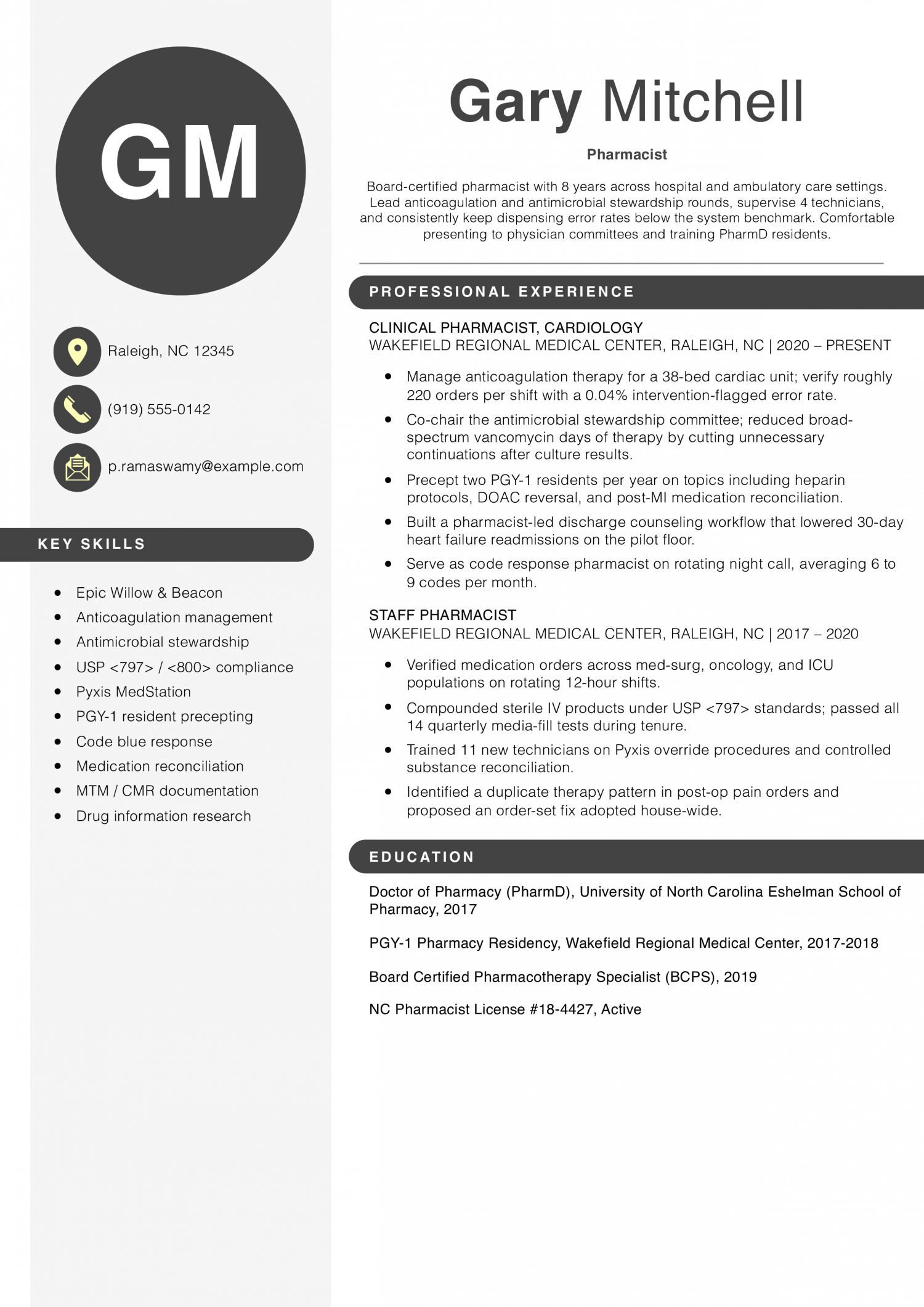
The pharmacist resumes that get scheduled share three things: an active license and DEA registration confirmed in the first six seconds, verified script volume per shift, and BPS or MTM credentials matched to the posted service line.

Andrew Stoner , Executive Resume Writer and Career Coach

Why this resume works

  • Numbers tied to patient safety: Verification volume and error rate together show both throughput and quality, which is what hospital pharmacy directors care about most.
  • Clear growth at one employer: Moving from Staff Pharmacist to Clinical Pharmacist at the same hospital signals trust earned and a steady promotion track.
  • Teaching is called out specifically: Naming PGY-1 precepting and the topics covered tells residency programs and academic medical centers this candidate can train others.

Staff Pharmacist Example

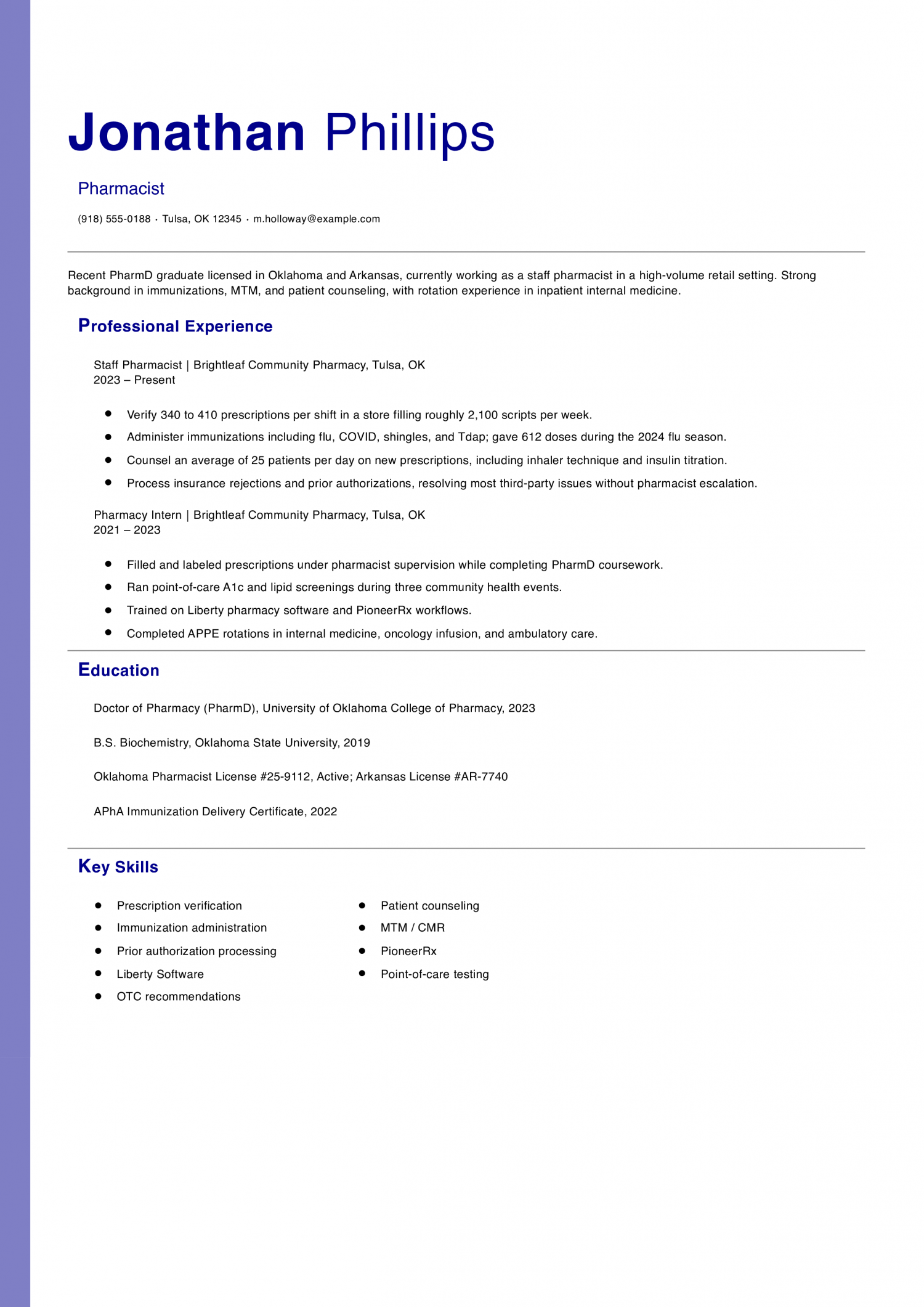
The staff pharmacist tab fits PharmDs in their first one to five years on the bench, working retail or hospital verification shifts. This resume needs to prove accurate dispensing volume, immunization counts, and clean controlled-substance handling.

Why this resume works

  • Daily volume is concrete: Stating script counts per shift and per week shows hiring managers exactly what kind of pace this pharmacist can handle.
  • Intern-to-pharmacist path is shown: The progression from intern to staff pharmacist at the same store explains the gap-free timeline without needing a cover letter.
  • Specific certifications listed: Naming the APhA immunization cert and two state licenses answers credential questions before the interview.

Senior Pharmacist Example

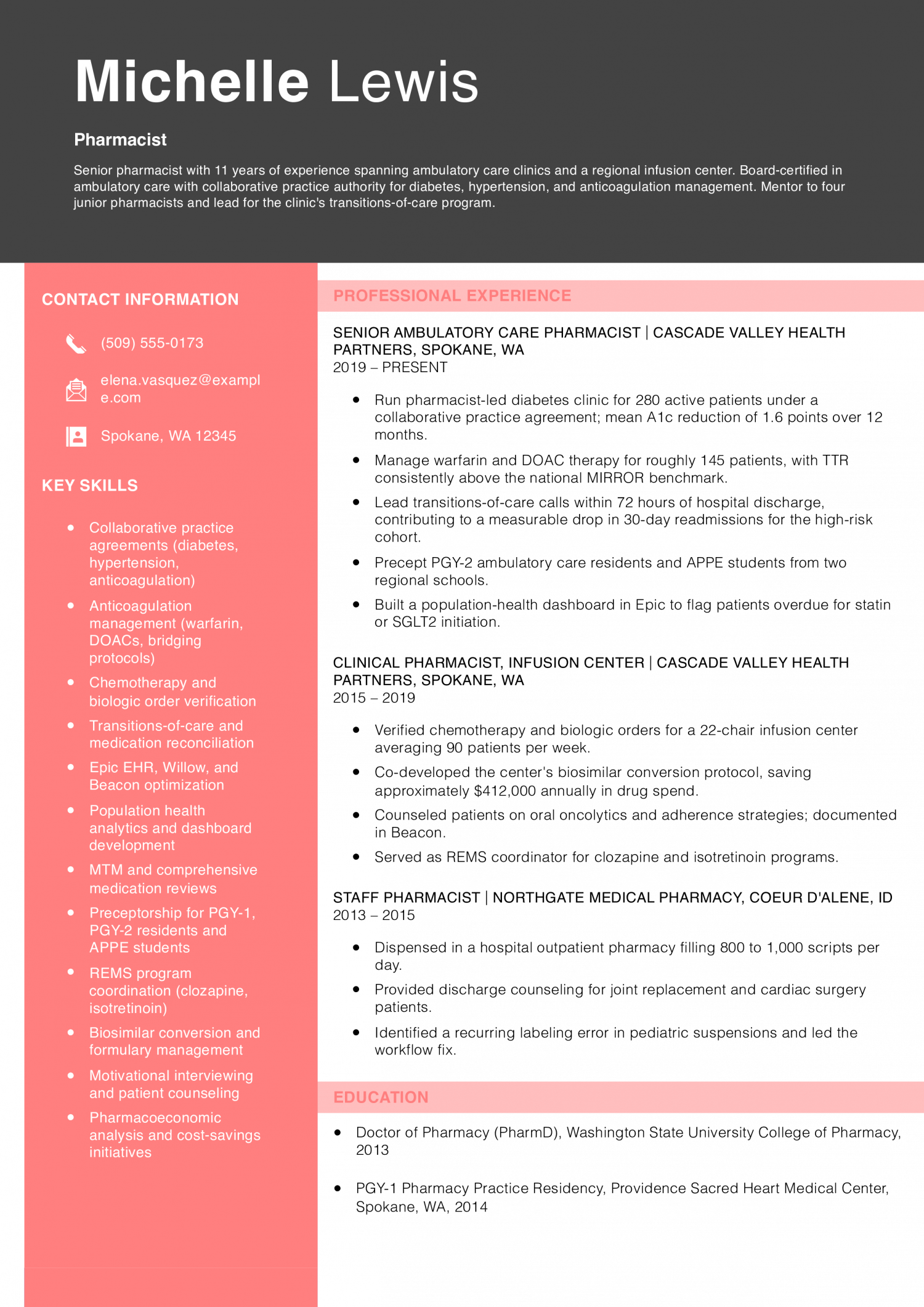
The senior pharmacist tab fits clinical and lead pharmacists who own a service line, precept students, or run MTM. This resume needs to prove intervention impact, board certification progress, and protocol authorship.

Why this resume works

  • Clinical outcomes are measured: A 1.6-point A1c reduction across a defined patient panel is the kind of outcome data ambulatory care employers ask for.
  • Dollar savings on a real project: The biosimilar conversion savings ties pharmacy work directly to the health system’s bottom line.
  • Mentoring is part of the role: Naming PGY-2 precepting and APPE students positions this candidate for clinical coordinator or specialist roles next.

Pharmacy Manager Example

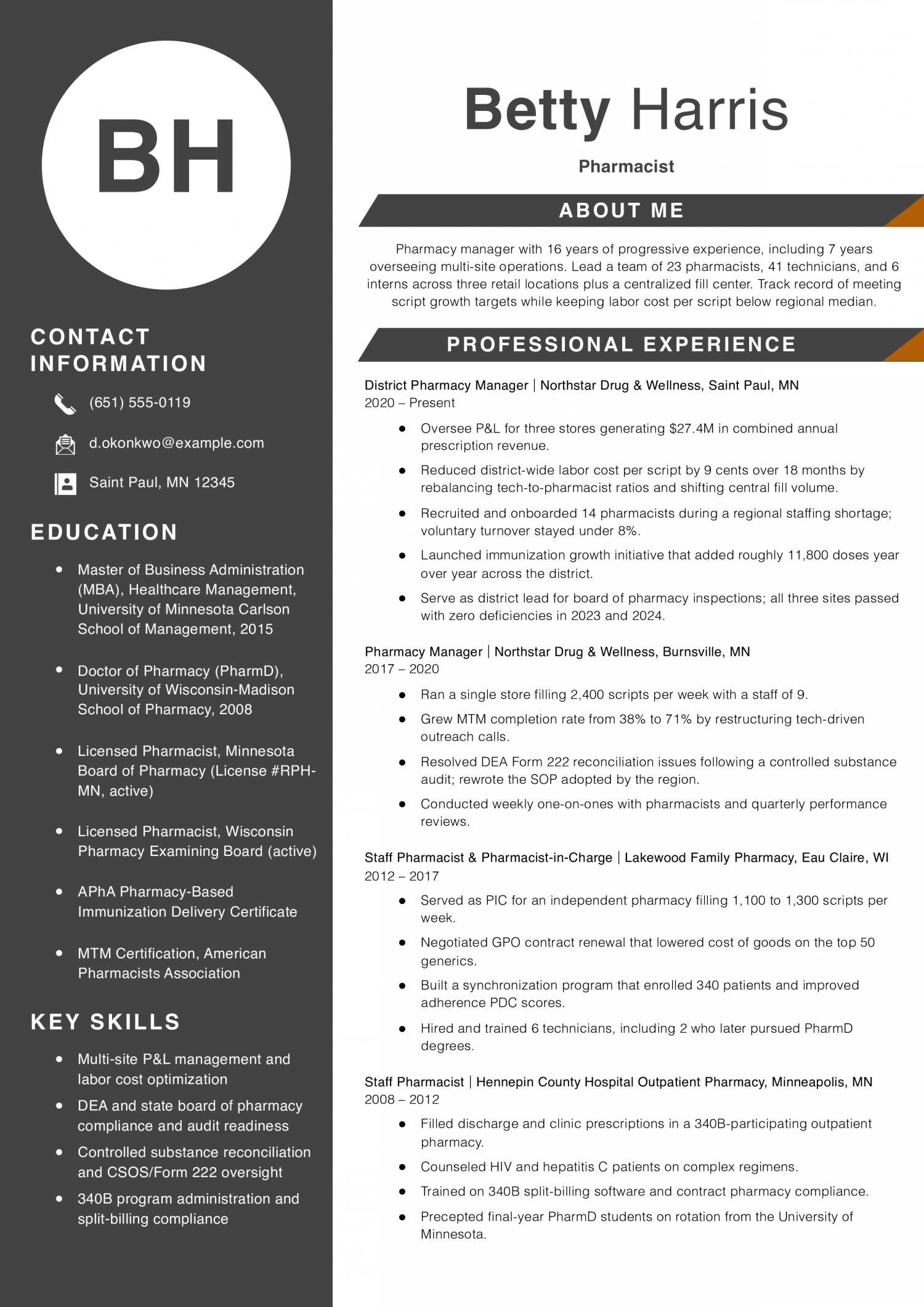
The pharmacy manager tab fits PIC and director-track pharmacists running staff schedules, P&L, and inspection readiness. This resume needs to prove team size, script volume under management, audit outcomes, and budget ownership.

Why this resume works

  • Scope of responsibility is clear: Listing headcount and prescription revenue tells regional directors the size of operation this manager has actually run.
  • Inspection record is named: Zero-deficiency board of pharmacy inspections across multiple sites is a direct signal of compliance leadership.
  • Cost work is quantified: Cents-per-script labor cost reduction is exactly the metric retail pharmacy operators track at the district level.

How to Write a Pharmacist Resume

01 Open with what a license lookup won't show

A pharmacy manager can confirm your license in 30 seconds. What they can’t pull from a state board is your specialty edge.

Add one line under your name that names the differentiator: BCPS in oncology, IV chemo certification, Spanish-language counseling, or 340B program experience. Lead with what the posting actually needs.

If the role is hospital-based, name the EHR you verify in (Epic Willow, Meditech, Cerner). If it’s retail, name the script volume tier you’ve worked. That single line moves you past the credential check and into the read.

02 Quantify volume, interventions, and accuracy

Pharmacy is a numbers-dense field, and bullets without numbers read as job duties. Strong resumes name three metric types: throughput, clinical impact, and accuracy.

Throughput looks like scripts verified per shift, immunizations delivered per quarter, or TPN orders compounded per week. Clinical impact looks like documented MTM cases, interventions accepted by prescribers, or readmission reductions on a service line.

Accuracy looks like error rates below department benchmark or clean audit cycles. Pick numbers you can defend in an interview. Recruiters scan the right margin of your bullets for figures before they read the verbs.

03 Group your work into four categories

Walls of bullets blur. Group your responsibilities into four buckets a pharmacy director recognizes on first scan.

Use clinical services (MTM, anticoagulation, immunizations, vaccination protocols), dispensing operations (verification, compounding, controlled-substance reconciliation), patient counseling and education (discharge counseling, adherence programs, bilingual consults), and team and compliance (precepting, USP 797/800, DEA inspection prep).

Each category gets two to four bullets with a metric. This structure mirrors how pharmacy job descriptions are written and helps your resume key-match the posting.

04 Place credentials and tools on page one

Pharmacy managers and director of pharmacy need to confirm five things before they read your experience: PharmD, active state license, DEA registration, board certifications, and immunization authority.

Build a credentials block under your contact line. List the state of licensure and “in good standing” without the license number, your DEA registration as a line item without the number, BPS certifications (BCPS, BCOP, BCACP), and BLS or ACLS as applicable.

Add an EHR and systems line: Epic Willow, Meditech, EPS, Pyxis, Omnicell. This block confirms you can be onboarded without a credentialing delay.

05 Close with education and CE that match the role

Your PharmD school, graduation year, and any PGY-1 or PGY-2 residency belong in the education block. Add APPE rotation focus areas if you graduated within the last three years.

List continuing education that maps to the posting: immunization certificate, MTM certificate, anticoagulation management, or pain and palliative care. State CE hour totals only if your board requires reporting.

Skip high school, GPA below 3.5, and CE older than five years. Keep this section to six lines so the page-one credential block stays the visual anchor.

Pharmacist hiring is tight in 2026. Hospital pharmacy teams are running leaner staffing models, and the bar to clear a screen is higher. The skills below come from our user-built pharmacist resumes.

Pharmacy managers and director of pharmacy weigh hard skills first (Epic Willow, BCPS, USP 797 compliance), then read soft skills as evidence behind your bullets. A claim like “patient counseling” only counts when a bullet shows the volume or outcome. Match this list against your target posting and use the soft skills as bullet themes, not standalone labels.

Soft Skills % of resumes with this skill
Patient counseling 70%
Attention to detail 50%
Communication 40%
Team collaboration 38%
Problem-solving 29%

And here are the top hard skills showing up most often.

Hard Skills % of resumes with this skill
Medication dispensing 69%
Drug utilization review 53%
Medication therapy management 44%
Sterile compounding 39%
Immunization administration 26%

Based on data from thousands of pharmacists’ resumes built on ResumeTemplates.com, May 2026.

Must Have on a Pharmacist Resume

These are the must-haves hiring teams look for when scanning a pharmacist resume.

Licensure Requirements

Pharmacy managers and director of pharmacy verify licensure before they read your bullets. Put this block under your contact line so the first scan clears credential gates.

List your PharmD, your state of pharmacist licensure with status (“in good standing”), and any additional state licenses if you work across markets. Do not publish license numbers on the resume itself.

Add DEA registration as a line item without the number, plus controlled-substance reporting program registration if your state requires one (PMP, PDMP).

  • PharmD, [School of Pharmacy], [Year]
  • Licensed Pharmacist, [State] (in good standing)
  • DEA registration, active
  • NABP e-Profile registered (for multi-state reciprocity)
  • BLS / ACLS, American Heart Association

Continuing Education That Maps to the Role

List CE that ties to the posted service line, not your full transcript. State boards track CE hours separately; the resume version is curated.

Pick three to five CE programs that match the role’s clinical scope. An oncology infusion center wants to see chemotherapy safety and USP 800 hours, not general retail CE.

Note CE hour totals per your state board’s reporting cycle only if the posting asks. Drop CE older than five years unless it’s a major credential.

  • APhA Pharmacy-Based Immunization Delivery
  • ACPE-accredited MTM Certificate Program
  • Anticoagulation Management Certificate
  • USP 797 / 800 Sterile Compounding Update
  • Pain Management and Opioid Stewardship CE

Board Certification and Specialty Recognition

BPS certifications signal which clinical track you’ve committed to. Hospital and ambulatory care postings increasingly list one or more as preferred or required.

  • BCPS (Board Certified Pharmacotherapy Specialist), BPS
  • BCOP (Board Certified Oncology Pharmacist), BPS
  • BCACP (Board Certified Ambulatory Care Pharmacist), BPS
  • BCPP (Board Certified Psychiatric Pharmacist), BPS
  • BCIDP (Board Certified Infectious Diseases Pharmacist), BPS

Pharmacy Credentials That Get You the Job

Pharmacy managers and director of pharmacy read this list as a map of where your clinical work is heading. The certifications below tell them which service line, specialty, or billing scope you’ve invested in. List each one with the issuing body and year earned, no certification numbers.

  • BCPS (Board Certified Pharmacotherapy Specialist): Signals readiness for clinical pharmacist roles on inpatient teams and is often listed as preferred in hospital postings.
  • BCOP (Board Certified Oncology Pharmacist): Required or strongly preferred for infusion centers and academic medical centers running active chemotherapy services.
  • APhA Immunization Delivery Certificate: Documents authority to administer vaccines under state protocols and is standard for retail and ambulatory care roles.
  • APhA MTM (Medication Therapy Management) Certificate: Confirms you can bill and document MTM encounters, which matters for ambulatory care and Medicare Part D contracts.

Latest BLS Statistics for Pharmacists

The top-paying states for pharmacists cluster in lower-supply regions and rural-heavy markets, not the dense East Coast metros most candidates target first. Lower pharmacist density and sign-on competition push wages up where chains and health systems compete for a smaller bench. If you’re geographically flexible, your resume should foreground multi-state licensure status, any reciprocity exams you’ve passed, and willingness to work float or rural shifts.

Lead with portability when the target market trades higher pay for harder staffing.

$137,480 National median annual
$137,210 National mean annual
$86,930 Entry-tier floor (10th percentile)
$172,040 Top-decile ceiling (90th percentile)
328,870 Pharmacists in the U.S.
Where you stand

Entry tier

$86,930 to $137,480 At this tier, your resume needs to show PharmD, active license, and APPE rotation focus, and lead with immunization authority.

Mid band

$137,480 to $172,040 At this tier, your resume needs to show script volume per shift, BCPS or MTM credentials, and lead with documented interventions.

Top decile

$172,040+ At this tier, your resume needs to show PIC scope, team size, P&L ownership, and lead with audit and 340B outcomes.

Top-paying states

# State Avg. Annual
1 California $165,150
2 Alaska $163,200
3 Oregon $163,120
4 Washington $157,020
5 Minnesota $154,610
6 Colorado $151,680
7 Hawaii $150,710
8 District of Columbia $141,560
9 New Hampshire $141,480
10 Delaware $140,470

Highest-employment states

# State Workers Median
1 California 34,490 $165,150
2 Texas 22,720 $136,950
3 New York 21,330 $136,350
4 Florida 20,270 $135,460
5 Pennsylvania 15,120 $135,830
Source: U.S. Bureau of Labor Statistics, OEWS 2024 release (SOC 29-1051).
Written by professional resume writers and loved by hiring managers

Resume Templates offers HR approved resume templates to help you create a professional resume in minutes. Choose from several template options and even pre-populate a resume from your profile.

Frequently Asked Questions

How long should a pharmacist resume be?

One page for staff and clinical pharmacists with under 10 years of experience.

Two pages for pharmacy managers, directors, and residency-trained clinicians with publications or precepting history.

Keep the credentials block on page one either way, so verification clears before the reader scrolls.

Can I list IPPE and APPE rotations on my resume?

Yes, if you graduated within the last three years or you're applying to a residency.

List APPE rotations with the site, preceptor specialty, and one bullet on what you owned.

Drop IPPE once you have a full pharmacist role on your timeline.

Should I put my license number or DEA number on the resume?

No. List the state of licensure and "in good standing," plus DEA registration as a line item.

Provide the actual numbers on the employer's application form or during credentialing.

Many state boards warn against publishing these numbers on documents you upload to job sites.

Do I put GPA on a pharmacist resume?

Only if it's 3.5 or higher and you graduated within the last two years.

After your first pharmacist role, replace GPA with intervention metrics, script volume, and board certifications.

Residency directors still look at GPA for PGY-1 applications, so keep it for that audience.

Which resume template works best for a pharmacist?

For a pharmacist, an ATS-friendly template is the safest pick, because it puts your certifications and experience where a hiring manager scans first. A basic template is a solid alternative. Whichever you choose, keep the formatting clean and easy to parse: clear section headings, a standard font, and no graphics a parser can choke on.

Rate this article

Pharmacist Resume

Average Rating

4.1/5 stars with 188 reviews

You have given 0 Star(s)
4.1/5 stars with 188 reviews
Andrew Stoner

Executive Resume Writer and Career Coach

Andrew Stoner is an executive career coach and resume writer with 17 years of experience as a hiring manager and operations leader at two Fortune 500 Financial Services companies, and as the career services director at two major university business schools.