Investment Banking Resume Examples
Add a single line a deal team cannot pull from your LinkedIn or your school’s recruiting list. That means a closed deal with a real size, a sponsor name you’ve worked across the table from,…
Every resume example is written and reviewed by our team of Certified Professional Resume Writers to ensure top-quality content and formatting.
Your deal track record carries more weight than any title on your resume. Managing directors and buy-side recruiters scan for closed transactions, fund sizes, and IRR figures you helped drive. A CFA or CAIA designation can strengthen your profile at the senior level.
Show each deal with the sector, enterprise value, and your exact role in sourcing or execution. Quantify portfolio company improvements you led, such as EBITDA margin gains or revenue growth. The private equity resume examples below show how to present that proof on one sharp page. To compare layouts before you start, browse our resume templates.
Managing directors decide whether to keep reading by the deal experience section; if specific transaction sizes, sectors, and outcomes are not clear there, the resume moves to the pass pile.
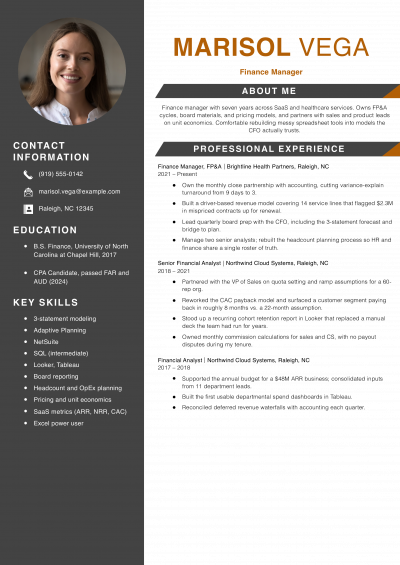
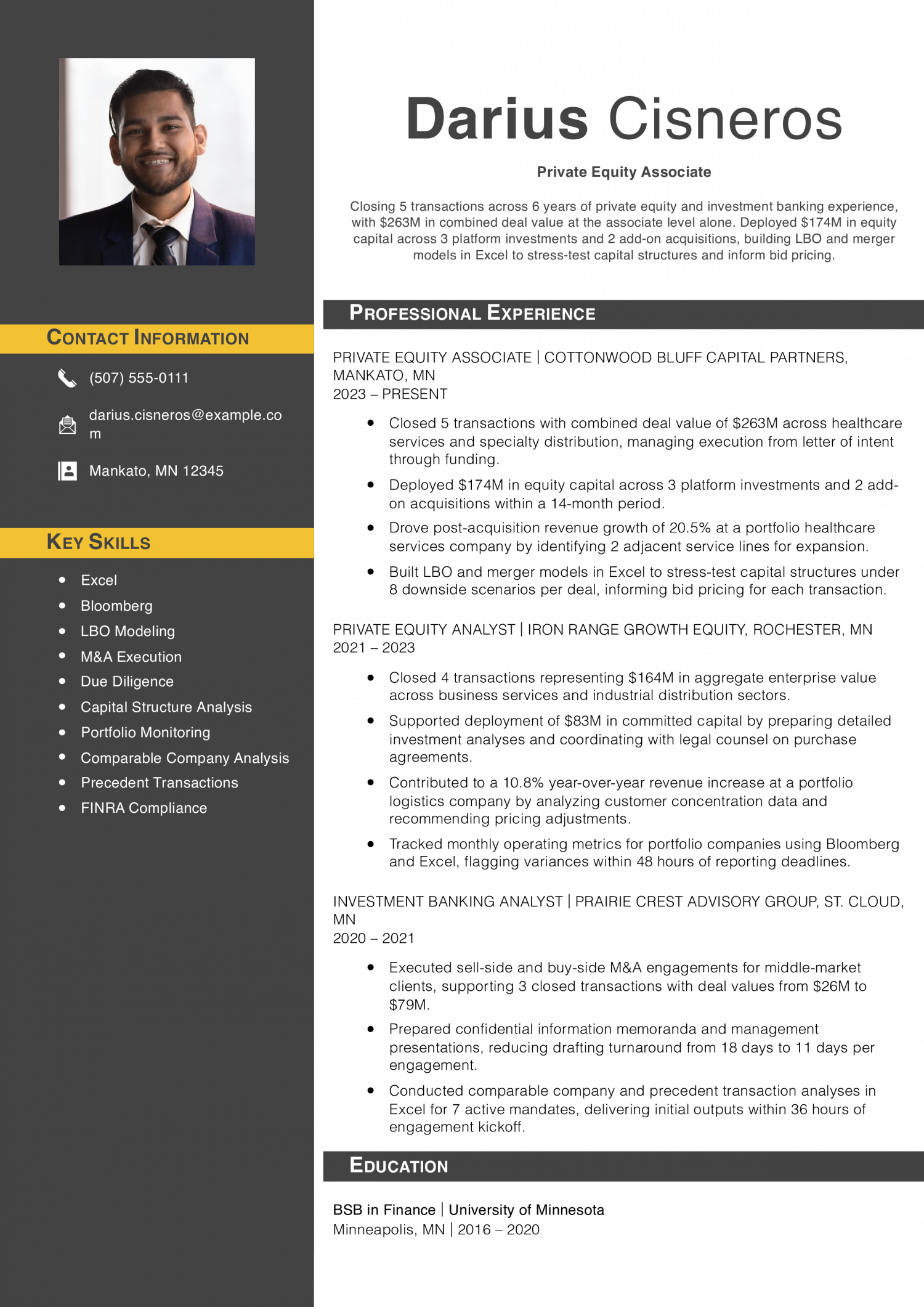
Consider this resume if you are a mid-level private equity associate with about six years spanning analyst and associate roles. Lead each bullet with deal count and dollar volume before describing your execution role, as this resume does throughout.
Revenue growth after the deal close is tied to new service lines the associate identified for expansion. When you describe work after a deal closes, name what you found and what it added.
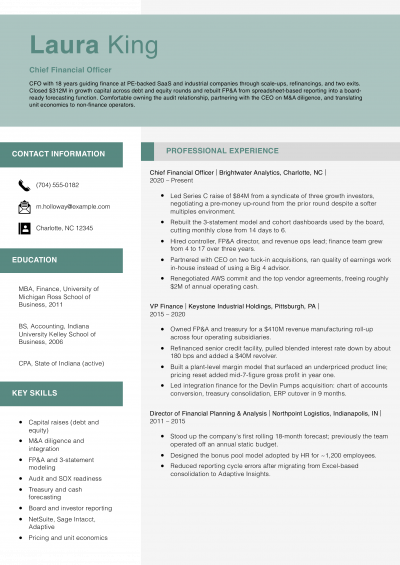
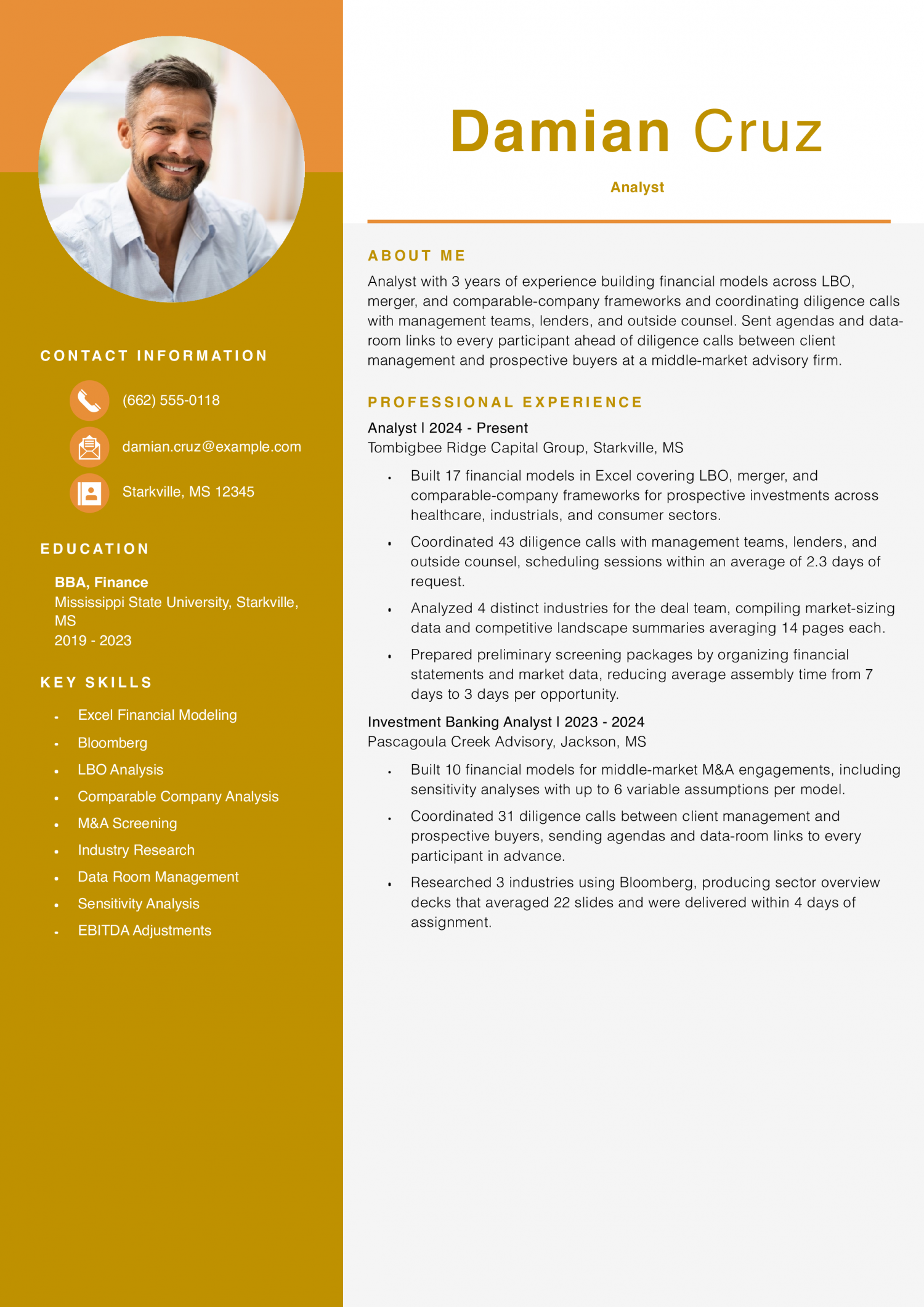
Start with this resume if you are an entry-level analyst with about three years of finance experience spanning advisory and buy-side roles. Split each bullet between the task performed and the turnaround time or volume count attached to it.
Naming the model types and the software used tells a senior associate exactly what this analyst built. A vague “built financial models” line would leave that question open. List your own modeling work by framework name and count so reviewers know your range.
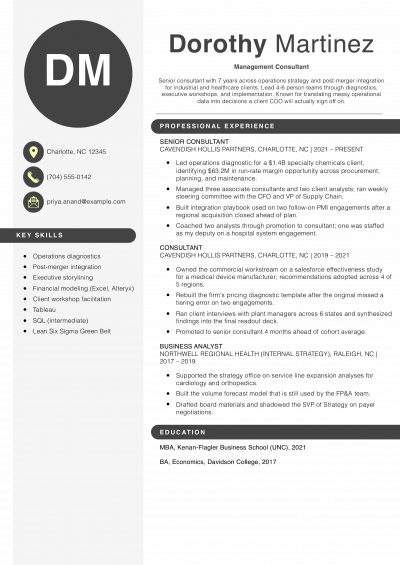
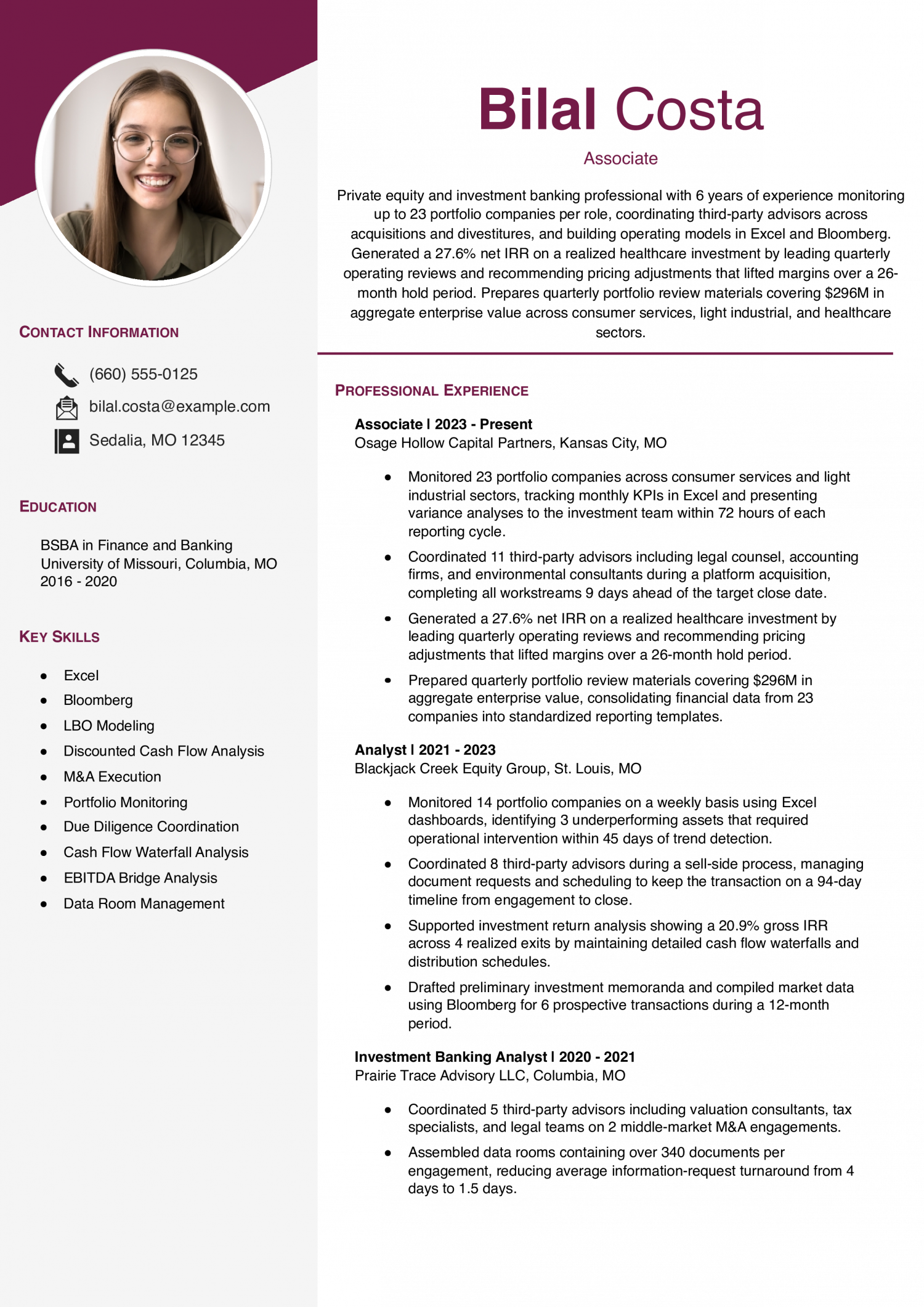
Try this resume if you are a mid-level associate with about six years spanning investment banking analyst and private equity seats. Surface how advisor coordination counts grow from role to role, proving expanding deal management responsibility.
A delivery window for variance reports shows the associate kept to a deadline, not just that the reports went out. When you describe portfolio reporting, include how soon after each cycle your analysis reached the team.
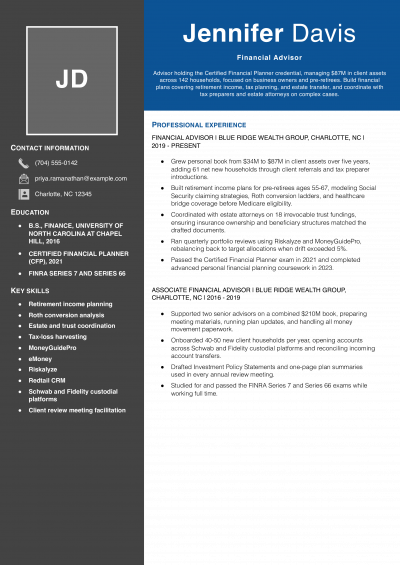
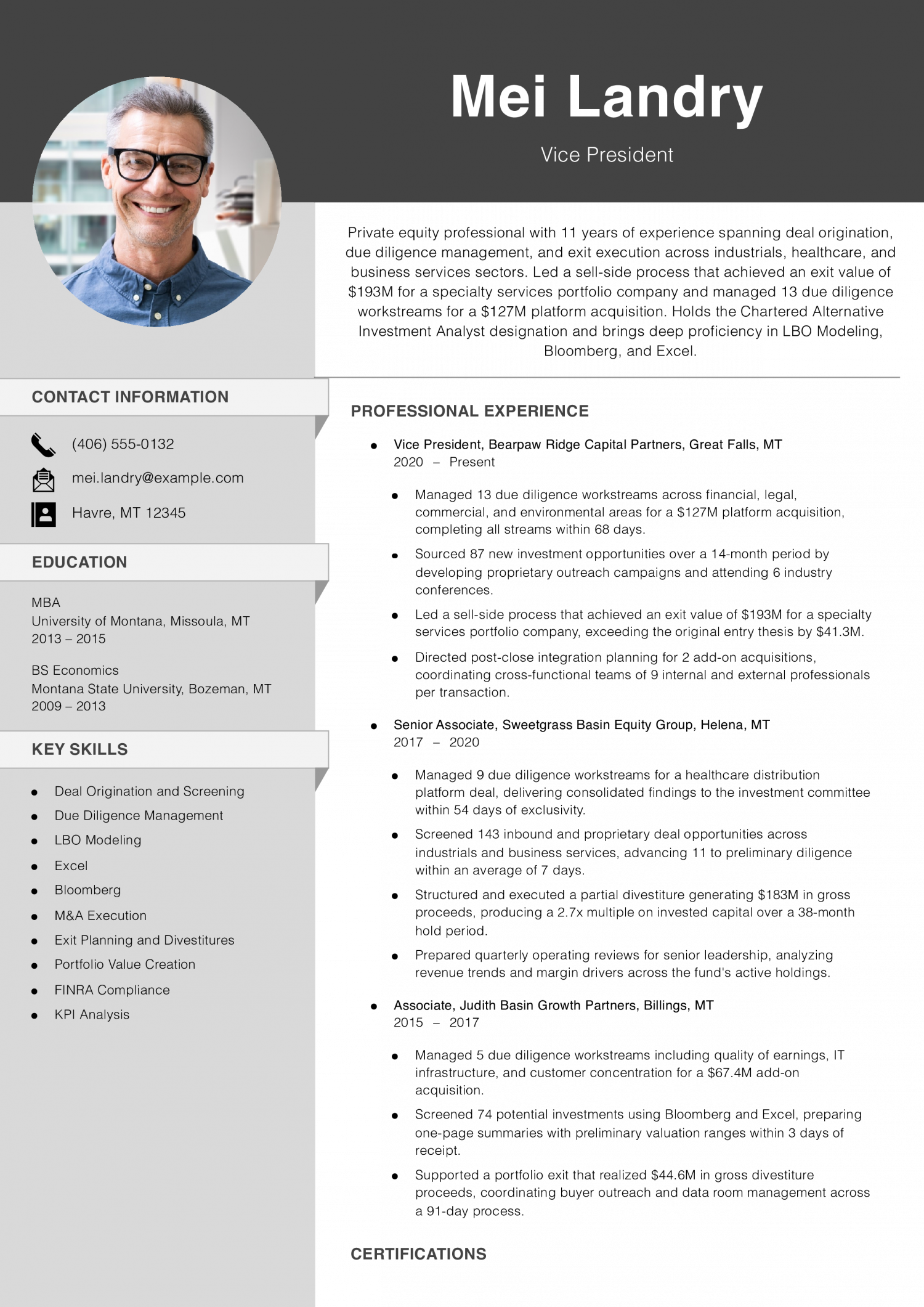
Lean on this resume if you are a senior private equity professional with roughly a decade of experience pursuing a Vice President position. Swap generic deal descriptions for day-count deadlines attached to each workstream, as every bullet here does.
Comparing the exit result to the original entry thesis is what gives this bullet its weight. A managing director can measure the return against the plan, not the headline number alone. Write your own exits the same way: state the original target and how far the outcome went past it.
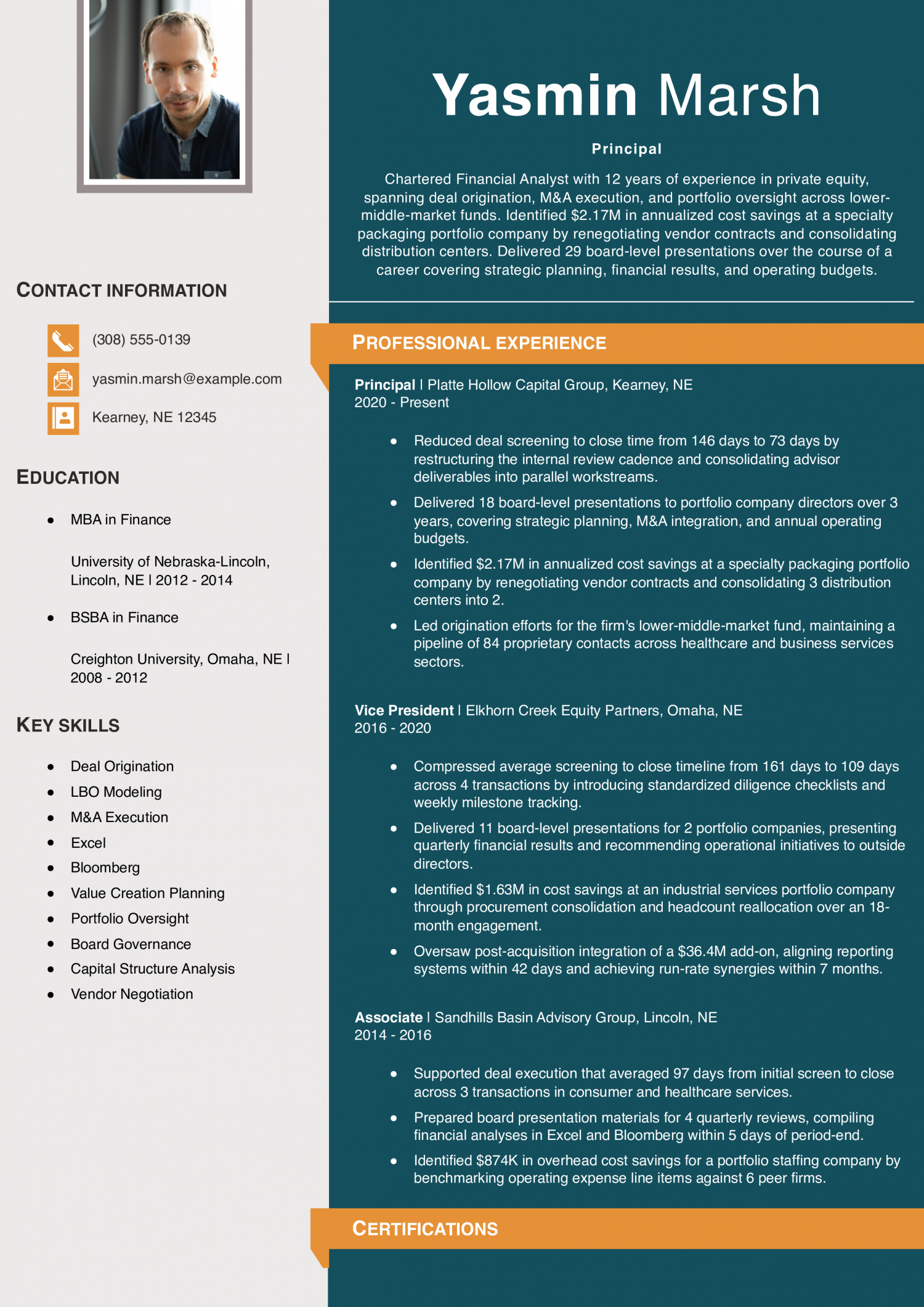
Read this resume if you are a senior private equity professional with over a decade of experience targeting a Principal or Managing Director seat. Tighten your deal metrics by pairing before-and-after day counts for screening-to-close timelines, as every role here does.
Integration work here is broken into phases with a deadline for each: reporting alignment and run-rate synergies both carry a time target. A board member can see the pace and the order of the work. Spell out each integration phase with its own timeline so the scope is visible.
Experienced in private equity investing across 6 years spanning analyst, associate, and senior associate roles, with 40 completed valuation analyses and 31 investment committee memos prepared across all positions. Drove $2.47M in annualized EBITDA improvement at a portfolio business services company by leading a procurement renegotiation and restructuring the field operations team. Skilled in LBO Modeling, Comparable Company Analysis, Sensitivity Analysis, and EBITDA Bridge Analysis using Excel and Bloomberg.
State your years in private equity, the fund size you have worked within, and the specific deal types you have closed. Name the sectors you cover, such as healthcare and industrials.
Add a third sector on its own if it matters. State whether you focus on buyouts, growth equity, or add-on acquisitions. Managing directors and buy-side recruiters scan this section in seconds.
They want to see if your deal scope fits their fund’s strategy. A clear scope line helps them place you fast. Keep this section to three or four lines.
Cut any phrase that does not name a fact about your fund or deal experience.
Most strong PE resumes lead with hard numbers. State the enterprise value of deals you sourced or closed. Name the IRR or MOIC your portfolio companies returned.
Include revenue or EBITDA growth you drove at a portfolio company. A strong bullet might read: “Led $85M take-private transaction, achieving 3.2x MOIC at exit.” You can also cite the number of CIMs reviewed per quarter.
Track how many LOIs moved to signed PSAs under your leadership. If you worked on the operating side, name the margin gains. Use percentages for cost cuts and dollar figures for value created.
Two or three metrics per role is enough to show your impact.
Private equity work spans several areas, and your bullets should reflect that range. Group them under clear themes. Sourcing and origination covers pipeline building, cold outreach, and confidential information memorandum review.
Due diligence includes financial modeling, quality of earnings analysis, and management meetings. Execution covers deal structuring and purchase agreement negotiation. Portfolio value creation includes board participation, operational improvement initiatives, and add-on integration.
A fifth category is fundraising and limited partner relations, if you have that exposure. Label each role’s bullets by these groups when you can. This organizational structure helps managing directors see where you are strongest and shows buy-side recruiters that you understand the full deal lifecycle from origination through exit.
List the CFA from CFA Institute or the CAIA from CAIA Association in a credentials block on page one. Managing directors and buy-side recruiters look for these early. If you hold either charter, place it right after your name or in a header line.
Do not bury it in an education section positioned at the bottom of the document. For tools, name the platforms you use daily. Common ones include CapIQ, PitchBook, and Excel with VBA or macros.
Mention any experience with data rooms such as Intralinks or Datasite. If you build LBO models or DCF models, state that clearly. These details signal that you can work at deal speed.
Keep this block short but visible.
If you carry ten or more years of PE experience, trim the older material. Remove internships and entry-level banking analyst tasks. They occupy space that should go to recent deal results and fund-level contributions.
Condense any pre-PE role into two or three bullets at most. Drop skills that every professional at your level holds, like basic Excel or PowerPoint. Managing directors reviewing senior candidates want to see fund-level outcomes.
They focus on exits, returns, and portfolio company performance. Keep your resume to two pages, not three. Cut any summary line that restates information your job titles already communicate.
Every line should add a fact that the next candidate’s resume might lack.
Managing directors and buy-side recruiters review hundreds of private equity resumes each quarter. The ones they shortlist pair deal metrics with clear proof of returns. Your resume needs both hard and soft skills to clear an ATS scan.
Hard skills like financial modeling show you can build a deal from scratch. Soft skills like negotiation prove you can close it. Managing directors weigh both when they staff a new fund or deal team.
Check each table below against your target job posting. Swap in the exact phrases that posting uses. Then add any terms you see there but not here.
Turn every soft skill you claim into a bullet with a measurable result. For example, tie negotiation to a purchase price reduction you led. Tie team leadership to the number of analysts you managed on a deal.
Hard skills belong in your experience section and in a tools or skills line. Soft skills work best inside deal bullets, not in a standalone list. Placing them this way helps the ATS and the human reader at once.
| Soft Skills | AI-estimated % |
|---|---|
| Investor relations | 67% |
| Executive persuasion | 62% |
| Analytical judgment | 45% |
| Stakeholder negotiation | 35% |
| Strategic decision-making | 33% |
And here are the top hard skills showing up most often.
| Hard Skills | AI-estimated % |
|---|---|
| LBO modeling | 70% |
| Deal sourcing | 54% |
| Portfolio company oversight | 47% |
| Financial due diligence | 40% |
| Valuation analysis | 31% |
Skill names and rankings come from an AI model grounded in U.S. Department of Labor occupation data for private equity professionals, not from a count of private equity professionals’ resumes built on ResumeTemplates.com.
Open with how you use AI.
What managing directors and buy-side recruiters expect has shifted. Listing only Excel and FactSet now reads as incomplete. Naming the AI tools you use for sourcing reads as current.
Be specific about what you fed the model. State what output you checked by hand. Mention the data set size and the deal stage.
Describe who reviewed the final memo. The list below names what to add and skip. Stick to tools you have used on a real deal.
Honest detail matters more than a long list of names. Keep each bullet tied to one task you performed.
What AI is actually changing for this role
Deal sourcing: AI screens thousands of private companies against sector, revenue, and growth filters in hours, not weeks.
Due diligence: Large language models extract red flags from data rooms, letting associates focus on judgment calls.
Financial modeling: AI copilots draft sensitivity tables and LBO scenarios that analysts then stress-test for accuracy.
Portfolio monitoring: Dashboards fed by AI flag covenant breaches and working capital shifts across portfolio companies each week.
Memo drafting: AI tools produce first drafts of investment committee memos, which partners then revise for thesis clarity.
AI tools to name
How to phrase AI on your resume
Do
Skip
Buy-side recruiters scan for recognized credentials early. The right charter signals deep analytical training. It also sets you apart in a crowded pool.
Lead with total assets under management across funds. State your carry and co-invest track record clearly. Name the sectors where you sourced proprietary deal flow.
Board seats you held at portfolio companies carry real weight. List each company, your role, and the outcome. Include revenue growth or EBITDA gains under your oversight.
Beyond your firm’s own screening criteria, the credentials below tell managing directors and buy-side recruiters how deep your training runs in valuation and alternative assets. They signal that you chose to invest years in a rigorous program on your own time. Many firms treat these as tie-breakers when two candidates show similar deal experience.
List each credential with the issuing body, your charter or designation date, and your current status. Neither credential is required at every fund. Requirements vary by firm size, strategy focus, and seniority level.
Still, holding one or both can set you apart in a competitive pool. Earning either charter shows you can commit to a multi-year study program while carrying a full deal workload. That kind of discipline matters to partners building long-term teams.
Review each posting to confirm which credentials the fund values most.
Resume Templates offers HR approved resume templates to help you create a professional resume in minutes. Choose from several template options and even pre-populate a resume from your profile.
A strong private equity resume fits on one page and leads with a profile stating your fund size and deal count. Each bullet in your experience section ties an action to a dollar figure or return multiple. That format lets managing directors scan your track record in seconds.
A private equity internship carries real weight, especially if you list the deals or screens you worked on. Name the sector and the deal size rather than writing a vague task description. Buy-side recruiters treat a private equity internship as a stronger signal than most banking summer roles.
Yes, but reshape each bullet around the skill that transfers to the buy side. Replace banking language like "prepared pitch books" with results such as "built three-statement models for a $200M acquisition." Managing directors want to see that you already think like an investor.
One page is the standard for analysts and associates with under ten years of experience. Principals and partners with a long deal history may use two pages if every bullet ties to a measurable outcome. Remove anything older than fifteen years unless it shows a landmark transaction.
Lead your profile with the transferable skill set, such as LBO modeling or sector expertise from consulting. Place a deal sheet or transaction list below your experience so buy-side recruiters see relevant exposure right away. Frame each prior role around valuation or due diligence work you performed.
Yes, a separate deal sheet is common at the associate level and above. List each transaction with the company name, sector, enterprise value, and your role in the process. Keep it to one page and match the formatting of your resume so both documents read as one package.
Note the gap period on its own line with a brief label, such as "MBA program" or "portfolio advisory project." If you completed any deal-related work during the gap, list it with the same metric-driven format as your other roles. Buy-side recruiters accept gaps when the surrounding results are strong.
Start with an ATS-friendly template so your deal history and credentials are organized under clear headings. A basic template is a good fit too.
Private Equity Resume
4.7/5 stars with 114 reviews

Executive Resume Writer and Career Coach
Andrew Stoner is an executive career coach and resume writer with 17 years of experience as a hiring manager and operations leader at two Fortune 500 Financial Services companies, and as the career services director at two major university business schools.
© 2026 Resumetemplates.com All rights reserved.