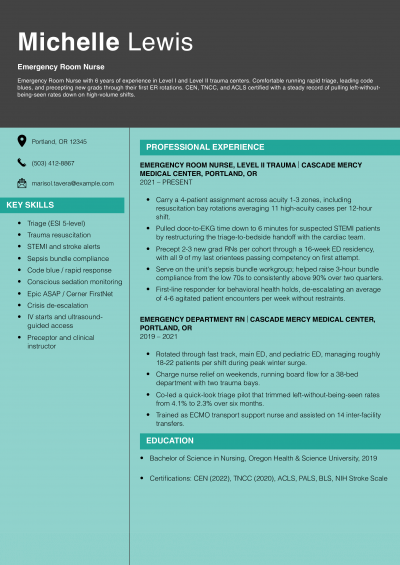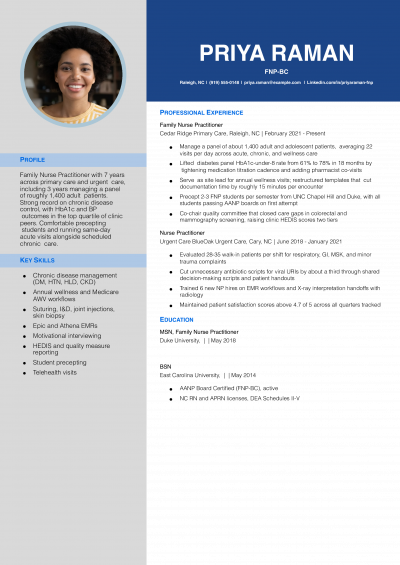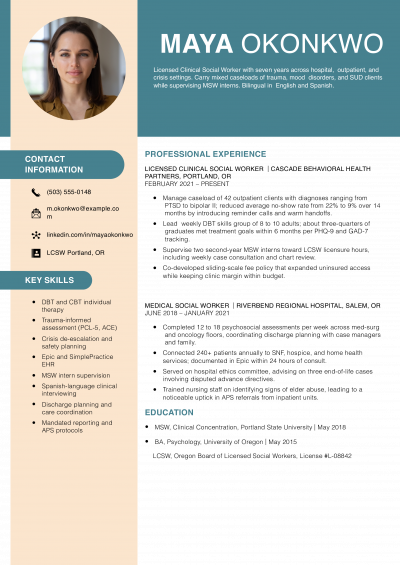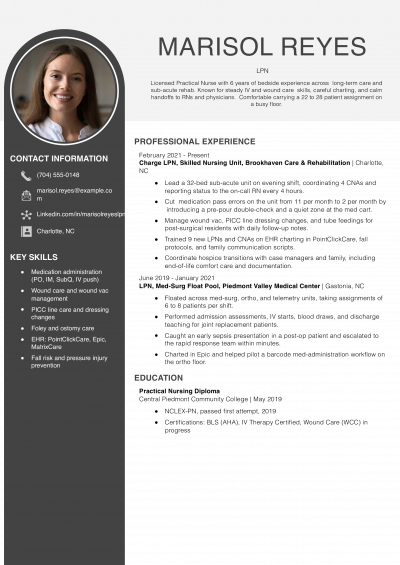
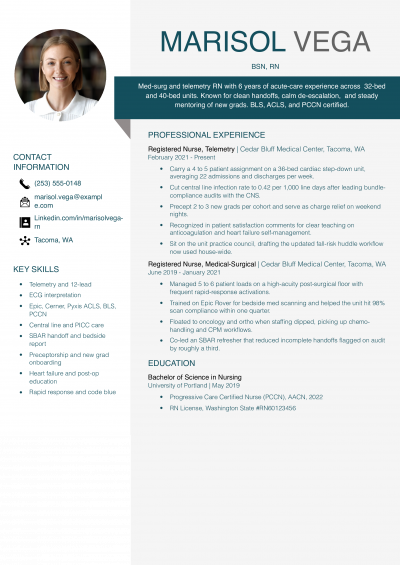
Registered Nurse Resume Examples
A state board lookup confirms you hold an active RN license. It does not show acuity, specialty, or the unit you actually staff. Lead the summary with the one signal that separates you from the…
Every resume example is written and reviewed by our team of Certified Professional Resume Writers to ensure top-quality content and formatting.
Most psychiatric nurse hires come down to clinical proof, not soft claims. Psych nurse managers and hospital recruiters scan for patient acuity levels you have handled. They look for experience with safety protocols and crisis de-escalation.
Your resume should show skills like mental status exams and medication administration. Include your RN license and any PMH-BC certification from the ANCC. The resumes below show different ways to present that background. To compare layouts before you start, browse our resume templates.
A PMH-BC credential listed near the header, documented de-escalation training, and measurable patient outcomes are what distinguish the strongest psychiatric nurse resumes from the rest.
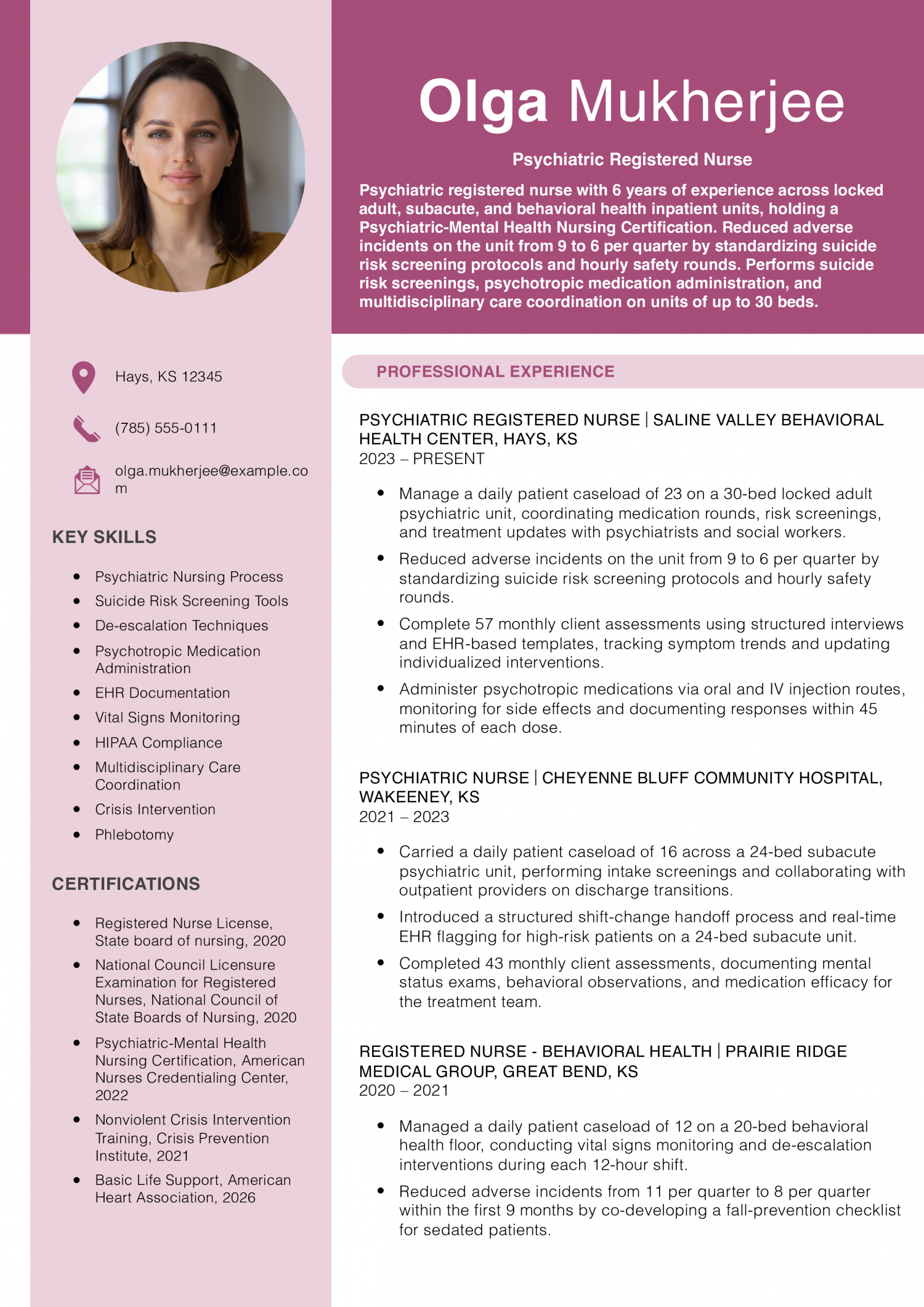
Consider this resume if you are a mid-level psychiatric RN transitioning between inpatient behavioral health facilities with growing caseload responsibility. Lead with adverse incident reductions tied to specific protocols you built or revised at each position.
Incident counts dropped because screening protocols and safety rounds were standardized, not because the unit got quiet. Nursing directors see the clinical change behind the number. Name the protocol you put in place and connect it to the outcome.
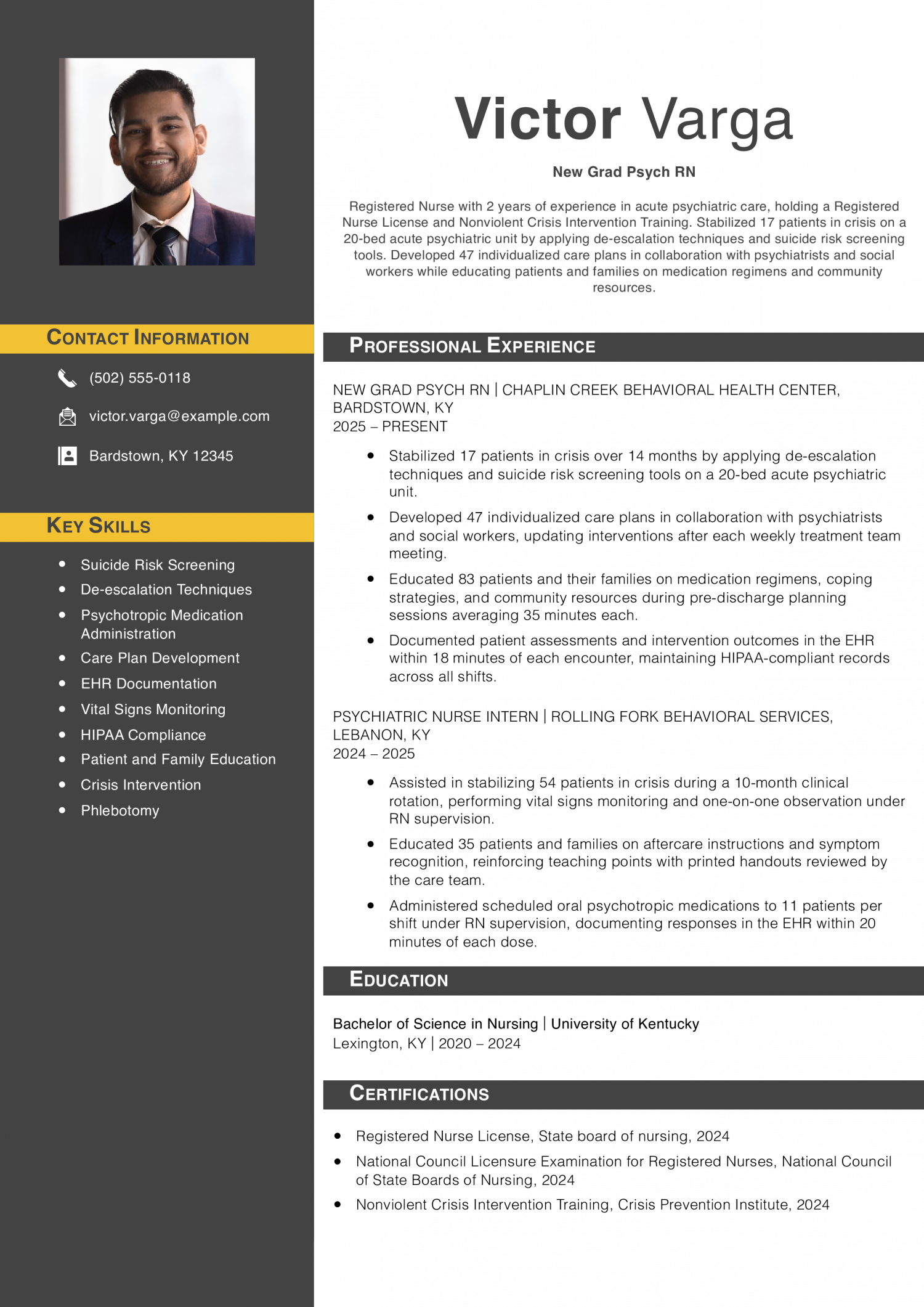
Start with this resume if you are an entry-level psychiatric RN building your first inpatient behavioral health career. Lead with crisis stabilization counts paired with unit size to give reviewers immediate clinical context.
Patient assessments are charted within a set time window after each encounter. Charge nurses can see the documentation pace and trust the records are current. State your charting turnaround time and the system you use to stay on schedule.
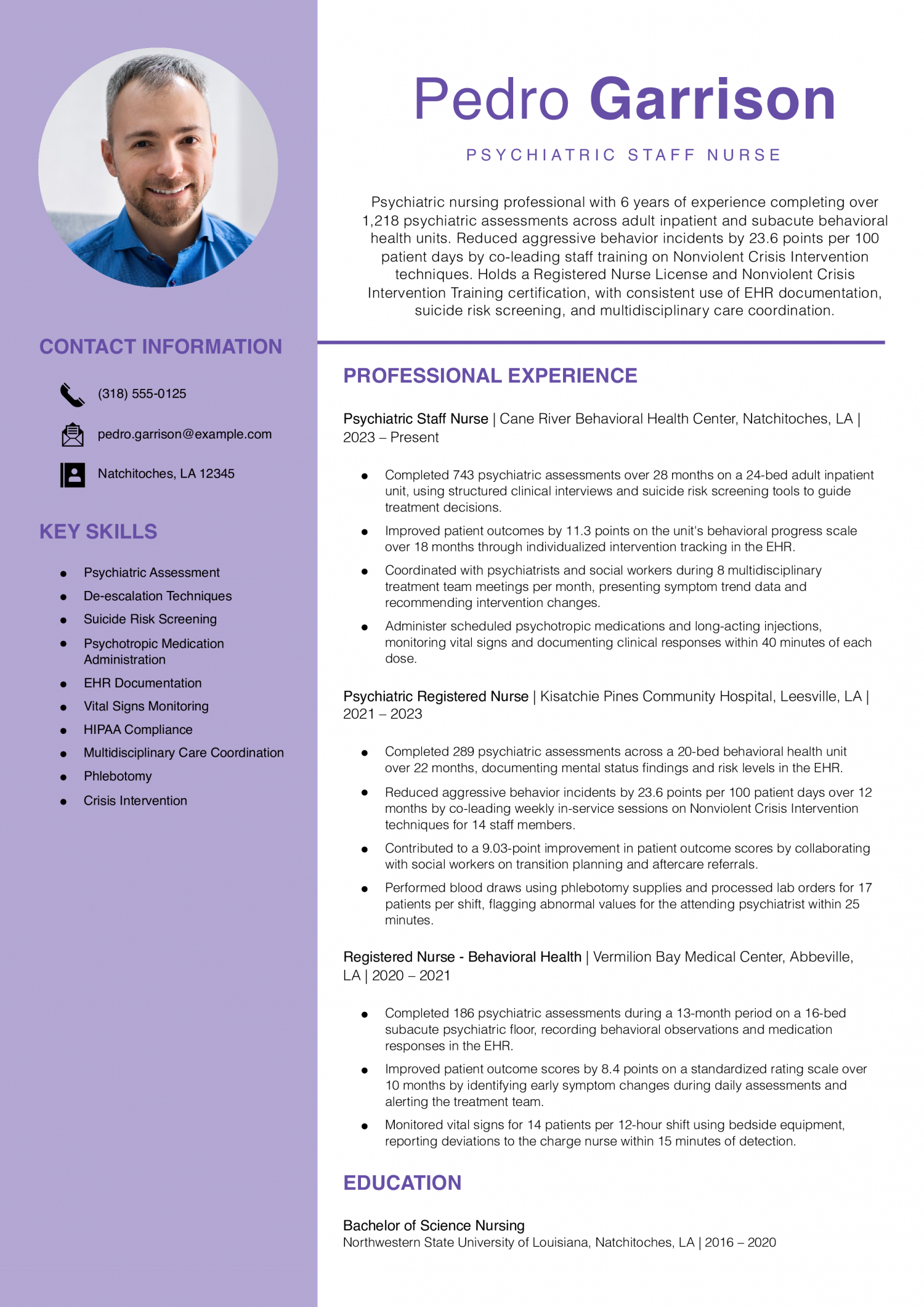
Try this resume if you are a mid-level psychiatric staff nurse building a record across multiple inpatient behavioral health units. Lead with assessment volume tracked across each role to show consistent clinical throughput.
Team meetings have a monthly count and a specific clinical contribution named. Unit managers can see that the nurse brings symptom trends and care suggestions to each meeting. Say how often you attend interdisciplinary rounds and what you contribute.
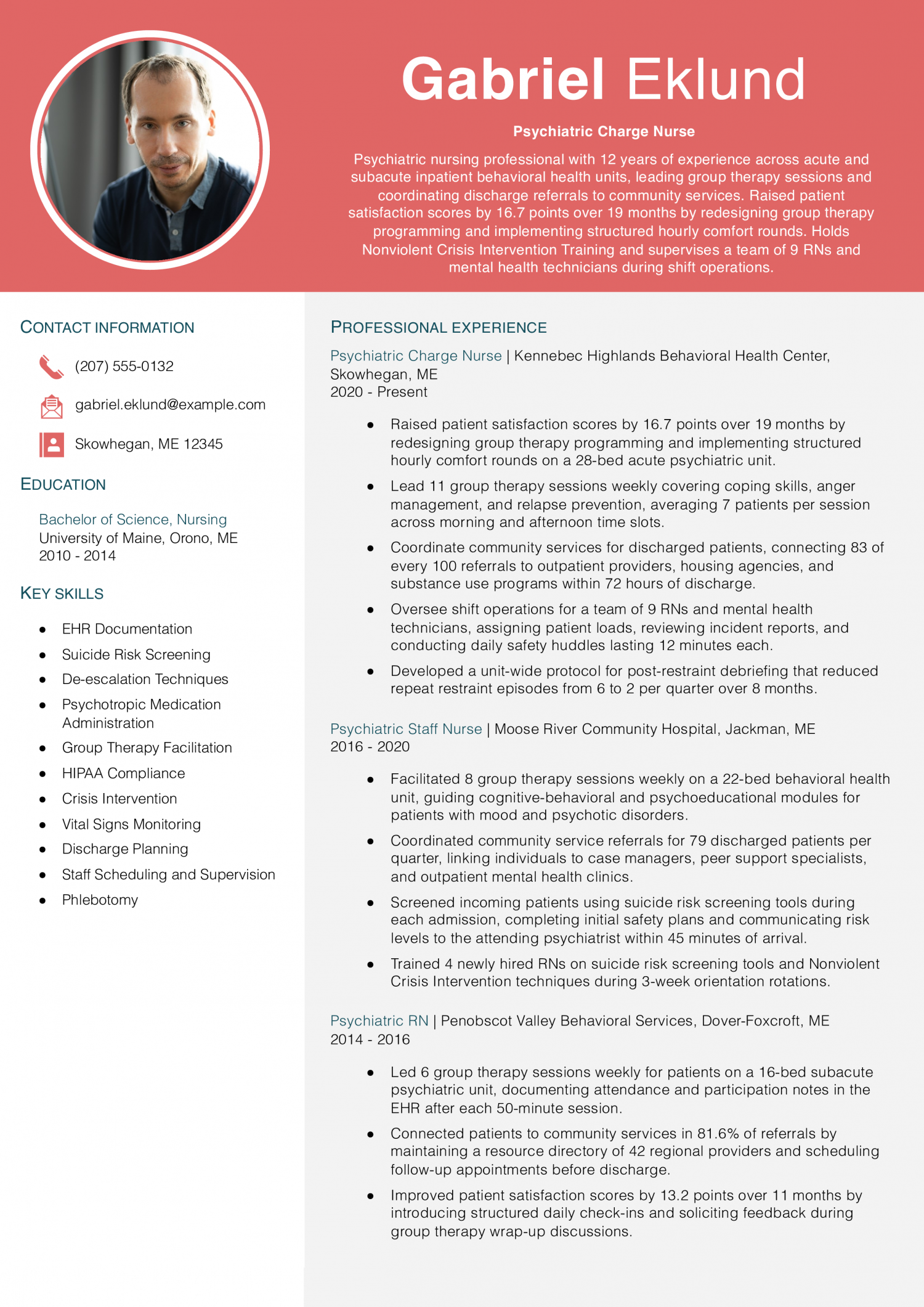
Lean on this resume if you are a senior psychiatric charge nurse managing unit operations and clinical programming on an inpatient behavioral health floor. Lead each bullet with a protocol change and the outcome metric it moved over a stated time frame.
Repeat restraint episodes dropped after a debriefing protocol was introduced on the unit. Hospital administrators can see the intervention behind the count. If you changed a safety practice, show the count before and after, along with the time period.
Mental health nurse with 6 years of experience across locked psychiatric and subacute behavioral health units, holding Nonviolent Crisis Intervention Training and Basic Life Support certifications. Raised patient medication compliance from 86.5% to 98.52% by introducing a bedside teach-back protocol that confirmed each patient’s understanding of prescribed psychotropic regimens. Skilled in EHR documentation, psychotropic medication administration, de-escalation techniques, and multidisciplinary care coordination.
Your RN license is public record. Psych nurse managers and hospital recruiters can verify it in seconds. What they cannot find there is the detail that sets you apart.
Lead your summary with one fact a comparable candidate is unlikely to share. That might be Nonviolent Crisis Intervention Training from CPI. It might be fluency in a second language your unit needs.
A dual-diagnosis specialty or forensic psych rotation works too. Pick the single strongest differentiator and place it in the first line. One clear signal beats a list of generic nursing phrases every time.
Psych nursing is clinical work, so strong resumes tend to carry real metrics. State your average patient load per shift. Note any reduction in restraint use you helped achieve.
Track falls, elopement attempts, or readmission rates you influenced. You can also count group therapy sessions you led each week. Medication volumes matter on busy inpatient floors.
Even process wins deserve a figure, such as cutting incident reports by a percentage. Two metrics per bullet is a solid target. Keep each figure tied to an outcome the unit cares about.
Organize your experience bullets into clear clusters. Start with patient assessment, covering psychiatric evaluations and suicide risk screening. Next, list medication management tasks such as monitoring side effects.
Follow with therapeutic work like de-escalation and crisis stabilization. Add a safety cluster for restraint protocols and incident documentation. End with interdisciplinary collaboration, noting work with psychiatrists and social workers.
These groupings let psych nurse managers scan your scope in seconds. Label each cluster with a bold subheading if the format allows it.
Group your license and certifications on page one, near your summary. List your state RN license in good standing first. Add the PMH-BC from ANCC if you hold it.
Psych nurse managers and hospital recruiters often filter by credential before reading further.
Burying these items on page two risks an early pass. Keep each entry short: credential name, issuing body, and status. Do not list license numbers or personal identifiers on your resume.
List your nursing degree with the school name and graduation year. Psych nurse managers and hospital recruiters at magnet hospitals often prefer a BSN or higher. Add relevant clinical rotations in psychiatric or behavioral health settings beneath the degree.
Include any completed coursework in psychopharmacology or crisis theory. If you passed the NCLEX-RN through the NCSBN, note the year. Ongoing CEUs in trauma-informed care or motivational interviewing belong here too.
Keep each entry to one line when possible. A clean, short education block closes the resume without crowding your clinical experience.
Psych nurse managers and hospital recruiters review dozens of psychiatric nurse resumes each week. The ones they shortlist name specific clinical skills and patient outcomes. Hard skills prove you can handle the clinical side of the unit.
Think medication administration, crisis response, and care planning. Psych nurse managers and hospital recruiters weigh these against soft skills like empathy and de-escalation. Both types carry weight, but in different ways.
Hard skills show you meet the baseline for safe patient care. Soft skills show you can build rapport with patients in acute distress. A strong resume pairs both in each bullet point.
Mirror the exact phrasing your target posting uses for each skill. Treat soft skills as evidence you weave into your work history bullets.
For example, tie de-escalation to a specific unit outcome you helped achieve.
| Soft Skills | AI-estimated % |
|---|---|
| Therapeutic communication | 67% |
| Empathy under pressure | 54% |
| De-escalation judgment | 47% |
| Interdisciplinary collaboration | 35% |
| Emotional resilience | 34% |
And here are the top hard skills showing up most often.
| Hard Skills | AI-estimated % |
|---|---|
| Psychiatric patient assessment | 72% |
| Psychotropic medication administration | 53% |
| Mental health documentation | 48% |
| Behavioral crisis intervention | 36% |
| Care plan coordination | 31% |
Skill names and rankings come from an AI model grounded in U.S. Department of Labor occupation data for psychiatric nurses, not from a count of psychiatric nurses’ resumes built on ResumeTemplates.com.
Your RN license and any PMH-BC credential belong near the top.
Your RN license is the baseline for every psych role. You earn it after passing the NCLEX-RN exam. Requirements vary by state, so list your state clearly.
The PMH-BC from ANCC signals specialty-level expertise. Many job postings prefer or require this credential. Nonviolent Crisis Intervention Training from CPI is common too.
Basic Life Support from the American Heart Association is expected. Include expiration dates for each active credential.
Psych nurse managers look for ongoing learning in your field. List courses that sharpen clinical or therapeutic skills. Focus on topics tied to your patient population.
Your PMH-BC from ANCC requires renewal every five years. Show the hours you earned toward that renewal. Courses in trauma, addiction, or adolescent care stand out.
Most inpatient psych units rely on electronic records daily. Name each EMR system you have used before. Psych nurse managers want to cut your training time.
Behavioral health documentation adds privacy steps that belong on your resume.
Psychiatric Records Carry Stricter Privacy Protections
Hospital recruiters screen for HIPAA training on every resume. Note any audits you passed or privacy projects you led. Keep the entry brief and specific to your role.
A current RN license keeps you in the running for any psychiatric nursing role. The credentials below move your resume from the qualified stack into the shortlist. Psych nurse managers and hospital recruiters scan them to gauge your clinical scope.
They also check your crisis readiness. List each credential with the issuing body, the date earned, and the expiration date. Put the most recent credential first.
Keep each entry on one line so it reads fast. If a credential has lapsed, leave it off or note that renewal is in progress. Many postings name these credentials by abbreviation, so include the abbreviation next to the full name.
That helps automated filters match your resume to the posting. Order the rest by relevance to the unit you are targeting.
About These Numbers
The Bureau of Labor Statistics does not publish a wage code for Psychiatric Nurse specifically. The numbers below are a proxy: the closest published match is Registered Nurses (SOC 29-1141), so use them as an estimate for this role, not an exact figure.
BLS wage data covers all registered nurses, a group that includes psychiatric nurses. The top-paying states for psychiatric nurses tend to cluster in lower-supply regions, not the large metro areas most nurses target first. So being open to a move can shift your pay range more than years on the job alone.
Nurses near the top out-earn the middle by a wide gap, and those near the bottom sit well below it. If you are open to relocation, list any multi-state compact license status and highlight unit types you have staffed across more than one facility or region.
| # | State | Median Annual |
|---|---|---|
| 1 | California | $140,270 |
| 2 | Hawaii | $136,320 |
| 3 | Oregon | $129,010 |
| 4 | Washington | $124,200 |
| 5 | Alaska | $109,480 |
| 6 | New York | $109,440 |
| 7 | New Jersey | $106,500 |
| 8 | Massachusetts | $104,550 |
| 9 | Nevada | $103,670 |
| 10 | Connecticut | $102,740 |
| # | State | Workers | Median |
|---|---|---|---|
| 1 | California | 338,940 | $140,270 |
| 2 | Texas | 271,380 | $95,970 |
| 3 | Florida | 229,940 | $84,190 |
| 4 | New York | 205,810 | $109,440 |
| 5 | Pennsylvania | 146,520 | $96,430 |
Resume Templates offers HR approved resume templates to help you create a professional resume in minutes. Choose from several template options and even pre-populate a resume from your profile.
Name the specific unit in your experience header, such as acute inpatient or adolescent behavioral health. Mirror the language from the job posting so psych nurse managers can match your background to the open role. Forensic units call for different terms than outpatient clinics, so adjust each version.
Yes, a two-line summary works well when it names your specialty area and your years in psychiatric settings. Include one measurable outcome, such as a drop in patient restraint use. Psych nurse managers prefer to see what you have done rather than a generic objective.
Place de-escalation in your skills section and back it up with a bullet under your experience. Describe a result, such as reducing code-grey events by a percentage on your unit. Proof matters more than a claim when psych nurse managers review your file.
A resume is one to two pages and highlights clinical skills, outcomes, and credentials for a single role. A CV lists every publication, presentation, and academic post without a page limit. Most hospital postings ask for a resume unless the role involves research or teaching.
List the gap period honestly and note any relevant activity during that time. Continuing education hours or volunteer crisis-line work both show you stayed current. Psych nurse managers look for proof that your clinical knowledge is up to date.
Yes, list each contract under a single heading for the staffing agency. Note the facility name and unit type for every assignment below that heading. This format keeps the layout clean while showing psych nurse managers your range of settings.
A two-page resume is reasonable when you have more than ten years of psych nursing experience. Keep the strongest clinical outcomes and credentials on page one. Psych nurse managers often review dozens of files, so your best material should appear early.
Go with an ATS-friendly template so your license and clinical work each have a heading. A basic template works well for nursing roles too.
Psychiatric Nurse Resume
4.1/5 stars with 101 reviews

Executive Resume Writer and Career Coach
Andrew Stoner is an executive career coach and resume writer with 17 years of experience as a hiring manager and operations leader at two Fortune 500 Financial Services companies, and as the career services director at two major university business schools.
© 2026 Resumetemplates.com All rights reserved.