Business Analyst Resume Examples
Lead with the one signal another BA cannot copy from a LinkedIn search. That might be a domain (claims, payments, supply chain), a system (Salesforce, SAP S/4HANA, Workday), or a methodology depth like SAFe RTE…
Every resume example is written and reviewed by our team of Certified Professional Resume Writers to ensure top-quality content and formatting.
Most systems analyst roles fill based on one proof point: can you map a broken workflow, then spec the fix in terms developers ship? IT managers and application development directors scan for SQL queries you wrote and requirements docs you owned. They also look for testing cycles you led.
They want to see the gap between the old process and the new one, measured in time or cost.
Your resume should name the ERP, CRM, or middleware you configured. It should show a before-and-after metric tied to each project. The examples below give you tested formats built for this kind of detail. To compare layouts before you start, browse our resume templates.
Quantified project outcomes, a skills matrix that maps to the tech stack in the posting, and a CBAP or PMI-PBA credential are what separate the Systems Analyst resumes IT managers schedule for interviews from the rest.
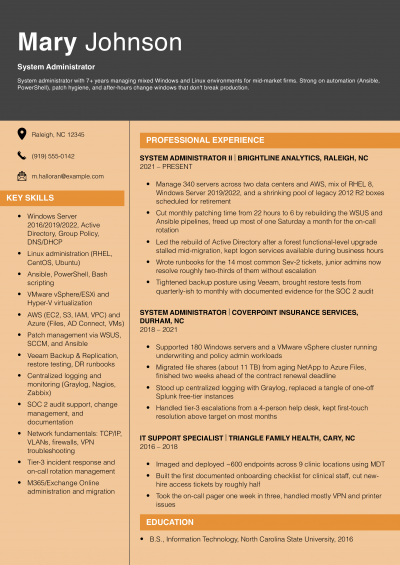
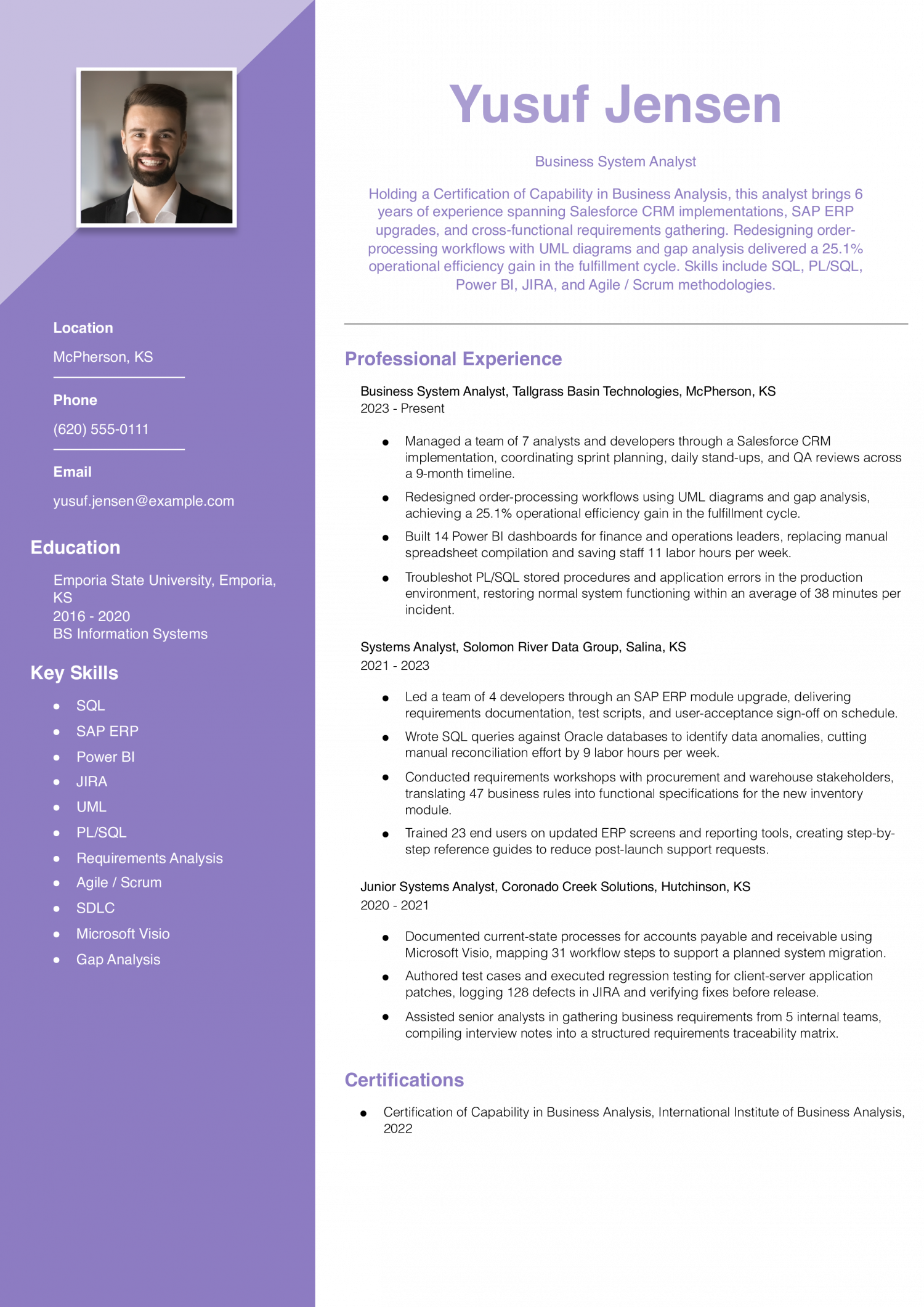
Pick this resume if you are a mid-level business system analyst with about six years bridging technical teams and business stakeholders. Drop vague process claims and instead attach labor-hour savings to every dashboard and workflow you built.
Look at the spreadsheet process the dashboard replaced and the weekly hours it freed. That helps a reader picture what people were doing by hand before. For your own reporting work, say what the manual step was and how much time your tool gave back.
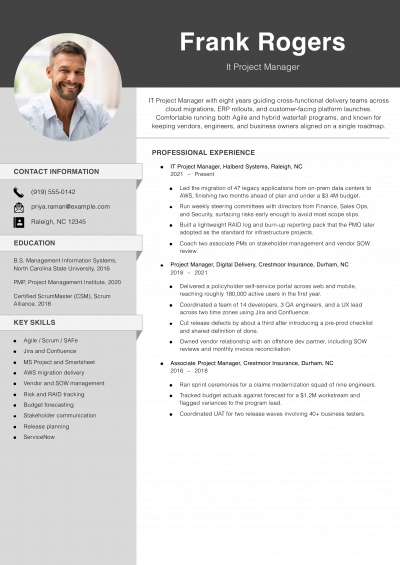
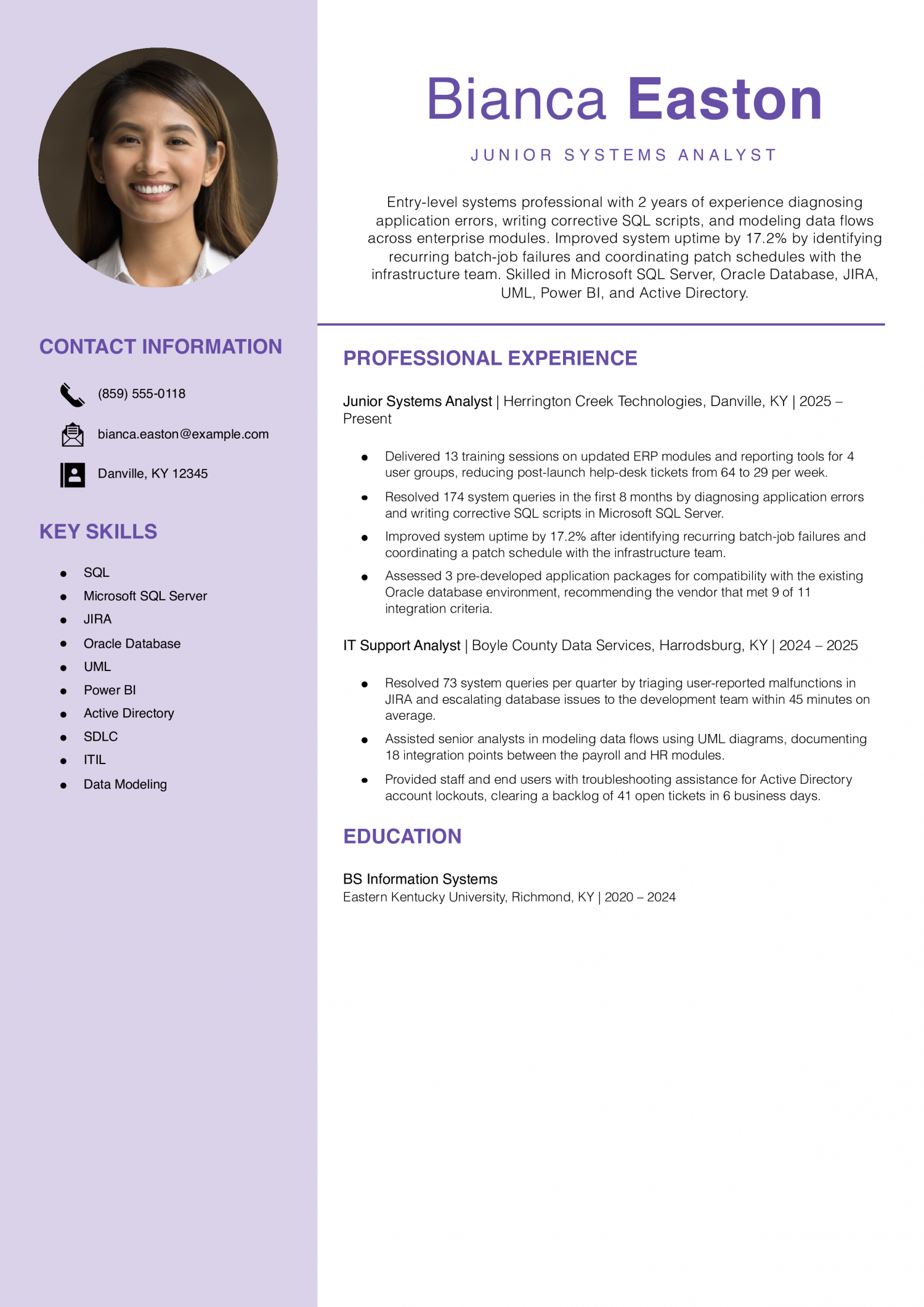
Start with this resume if you are an entry-level systems analyst moving from IT support into systems analysis after a BS in Information Systems. Fit a before-and-after metric into each bullet so every contribution carries a measurable outcome.
This resume pairs the number of backlog items with the time it took to clear them. A reviewer sees how fast you work under pressure, not only that you cleared a queue. For any backlog, say how many items and how long it took.
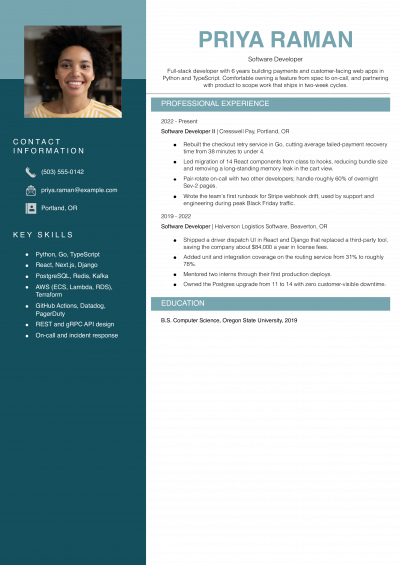
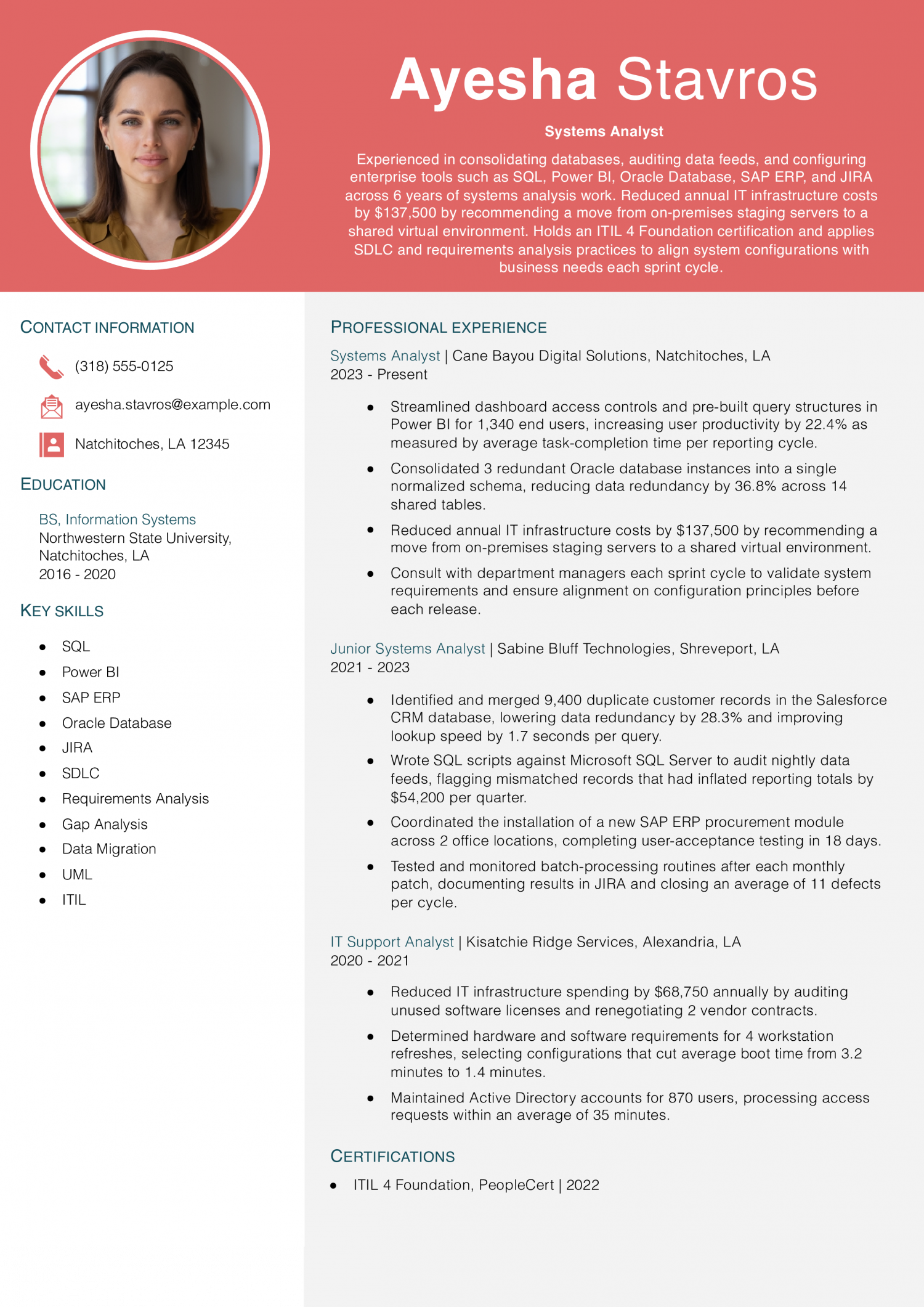
Try this resume if you are a mid-level systems analyst with about six years of database consolidation and infrastructure cost-reduction experience. Hand each cost-saving bullet the dollar amount and the sourcing decision that produced it.
Consolidation here means combining Oracle databases and reducing duplicate data, and the resume spells that out. A hiring manager can see what the cleanup achieved. On your resume, name the systems you combined, what the merged result looked like, and what changed.
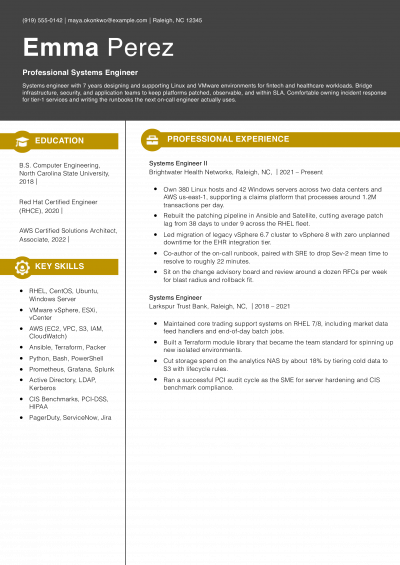
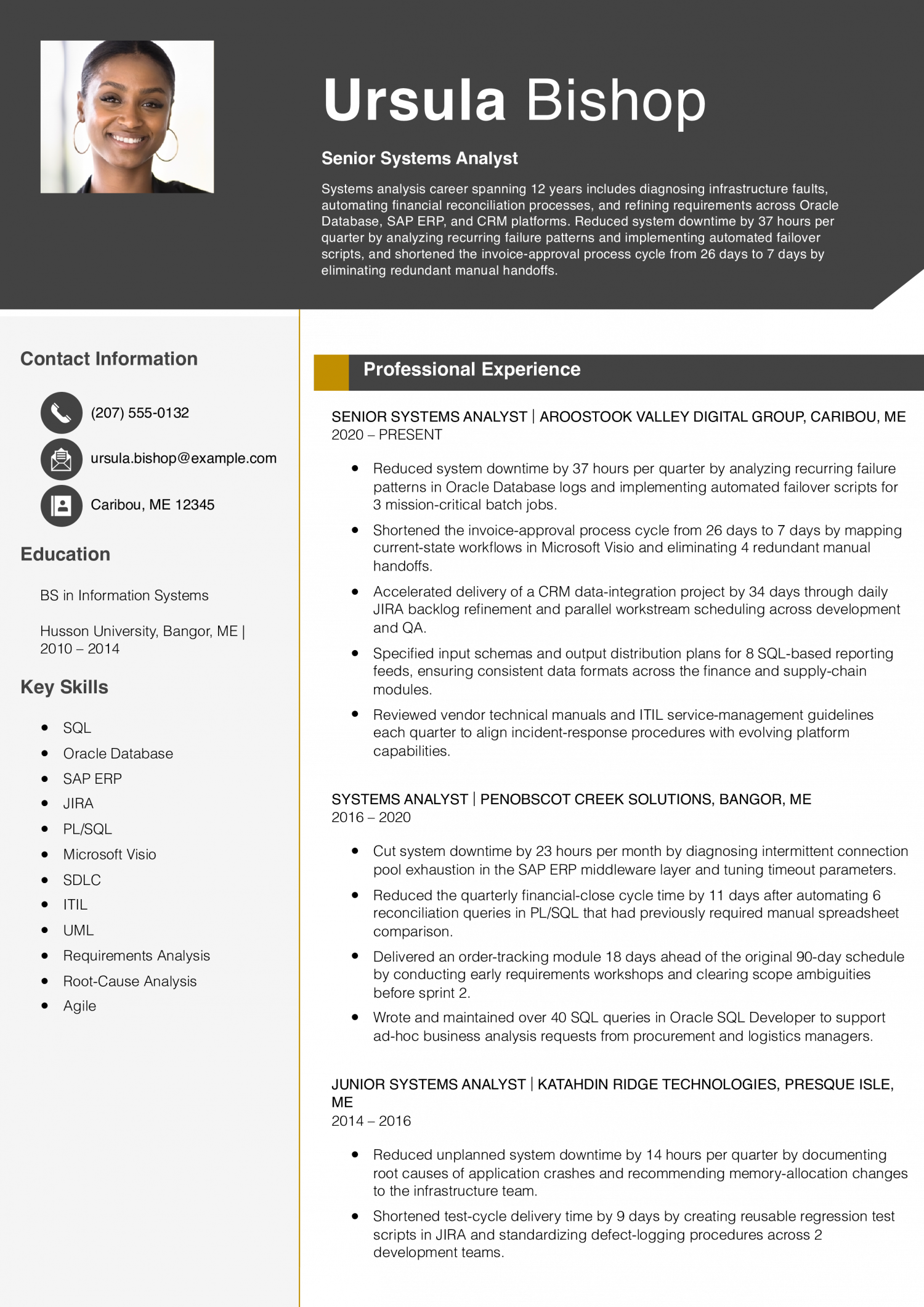
Lean on this resume if you are a senior systems analyst with roughly twelve years of experience across database, ERP, and integration projects. Hold each downtime reduction to the specific diagnostic action that caused it, the way every bullet here does.
Finishing early only means something when you state the original schedule and how much sooner you finished. Putting those two numbers together, as done here, lets a reader see how much time you saved compared with the full schedule. Give the original length beside the days you saved.
Experienced in migrating hundreds of thousands of records across Oracle, SQL Server, and SAP ERP platforms, achieving a 99.97% match rate when transferring archived transaction data. Over 6 years of analysis work spanning 10 departments, building integrations between CRM, ERP, and finance systems while authoring test procedures aligned with SDLC standards.
IT managers and application development directors can search for job titles and years of experience online. They cannot filter for the one thing that sets you apart. Lead your summary with that differentiator.
It might be a domain you know deeply, like healthcare claims or ERP migration. It could be fluency in a modeling language such as UML or BPMN. Name the platform pair you bridge, such as SAP and Salesforce.
A single specific line tells a reviewer you solve their problem, not a generic one. Place this line before any list of soft skills. It should be the first thing anyone reads on the page.
This focus gives your resume a clear opening that invites the reviewer to keep reading.
Strong systems analyst resumes tie each project to a measurable result. State how many users a new system served.
Note the percentage by which a process change cut ticket volume. You can also cite the dollar value of a project budget you managed. Most IT managers and application development directors scan for scale first.
Even internal projects carry numbers worth naming. A data migration that moved 2 million records in 48 hours says more than “led data migration.” Track cycle time reductions and error rate drops. Two metrics per bullet is a strong target.
Organize your experience bullets into clear categories. Requirements gathering is one group. Include interviews, workshops, and business requirements documents here.
System design is another group. Cover data flow diagrams and process models. Testing and validation form a third category.
Name the test plans you wrote and defects you tracked. Integration and deployment is a fourth area. Call out APIs you mapped and go-live dates you met.
Ongoing support rounds out the list. Mention SLAs, incident triage, or change requests you handled. Grouping by deliverable helps IT managers and application development directors see which project phases you own.
Put your certifications on page one, right below your summary. Name each one with the issuing organization on its own line. The CBAP or CCBA from IIBA signals business analysis depth.
The PMI-PBA from PMI shows project-level rigor. ITIL 4 Foundation from PeopleCert proves you understand service management. IT managers and application development directors often skim the top third of page one before reading further.
If your credentials are buried on page two, they may not see them. For tools, create a separate “Technical Skills” section. List databases, operating systems, and BI platforms there.
Keep each entry short and scannable.
State your degree, school name, and graduation year. A degree in information systems or computer science is common, but not universal. If your degree is in another field, pair it with a relevant certification from the section above.
Add coursework only when it fills a gap, like a database design class. Below education, include a “Projects” or “Professional Development” section if you have space. Capstone projects and volunteer system builds show applied skill.
Keep this section to three or four lines. IT managers and application development directors value proof of hands-on work over a long course list. End with items that reinforce your technical range.
Systems analyst hiring is tight in 2026. IT teams are running leaner, so the bar for each screen is higher.
IT managers and application development directors weigh hard skills like SQL first. They then look for soft skills such as critical thinking. Both types carry real weight in an ATS screen.
Hard skills prove you can do the technical work on day one. Soft skills show you can work across teams and handle change. A resume that covers both types scores higher in most filters.
Cross-check each table against your target posting. Weave matched hard skills into your job titles and tool lines. Then fold soft skills into your bullet results with clear metrics. Drop any skill from your resume that the posting does not name. That swap keeps your match rate high for each new role you target.
| Soft Skills | AI-estimated % |
|---|---|
| Stakeholder communication | 70% |
| Cross-functional collaboration | 61% |
| Analytical problem-solving | 49% |
| Translating technical concepts | 40% |
| Adaptability to change | 26% |
And here are the top hard skills showing up most often.
| Hard Skills | AI-estimated % |
|---|---|
| Systems requirements analysis | 65% |
| Business process modeling | 54% |
| Technical documentation writing | 40% |
| Gap analysis reporting | 36% |
| Systems integration testing | 26% |
Skill names and rankings come from an AI model grounded in U.S. Department of Labor occupation data for systems analysts, not from a count of systems analysts’ resumes built on ResumeTemplates.com.
AI skills are up first.
When it comes to AI, systems analyst resumes tend to fall into one of three patterns. You claim AI builds your data models for you. You leave it off and answer questions later in the call.
Or you describe the actual workflow: where AI drafts and where you verify. IT managers and application development directors can validate the third option. They will ask how you checked the output.
They will ask what you changed after review. Name the tool, name the task, and name your role in the loop. That framing fits how analysts already document processes.
It also matches how most teams talk about AI in practice. Keep it specific to tasks you have done.
What AI is actually changing for this role
Requirements gathering: AI can draft initial requirements from stakeholder transcripts, but you still validate each item against business rules.
Data mapping: AI tools suggest field-level mappings between source and target systems, though analysts must confirm logic and exceptions.
Gap analysis: Large language models can compare feature lists across platforms, yet you interpret which gaps carry real business risk.
Test case creation: AI generates baseline test scripts from requirements documents, and you refine edge cases that the model overlooks.
Vendor evaluation: AI can summarize vendor documentation into comparison matrices, but analysts verify pricing tiers and contract terms.
AI tools to name
How to phrase AI on your resume
Do
Skip
IT managers and application development directors scan for tools fast. They want proof you can map processes to code. A strong tech stack section makes that proof visible.
A degree and hands-on project work keep you eligible for most systems analyst roles. The credentials below show IT managers and application development directors how deep your analysis skills run. They also help sort you by tier for complex projects.
List each credential with the issuing body, the date you earned it, and the level if one applies. Place the block after your skills section so it stands out on a quick read. Not every posting asks for the same ones, so match what you list to each job ad.
Systems analyst is one of the larger occupations tracked by BLS, which means the median pulls in a long tail of entry-tier and help-desk-adjacent variants. Workers near the top out-earn the median by roughly 58 percent.
Workers near the bottom sit about 36 percent below it. That range matters when you write your resume. Lead with the specific platforms you have configured or migrated, not a generic list of technical skills.
IT managers and application development directors scan for project scope and system names first.
| # | State | Median Annual |
|---|---|---|
| 1 | Rhode Island | $134,630 |
| 2 | Washington | $129,410 |
| 3 | Massachusetts | $128,240 |
| 4 | Colorado | $127,750 |
| 5 | California | $127,720 |
| 6 | New Jersey | $122,890 |
| 7 | Oregon | $121,620 |
| 8 | Virginia | $120,840 |
| 9 | District of Columbia | $116,820 |
| 10 | Maryland | $113,610 |
| # | State | Workers | Median |
|---|---|---|---|
| 1 | California | 59,060 | $127,720 |
| 2 | Texas | 47,990 | $107,390 |
| 3 | Florida | 35,270 | $101,900 |
| 4 | Washington | 24,120 | $129,410 |
| 5 | New York | 24,100 | $109,610 |
Resume Templates offers HR approved resume templates to help you create a professional resume in minutes. Choose from several template options and even pre-populate a resume from your profile.
Lead with a summary that names the tools you used in coursework or internships. List academic projects where you gathered requirements or mapped workflows. IT managers look for applied skills, so frame each project as a problem you helped solve.
One page works well for fewer than ten years of relevant work. A two-page resume is fine beyond that point if every bullet ties to a measurable result. Cut older roles to two or three lines so recent projects get the most space.
Yes, list it in your certifications section if the posting mentions service management or change management. ITIL 4 Foundation, issued by PeopleCert, signals that you understand incident and release workflows. Place it below any senior credential so the strongest one leads.
A business systems analyst resume stresses stakeholder interviews and process modeling. A general systems analyst resume leans more toward technical design and integration testing. Read the posting title carefully and mirror its language in your summary and bullet points.
List each contract under one consulting header with the staffing firm named. Add the client name and project scope for every engagement. Application development directors want to see that you delivered on time across varied environments.
Note any relevant activity during the gap, such as earning a certification or completing a data analytics course. Place those entries in a professional development section between experience and education. A brief gap with visible skill growth raises fewer questions than a longer one left blank.
No, most employers in the United States expect a standard resume rather than a multi-page CV. A CV is more common in academic or government research settings outside the U.S. If you are applying to a U.S.
company, keep the document to one or two focused pages.
An ATS-friendly template lets IT managers find your certifications and project work right away. A basic template handles this role well too.
Systems Analyst Resume
4.3/5 stars with 121 reviews

Executive Resume Writer and Career Coach
Andrew Stoner is an executive career coach and resume writer with 17 years of experience as a hiring manager and operations leader at two Fortune 500 Financial Services companies, and as the career services director at two major university business schools.
© 2026 Resumetemplates.com All rights reserved.