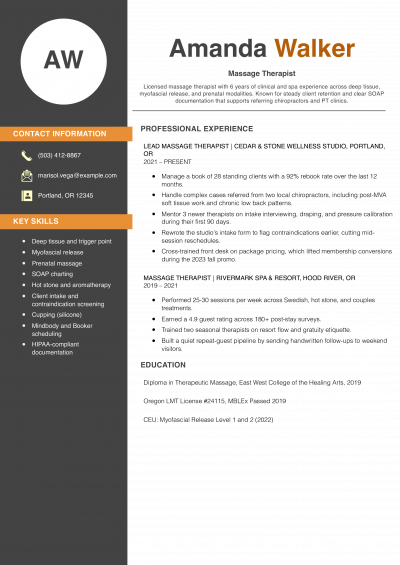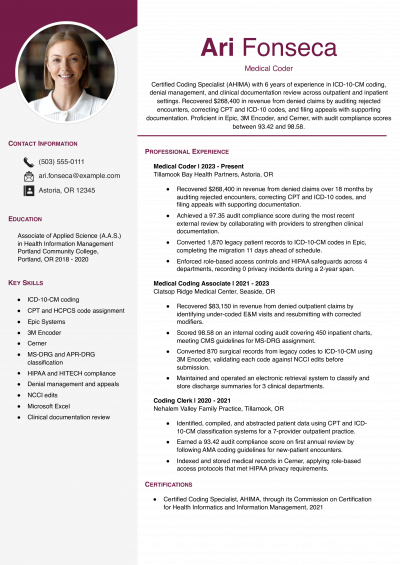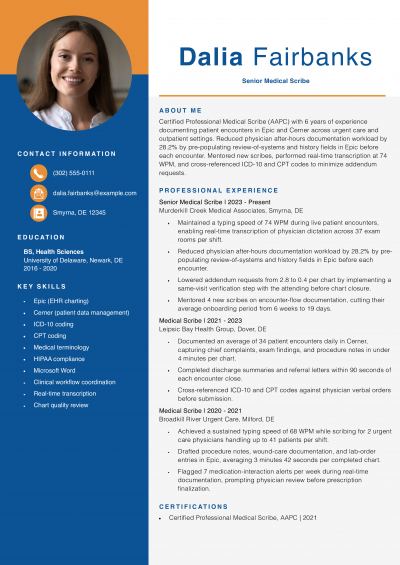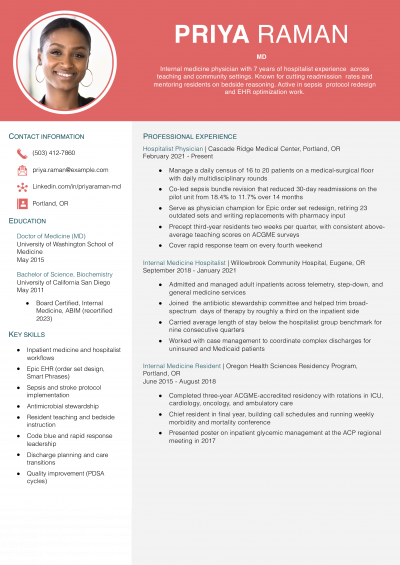
Medical Resume Examples and Templates for 2026



Practice managers want to see your certification status, EHR system, and daily patient volume in the top third of the resume, because that tells them in under a minute whether you can room patients on day one.
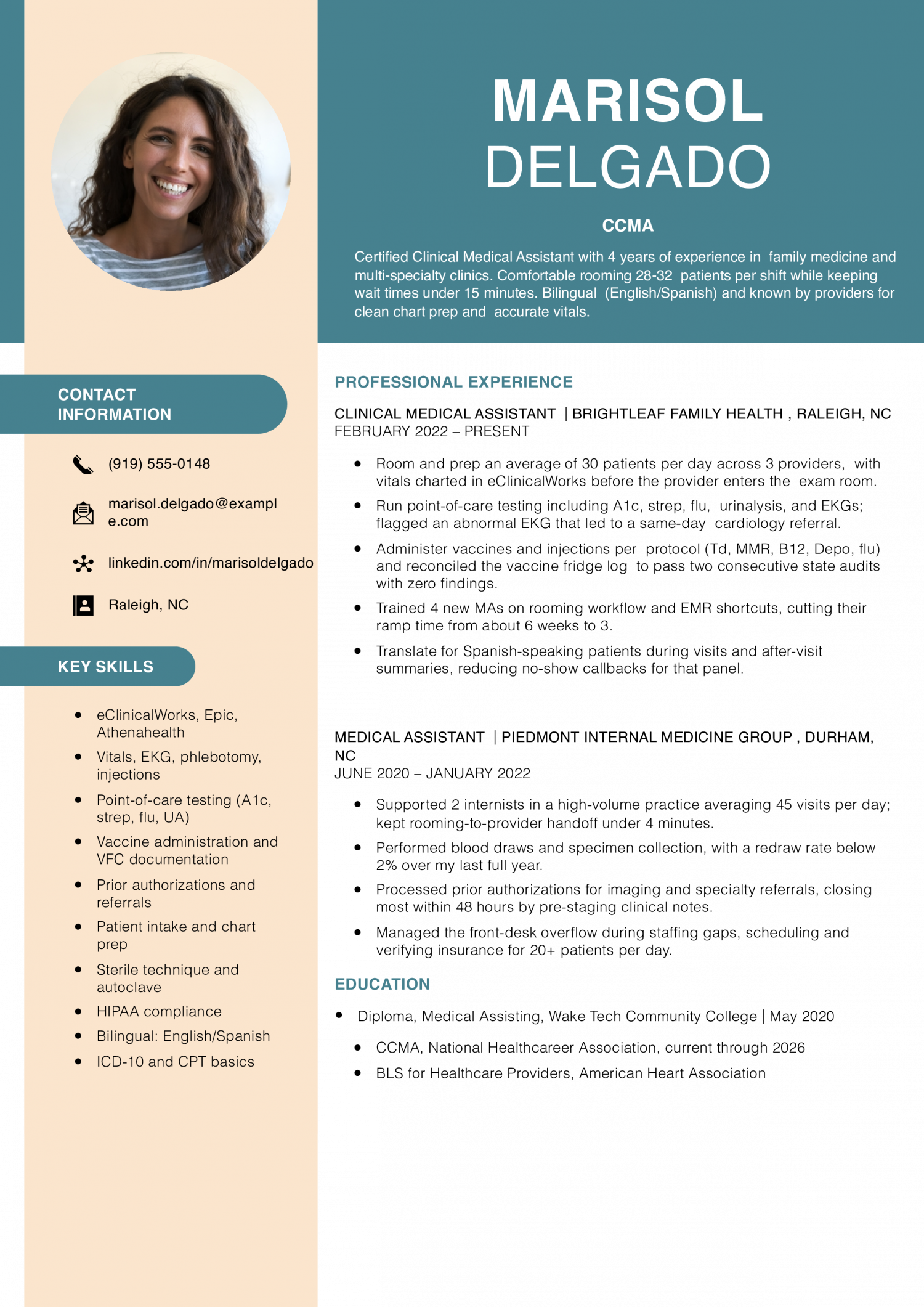
You finished an accredited MA program in the last year or two and need to show clinical hours, externship rotations, and any CMA, RMA, or CCMA exam status. The resume has to prove you can room patients and document in an EHR on day one.
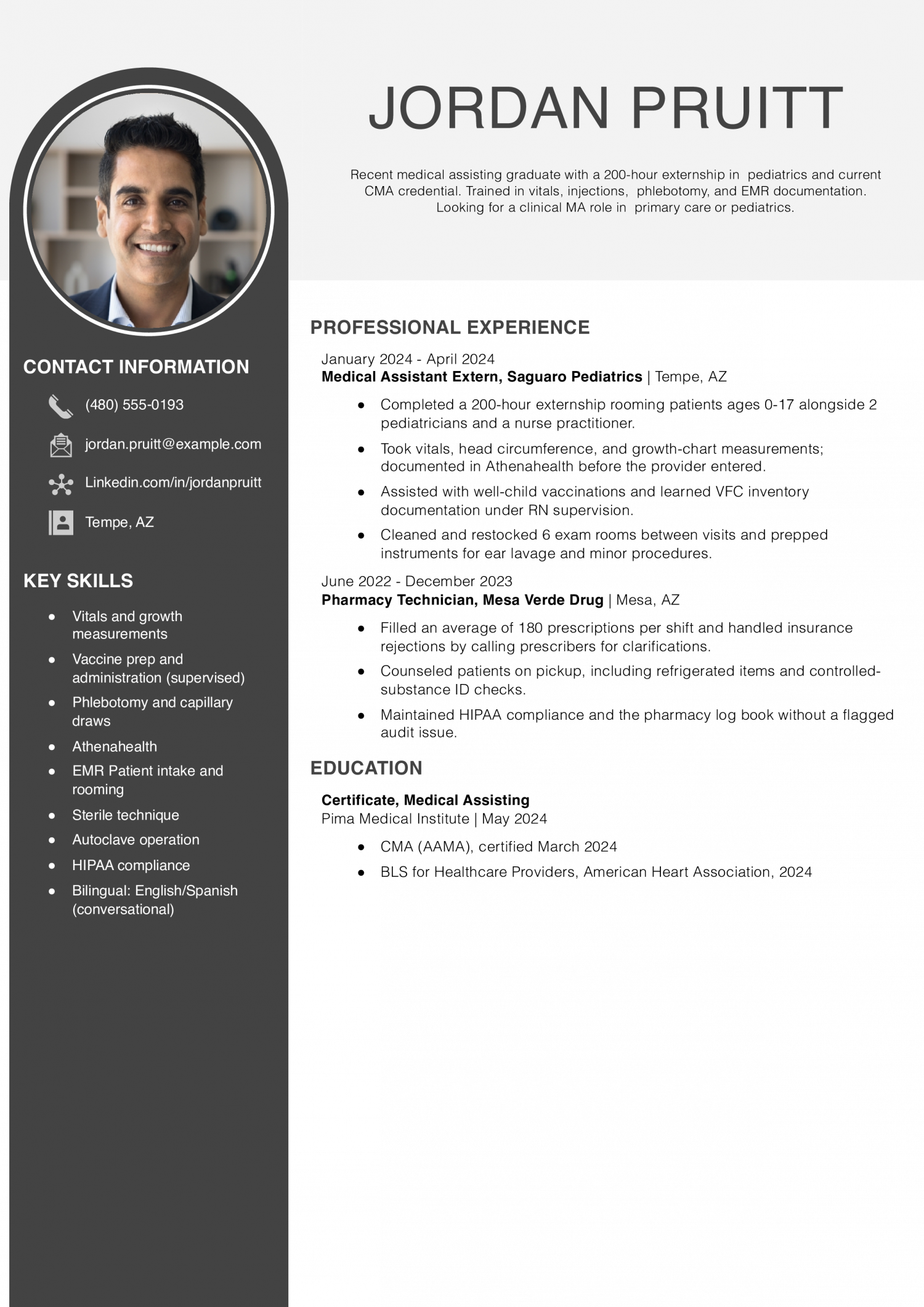
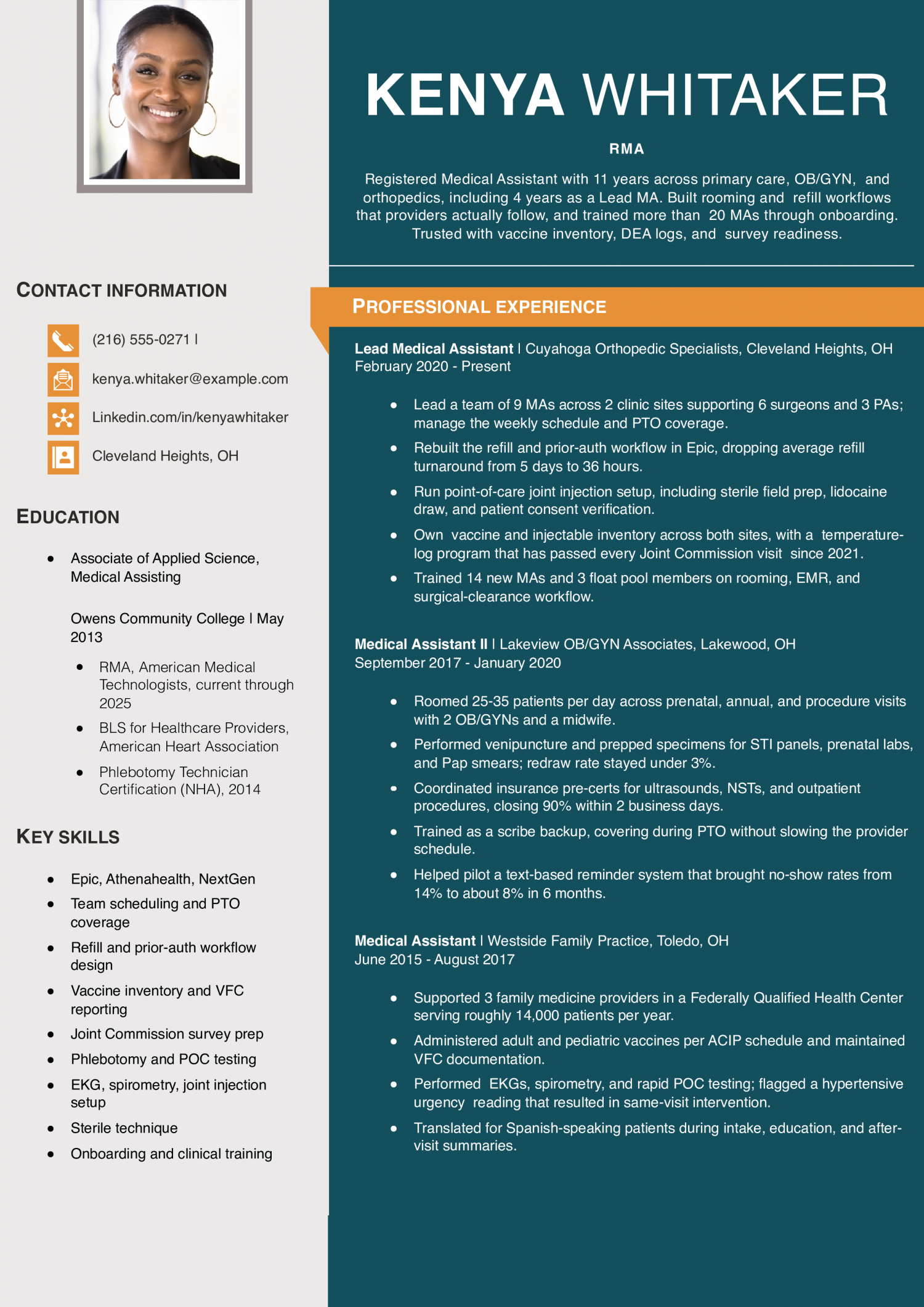
You have two or more years rooming patients, drawing labs, and managing front-desk flow across a multi-provider clinic. The resume needs to show patient volume, specialty exposure, and the EHR systems you own without supervision.
Aaliyah Robinson, CCMA
Charlotte, NC | (704) 555-0162 | [email protected] | linkedin.com/in/aaliyahrobinson
Certified Clinical Medical Assistant with 7 years of outpatient experience across internal medicine, dermatology, and cardiology. Comfortable supporting 3-4 providers at once, with a steady track record on vitals accuracy, vaccine documentation, and prior-auth turnaround. Known for staying calm during double-booked schedules and walk-ins.
Senior Medical Assistant
Queen City Cardiology Associates | Charlotte, NC | 2022-Present
Medical Assistant
Carolinas Dermatology Partners | Matthews, NC | 2019-2022
Medical Assistant
Tryon Internal Medicine | Charlotte, NC | 2017-2019
Medical Assistant
Catawba Valley Urgent Care | Hickory, NC | 2016-2017
Start with a line a practice manager cannot pull from a CMA registry. Name the EHR you run, the specialty you trained in, or the patient volume you carry per shift.
Bilingual Spanish or Vietnamese fluency, phlebotomy add-on certification, EKG competency, and pediatric or geriatric specialty exposure all read as differentiation. Practice managers running a busy family medicine clinic care more about Epic fluency at 30 patients a day than the certification line itself, since the credential is table stakes.
Bullets without a number tend to read as a job description. Practice managers and physicians scan for patient volume, provider count, and visit type.
Strong medical assistant bullets name three metrics: patients roomed per shift, providers supported, and visit-type mix. Try ‘Roomed 28 to 35 patients per shift across four providers in a family medicine clinic’ or ‘Drew 40 venipunctures weekly with a 95% first-stick success rate.’ Volume language works when exact counts are not tracked.
Mushing vitals and scheduling into one block hides your range. Group your bullets so a reader sees both sides fast.
Use four buckets: clinical procedures (vitals, injections, EKGs, phlebotomy, point-of-care testing), patient flow (rooming, history intake, chart prep), administration (scheduling, insurance verification, prior authorization, ICD-10 and CPT coding), and EHR documentation. Name the CLIA-waived tests you ran, such as rapid strep, urinalysis, glucose, and flu swabs. If you spend much of your day on coding and billing, see our medical billing and coding resume examples for ways to present that work.
Credentials drive the first filter, so put them on page one in a credentials block under your headline. List CMA (AAMA), RMA (AMT), or CCMA (NHA) with the issuing body, plus BLS or CPR with expiration month and year.
Add EHR and clinical software on the same page: Epic, Cerner, Athenahealth, eClinicalWorks, NextGen, or Allscripts. Practice managers and physicians need this visible early because it tells them whether you can start charting without a two-week ramp.
For entry and mid-level medical assistants, education carries real weight. List your CAAHEP or ABHES accredited program, graduation month, and externship site with hours logged and procedures performed.
Add continuing education in a short section: phlebotomy workshops, EKG refreshers, vaccine administration training, or specialty modules in pediatrics or OB-GYN. Note that CMA recertification runs 60 hours every five years, and listing recent CE hours signals you are current and recertification-ready.
The skills below come from medical assistant resumes our users built on ResumeTemplates.com. Practice managers and physicians scan dozens of resumes a week, and these are the skills that show up most often. Hard skills like Epic charting and phlebotomy clear the keyword filter.
Soft skills like patient rapport back up the bullets where you name volume and acuity. Match the hard skills against the posting, then use the soft skills as evidence tied to a specific bullet rather than a standalone list.
| Soft Skills | % of resumes with this skill |
|---|---|
| Patient communication | 76% |
| Empathy and compassion | 68% |
| Attention to detail | 50% |
| Time management | 35% |
| Problem-solving | 25% |
And here are the top hard skills showing up most often.
| Hard Skills | % of resumes with this skill |
|---|---|
| Vital signs measurement | 71% |
| Electronic health records | 66% |
| Phlebotomy | 42% |
| Medical terminology | 39% |
| Appointment scheduling | 34% |
Based on data from thousands of medical assistants’ resumes built on ResumeTemplates.com, May 2026.
These are the credentials, software, and compliance signals hiring teams look for when scanning a medical assistant resume.
CMA recertification runs 60 hours every five years through the AAMA. Listing recent CE hours signals you are tracking the clock and current on clinical practice.
Add a short CE section under your credentials block. Name the topic, hours, and the year, and follow your state board’s specific requirements rather than a generic count.
EHR fluency is the second filter after certification. Name the systems by brand so the ATS catches the keyword and the practice manager sees you can chart on day one.
HIPAA fluency is assumed, but a short line on training and audit experience reads as a green flag to practice managers worried about chart access and patient privacy.
Add one line in your credentials or skills block noting your most recent HIPAA training year. If you handled minimum-necessary access reviews or chart audits, name that scope in a bullet under the relevant job.
A CMA or RMA and current BLS keep you eligible. The certifications below are what move a medical assistant resume from the qualified-but-typical stack into a practice manager’s shortlist. List each with the issuing body and expiration month and year.
Allied health add-ons widen the scope a practice manager can hand you. Listing two or three of these alongside your CMA or RMA tells the reader you can flex across roles when the schedule gets thin.
Medical assistant is one of the larger occupations in BLS, which means the median pulls in a long tail of uncertified and part-time variants working in small private practices. Pay separates fast once you cross into hospital systems, specialty clinics, and certified roles. To position above the median, lead the resume with your certification status, EHR system, and patient volume rather than a generic duties summary.
The clinics paying at the top of the band are filtering for proof you can run a panel, not a description of what an MA does.
| # | State | Avg. Annual |
|---|---|---|
| 1 | Washington | $55,120 |
| 2 | Alaska | $51,860 |
| 3 | Oregon | $49,900 |
| 4 | District of Columbia | $49,740 |
| 5 | Minnesota | $49,380 |
| 6 | Hawaii | $48,820 |
| 7 | Massachusetts | $48,540 |
| 8 | California | $48,050 |
| 9 | New Hampshire | $48,040 |
| 10 | Wisconsin | $47,610 |
| # | State | Workers | Median |
|---|---|---|---|
| 1 | California | 110,350 | $48,050 |
| 2 | Texas | 72,280 | $38,930 |
| 3 | Florida | 59,870 | $41,380 |
| 4 | New York | 39,250 | $46,040 |
| 5 | Georgia | 26,800 | $39,000 |
Resume Templates offers HR approved resume templates to help you create a professional resume in minutes. Choose from several template options and even pre-populate a resume from your profile.
Pull keywords directly from the job posting and mirror the exact phrasing. If the posting says 'EMR,' write EMR, not EHR.
Layer in role-standard terms: CMA or RMA, vital signs, phlebotomy, injections, EKG, rooming, ICD-10, CPT, prior authorization, and the EHR brand (Epic, Cerner, Athenahealth, eClinicalWorks).
Add CLIA-waived test names you ran, such as rapid strep, urinalysis, and glucose. These read as specific evidence, not filler.
Lead with your CAAHEP or ABHES accredited program and graduation date. List your externship site, total hours, and the procedures you performed.
Write the externship as a job entry, not a course note. Use bullets with patient volume, EHR used, and the visit types you supported.
Add CMA or RMA exam status (passed, scheduled, or eligible) and current BLS in the credentials block on page one.
Yes. Splitting them shows range and helps a practice manager see both sides in one scan.
Under each job, use two sub-headers or two bullet groups: clinical (vitals, injections, EKG, phlebotomy, point-of-care testing) and administrative (scheduling, insurance verification, ICD-10 and CPT coding, EHR documentation).
Clinics hiring for a back-office-only or front-office-only role will scan straight to the group that matches. You stay in the running for both.
Be direct about the status. Write 'CMA (AAMA), recertification scheduled [month, year]' or 'CMA exam eligible, sitting [month, year].'
If your CMA lapsed, list the original certification date and the recertification month you have booked. Pair it with current BLS to signal you stayed clinically active.
Silence reads worse than a lapse with a plan. Practice managers will pass on a resume that omits status over one that names a recertification date.
For a medical assistant, an ATS-friendly template is the safest pick, because it puts your certifications and experience where a hiring manager scans first. A basic template is a solid alternative. Whichever you choose, keep the formatting clean and easy to parse: clear section headings, a standard font, and no graphics a parser can choke on.
Executive Resume Writer and Career Coach
Andrew Stoner is an executive career coach and resume writer with 17 years of experience as a hiring manager and operations leader at two Fortune 500 Financial Services companies, and as the career services director at two major university business schools.