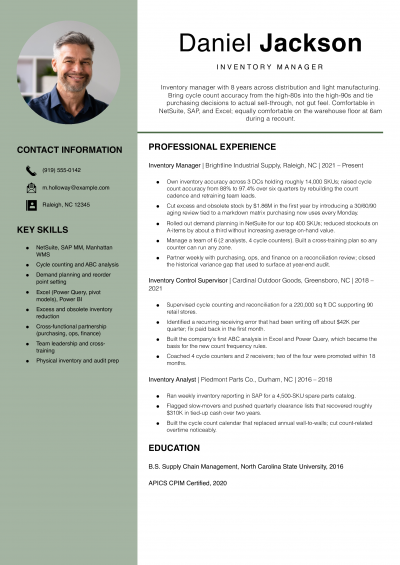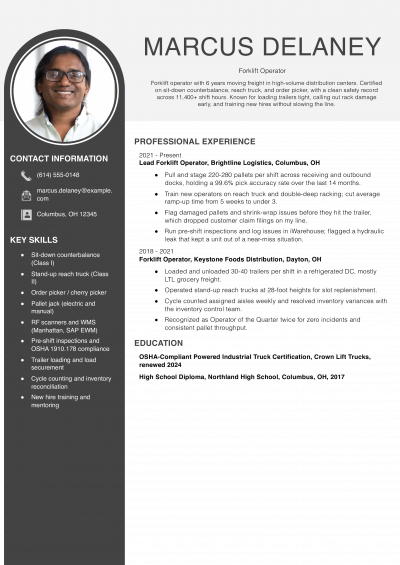
Forklift Operator Resume Examples and Templates for 2026



Warehouse supervisors and logistics managers decide whether to keep reading by the top third of page one; if forklift certification, equipment operated, and shift availability aren't clear by then, the resume moves to the reject pile.
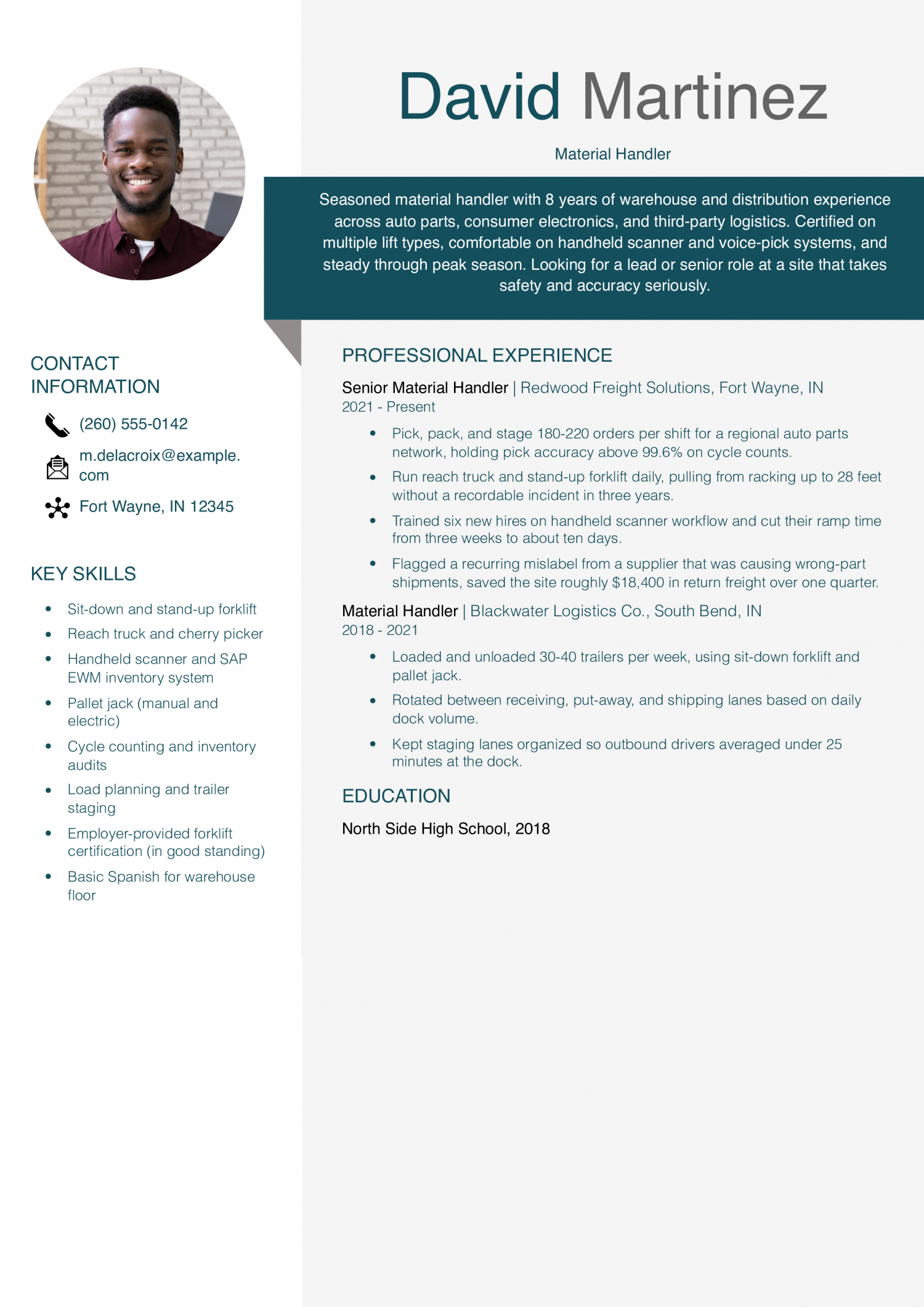
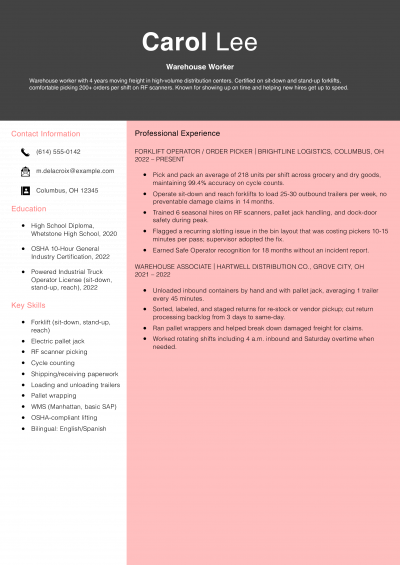
This resume fits a Material Handler moving pallets, picking orders, and running a forklift on a warehouse floor. It has to prove safe equipment use, accurate counts, and steady output against daily pick or load targets.
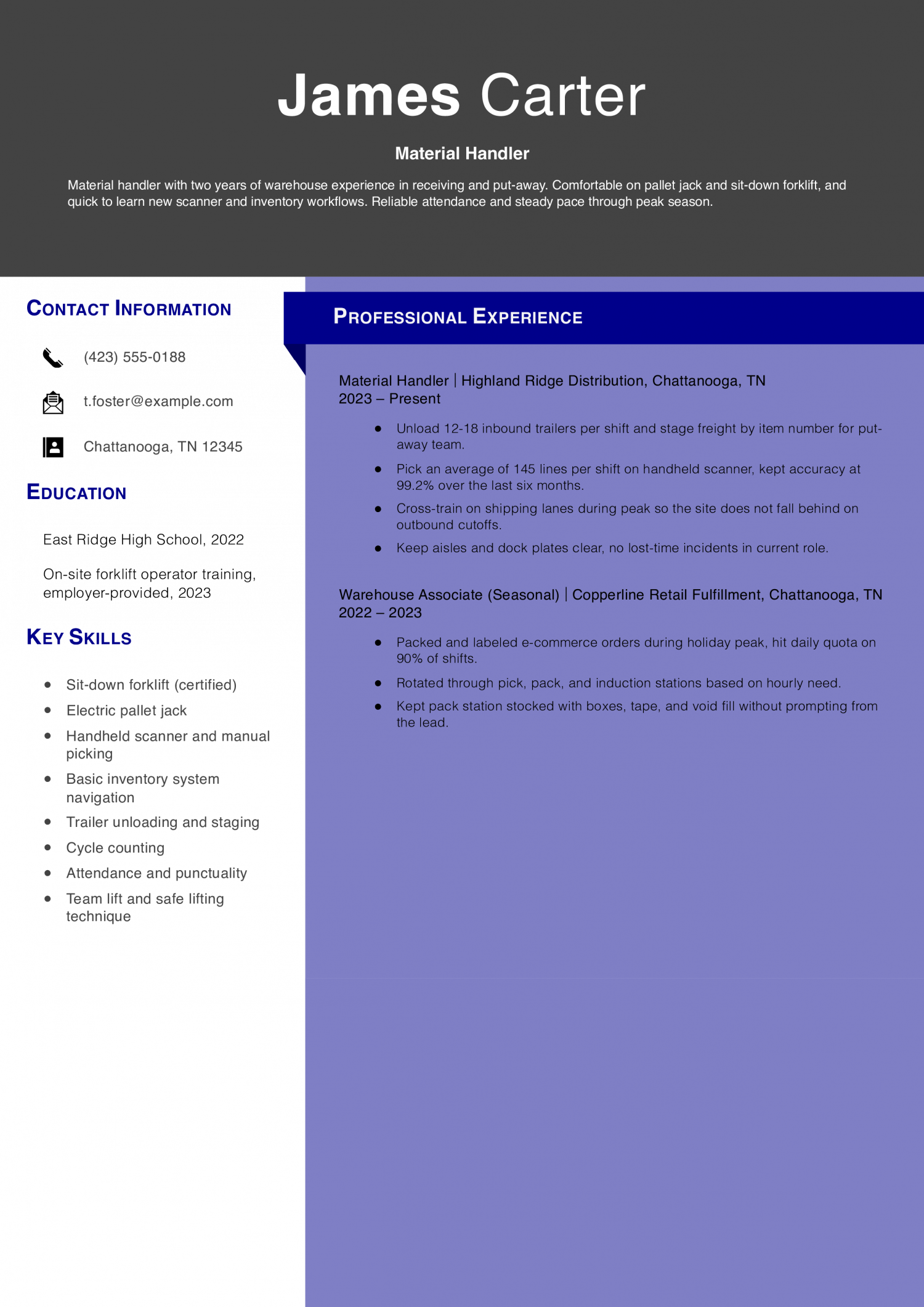
This resume fits a Senior Material Handler or Lead who trains new hires and runs a zone or shift. It has to prove that you own inventory accuracy, coach safe practice, and keep a crew hitting shift goals.
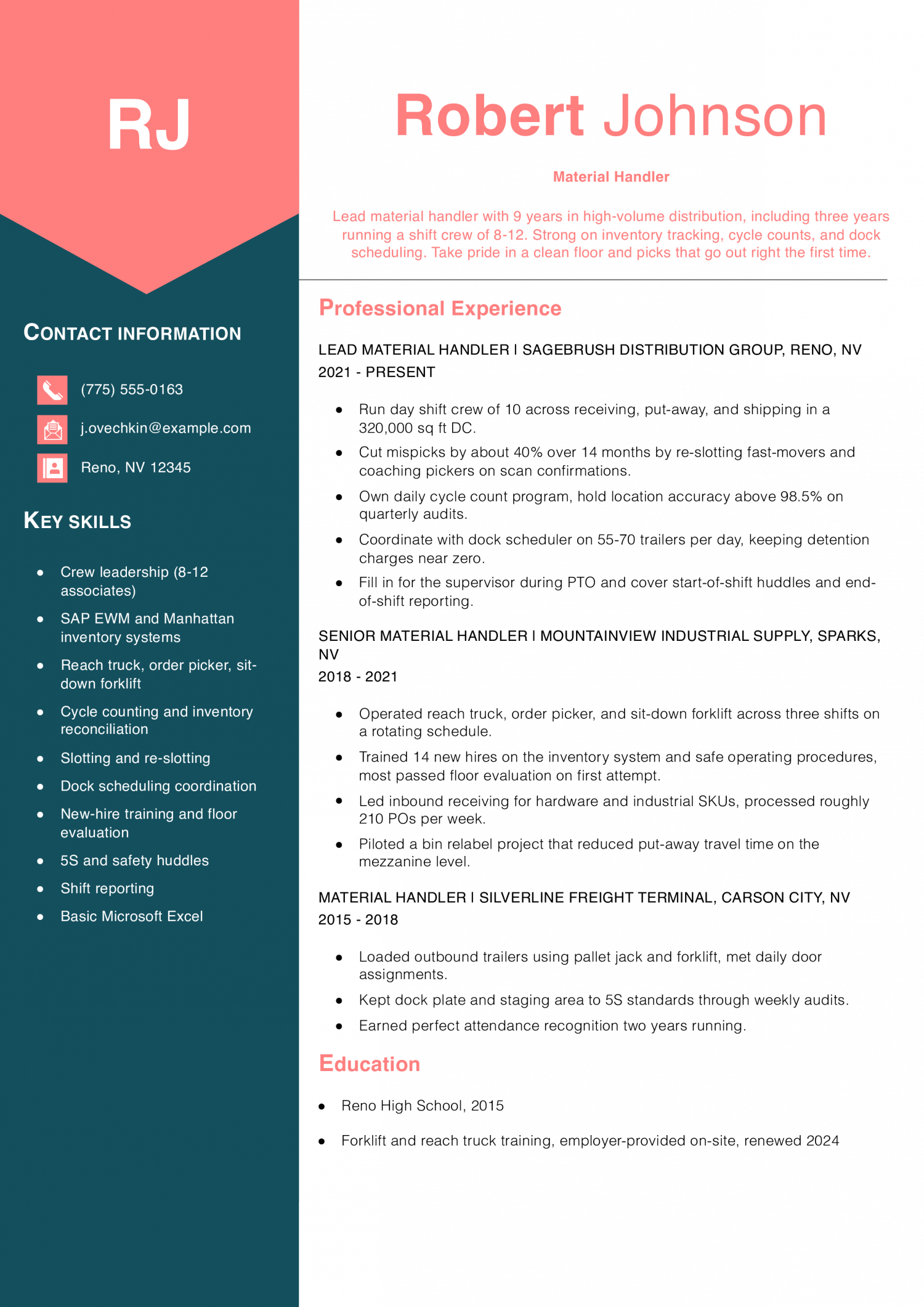
This resume fits a Warehouse Supervisor running a full shift, a department, or a distribution site. It has to prove staffing, safety compliance, and cost or throughput results across receiving, storage, and outbound shipping.
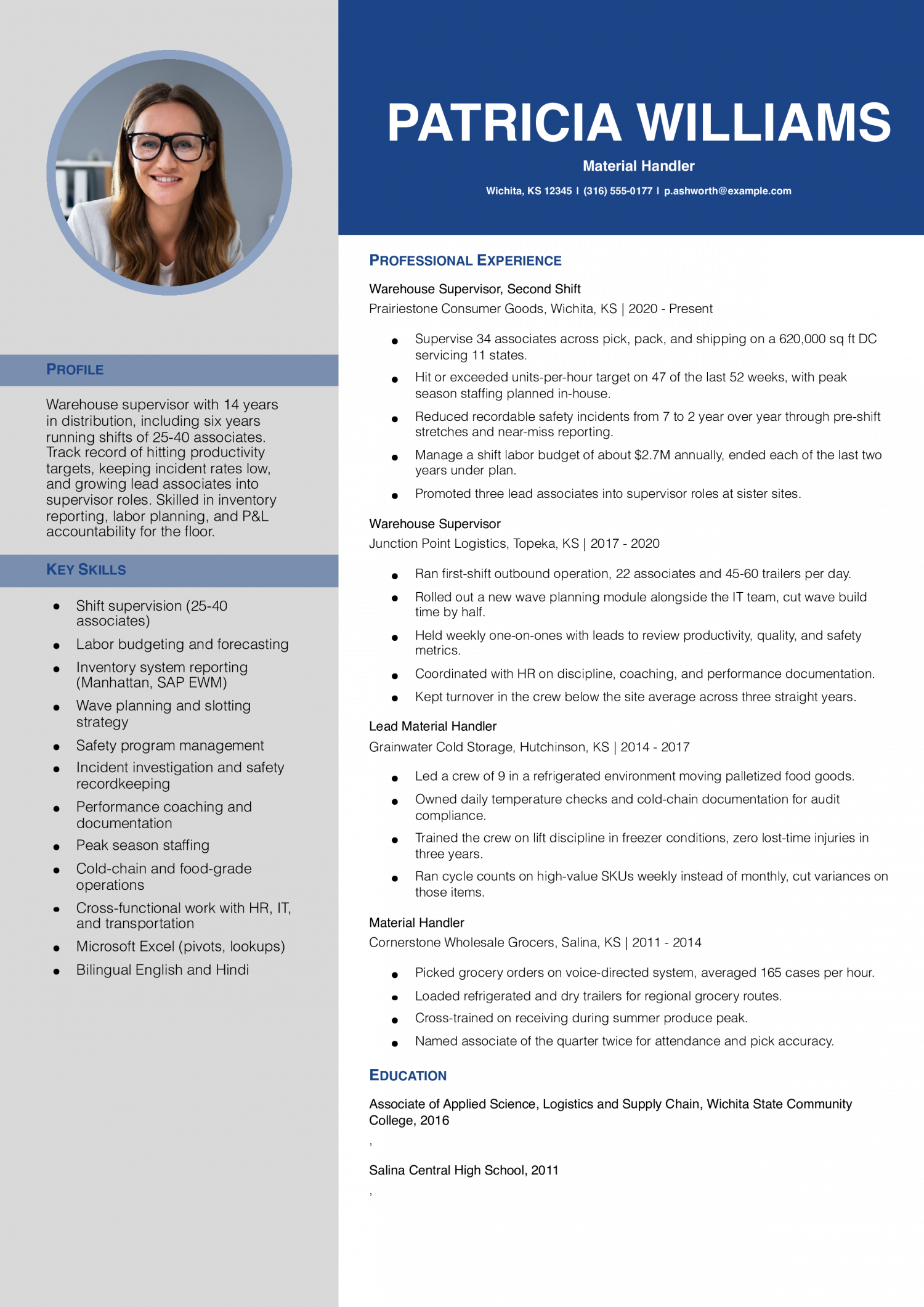
Devon Kaltenbach
Grand Rapids, MI | (616) 555-0134 | [email protected] | linkedin.com/in/devonkaltenbach
Eight-year warehouse veteran with receiving, put-away, and shipping experience across electronics, third-party logistics, and auto parts freight. Runs reach truck and stand-up forklift daily, steps in as backup lead when needed, and mentors new hires through structured floor training. Targeting a lead or senior handler role at a site that takes safety and accuracy seriously.
Senior Material Handler
Northbrook Distribution Partners | Grand Rapids, MI | 2022-Present
Material Handler
Ironwood 3PL Services | Kalamazoo, MI | 2019-2022
Warehouse Associate
Lakeside Auto Parts Warehouse | Muskegon, MI | 2017-2019
Warehouse Associate (Entry)
Bayfront Consumer Fulfillment | Holland, MI | 2016-2017
The first line of your summary should name daily units moved, pick rate, or order accuracy percentage. Warehouse supervisors and logistics managers read that number as your readiness to hit their floor pace. Lead with something like 300 orders picked per shift at 99.8 percent accuracy.
Follow it with the equipment class you run and the warehouse system you know. Skip vague scope lines like hardworking team player with warehouse background. That reads as filler to a supervisor scanning 40 resumes for a Monday start.
A metric-first opener also anchors the bullets underneath, since your work history has to back the claim. Save soft traits for the last clause of the summary, if at all.
Material handling is a metric-heavy floor, so most strong resumes carry two or three real numbers per role. Recruiters scan for pick rate, order accuracy, units per hour, and safety incident count first. A bullet without a number tends to read as a duty, not a result.
Write picked and packed 220 orders per 8-hour shift at 99.5 percent accuracy, not responsible for order fulfillment. Name the scanner or pick method you hit those numbers on, since pace on a handheld differs from voice-pick. Include load and unload counts, pallet volume per day, and cycle count variance if you have it.
Round honestly. Inflated numbers get caught in the working interview or the first week on the dock.
Sort your bullets into four buckets so a supervisor can scan them in 20 seconds. First, receiving and put-away: inbound trailers unloaded, pallets staged, and locations verified. Second, picking and packing: order volume, method used, and accuracy rate.
Third, equipment operation: sit-down forklift, reach truck, order picker, pallet jack, and cherry picker. Fourth, inventory and cycle counts: shrinkage rate, count frequency, and variance resolved. Under each bucket, name the warehouse system you worked in, such as SAP, Manhattan, HighJump, or Oracle.
Keep verbs concrete: loaded, staged, wrapped, scanned, cycled. Avoid a jargon wall by picking your two strongest bullets per bucket. Bullets that read as a task list without volume tend to get skipped.
Warehouse supervisors and logistics managers need to see forklift and safety credentials before they read your bullets. Put a short credentials block on page one, right under the summary. List any safety training you hold, plus your forklift class certifications by number: Class I sit-down, Class II reach, Class III pallet jack, Class IV or V.
Note the issuing employer or training provider and the year. Add freight or port credentials if the posting calls for them. Requirements vary by employer and site, so match the posting language when you can.
Software goes in the same block or a short tools line: SAP EWM, Manhattan, HighJump, handheld scanners, and voice-pick systems. Do not bury these in a paragraph.
Close the resume with a short education section and a physical scope line. A high school diploma or equivalent is the common baseline for material handler roles, though this varies by employer. List any technical school coursework in logistics, supply chain, or industrial equipment.
If you finished a forklift training program through a staffing agency or community college, name it here. Add a one-line note on shift availability: first, second, third, weekends, or rotating. Warehouse supervisors staff around coverage gaps, so shift flexibility reads as immediate value.
Close with a physical scope line naming lift capacity and stand time, such as lifts 50 pounds repeatedly and stands 8 to 10 hours per shift. That answers a question the supervisor asks in the phone screen anyway.
The material handler resumes that get callbacks share a specific skill mix. Warehouse supervisors and logistics managers scan for these patterns first, not generic teamwork lines. Check each list against the specific posting, since warehouse job ads differ in what they emphasize.
Hard skills carry more weight here than in most roles. Forklift operation and pick rates get you past the first screen. Soft skills like safety awareness back up your bullets and confirm the numbers.
Pull the hard skills that appear in your target posting and mirror the exact wording. Add soft skills only where a bullet proves you used them on shift. Drop any item you cannot support with a shift metric or example.
Keep the section tight. Six to ten total keywords is plenty for a one-page resume. Move anything else into your work history where the context makes it real.
| Soft Skills | AI-estimated % |
|---|---|
| Physical stamina | 74% |
| Team coordination | 53% |
| Safety compliance mindset | 41% |
| Attention to detail | 38% |
| Dependability under pressure | 26% |
And here are the top hard skills showing up most often.
| Hard Skills | AI-estimated % |
|---|---|
| Freight loading and unloading | 79% |
| Inventory cycle counting | 66% |
| Pallet jack operation | 42% |
| Shipment label verification | 39% |
| Warehouse receiving procedures | 30% |
Skill names and rankings come from an AI model grounded in U.S. Department of Labor occupation data for material handlers, not from a count of material handlers’ resumes built on ResumeTemplates.com.
The 90th-percentile Material Handler out-earns the median by roughly 37 percent, while the bottom tenth sits about 22 percent under it. That is a wide spread for a role with a large national headcount. It signals that the market rewards equipment range, shift flexibility, and sites that run high-volume freight.
Years on a pallet jack alone will not carry a resume into the top band. Warehouse supervisors and logistics managers read for the machines you are certified on and the throughput you have moved. Lead with the equipment you run, the WMS you use, and the daily case or pallet counts from your busiest shifts.
| # | State | Median Annual |
|---|---|---|
| 1 | Minnesota | $46,280 |
| 2 | Washington | $46,190 |
| 3 | District of Columbia | $45,740 |
| 4 | North Dakota | $45,690 |
| 5 | Colorado | $45,370 |
| 6 | Massachusetts | $44,920 |
| 7 | Oregon | $44,750 |
| 8 | California | $44,710 |
| 9 | New York | $44,630 |
| 10 | Wisconsin | $44,610 |
| # | State | Workers | Median |
|---|---|---|---|
| 1 | California | 355,500 | $44,710 |
| 2 | Texas | 216,970 | $37,540 |
| 3 | Illinois | 195,390 | $40,550 |
| 4 | Florida | 164,400 | $38,160 |
| 5 | Georgia | 137,580 | $38,480 |
Resume Templates offers HR approved resume templates to help you create a professional resume in minutes. Choose from several template options and even pre-populate a resume from your profile.
Name the goods, the equipment, and the volume in one line. Write "moved 400 pallets per shift using a sit-down forklift and pallet jack" rather than "handled material."
Warehouse supervisors need to picture the dock, the load, and the pace before they call you.
List receiving, put-away, picking, packing, loading, and cycle counts, in the order your shift actually ran them. Attach a number to each duty: cases per hour, pallets per shift, or scan accuracy percentage.
Skip generic lines like "kept work area clean" unless a safety audit score backs them up.
Yes, put the class of truck and the issue date in a certifications block near the top. Write "sit-down counterbalance and reach truck, certified March 2024" so a supervisor sees the class right away.
Employers recertify every three years, so a fresh date matters more than the training vendor.
Put the agency as your employer and the client site in the role description below. Write "Aerotek, assigned to Home Depot distribution center, Atlanta" so the resume covers the gap between assignments.
Group short stints under one agency heading when they lasted under 90 days each.
Split the section into equipment, systems, and safety, with three or four items in each. Under equipment list the trucks you drive; under systems name the scanner or inventory software you used; under safety list lockout, load securement, and hazmat familiarity.
A supervisor scans these before reading a single bullet point.
Yes, bring one to the interview even when the online form does not request it. Logistics managers use the resume to compare shift history and equipment across finalists in the room.
A one-page sheet with dates, sites, and trucks driven often decides the callback.
Lead with any job that involved lifting, inventory, or shift work: retail stock, moving crews, or grocery receiving all count. Name the weights you moved, the hours you worked, and any handheld scanner or POS system you used.
Add a short line stating you are willing to train for a forklift certification on hire.
For a material handler, an ATS-friendly template is the safest pick, because it puts your certifications and experience where a hiring manager scans first. A basic template is a solid alternative. Whichever you choose, keep the formatting clean and easy to parse: clear section headings, a standard font, and no graphics a parser can choke on.
Executive Resume Writer and Career Coach
Andrew Stoner is an executive career coach and resume writer with 17 years of experience as a hiring manager and operations leader at two Fortune 500 Financial Services companies, and as the career services director at two major university business schools.
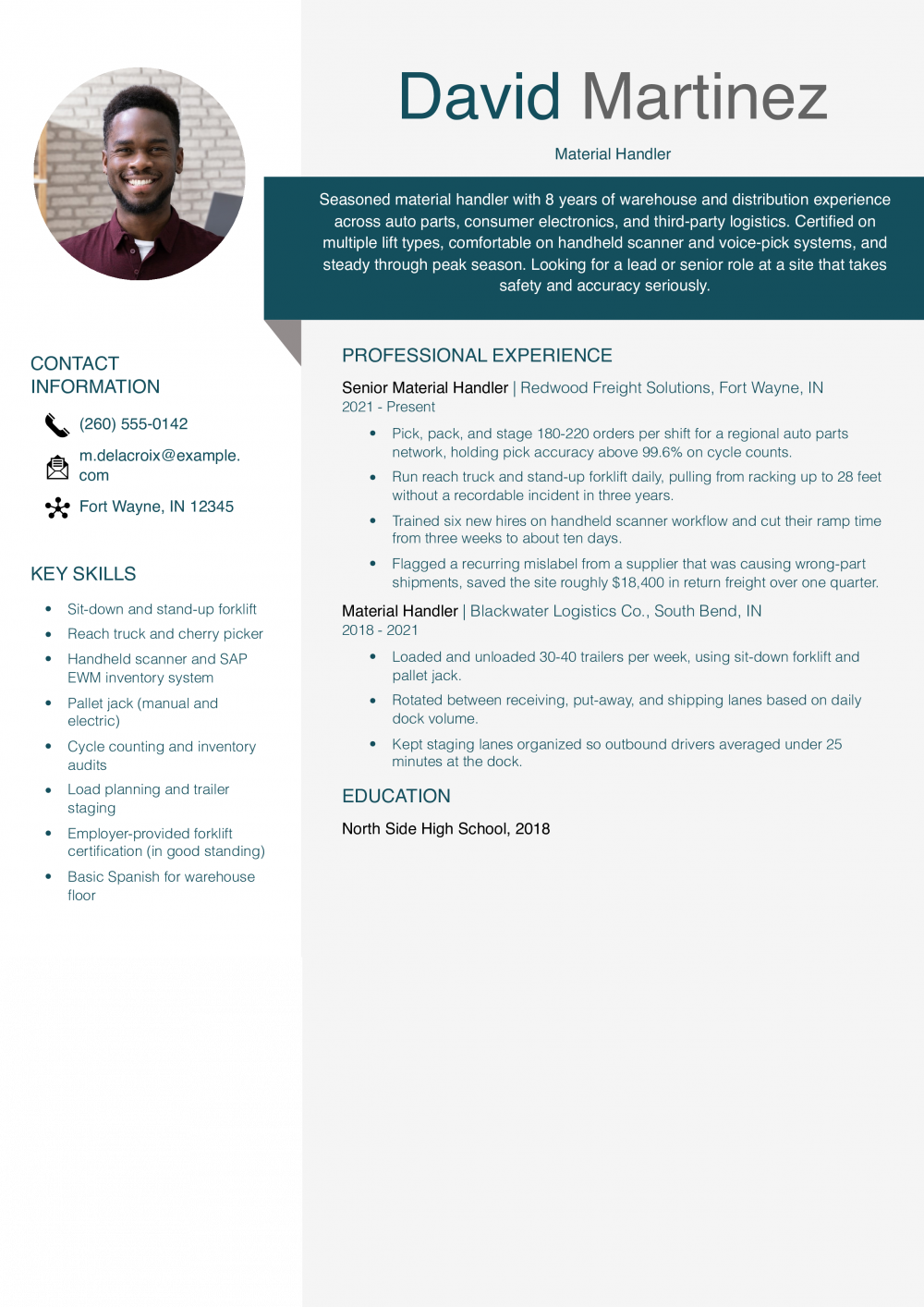
Customize this template in our builder in under 10 minutes.