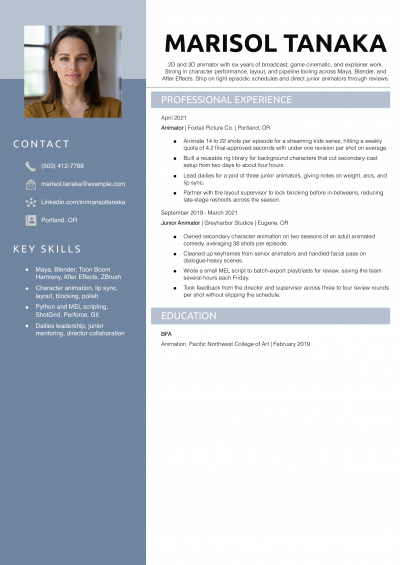
Animator Resume Examples
Your profile should name the type of animation you do, the pipeline you work in, and your shot range. State whether you focus on character, creature, cinematic, game, or motion graphics work. Name the software…
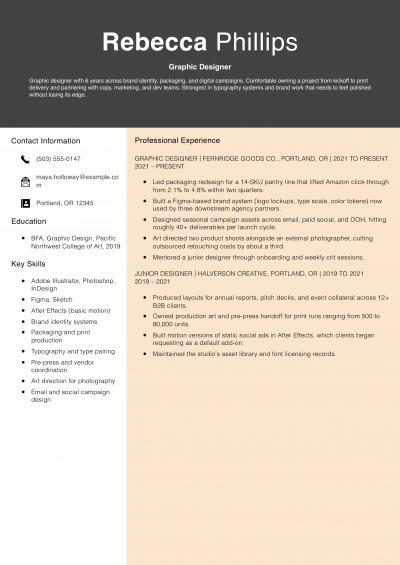
Every resume example is written and reviewed by our team of Certified Professional Resume Writers to ensure top-quality content and formatting.
Your portfolio shows what you can build, but your resume shows how you work. Art directors and studio recruiters want to see the tools you know, like Maya, ZBrush, or Substance Painter. They also want proof you ship assets on deadline within a production pipeline.
Call out polygon counts you hit, render times you cut, or texture workflows you owned. A strong 3D artist resume pairs technical depth with real project outcomes. The examples below show how to lay out that proof on your resume. To compare layouts before you start, browse our resume templates.
Art directors and studio recruiters look for relevant software proficiency near the top of page one. A portfolio or reel link can help them review your work.
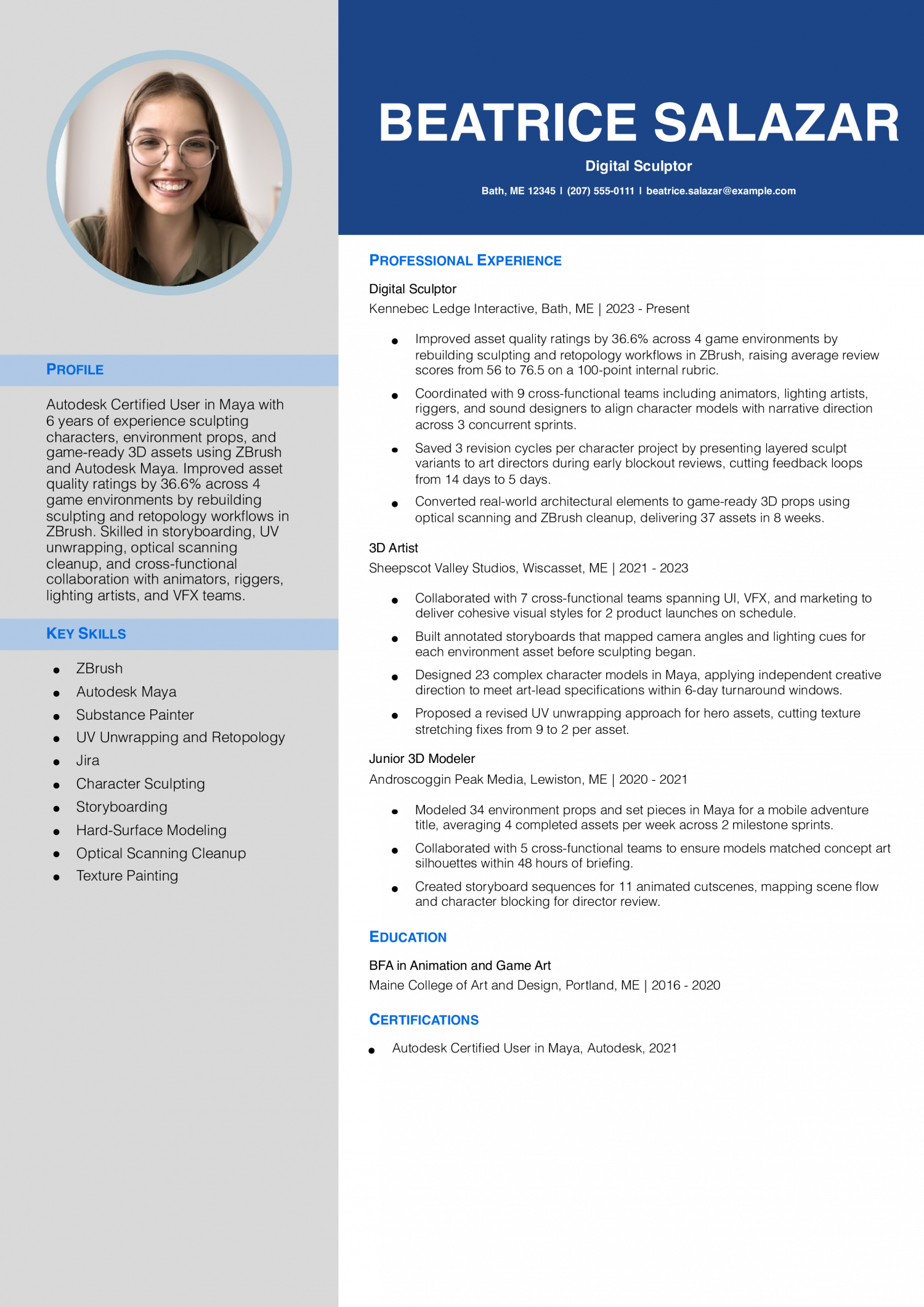
Pick this resume if you are a mid-level digital sculptor with around six years of experience creating characters and environment assets for games. Anchor each workflow change to the revision cycles it removed so reviewers see speed gains tied to your sculpting decisions.
Review scores gain meaning when the starting point sits beside the end point and the scale is named. An art director reading both numbers on a known rubric can measure the quality jump instantly. If your studio rates assets, show where you started and where you finished.
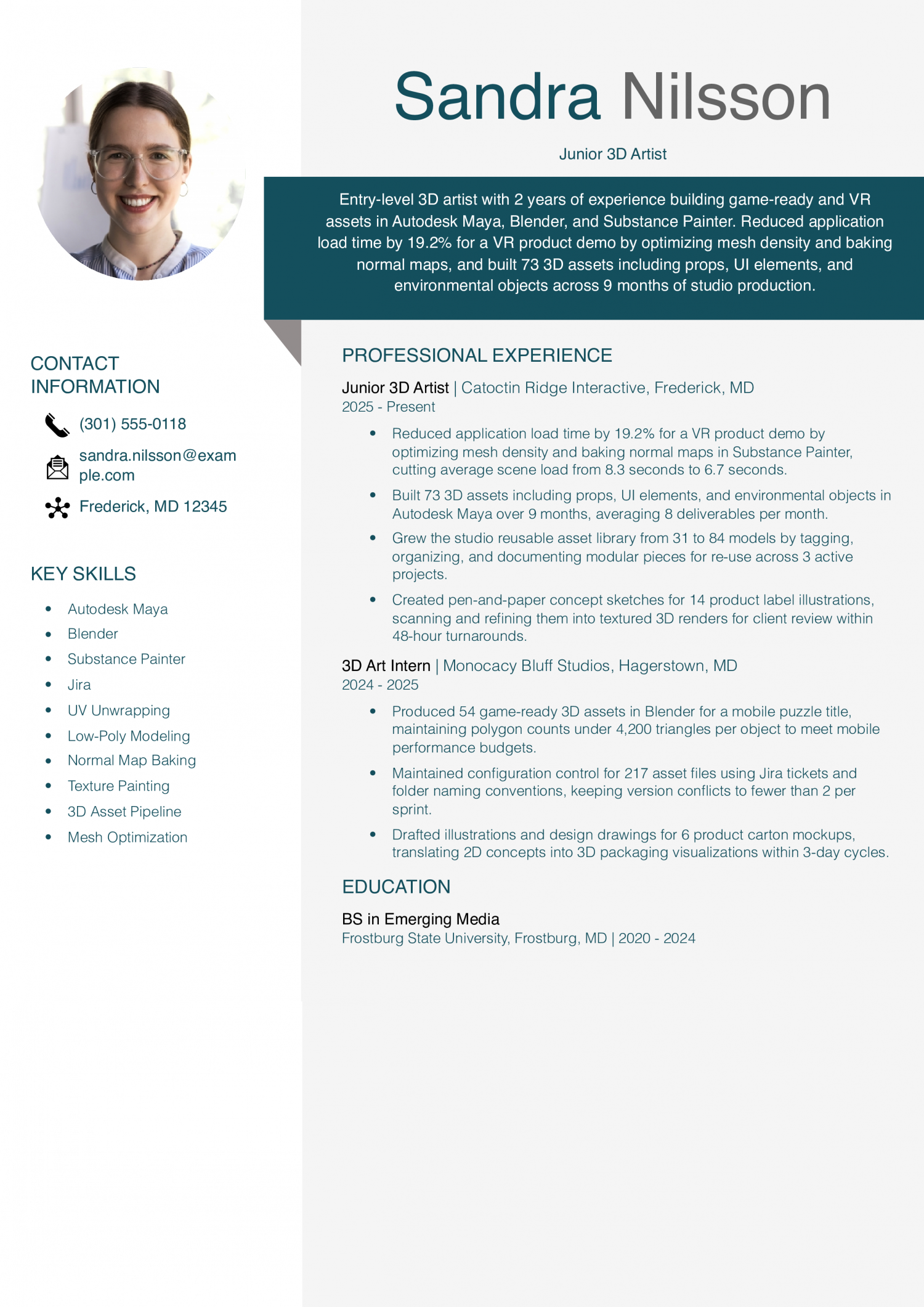
Start with this resume if you are an entry-level 3D artist moving from an internship into your first full-time studio role. Back every modeling task with a polygon budget or load-time gain so your output reads as performance-aware, not decorative.
Raw load times make an optimization bullet believable. A lead artist who sees the old load time and the new one can feel the difference on every preview. Give load time in seconds so a reviewer can judge performance alongside any percentage you claim.
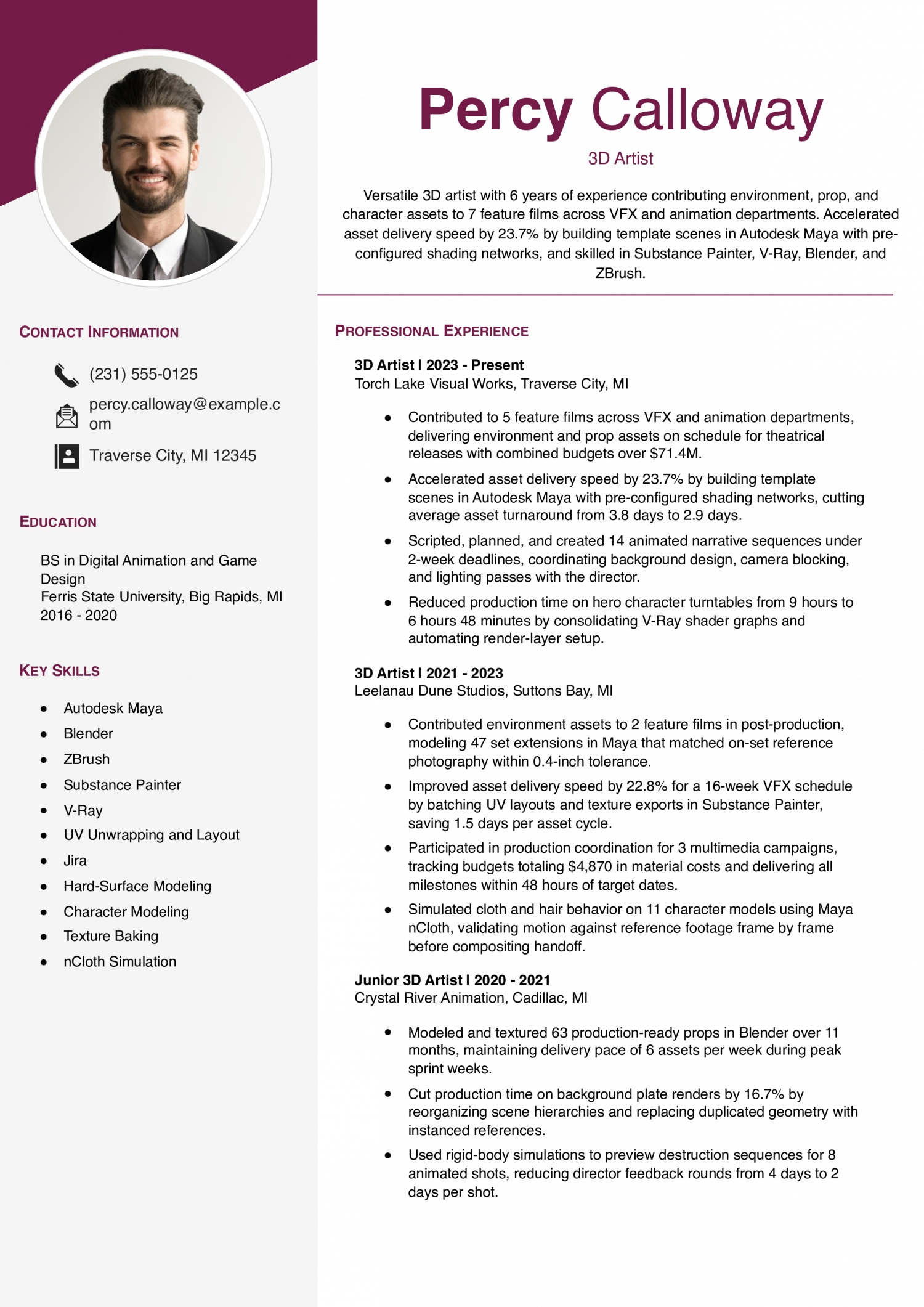
Try this resume if you are a mid-level 3D artist with around six years of film VFX and animation experience spanning multiple studios. Connect each workflow improvement to a before-and-after turnaround time so reviewers can measure your speed gains in real production days.
Shorter feedback rounds per shot save time that adds up across a whole production. Cutting director review from one length to another, measured per shot, lets a producer multiply the gain by the shot count. State the old turnaround and the new one at the unit level.
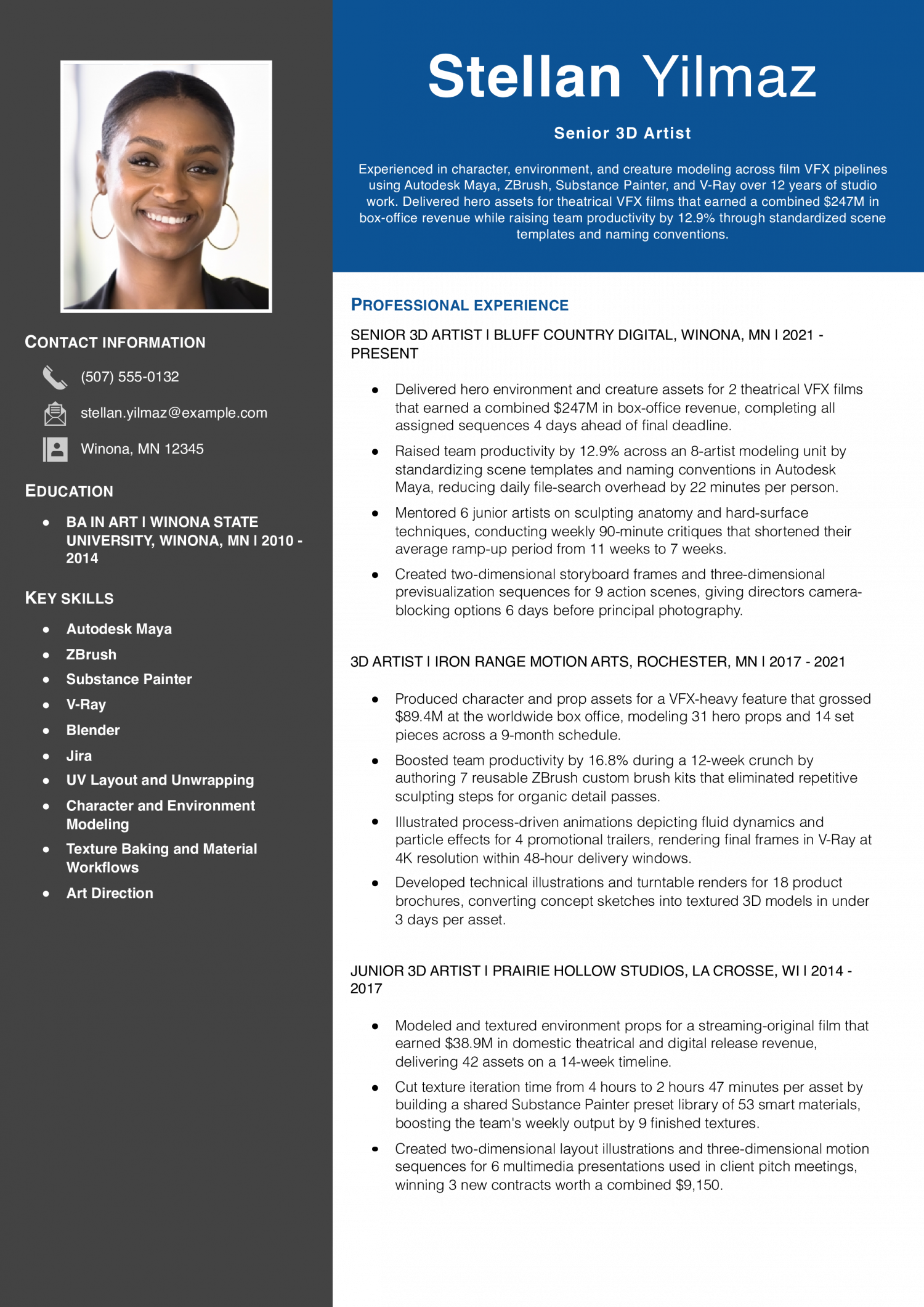
Rely on this resume if you are a senior 3D artist with about twelve years of film VFX and digital production experience. Move your mentoring bullets beyond vague coaching claims by attaching a measurable ramp-up reduction for the artists you trained.
Finding files used to eat minutes from every artist’s day, and this resume says how many minutes each person got back. A studio lead reading that knows exactly which part of the workday improved. Say how many minutes each person saved on the task that got faster.
Resourceful 3D game artist with 6 years of experience spanning environment modeling, character lookdev, and physically based texturing in Autodesk Maya, Substance Painter, and Blender. Saved $7,640 in outsourcing costs by modeling and texturing 38 modular environment pieces in-house, and trained 14 workshop attendees across two studios on texturing, lighting, and UV unwrapping best practices.
State your years of 3D experience and the type of work you do most. Name the industry you work in, such as game development or architectural visualization.
Then name the stage of the pipeline you own, like modeling or lighting. Art directors and studio recruiters scan profiles in seconds. A clear scope line tells them whether your skills fit the project.
Mention the engines or renderers you use daily. If you focus on characters, say so. If you focus on hard-surface assets, say that instead.
One or two sentences can cover your scope without crowding the page. Keep the tone direct and skip vague claims about creativity.
Most strong 3D artist resumes include volume and scope data. State how many assets you built per sprint or per project. Note the polygon budgets you hit for real-time engines.
You can list the frame counts you lit or the texture resolution targets you met. Without a count or an outcome, your lines tend to read as duty lists. Art directors want to see how fast you deliver clean work.
Mention team size if you led or coordinated with other artists. Note deadlines you met, such as a shipped title date. If your work cut revision rounds, state the percentage drop.
Even one metric per bullet gives your experience more weight than a plain task description.
Break your experience into clear categories that match studio pipelines. Modeling and sculpting cover the mesh work you do from first draft to final shape. Texturing and shading cover material creation and UV layout.
Rigging and animation cover joint setup and motion cycles. Lighting and rendering cover scene assembly and final output. Arrange your bullets by these categories under each job title.
This structure helps art directors find the skills they need fast. It also shows you understand how studios divide labor. Pick the categories that match your strongest work.
You do not need all five if your role was narrower. Two or three well-documented stages carry more weight than a vague list.
Add a tools section on page one, near your profile. List your primary software, such as Maya and ZBrush. Add your renderer, like V-Ray or Arnold.
Include game engines if you use them, such as Unreal Engine or Unity. Art directors and studio recruiters look for tool matches early in a review. If you hold the Autodesk Certified User credential in Maya, list it in a credentials line near your tools section.
This certification signals tested baseline skill in Maya workflows. Keep the format tight: tool name, then version if it matters. Do not bury software deep in your bullet points.
A visible tools section saves reviewers from scanning every line for a keyword.
If you are early in your career, place your degree near the top. A bachelor’s in animation, game design, or fine arts fits well here. List relevant coursework only if it names a specific tool or technique.
Add a portfolio link on the same line as your contact details. Art directors and studio recruiters expect to see rendered work, not read about it. Your resume supports the portfolio, not the other way around.
If you are changing careers from graphic design or drafting, highlight transferable 3D skills. Name the software overlap and any personal projects you completed. Freelance or game-jam work counts as real experience on a 3D artist resume.
Keep your education section to three lines or fewer.
Art directors and studio recruiters scan for a mix of tool names and production skills. Read each table and mark the terms the posting also uses.
Hard skills like Maya and UV mapping prove you can build assets. Soft skills like collaboration show you fit a production pipeline. Art directors and studio recruiters weigh both types.
Tool names get filtered by the ATS before a person reads your file. Place each hard skill in a bullet point that includes a measurable result. Name the software version when the posting specifies one.
Show each soft skill in a bullet that names a real project outcome.
If a term is not in the posting, leave it off. Add any term the posting repeats that you truly have.
| Soft Skills | AI-estimated % |
|---|---|
| Creative problem-solving | 78% |
| Artistic collaboration | 57% |
| Deadline management | 46% |
| Client feedback integration | 39% |
| Attention to detail | 34% |
And here are the top hard skills showing up most often.
| Hard Skills | AI-estimated % |
|---|---|
| 3D modeling | 70% |
| Texture and lighting | 66% |
| Character rigging | 44% |
| Animation keyframing | 35% |
| Visual effects compositing | 34% |
Skill names and rankings come from an AI model grounded in U.S. Department of Labor occupation data for 3D artists, not from a count of 3D artists’ resumes built on ResumeTemplates.com.
Your portfolio handles the art, but your resume needs these too.
There are three ways to handle AI on a 3D artist resume. You could lead with vague hype like “AI-driven 3D creator.” Art directors and studio recruiters screen that out. You could skip AI and bring it up in the interview.
Or you could show how AI fits your actual workflow. The third option is what art directors and studio recruiters can validate. Name the tool you used and the step it handled.
Then describe the output you refined. That framing shows you still control topology, lighting, and final polish. It also shows you can speed up early stages without losing craft.
Stick to tools you have used on a shipped or portfolio project.
What AI is actually changing for this role
Concept art: AI image generators produce rough concepts faster, but artists still paint over and adapt them to project style guides.
Texturing: Text-to-texture tools create base materials in minutes, though artists must adjust tiling and material values by hand.
UV and retopology: Auto-retopology plugins suggest cleaner meshes, yet artists review edge flow for animation and deformation needs.
Motion and rigging: AI motion-capture cleanup tools reduce manual keyframe editing while artists refine contact points and weight painting.
Asset variation: Procedural AI scatters and randomizes props across scenes, but artists curate placement for composition and storytelling.
AI tools to name
How to phrase AI on your resume
Do
Skip
Art directors and studio recruiters evaluate your portfolio before they read a single bullet on your resume. A strong portfolio site pairs finished renders with breakdowns that show your modeling, texturing, and lighting process. Link it in your resume header so reviewers reach your work in one click.
Curate ten to fifteen of your strongest pieces rather than dumping every project you have touched. Each entry should name the software you used, the asset type, and the turnaround time. Art directors and studio recruiters want to see range across hard-surface, organic, and environment work.
Add wireframe or topology overlays beside final renders to prove clean edge flow. If you completed work under a confidentiality agreement, describe the scope in general terms and note the restriction. A short caption that states the brief, your role, and the poly budget tells more than a title alone.
Your tools list tells a studio how fast you can start. Group software by task so it reads at a glance. Keep each entry to the tool name and your skill tier.
Art directors and studio recruiters scan for shipped work first. A credited film or game title proves you met a pipeline deadline. Awards add weight, but credits carry more.
Art directors and studio recruiters read this list as a map of where your work is heading. The items below tell them which tools and pipelines you have put real study into. This helps them see if your skills fit the team’s next project.
Most 3D art roles do not require a formal cert. But listing one can set you apart from other artists in the pile. A cert shows you went past daily use and passed a scored exam.
That kind of proof carries weight when a studio is choosing between two close reels. Note who issued it and the year.
About These Numbers
The Bureau of Labor Statistics does not publish a wage code for 3D Artist specifically. The numbers below are a proxy: the closest published match is Special Effects Artists and Animators (SOC 27-1014), so use them as an estimate for this role, not an exact figure.
The 90th-percentile 3D Artist out-earns the median by about 74 percent. That gap tells you the market pays a steep premium at the top of the range. The 10th percentile sits roughly 43 percent below the median, so the floor is far from the ceiling.
National employment is small, which means open roles cluster in a handful of markets. Lead with the render engine, asset type, and project scale that match the tier you are targeting.
| # | State | Median Annual |
|---|---|---|
| 1 | Washington | $133,480 |
| 2 | California | $130,540 |
| 3 | Nevada | $97,350 |
| 4 | New York | $96,770 |
| 5 | Colorado | $91,290 |
| 6 | Arizona | $89,650 |
| 7 | North Carolina | $88,350 |
| 8 | Utah | $88,210 |
| 9 | Michigan | $86,630 |
| 10 | Florida | $85,870 |
| # | State | Workers | Median |
|---|---|---|---|
| 1 | California | 7,410 | $130,540 |
| 2 | New York | 1,540 | $96,770 |
| 3 | Florida | 1,530 | $85,870 |
| 4 | Washington | 1,130 | $133,480 |
Resume Templates offers HR approved resume templates to help you create a professional resume in minutes. Choose from several template options and even pre-populate a resume from your profile.
List your strongest software tools, a link to your portfolio, and bullet points showing measurable output. Art directors scan for render engines and polygon counts before they read anything else. Place those technical details high on the page.
Host your portfolio on a personal site or on ArtStation. Then add a clickable link in your resume header. Choose eight to twelve pieces that match the type of work the studio produces.
Label each piece with the software you used and the time you spent. Studio recruiters use those details to judge your speed and pipeline fit.
Yes, studios in games, film, and product visualization hire 3D artists at the junior level. Most entry-level candidates start with environment art or asset cleanup before moving to hero characters. Listing shipped titles or published projects on your resume helps you stand out early.
Most 3D artists with under 10 years of work fit everything on a single page. If you have shipped multiple titles or held senior roles at several studios, a second page is reasonable. Keep your strongest credits and most relevant tools on page one.
Create a single heading such as "Freelance 3D Artist" with a date range. List each notable client or project as a bullet point beneath it. Include the deliverable type, the software, and any deadline or volume metric.
This format prevents your experience section from looking fragmented across short contracts.
Yes, if you used AI tools as part of a production pipeline, list them alongside the stage where you applied them. For example, note that you used an AI tool for concept exploration and then modeled the final asset in Maya. Art directors want to see that AI sped up your workflow rather than replaced core modeling skill.
Fill the gap with personal projects, game jam entries, or open-source work that kept your skills current. Add them under a "Personal Projects" heading with dates so the timeline reads without a break. Studio recruiters care more about recent output quality than about continuous employment.
An ATS-friendly template with plain sections keeps your certifications and work history where reviewers look. A basic template works for this too.
D Artist Resume
4.2/5 stars with 201 reviews

Executive Resume Writer and Career Coach
Andrew Stoner is an executive career coach and resume writer with 17 years of experience as a hiring manager and operations leader at two Fortune 500 Financial Services companies, and as the career services director at two major university business schools.
© 2026 Resumetemplates.com All rights reserved.