Occupational Therapy Resume Examples
Your state license and NBCOT number prove you can practice. They do not prove what you bring to a caseload. Add one line under your name a clinical director cannot find on a credential check.…
Every resume example is written and reviewed by our team of Certified Professional Resume Writers to ensure top-quality content and formatting.
Most COTA roles fill through referrals or clinical postings where your resume reaches rehab directors and supervising OTs first. They scan for patient caseload volume, treatment settings, and your NBCOT credential. Functional outcome data, such as gains in ADL scores, sets strong resumes apart.
List the diagnoses you treat most, the modalities you use, and your state license status. Top earners in this field reach near $89,780 a year, so the stakes of a clear resume are real. The examples below show how to present each of these details on the page. To compare layouts before you start, browse our resume templates.
Rehab directors and supervising OTs look for NBCOT certification, state licensure, and documented patient caseload on the first page, because those details show whether a COTA can carry a full treatment schedule under supervision.
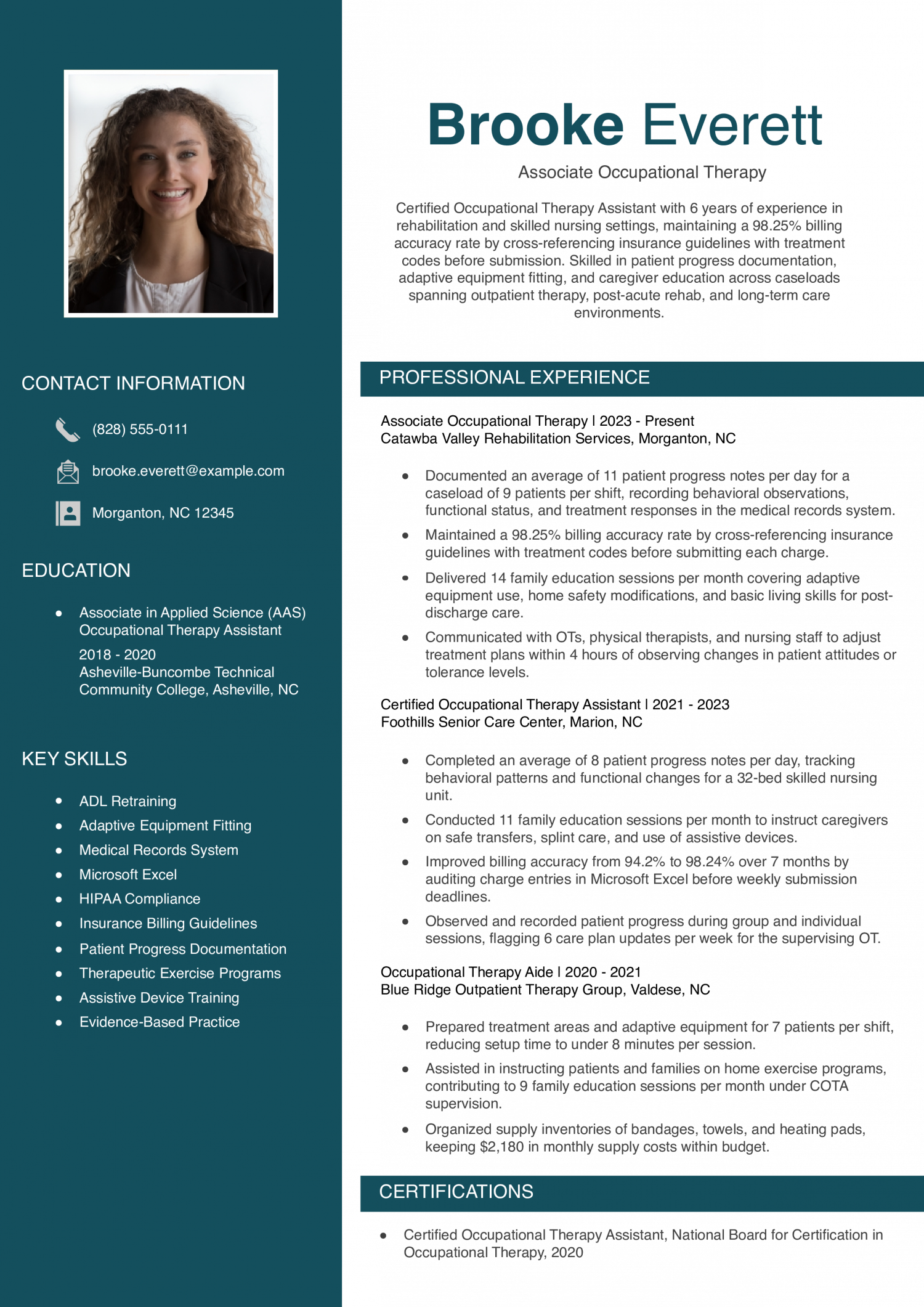
Pick this resume if you are a mid-level associate occupational therapy professional building on clinical and documentation experience across multiple care settings. Lead each bullet with a billing or documentation frequency figure that proves daily consistency.
Family education sessions have a monthly count and named topics here. That shows a clinic director a steady teaching commitment, not a one-time class. Say how often you teach patients or families and what each session covers.
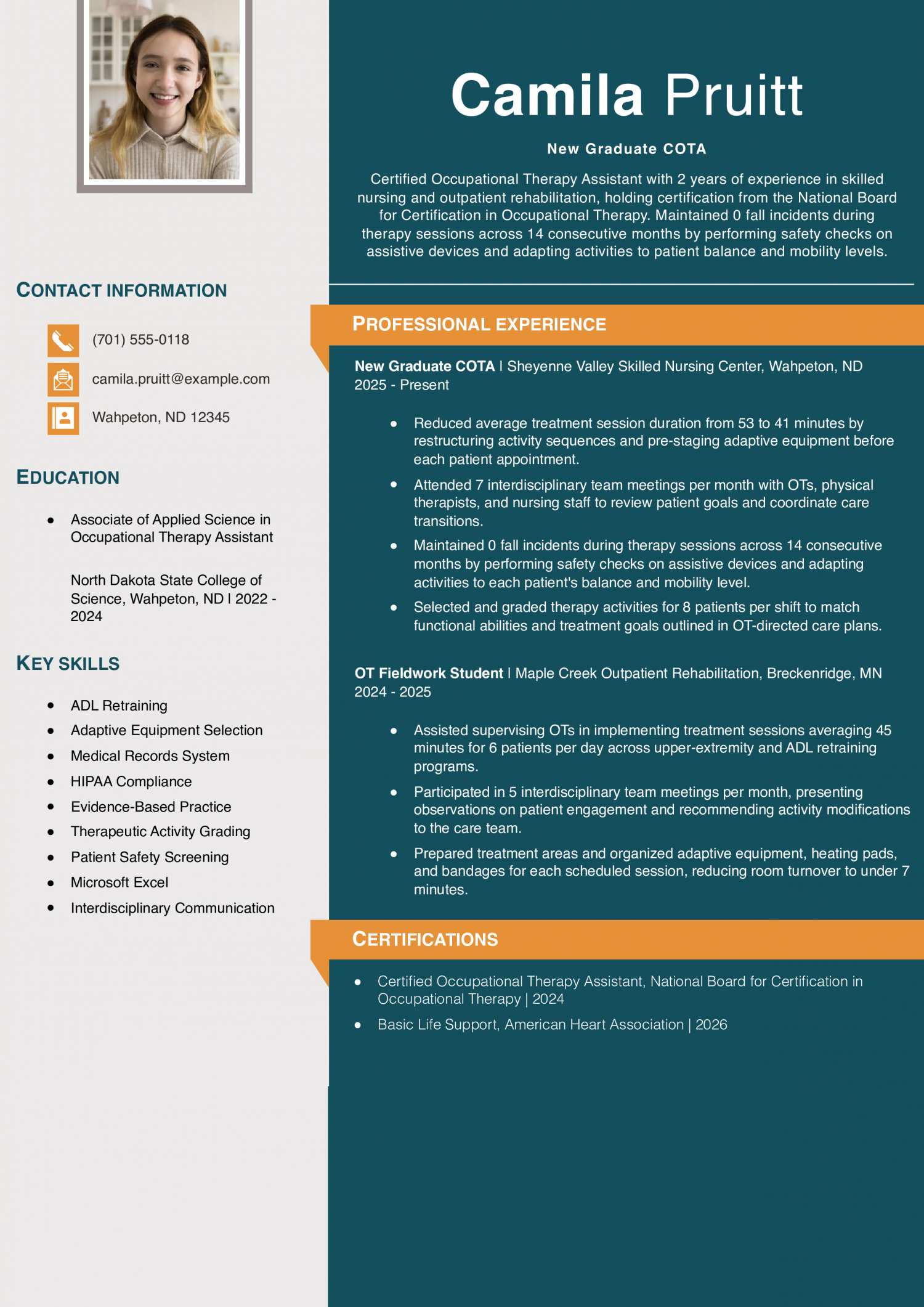
Start with this resume if you are a new graduate COTA entering your first clinical role after fieldwork. Lead with patient safety records and session efficiency gains rather than listing general clinical duties.
Zero falls during therapy means the patients stayed safe while they worked on recovery. Any clinic that puts patient welfare first will notice that record. Keep a count of incident-free months and name the precautions you used during treatment.
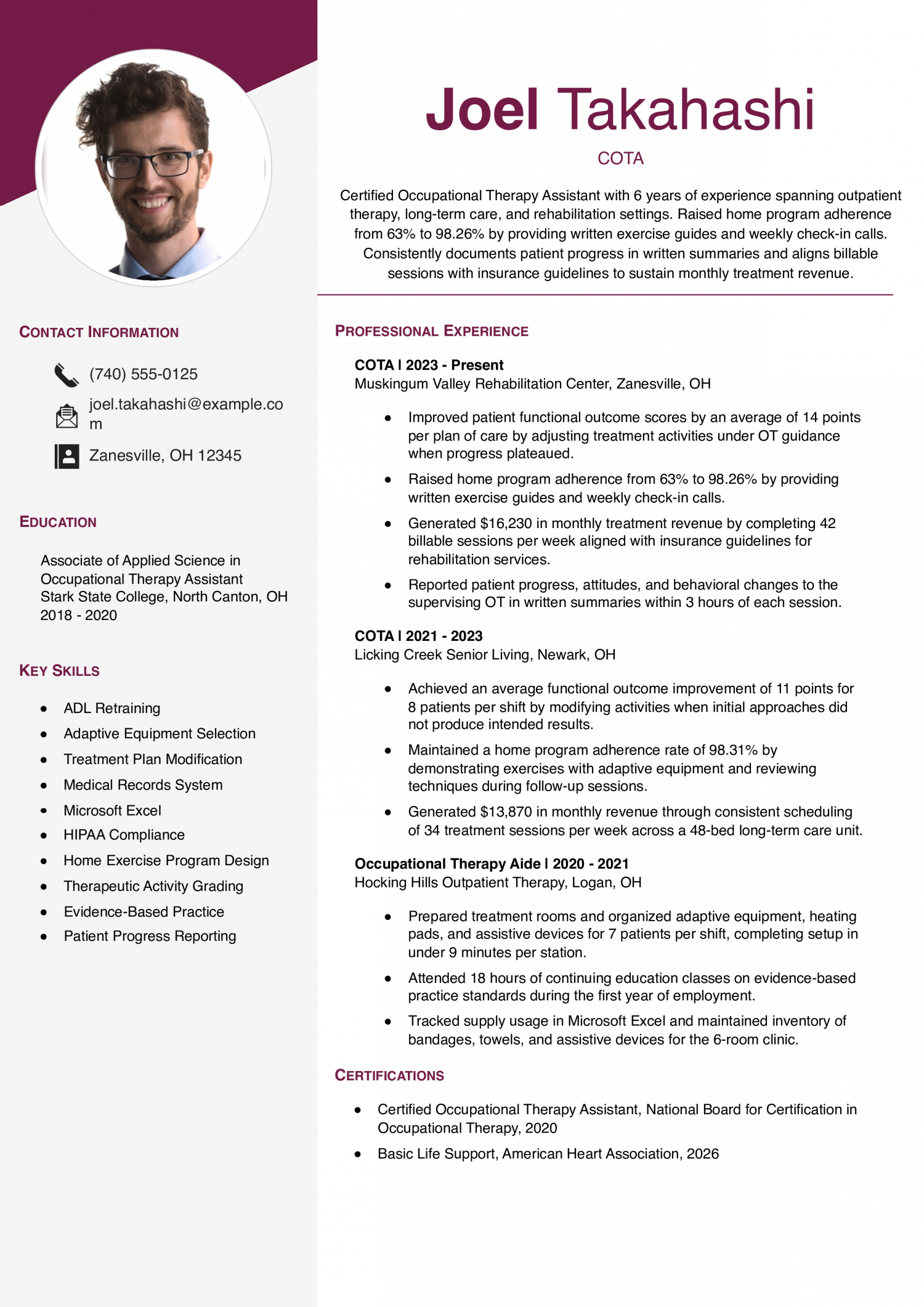
Try this resume if you are a mid-level COTA with experience across rehabilitation and long-term care facilities. Lead with home program adherence gains stated as before-and-after percentages to prove patient education impact.
Revenue is tied to a weekly session count and insurance billing rules here. The practice manager reading that can see how the caseload connects to income. Track the sessions you complete each week and note how your billing follows the payer guidelines.
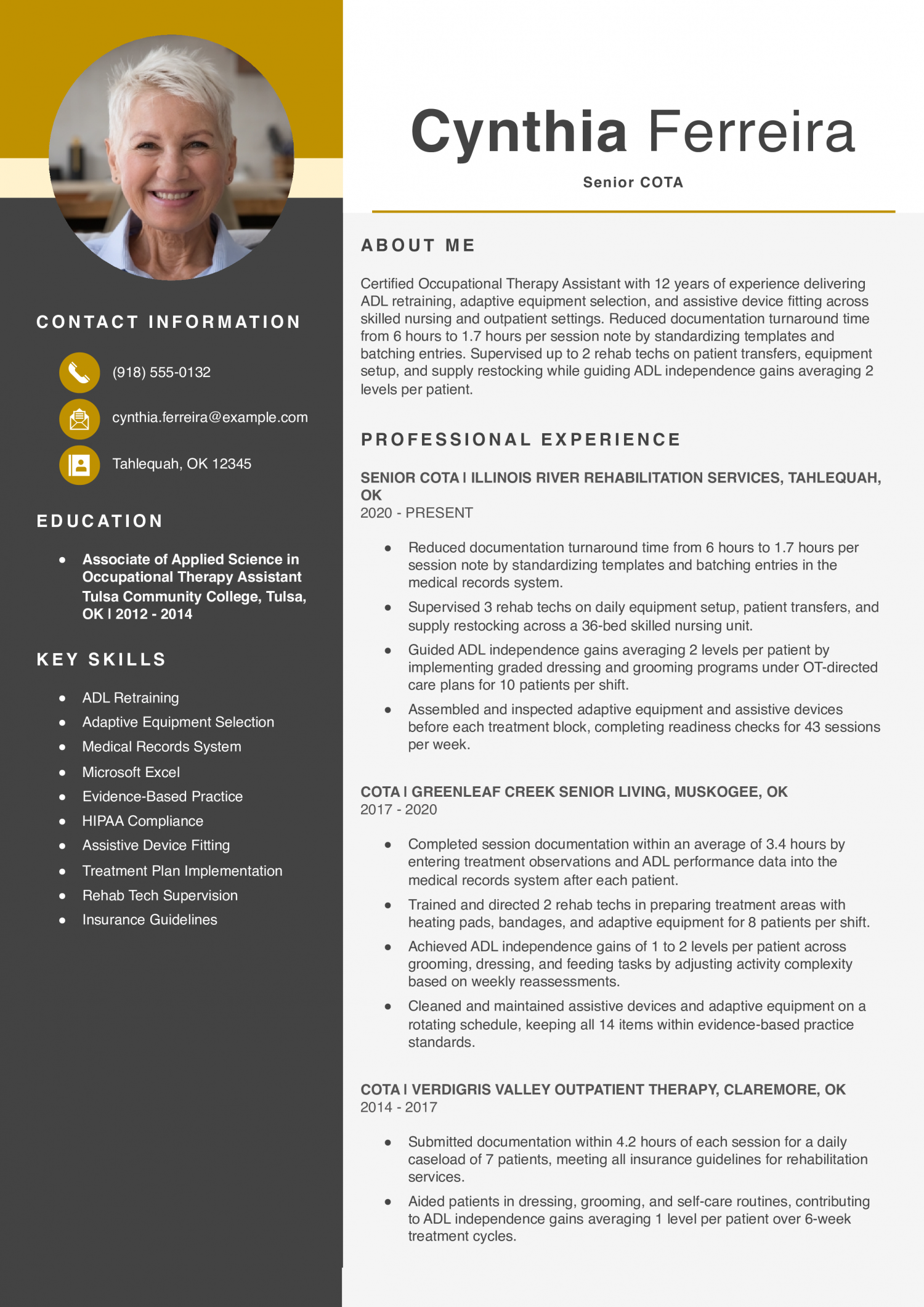
Lean on this resume if you are a senior COTA with a decade or more of clinical and supervisory experience. Lead with documentation speed improvements stated as before-and-after figures rather than vague efficiency claims.
Supervision work names the staff count and the unit size in one line. Whoever reviews it can picture the setting and judge the responsibility. Give the number of people you direct and the size of the floor where you work.
Certified Occupational Therapy Assistant with 6 years of experience across outpatient, skilled nursing, and rehabilitation settings, completing discharge plans for 98.28% of assigned cases within 24 hours of the OT’s final assessment. Currently leading daily ADL sessions and mentoring 2 junior COTAs on treatment protocols while coordinating early discharge planning that reduced average length of stay from 19 days to 15 days for rehabilitation patients.
Your summary should start with a metric. State your average daily patient count and your primary setting. Rehab directors and supervising OTs read this line first.
It tells them if your pace fits their clinic. A line like “COTA with a 10-patient daily caseload in outpatient orthopedics” works well. It is short and clear.
Avoid vague openers like “passionate therapist with years of experience.” That sentence tells no one anything useful. Name your caseload, your setting, and your population. Pediatrics and geriatrics require different skill sets, so calling yours out saves everyone time during the screening process.
If you split time across two settings, name both and note the ratio. This kind of detail shows that you understand workload balance across care environments.
Strong COTA resumes tend to include patient progress data. Bullets without a number often read as duty lists. Note the percentage of patients who met their goals under your care.
You might write that 85% of your caseload hit discharge benchmarks on time. Track functional gains too, such as improved ADL scores. Fall reduction rates also work well in skilled nursing settings.
If your facility tracked patient satisfaction scores, include yours. Most strong resumes pair a volume metric with a quality metric. For example, state your weekly treatment sessions alongside your reassessment completion rate.
You do not need a number in every bullet. Aim for at least two per job entry to show your impact.
Organize your clinical bullets into clear groups. Start with direct patient care, such as ADL training and therapeutic exercise. Next, list splinting and adaptive equipment work.
Cover documentation separately, noting progress notes and treatment plan updates. Then add a group for patient and caregiver education. A final category can cover your collaborative work with OTs.
Include co-treatment planning and discharge recommendations there. This structure helps supervising OTs scan your resume fast. They want to see if your hands-on skills match their open role.
Avoid mixing a billing task into a patient care bullet. Keep each group focused on one type of work so nothing gets lost.
List your COTA credential from NBCOT right after your name. Add your state occupational therapy assistant license on the same line. Requirements for state licensure vary, so name the state.
If you hold Basic Life Support from the American Heart Association, include it here too. Rehab directors and supervising OTs need to confirm your credentials before reading further. A dedicated credentials block on page one makes this instant.
Do not bury licenses in a section at the bottom. Put your NBCOT certification status and your state license status above your work history. If your license is current, say “active” or “in good standing.” This small detail prevents follow-up questions during screening.
As an entry-level or mid-career COTA, your education section still matters. List your associate degree in occupational therapy assisting first. Name the school, city, and graduation year on one line.
If you completed Level II fieldwork, add the site and setting below. Rehab directors and supervising OTs want to see where you trained clinically. Fieldwork in a pediatric hospital reads differently than a home health rotation.
Name the population you served during each placement. Below education, add any relevant continuing education courses. Topics like hand therapy or lymphedema management stand out.
Keep each entry to one line so the section stays tight. End your resume with a short skills list of five to eight tools or techniques.
COTA resumes that earn callbacks share a specific skill mix. Match the lists below against the posting you want. Rehab directors and supervising OTs scan for these patterns first, not broad compassion language.
Hard skills prove you can carry out treatment plans on day one. Soft skills show how you work with patients and the care team. Rehab directors and supervising OTs weigh both, but hard skills set the filter.
ADL training and patient education often top the list. Without them, soft skills lack a clinical anchor. Compare each table to the job posting you are targeting.
Add soft skills as proof inside your bullet points, not as a standalone list.
| Soft Skills | AI-estimated % |
|---|---|
| Patient encouragement | 71% |
| Empathy under pressure | 63% |
| Therapist collaboration | 41% |
| Family communication | 39% |
| Adaptability to needs | 34% |
And here are the top hard skills showing up most often.
| Hard Skills | AI-estimated % |
|---|---|
| Therapeutic exercise instruction | 71% |
| ADL training support | 59% |
| Treatment plan implementation | 41% |
| Patient progress documentation | 36% |
| Adaptive equipment fitting | 35% |
Skill names and rankings come from an AI model grounded in U.S. Department of Labor occupation data for certified occupational therapy assistants, not from a count of certified occupational therapy assistants’ resumes built on ResumeTemplates.com.
These are the must-haves hiring teams look for when scanning a certified occupational therapy assistant resume.
You need two credentials before you can practice. The Certified Occupational Therapy Assistant credential comes from NBCOT. A State Occupational Therapy Assistant License comes from your board.
State license rules vary, so check your board’s site. List your state license with its status, not its number. Basic Life Support is also expected at most facilities.
NBCOT requires renewal units to keep your COTA active. Most states tie license renewal to continuing education hours. Listing recent courses signals you stay current in practice.
Group your courses under a clear heading on the resume. Include the topic, provider, and year for each one. Focus on courses tied to your clinical setting or patient population.
Rehab directors expect you to document in the facility EMR. Naming each system you have used saves orientation time. Add your EMR skills in a tools or technology section.
HIPAA governs how you handle patient health information daily. Supervising OTs want proof you follow privacy standards. A short note on your resume confirms this awareness.
Never Put Patient Information on Your Resume
Mention HIPAA training in your certifications or education section. Reference how you applied it in a past role. Never include any patient data on your resume.
Beyond your state license, the credentials below tell rehab directors and supervising OTs more about your clinical readiness. They signal how current your training is. They also show you stay prepared for urgent situations on the treatment floor.
Most clinics and school districts look for these items early in a review. List the issuing body and your current expiration date for each one. Keep the format the same across every entry so the section is easy to scan.
Place this section near the top of your resume, right after your summary or education block. That position helps reviewers confirm your standing before they read deeper into your work history. If a credential is pending, note the expected date so no one has to guess about your timeline.
BLS tracks Occupational Therapy Assistants as a single group, so the figures below cover a broader pool than COTAs alone. The occupation is moderate in size, and the pay spread is tighter than in many healthcare fields. The 90th percentile sits only about a quarter above the median.
The 10th percentile falls roughly 29 percent below it. That narrow range means geography and setting carry real weight in where you land on the curve. A tight distribution also means small resume signals can separate you from peers at the same experience level.
Lead your resume with your NBCOT credential, your state license status, and the patient populations you treat most often.
| # | State | Median Annual |
|---|---|---|
| 1 | Maryland | $82,010 |
| 2 | California | $81,770 |
| 3 | Texas | $81,500 |
| 4 | Nevada | $79,510 |
| 5 | Arkansas | $78,940 |
| 6 | Delaware | $78,640 |
| 7 | Washington | $77,590 |
| 8 | New Mexico | $77,020 |
| 9 | Oregon | $76,850 |
| 10 | Georgia | $75,920 |
| # | State | Workers | Median |
|---|---|---|---|
| 1 | Texas | 5,610 | $81,500 |
| 2 | Florida | 3,910 | $71,630 |
| 3 | Ohio | 3,890 | $62,700 |
| 4 | California | 3,840 | $81,770 |
| 5 | Pennsylvania | 2,560 | $71,590 |
Resume Templates offers HR approved resume templates to help you create a professional resume in minutes. Choose from several template options and even pre-populate a resume from your profile.
A reverse-chronological format works best because rehab directors want your most recent clinical setting first. Start with contact information, then list your COTA credential and a brief summary. Follow those with work history, education, and skills in that order.
Yes, one page is the standard for COTAs with fewer than ten years of experience. If you have worked across several clinical settings over a longer career, a second page is fine. Keep every line tied to patient care or measurable treatment outcomes.
Lead with your Level II fieldwork rotations and list each one the way you would list a paid position. Include the facility name, the setting type, and the patient count per day.
Add any volunteer hours in rehab or community health programs to fill out the work section.
List clinical skills that match the job posting, such as splint fabrication and therapeutic exercise. Add soft skills like patient education and caregiver training as well. Rehab directors scan for skills that match their caseload mix, so tailor the list to each posting.
Yes, a cover letter gives you room to explain why a specific setting interests you. Mention the patient population you want to serve and one result from your fieldwork. Keep it under one page and address it to the rehab director by name when possible.
List the gap honestly and note any relevant activity during that time, such as continuing education or clinical volunteer work. Supervising OTs care more about whether your skills stayed current than about the gap itself. A brief note in your summary or a single line in your work history is enough.
Yes, list each PRN or contract assignment as its own entry with the facility name and setting type. Rehab directors value exposure to varied patient populations, so treat short-term roles the same as permanent ones. Include the same outcome numbers and caseload details you would for any other position.
For a certified occupational therapy assistant, an ATS-friendly template is the safest pick, because it puts your certifications and experience where a hiring manager scans first. A basic template is a solid alternative. Whichever you choose, keep the formatting clean and easy to parse: clear section headings, a standard font, and no graphics a parser can choke on.
Certified Occupational Therapy Assistant Resume
4.6/5 stars with 175 reviews

Executive Resume Writer and Career Coach
Andrew Stoner is an executive career coach and resume writer with 17 years of experience as a hiring manager and operations leader at two Fortune 500 Financial Services companies, and as the career services director at two major university business schools.
© 2026 Resumetemplates.com All rights reserved.