Producer Resume Examples and Templates for 2026



A logline-style summary naming genre and budget range, a credits table that lists role, format and distribution for each project, and festival or platform placements are what separate the Filmmaker resumes that advance in executive producer review from the rest.
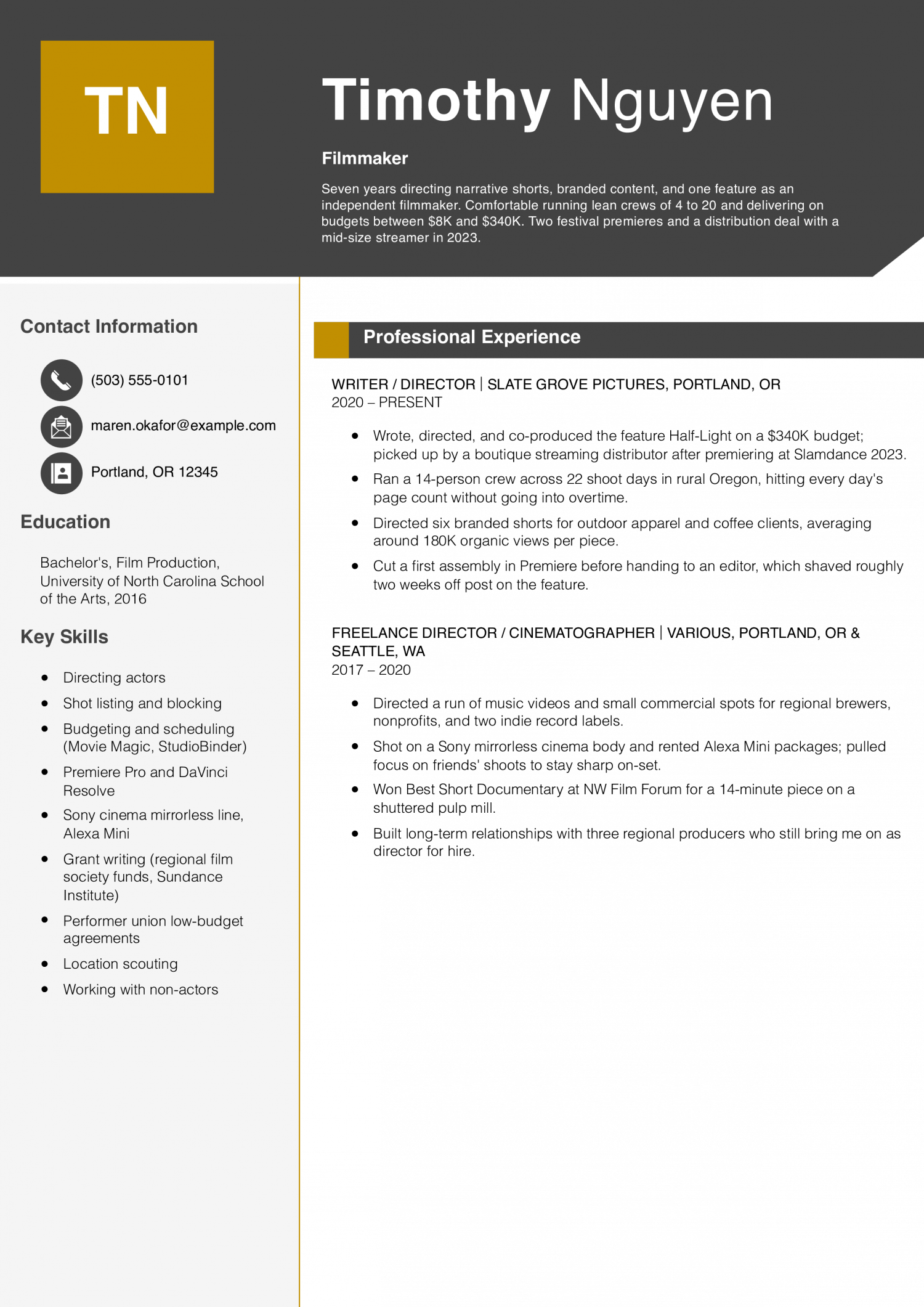
A production assistant resume has to prove you kept a busy set running, from call sheets to lock-ups. Executive producers and studio heads want to see the departments you supported and the shoot days you logged.
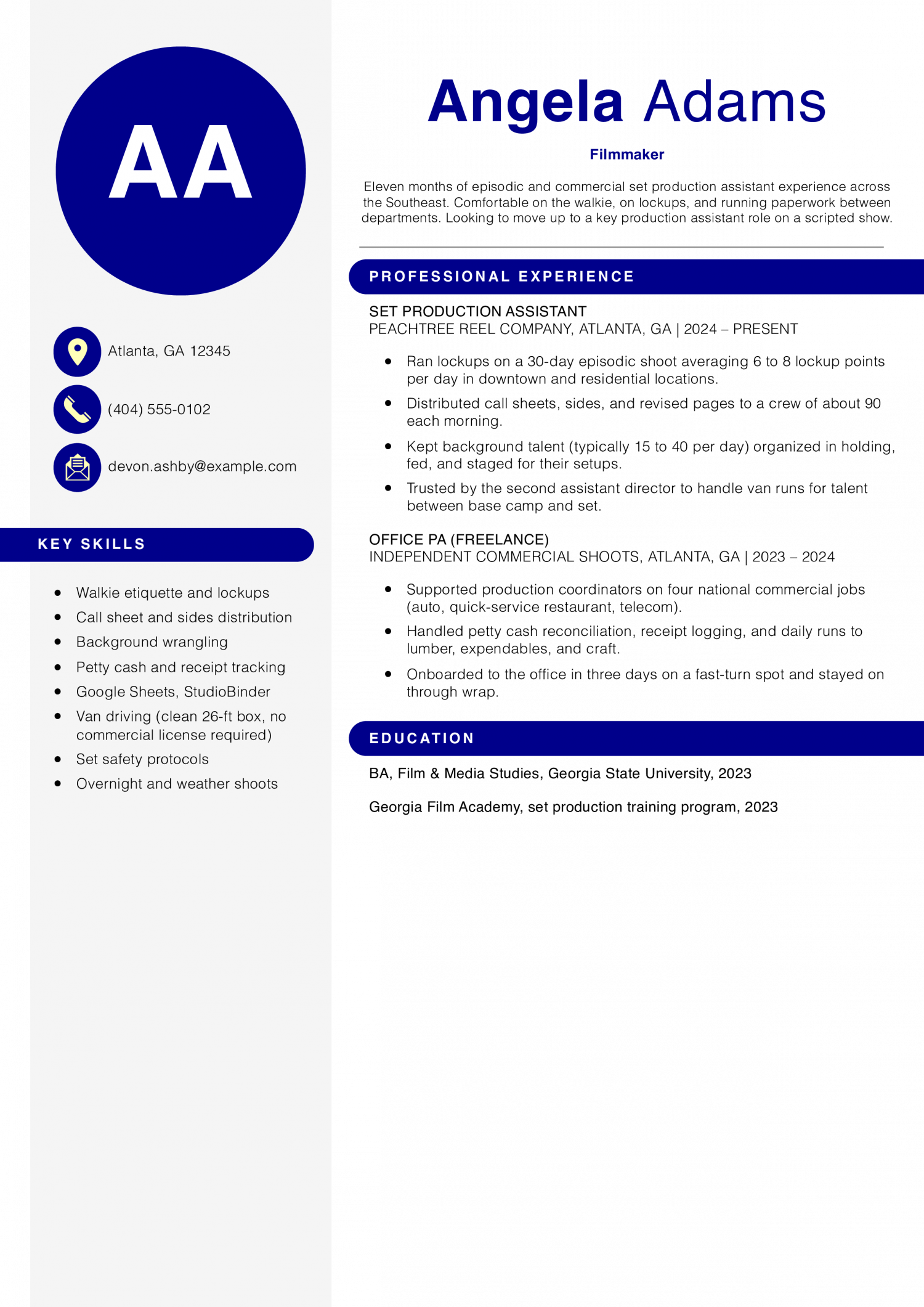
An indie filmmaker resume has to show you carried a project from script to festival cut on a lean crew. Studio heads look for finished titles, festival picks, and the roles you wore on each.
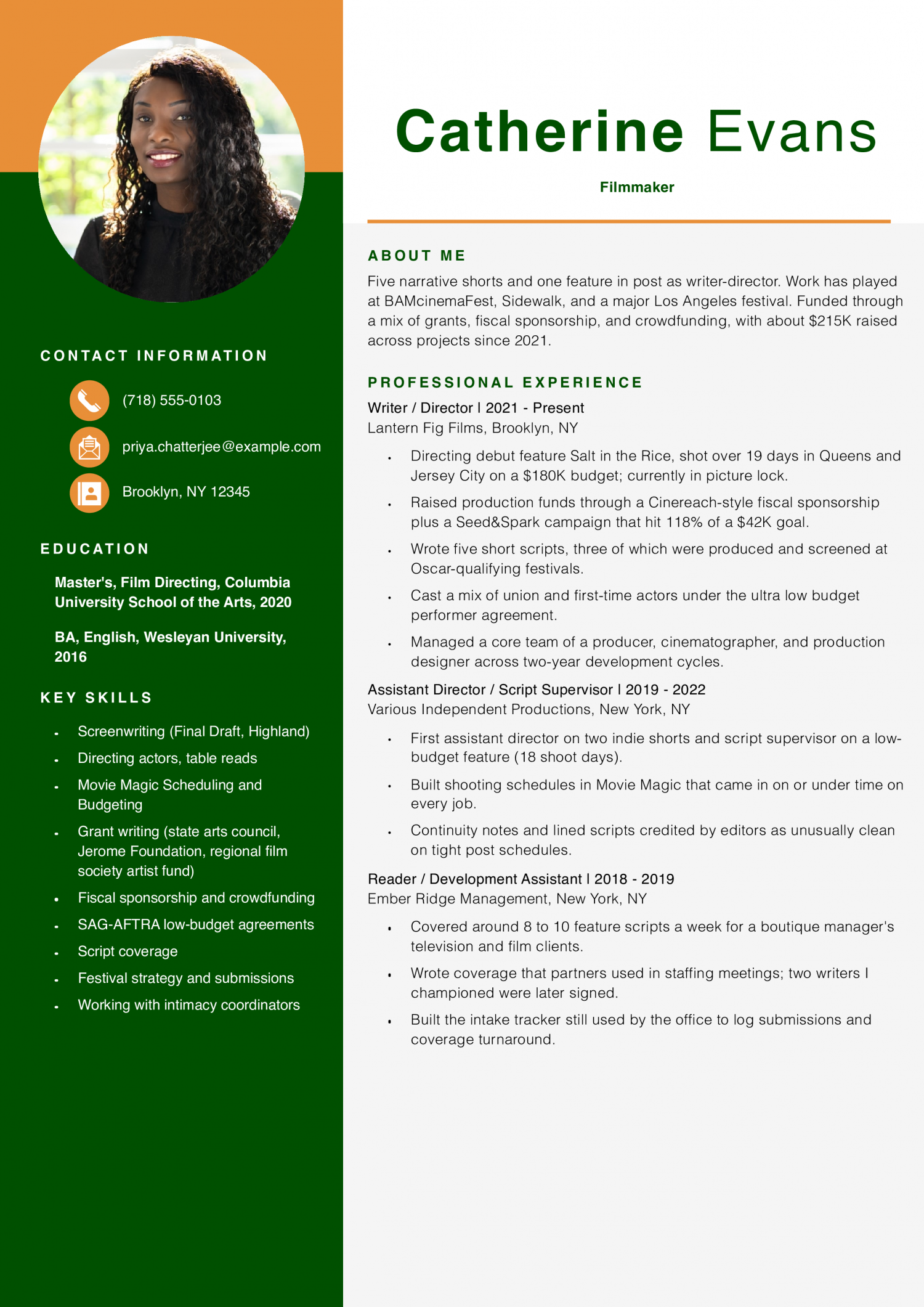
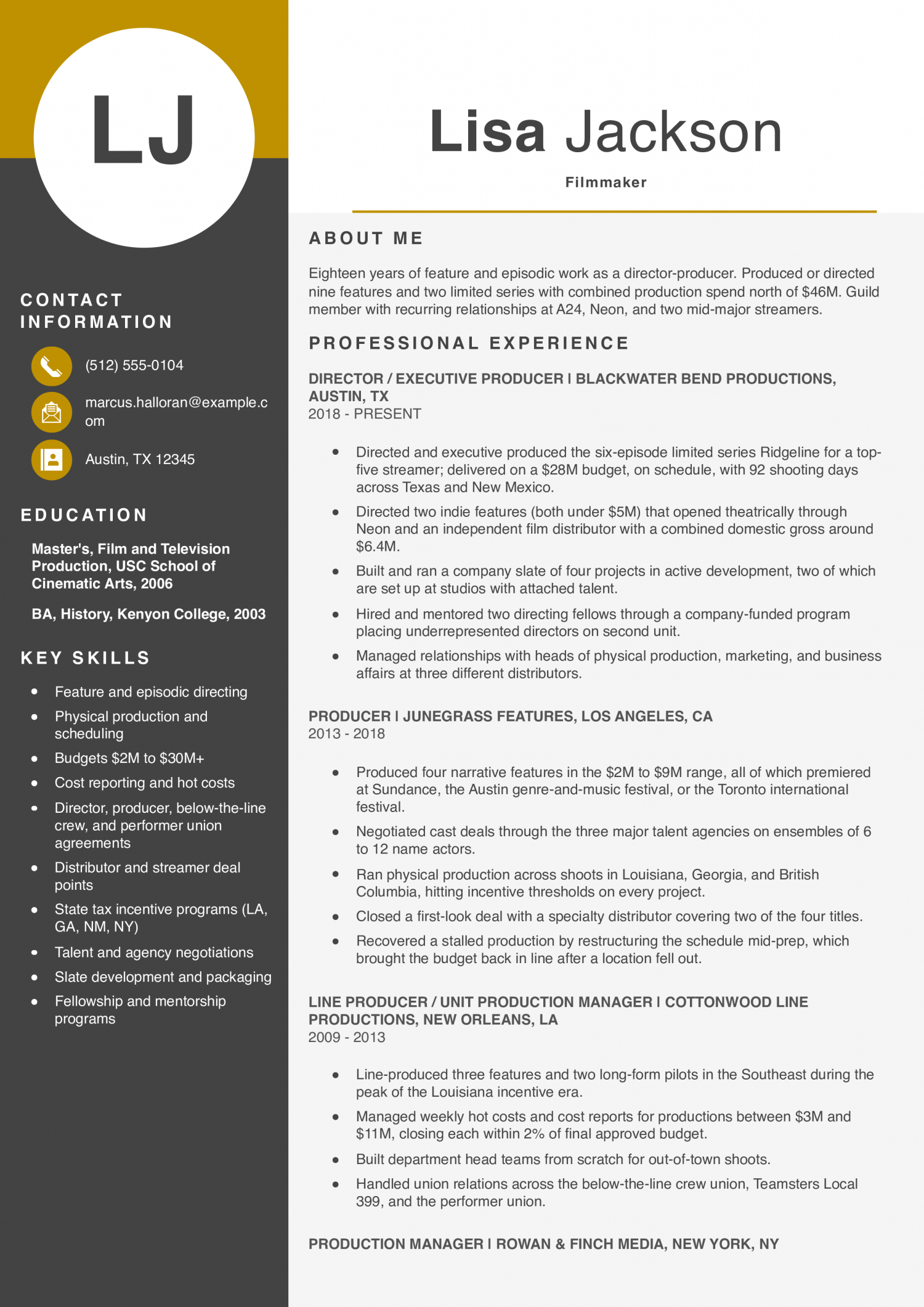
A director or producer resume has to prove you shipped features or series on budget with named cast. Studio heads want release credits, box office numbers, and the size of the teams you led.
Elena Vasquez-Moreno
Chicago, IL | (312) 555-0105 | [email protected] | linkedin.com/in/elenavasquezmoreno
Writer-director and producer with nine years across narrative shorts, documentary features, and branded work. Directed one feature documentary that premiered at Full Frame in 2022 and produced three narrative shorts on the festival circuit. Comfortable running the creative and the budget on projects between $15K and $650K.
Director / Producer
Bluestem Field Films | Chicago, IL | 2021-Present
Producer / First Assistant Director
Halewood & Park Productions | Chicago, IL | 2018-2021
Freelance Director (Branded)
Various Agencies and Direct Clients | Chicago, IL | 2019-Present
Associate Producer
Riverwalk Docs | Chicago, IL | 2016-2018
Production Assistant
Midwest Commercial Productions | Chicago, IL | 2015-2016
Start with the single signal that a festival page or IMDb credit will not show. Name your directing lane in one line at the top. That could be a Sundance labs fellowship or a Dolby Atmos mix credit.
It could be a union card, a second language on set, or a shooting format you own. Executive producers and studio heads read the top third of page one first. They are looking for the reason to keep reading past the logline.
A generic summary that says you tell stories will lose that slot. Put the specific thing there instead. Save the broader philosophy for a director statement or a cover letter.
Most strong filmmaker resumes carry numbers next to every major credit. Recruiters scan for budget tier, runtime, and distribution first. A bullet without a figure tends to read as a duty rather than a credit.
Name the budget band, such as a 1.2 million dollar feature or a 45,000 dollar short. Add the runtime, the shoot days, and the crew size you directed. For released work, name the festival count, the platform, or the viewer figure.
For commercial work, name the client, the spot length, and the media buy where you know it. Two or three hard numbers per credit is a strong bar. Round honestly and skip any figure you cannot defend in a room.
Break the body of the resume into three or four clear sections. Directing credits go first, ordered by scale rather than by date. Writing credits sit next if you are a writer-director, with draft status noted.
Producing credits follow, with your title, the budget tier, and delivery status. Keep a short technical block for camera packages, edit suites, and color tools you actually run. Under each credit, use two to four bullets that name your on-set decisions.
Cover the pitch or pitch deck, the cast attached, the location scope, and the post pipeline. Avoid a wall of department jargon. Executive producers and studio heads want to see judgment, not a gear list dressed up as experience.
Put credentials in a short block on page one, under your contact line. Name your guild status and the local where it applies. Add your loan-out company, your E and O insurance status, and your work authorization if a hire depends on it.
List the editing, color, and prep software you run in your own suite. That covers tools like Avid, Premiere, Resolve, Movie Magic, and Frame.io. Executive producers and studio heads need these signals early because they drive the hire-or-pass call before a screener is booked.
Buried at the bottom, they read as an afterthought. Up top, they let a producer green-light a meeting the same day.
Senior filmmaker resumes get longer with time, and that works against you. Cut student shorts once you have two paid features or a released series episode. Drop crew roles from a decade back unless they explain a directing jump.
Remove any bullet that a screener on your reel already shows in 30 seconds. Trim festival laurels to the tier that matters, such as the top 20 Oscar-qualifying festivals. Pull the objective line, the soft skills list, and the stock photo.
Keep the resume to two pages, with the reel link and password on page one. A tighter page tells an executive producer you know what your own body of work is worth.
Five years ago, a filmmaker resume read like a credits reel with festival laurels stacked at the top. The mix has shifted toward budget scale, delivery specs, and post pipeline fluency. Directing credit alone no longer carries a first read.
Executive producers and studio heads scan the hard skills first to confirm you can hit a schedule. They want to see tools like Avid Media Composer and delivery formats you have shipped. Soft skills then back up the bullets that describe how a shoot actually ran.
Crew leadership matters, but only when a bullet shows a crew size and a wrap date. Read the target job posting line by line before you touch this section. Mirror the exact tool names and role verbs the posting uses, in the posting’s phrasing.
Move any hard skill the posting names into your top five, even if you rank it lower. Treat soft skills as labels for the story a bullet is already telling. Cut any skill you cannot point to in a specific credit on the resume.
| Soft Skills | AI-estimated % |
|---|---|
| Creative vision | 78% |
| On-set leadership | 63% |
| Actor communication | 41% |
| Deadline management | 35% |
| Collaborative decision-making | 27% |
And here are the top hard skills showing up most often.
| Hard Skills | AI-estimated % |
|---|---|
| Shot composition planning | 80% |
| Script analysis | 69% |
| Production crew coordination | 41% |
| Post-production review | 37% |
| Live broadcast direction | 29% |
Skill names and rankings come from an AI model grounded in U.S. Department of Labor occupation data for filmmakers, not from a count of filmmakers’ resumes built on ResumeTemplates.com.
The items below are what separate a filmmaker resume from one that gets put back in the pile.
Executive producers and studio heads scan for the format you know. They want the tools and delivery specs your last projects used. Sort each keyword by the production lane it belongs to. Narrative work reads different from commercial or doc work. Post workflow terms tell a reader which room you sit in. Camera and lens names signal the tier of set you run. Budget and payroll terms flag the scale you have run. Delivery specs prove you can hand off to a broadcaster. Keep each term the way the trade writes it. Cap the credential. Skip the search phrasing. Let the rows below show the shape.
| Niche | Keywords ATS scans for |
|---|---|
| Narrative Directing | shot list, blocking, coverage |
| Documentary Production | vérité, field mixing, archival clearance |
| Commercial Directing | bid, treatment, agency review |
| Post Workflow | DaVinci Resolve, Avid, color grade |
| Camera Package | digital cinema, anamorphic, prime lens |
Executive producers and studio heads are split on generative AI on set. Some want the speed of AI previz, storyboards, and rough sound design. Others ban generative tools in scripts, footage, or voice for guild and rights reasons. Name the tools you actually use and where in the pipeline they sit. Say who reviews the output before it reaches picture lock or a client. Do not claim you direct with AI if your real practice is using it for boards, scouting decks, or a first pass on transcripts. Match your language to the union, guild, and rights posture of the project you are pitching.
Directors now generate storyboard frames and shot lists in hours, then hand them to a human artist for final.
Image tools mock up looks for a location before a scout day, which tightens the recce list.
Editors pull selects from AI transcripts and speaker labels, cutting log time on documentary and interview footage.
Guild rules and buyer contracts increasingly require you to disclose AI use in script, image, or voice work.
Your reel is the résumé. Executive producers and studio heads will click a link before they read a bullet, so the platform you choose sets the first impression. Pick one primary home for the work and treat every other channel as a feeder to it.
Full control of layout, password-gated cuts, and clean project pages for each film.
Preferred by producers for high-bitrate playback and private review links.
Wide discovery and easy embeds, good for behind-the-scenes and shorts.
The credit ledger executive producers actually check before a meeting.
Frame grabs, set photos, and short teasers that drive traffic to your site.
Lead your site with a 60 to 90 second reel cut for the genre you want more of. A drama reel and a commercial reel can live on the same site under separate tabs. Do not mix them in one cut.
Under the reel, list three to five signature projects with role, format, length, and one line on the creative problem you solved. Link each to a full film, a password-protected cut, or a trailer. Keep credit blocks short and put festival laurels next to the piece they belong to, not across the header.
The Bureau of Labor Statistics does not publish a wage code for Filmmaker specifically. The numbers below are a proxy: the closest published match is Producers and Directors (SOC 27-2012), so use them as an estimate for this role, not an exact figure.
For filmmakers, the 10th-percentile floor sits well below the median and the top-decile ceiling runs more than twice the middle wage. That spread is wide, wider than in most creative fields, and it tells you the pay range is heavily shaped by the kind of project you get credited on. The floor tracks short-form, indie, and assistant credits.
The ceiling tracks feature and series credits with named studios or streamers. National employment is moderate, so the top of the market is small and competitive. Position the resume to the band you are targeting: name the format, the runtime, the release channel, and the role you held on each credit, in that order.
| # | State | Median Annual |
|---|---|---|
| 1 | California | $129,790 |
| 2 | New Jersey | $119,840 |
| 3 | New York | $107,550 |
| 4 | District of Columbia | $104,270 |
| 5 | Connecticut | $88,260 |
| 6 | Oregon | $87,460 |
| 7 | Rhode Island | $84,250 |
| 8 | Washington | $81,550 |
| 9 | Illinois | $81,080 |
| 10 | Massachusetts | $80,970 |
| # | State | Workers | Median |
|---|---|---|---|
| 1 | California | 34,110 | $129,790 |
| 2 | New York | 27,990 | $107,550 |
| 3 | Florida | 7,160 | $79,920 |
| 4 | Texas | 6,610 | $71,710 |
| 5 | Georgia | 5,010 | $79,950 |
Resume Templates offers HR approved resume templates to help you create a professional resume in minutes. Choose from several template options and even pre-populate a resume from your profile.
Open with a summary that names your format, your genre, and your last two credits by title.
Follow with a credits list grouped by role, then software, gear, and guild status. Keep the whole document to one page unless you have shot for over a decade.
Yes, but only when you wear several hats on the same project, like writing, directing, and editing.
If you mostly direct or mostly shoot, use that title instead so a producer knows what to hire you for. A vague title costs you the first read.
Treat each film like a project and name the role, the budget you managed, and the crew size you led.
A short film with a five-person crew shows the same skills as running a small team at work. Skip festival laurels for a non-film employer and keep the section to four lines.
Yes, when the work shows a craft your paid credits do not, or when the film played festivals a producer respects.
Label it a self-produced short so no one thinks you are hiding a client. Cut it once you have three paid credits in the same lane.
Cover the last seven to ten years for narrative work, and the last five for commercial and branded work.
Older credits stay only when they carry a name a producer still recognizes. Move the rest to your website so the resume does the current pitch.
Fill the gap with the paid work you actually did, like second unit days, commercial gigs, or teaching.
A studio head reads a gap as a mystery, and a mystery costs you the meeting. One honest line about a writing sabbatical or a family year reads better than a blank stretch.
No, credits carry more weight than a degree once you have shot professionally for three years.
List the degree in one line if you have it, and drop it lower than your credits. A workshop with a named mentor can replace the school line for a self-taught director.
For a filmmaker, an ATS-friendly template is the safest pick, because it puts your certifications and experience where a hiring manager scans first. A basic template is a solid alternative. Whichever you choose, keep the formatting clean and easy to parse: clear section headings, a standard font, and no graphics a parser can choke on.
Executive Resume Writer and Career Coach
Andrew Stoner is an executive career coach and resume writer with 17 years of experience as a hiring manager and operations leader at two Fortune 500 Financial Services companies, and as the career services director at two major university business schools.
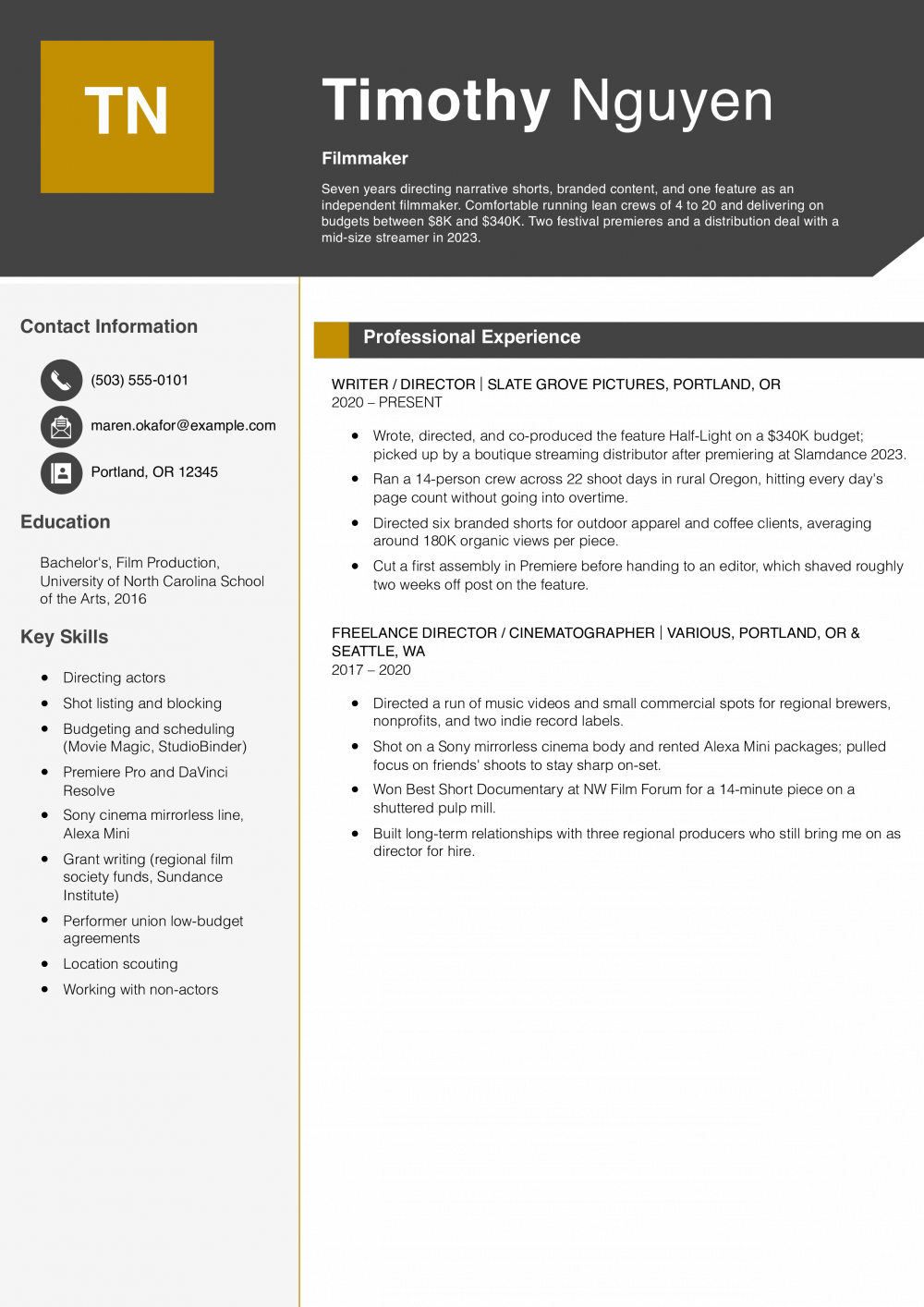
Customize this template in our builder in under 10 minutes.