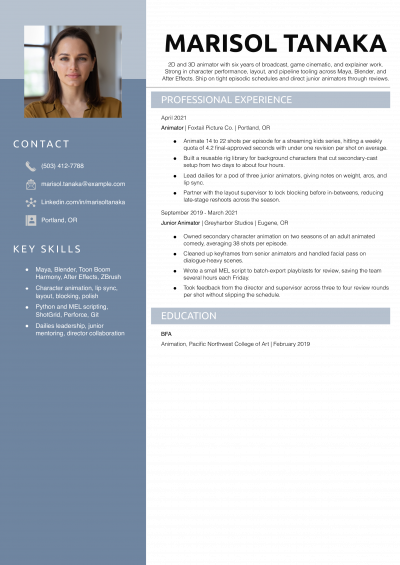
Animator Resume Examples
Your profile should name the type of animation you do, the pipeline you work in, and your shot range. State whether you focus on character, creature, cinematic, game, or motion graphics work. Name the software…
Every resume example is written and reviewed by our team of Certified Professional Resume Writers to ensure top-quality content and formatting.
Studios hire game designers who can prove they shipped features, not only pitched them. Your resume should show a design you owned from concept doc through playtesting to launch. Creative directors and studio recruiters look for work in engines like Unity or Unreal, plus systems design skills tied to real player outcomes.
Name the genre, the team size, and the mechanic you balanced or built. Metrics like retention lift or session length change carry weight, even from a game jam. The examples below show how to frame that proof on your own resume. To compare layouts before you start, browse our resume templates.
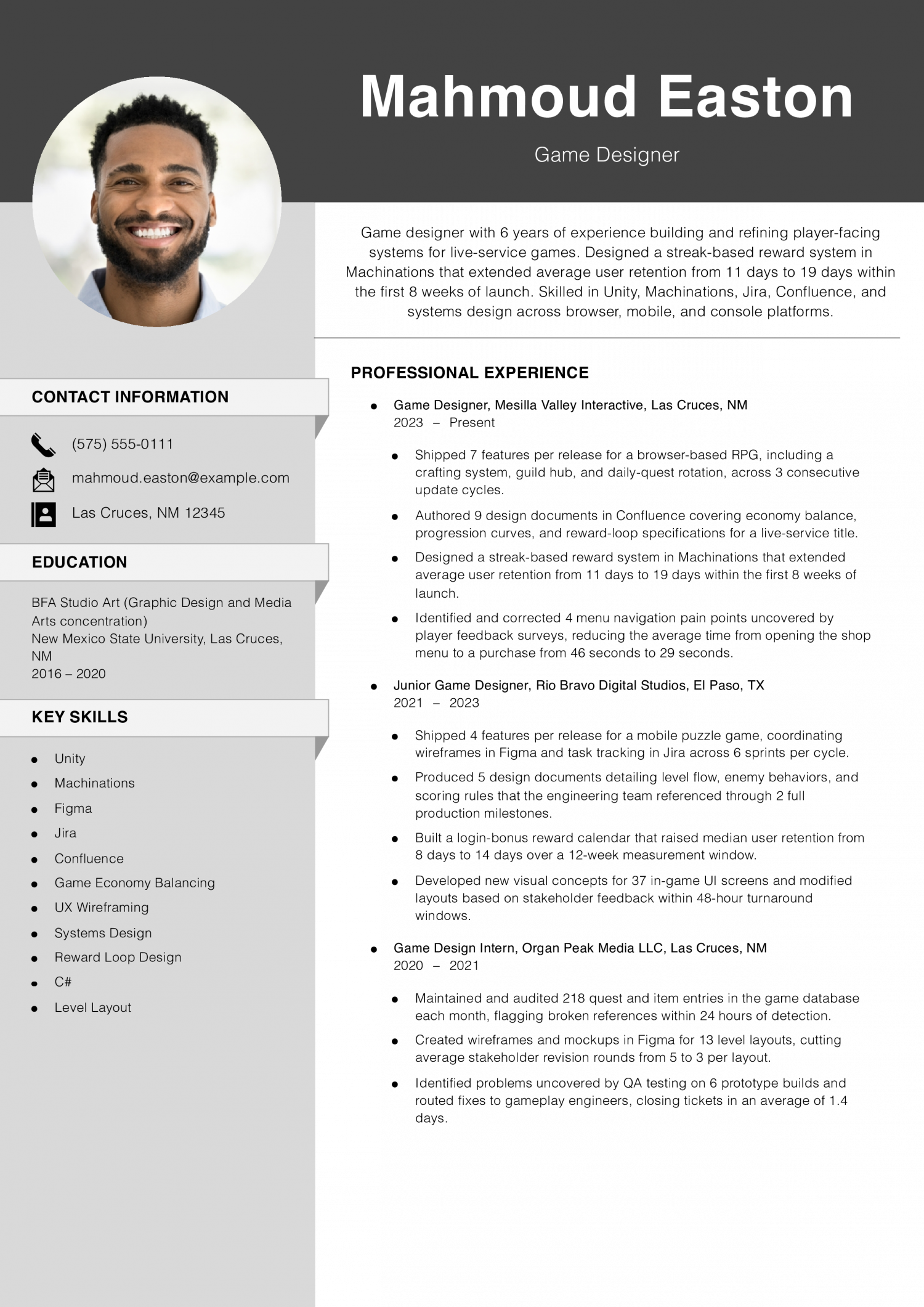
Pick this resume if you are a mid-level game designer with several years of live-service design work. Lead with retention metrics tied to specific reward systems you built, the way this candidate does.
Menu navigation fixes came from player feedback, and the faster shop menu let players make purchases sooner. That connects the fix to a better experience for the people playing. If you fixed a UX issue, say where the complaint came from and how the experience changed.
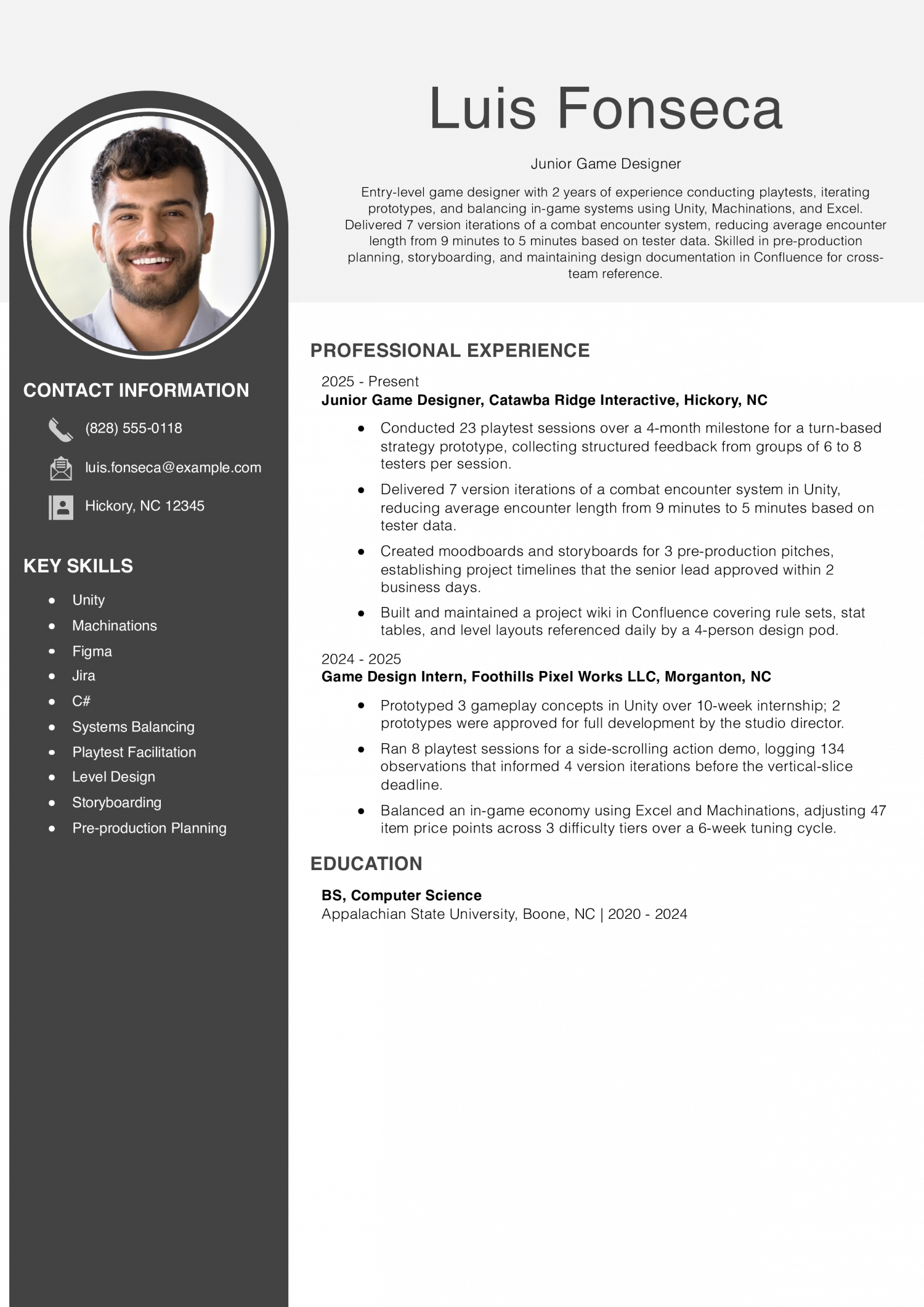
Start with this resume if you are an entry-level game designer moving from an internship into your first full-time design role. Lead with iteration counts and playtest volumes rather than listing course projects or hobby work.
Prototypes that moved to full development had a real decision-maker behind the approval. Studio heads can see that the director approved prototypes for full development. Say who approved your work and how many pieces advanced so the contribution is clear.
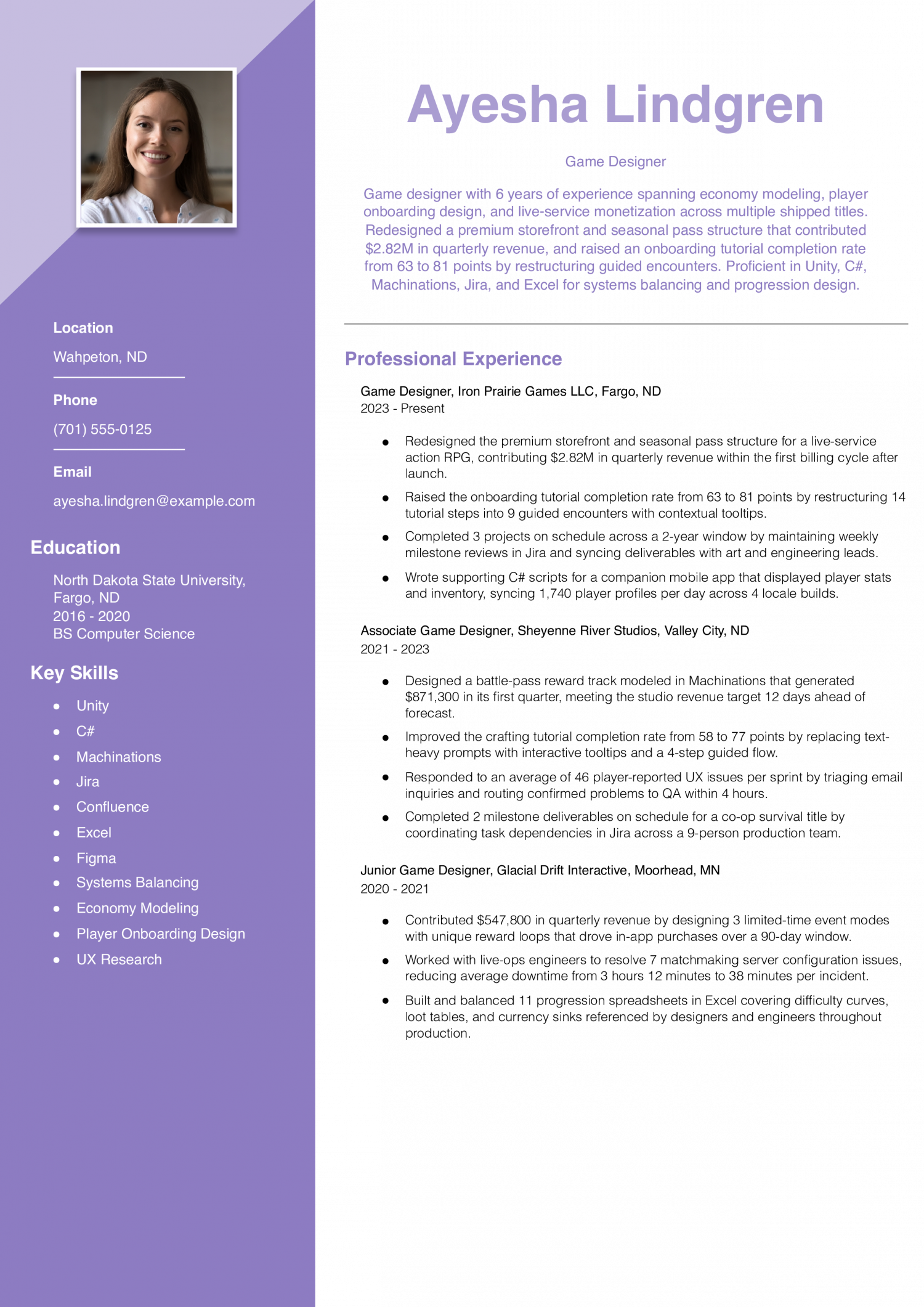
Try this resume if you are a mid-level game designer with live-service and monetization experience across multiple studios. Lead with revenue figures tied to specific economy structures you designed, the way each role here does.
The battle-pass reward track names the modeling tool used to plan it and the revenue it delivered. Producers can see which reward track was modeled and what sales it brought in. Name the system you designed, the tool behind it, and the outcome it produced.
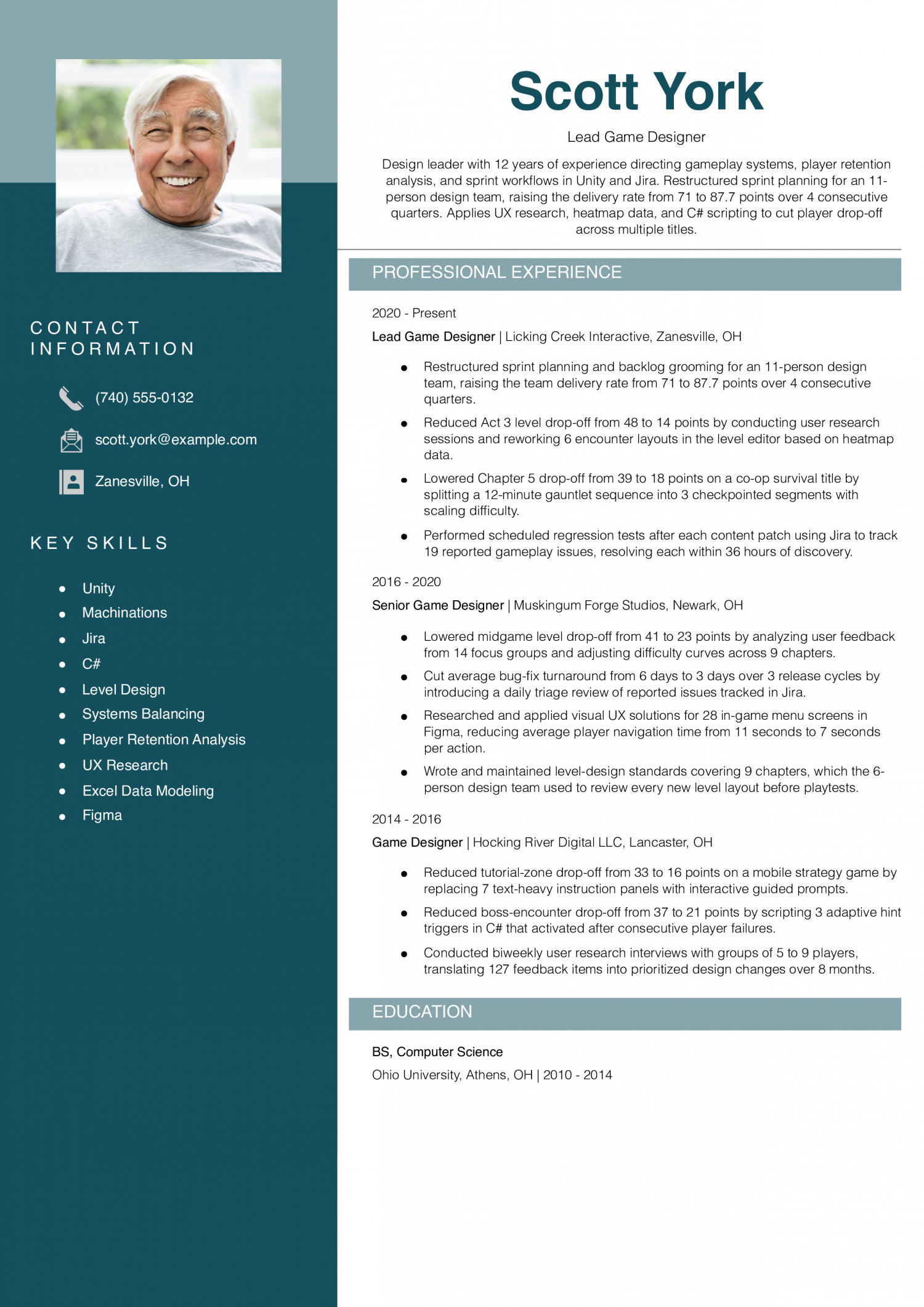
Lean on this resume if you are a senior lead game designer with over a decade of experience spanning multiple studios and titles. Lead each bullet with a specific drop-off reduction tied to the design change that caused it, the way this candidate does.
Difficulty tuning names the structural change, splitting a long section into shorter segments with checkpoints. Creative directors see a deliberate design decision, not a lucky fix. If you reworked a game section, name what you changed and what happened to player behavior.
Experienced in coordinating cross-discipline teams of designers, developers, and QA across game projects using Figma, Jira, and Confluence over 6 years of game design work. Raised an in-game survey satisfaction rating from 61 to 79 points by redesigning 12 menu screens based on structured user feedback. Built style guidelines, reusable component libraries, and interaction specs that shortened handoff cycles and reduced post-launch bugs across multiple releases.
Your profile sits at the top of page one. It should state your years of professional experience in game design methodology. It should name the genre you know best, such as RPG or mobile puzzle.
Then note the collaborative team size you have contributed within. Creative directors want to see your platform specialization immediately. State whether you ship on PC, console, or mobile.
If you specialize in level design, name that. If you lead systems design, say so. A clear scope line tells studio recruiters what kind of project you fit.
Two sentences can cover genre, platform, and role focus. Keep the profile to four lines or fewer. Avoid vague phrases like “passionate creative.” Name your design focus and your shipped titles instead.
Quantifying game design contributions can be challenging to measure. Strong resumes still find ways to incorporate quantifiable numbers. You might cite a retention lift after a feature redesign.
You could note the DAU count your game reached post-launch. Session length gains after a UX pass work well too. Bullets without a quantifiable number tend to read as generic responsibilities.
Try pairing each feature you built with a result. For example, state that you redesigned the tutorial flow and cut Day 1 churn by 12 percent. If hard data is under NDA, use scope numbers instead.
Name how many levels you built or how many items you balanced. Creative directors systematically scan for proof that your contributions moved a measurable player engagement metric.
Sort your bullet points under clear, descriptive skill category groups. Systems design covers economy tuning, progression curves, and reward loops. Level design includes blockouts, pacing, and spatial puzzles.
Narrative design spans dialogue trees and branching story paths. UX design covers menu flows and onboarding sequences. Pick three or four groups that match the posting.
Place the group the studio cares about most at the top. This organizational structure helps recruiters systematically evaluate your contributions efficiently. It also shows you understand how design teams split tasks.
Avoid dumping every task into one long block. A grouped layout proves you can organize complex project work into coherent categories. Label each group with a short descriptive header or bold keyword.
Consider referencing the specific methodology or framework each category represents.
Studio recruiters frequently filter candidate resumes by engine name. List your tools in a skills block on page one. Name the engines you have shipped in, such as Unity or Unreal.
Then list your prototyping tools, like Figma or Miro. If you script in Lua or Blueprint, state that next. Version control matters too, so note Git or Perforce.
Project tracking tools like Jira belong in this block as well. Maintaining tool visibility at the top conserves valuable review time. Creative directors may glance at a resume for under 30 seconds.
If they do not spot the right engine, they may move on. Order the list by relevance to the posted role. Put the engine the studio uses first.
A comprehensive portfolio carries considerably more weight than a degree in game design. Place a link to your portfolio site near your contact info. Include it again at the bottom with your education section.
Your portfolio should show playable builds or video walkthroughs. Design docs and GDDs can support your case as well. For education, list your degree and school on one line.
A bachelor’s in game design or computer science is common. Related coursework in 3D math or AI behavior can help. If you have shipped a game jam title, list it here too.
Jams demonstrate creative velocity and resourcefulness under a constrained deadline. Keep this section short, around three to five lines. Let your shipped work and portfolio do the heavy lifting.
Five years ago, a game design resume read like a list of game engines. The mix has shifted toward systems thinking and player data. Studios now want proof you can balance fun with scope.
Creative directors and studio recruiters weigh hard skills first during screening. They check for tools and methods tied to the open role. Soft skills like collaboration then shape their read of your work history.
Strong teamwork signals matter because design touches art, code, and audio teams. A solo portfolio alone will not carry the same weight it once did. Cross-check each table against the posting you plan to target.
Treat soft skills as labels for real stories in your bullet points. If the posting names level design, your bullets should show that skill in action. Pick the terms the posting uses, not loose synonyms.
| Soft Skills | AI-estimated % |
|---|---|
| Creative problem-solving | 67% |
| Player empathy | 58% |
| Cross-team collaboration | 47% |
| Iterative feedback integration | 36% |
| Deadline management | 33% |
And here are the top hard skills showing up most often.
| Hard Skills | AI-estimated % |
|---|---|
| Game mechanics design | 74% |
| Level design | 63% |
| Rapid prototyping | 44% |
| Systems balancing | 35% |
| Game design documentation | 34% |
Skill names and rankings come from an AI model grounded in U.S. Department of Labor occupation data for game designers, not from a count of game designers’ resumes built on ResumeTemplates.com.
These are the must-haves hiring teams look for when scanning a game design resume.
AI use on a game design resume can go three ways. You could lead with a vague claim like “AI-driven designer.” Creative directors and studio recruiters screen that out fast. You could leave AI off the resume entirely.
That is a valid choice if your workflow does not include it. Or you could describe how AI fits into your actual process. The third option is what creative directors can validate.
Name the tool, the task, and the human judgment you applied. A specific workflow line holds up in a portfolio review. A buzzword does not.
What AI is actually changing for this role
Level prototyping: AI layout generators produce rough blockouts faster, but designers still tune pacing and flow by hand.
Enemy and ally behavior: Trained agents can draft behavior trees, though designers must test them against player feedback loops.
Narrative branching: Large language models speed up early dialogue drafts, yet writers and designers revise for tone and lore accuracy.
Balancing and tuning: AI simulations run thousands of playthroughs to flag outlier stats, but designers interpret the data and set final values.
Asset concepting: Image generation tools create mood boards and concept variations that art directors and designers curate for style guides.
AI tools to name
How to phrase AI on your resume
Do
Skip
Creative directors and studio recruiters want to play or watch your work before they read your resume. A strong portfolio site shows your design thinking, not only your finished assets. Link it in your resume header so reviewers reach it in one click.
Each portfolio entry should walk the viewer through a design problem, your proposed solution, and the outcome. Open with a short video or animated gameplay clip so the reviewer sees the result before reading your process notes. Then describe the constraints you faced, the mechanics you chose, and any data that shaped your iteration.
Limit your portfolio to five or six of your strongest projects. One polished game jam prototype with clear documentation beats three unfinished side projects. If a project was collaborative, state your exact role and list the tools you used.
Game engines and scripting languages belong in one spot. A tech stack list tells studios your build environment. It keeps your work history section focused on results.
Creative directors scan for tools you use daily. A grouped software list proves hands-on skill fast. It also frees your bullet points for design impact.
The top-paying states for game designers are California, Washington and New York, so the large hubs most people target first do pay the most. BLS wage data covers all Web and Digital Interface Designers, a broader group that includes game design roles. The spread between the lowest and highest earners is wide.
Workers at the 90th percentile out-earn the median by roughly double. The 10th percentile sits nearly half below it. That gap suggests pay varies sharply across the field.
If you are open to relocating, your resume should name the platforms and engines you have shipped on so creative directors in those markets can see your fit.
| # | State | Median Annual |
|---|---|---|
| 1 | California | $136,110 |
| 2 | Washington | $130,480 |
| 3 | New York | $120,990 |
| 4 | Massachusetts | $113,540 |
| 5 | New Hampshire | $111,150 |
| 6 | District of Columbia | $107,650 |
| 7 | Rhode Island | $105,990 |
| 8 | Pennsylvania | $104,160 |
| 9 | Georgia | $103,810 |
| 10 | Texas | $102,650 |
| # | State | Workers | Median |
|---|---|---|---|
| 1 | California | 27,090 | $136,110 |
| 2 | New York | 16,560 | $120,990 |
| 3 | Washington | 11,580 | $130,480 |
| 4 | Texas | 5,910 | $102,650 |
| 5 | Florida | 4,620 | $77,730 |
Resume Templates offers HR approved resume templates to help you create a professional resume in minutes. Choose from several template options and even pre-populate a resume from your profile.
Creative directors look for level design, systems design, and narrative design as core entries. They also value prototyping, playtesting, and balancing on the same resume.
List the skills that match the posting and group them by type. Engine-specific skills like Unity or Unreal belong in their own line.
List each indie project under a Projects section with the title, your role, and the release year. Add one or two bullets covering player count, downloads, or a game jam result.
Link to a playable build or an itch.io page so studio recruiters can test your work.
Lead with a profile statement that names your design focus, such as systems or level design. Fill the experience section with game jam entries, modding projects, and coursework that produced playable builds.
Each bullet should name what you designed and the tool you used. Include a measurable result like retention rate or player feedback score.
Yes, a fan-inspired project shows you can apply proven design patterns to your own work. Describe the mechanics you built and the original choices you made rather than naming the franchise.
Creative directors care about your design reasoning over the reference itself. Focus your bullets on loop structure, balancing data, and playtesting outcomes.
Study the posting for the exact design pillar it names and mirror that language in your profile. Large studios filter hundreds of resumes, so front-load metrics like monthly active users or session length.
Tailor each bullet to show you have shipped or iterated on a feature at that scale.
One page works best when you have fewer than eight years of shipped titles. A second page can hold overflow credits and publications if you have led multiple shipped projects.
Keep the strongest work on page one because studio recruiters often spend under thirty seconds on the first pass.
Open your profile with the design discipline you are targeting and name one transferable skill. A UX researcher might highlight usability testing, and a software engineer might highlight scripting.
Pair that transferable skill with at least one personal or game jam project. This proves you can apply your prior experience to game design work.
For a game designer, an ATS-friendly template is the safest pick, because it puts your certifications and experience where a hiring manager scans first. A basic template is a solid alternative. Whichever you choose, keep the formatting clean and easy to parse: clear section headings, a standard font, and no graphics a parser can choke on.
Game Design Resume
4.1/5 stars with 150 reviews

Executive Resume Writer and Career Coach
Andrew Stoner is an executive career coach and resume writer with 17 years of experience as a hiring manager and operations leader at two Fortune 500 Financial Services companies, and as the career services director at two major university business schools.
© 2026 Resumetemplates.com All rights reserved.