Network Engineer Resume Examples
A CCNP on your resume tells an infrastructure director you passed an exam. It does not tell them what you’ve actually run. Add a single line under your name that names the differentiator a vendor…
Every resume example is written and reviewed by our team of Certified Professional Resume Writers to ensure top-quality content and formatting.
Uptime logs and subnet designs tell your story better than any summary line. IT managers and infrastructure directors scan for proof you kept systems live, cut ticket volume, or migrated VLANs without downtime. A strong network administrator resume leads with those outcomes.
Show the gear you manage, such as Cisco or Juniper switches, and name the protocols you route. List a CCNA or CompTIA Network+ if you hold one. Each resume below shows a different way to present that background. To compare layouts before you start, browse our resume templates.
Infrastructure directors decide whether to keep reading by the skills summary; if vendor certifications like CCNA or CCNP and uptime metrics are not visible there, the resume moves to the discard pile.
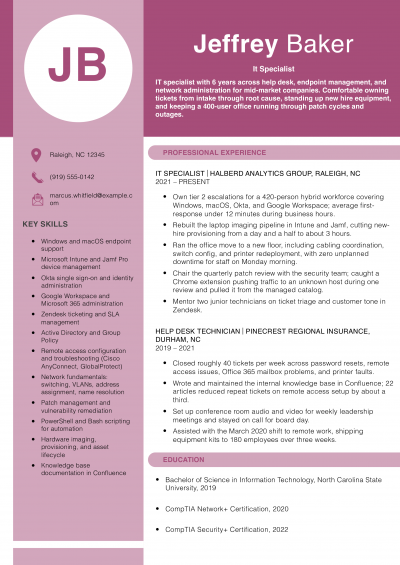
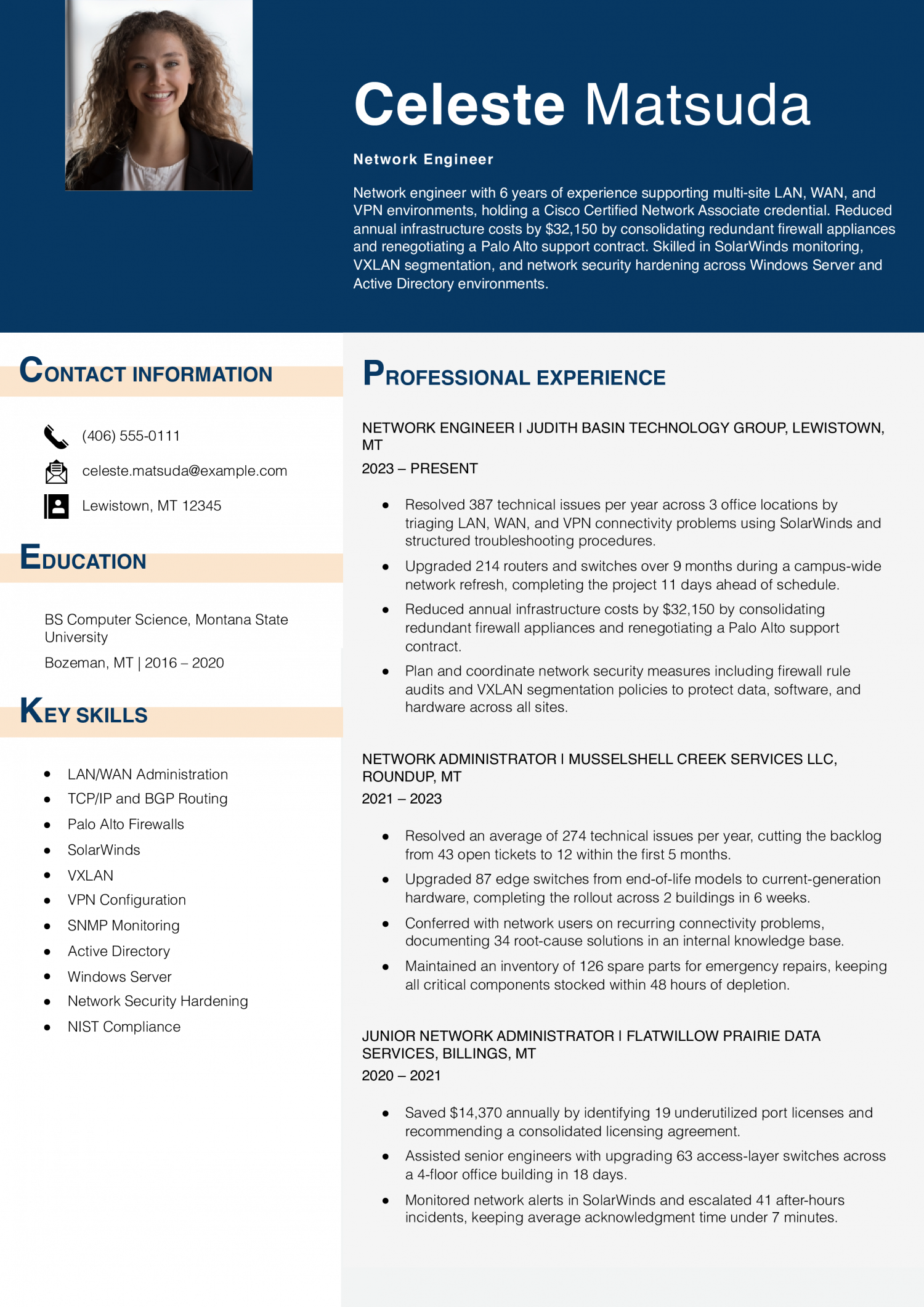
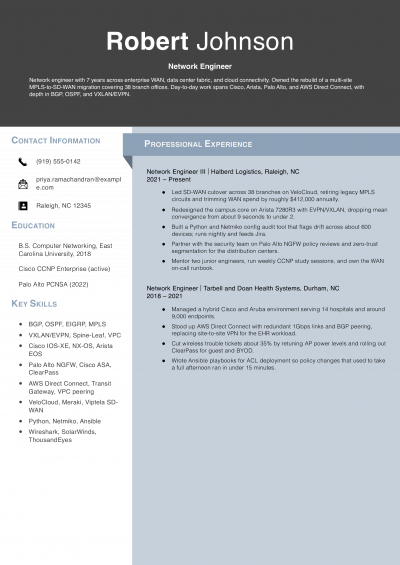
Pick this resume if you are a mid-level network engineer with about six years of hands-on infrastructure and security experience. Lead with device counts and project timelines so each bullet proves operational scale rather than listing generic duties.
Device count and project deadline in the same bullet show both the scale and the speed of this network upgrade. A CTO can judge the complexity at a glance. When you describe an infrastructure rollout, list the number of devices and whether you finished on or ahead of schedule.
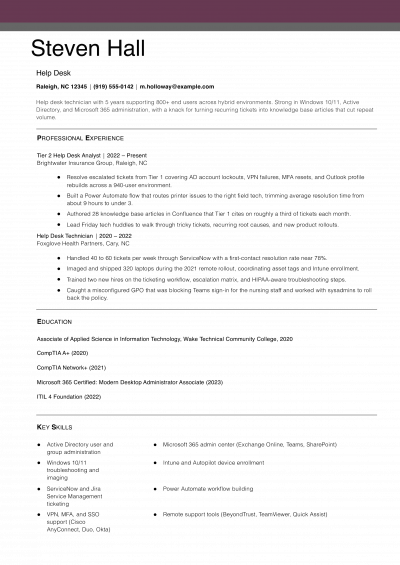
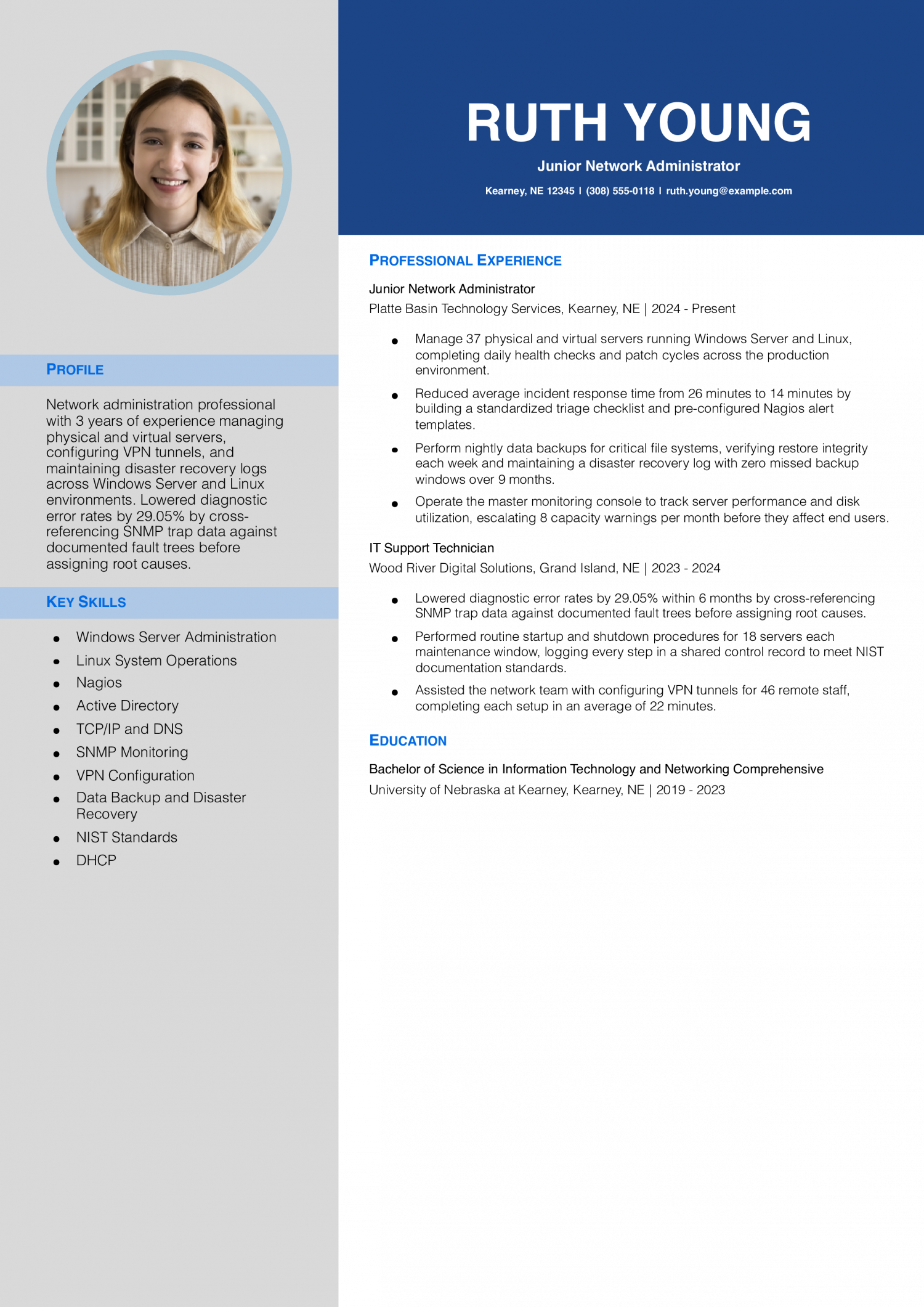
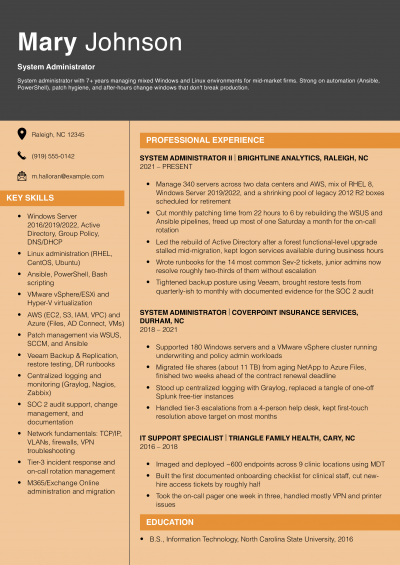
Start with this resume if you are an entry-level network administrator building a career from IT support into server and infrastructure management. Lead with specific server counts and response-time improvements so each bullet proves hands-on impact.
A backup log with no missed windows over months of operation tells a senior admin this person can be trusted with disaster recovery. The streak and the time span are what make it believable. Track your own backup record and state how long you maintained it without a gap.
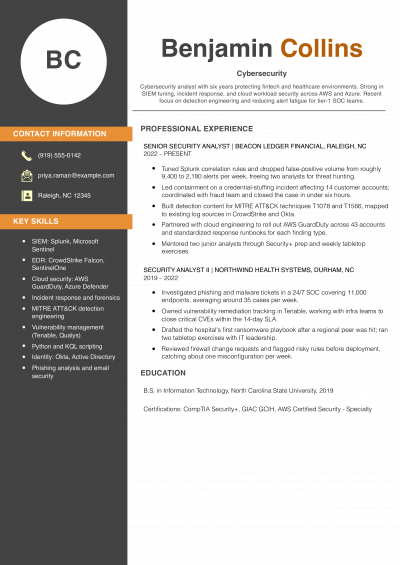
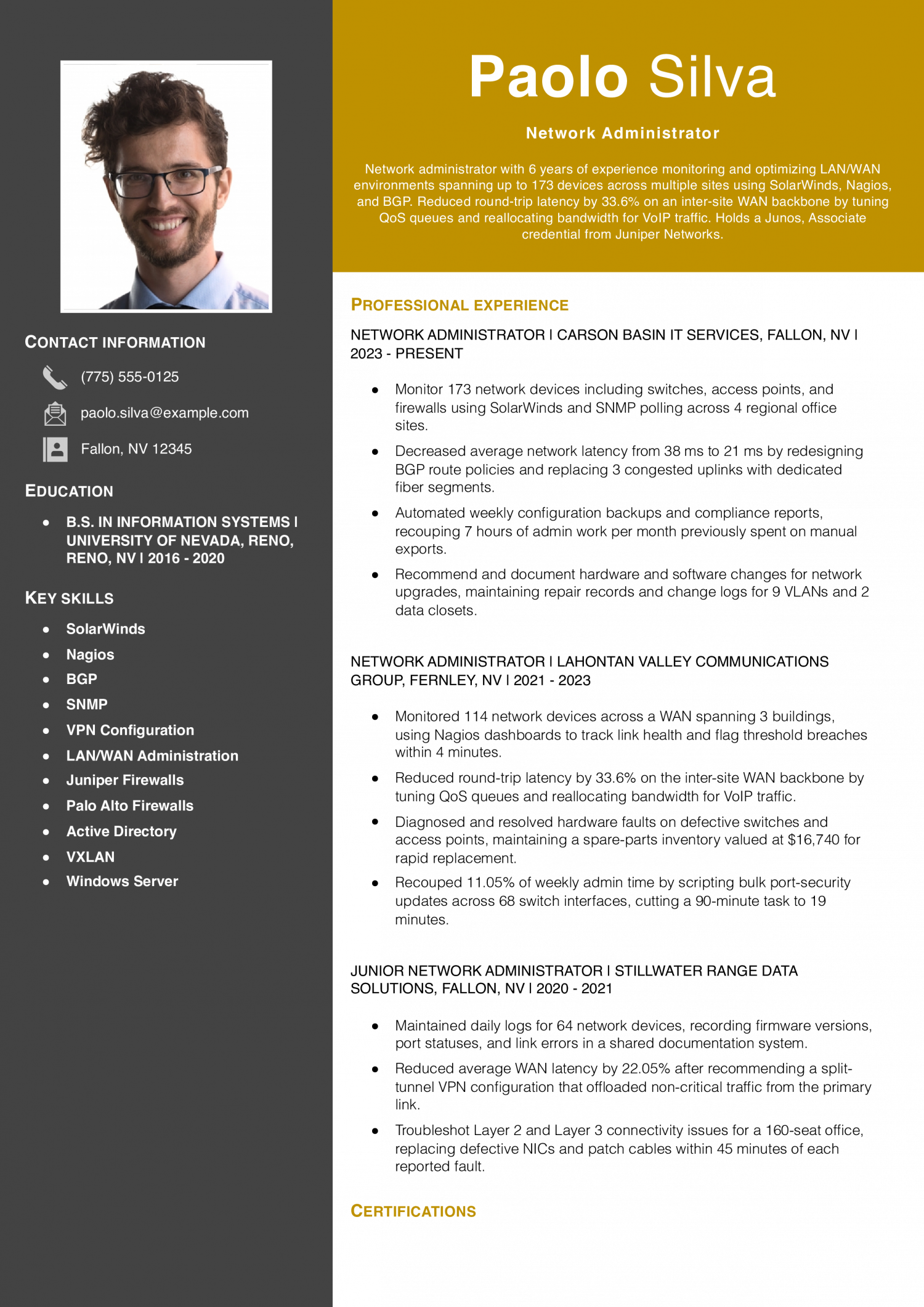
Try this resume if you are a mid-level network administrator with around six years of multi-site infrastructure and latency-reduction experience. Lead with specific device counts and before-and-after latency figures so reviewers see operational scope in every line.
The automation bullet names which tasks the scripts replaced and how much time the team got back each month. An IT manager can see the payoff was real, not guessed at. When you describe your own scripts, list the manual tasks they replaced and the hours they freed.
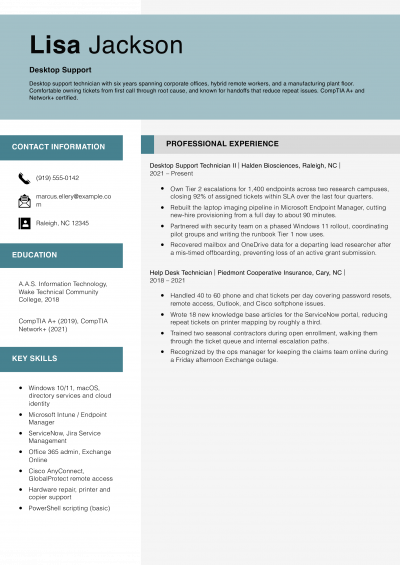
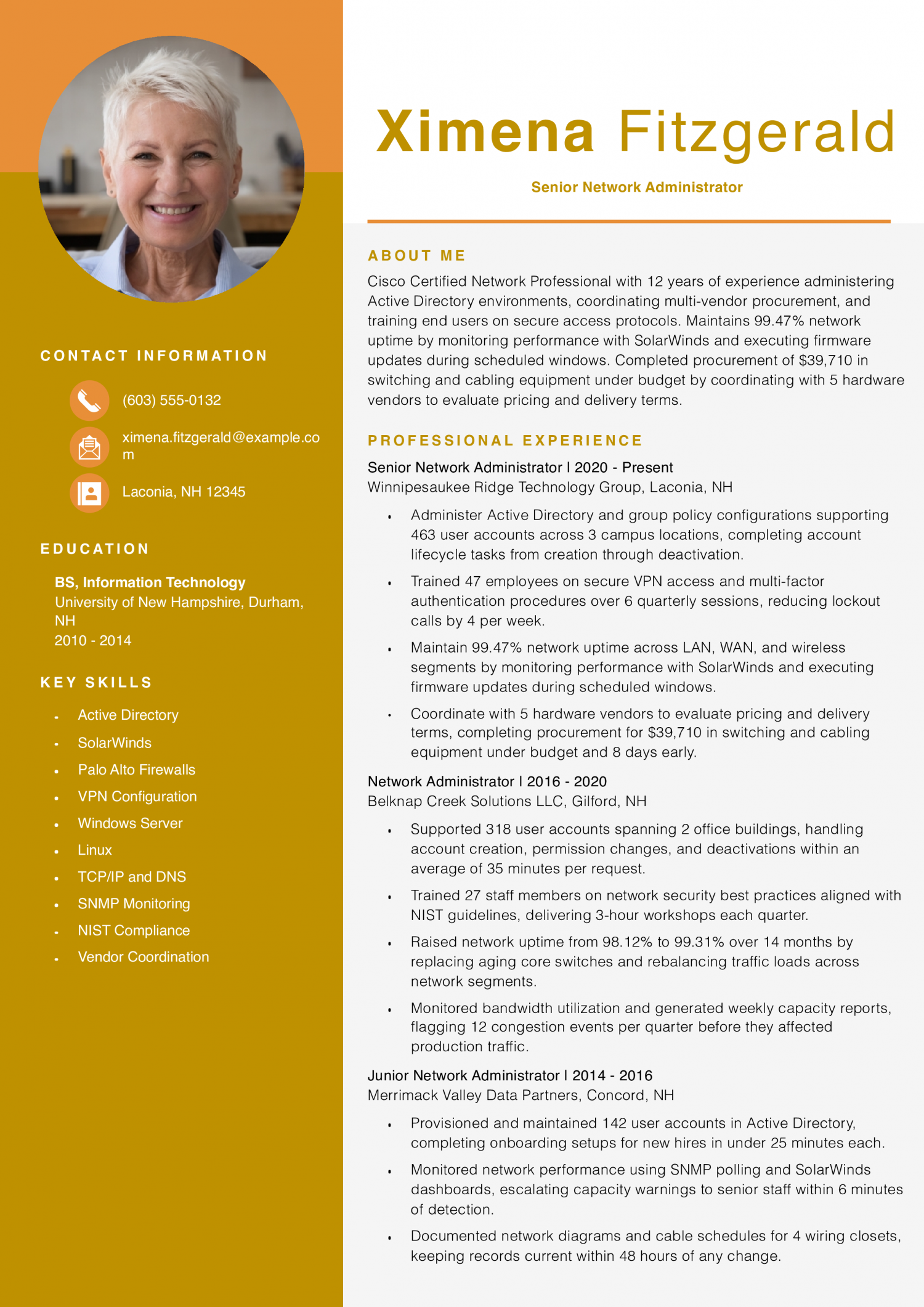
Lean on this resume if you are a senior network administrator with about a decade of multi-site infrastructure ownership and vendor management responsibility. Lead with user-account scale and uptime percentages so each accomplishment anchors your impact to a specific campus or segment.
Procurement work here is measured by the dollar total, the budget target, and whether the timeline was met. A director of IT can see all three in one line. For your own purchasing bullets, state the total spent, whether it landed under budget, and if it arrived on time.
IT infrastructure professional with 6 years of experience managing LAN/WAN environments, Fortinet firewalls, VPN configurations, and Windows Server deployments. Reduced average ticket resolution time by 34.6% across a 340-seat environment by restructuring the escalation workflow and assigning tiered priority categories in the help desk system. Holds a CompTIA Network+ certification and a background in SolarWinds monitoring, VMware administration, and NIST compliance.
List your years of hands-on network experience first. Name the environments you have managed, such as enterprise LAN/WAN or multi-site data centers.
Specify the scale you support in user counts or device counts. A vague profile reads like a template. A focused one tells IT managers and infrastructure directors what you own.
State whether you run Cisco, Juniper, or mixed-vendor stacks. Mention your strongest protocol areas, such as BGP and OSPF. If you hold a current CCNA or CCNP, place the abbreviation next to your name at the top.
This detail saves the reader time on every scan.
Most strong network administrator resumes lead with metrics. State the number of switches, routers, or firewalls you manage. Note the uptime percentage you maintained over a set period, such as 99.9 percent over 12 months.
You can also cite ticket volume and mean time to resolution. Mention bandwidth gains after an upgrade in concrete terms.
A good format is action verb, scope, then metric. For example, write that you cut average outage duration by 40 percent across 12 branch offices. IT managers and infrastructure directors scan for proof of scale first.
Numbers give them that proof in seconds. Even small figures help your case more than no figures at all.
Break your experience into categories that match the job posting. Routing and switching is one common group. List your work with VLANs, trunking, and dynamic routing protocols there.
Network security is a second group. Cover firewall rule management and VPN configuration. A third group can focus on monitoring and troubleshooting.
Name the tools you use, such as SNMP, Wireshark, or SolarWinds. A fourth group might cover cloud or hybrid infrastructure. Include tasks like connecting on-premises networks to cloud tenants.
Organizing your bullets this way helps IT managers and infrastructure directors find relevant experience. It also keeps your resume from looking like a random list of tasks.
Group your certifications together on page one, near your profile. List each certification with its issuing body and status. CompTIA Network+ from CompTIA is a strong entry-level signal.
CCNA from Cisco shows mid-level routing and switching skill. CCNP from Cisco signals senior-level depth. JNCIA-Junos from Juniper Networks shows Juniper networking knowledge.
IT managers and infrastructure directors often filter resumes by certification before reading bullets. Placing credentials low on page two risks them being missed. If a posting names a specific cert, mirror that exact title.
Do not bury tools like Ansible or Terraform in your bullets alone. Add a separate technical skills line so automated filters can parse them.
For entry-level and mid-level candidates, the education section still carries weight. List your degree, major, and graduation year. A degree in information technology or computer science is common.
If you lack a four-year degree, note relevant coursework or a two-year program. Lab projects deserve their own short entries. Describe a home lab where you configured OSPF across virtual routers.
Mention a packet capture project where you diagnosed latency issues. These entries show initiative when your paid experience is thin. Place this section after your work history but before any references.
Keep each entry to two or three lines so it stays scannable.
Network administrator postings in 2026 filter for specific terms. An ATS scores your resume before a person reads it. The two tables below list the skills that appear most often in postings.
Start with the hard skills table. Compare each term against the job ad you want. Add every match to your skills section word for word. Swap in the posting’s phrasing when it differs from the table.
Then move to the soft skills table. IT managers and infrastructure directors want proof of these traits. Weave each matched soft skill into a work bullet with a measurable result. A bare list of soft skills carries less weight than a bullet that shows one in action.
Review both tables each time you apply to a new role. Postings shift phrasing across companies. Matching the exact words in the ad raises your chance of clearing the screen.
| Soft Skills | AI-estimated % |
|---|---|
| Analytical problem-solving | 66% |
| Cross-team collaboration | 64% |
| Clear technical communication | 43% |
| Calm under pressure | 39% |
| Proactive planning | 26% |
And here are the top hard skills showing up most often.
| Hard Skills | AI-estimated % |
|---|---|
| Network infrastructure management | 76% |
| Disaster recovery planning | 65% |
| Network security implementation | 40% |
| System performance monitoring | 37% |
| Hardware troubleshooting and repair | 35% |
Skill names and rankings come from an AI model grounded in U.S. Department of Labor occupation data for network administrators, not from a count of network administrators’ resumes built on ResumeTemplates.com.
Lead with how you use AI.
IT managers and infrastructure directors are split on AI in network operations. Some teams want AI-driven anomaly detection running around the clock. Others worry about automated changes triggering outages without human review.
Name the tools you actually use in your daily work. Describe your real workflow, not a vendor pitch. Avoid claims that you “manage networks with AI” if your practice is reviewing alerts.
State what the tool flags and what you verify before acting. That honesty matters more than a long list of platforms. Focus on tools where you can explain the output.
What AI is actually changing for this role
Traffic analysis: AI models baseline normal traffic patterns and flag deviations faster than manual SNMP polling cycles.
Threat detection: Correlation tools match firewall logs with endpoint data to surface threats a static rule set would miss.
Capacity planning: Predictive models forecast bandwidth demand by site so you can justify upgrades with data.
Troubleshooting: AIOps platforms parse syslog floods and suggest root cause, cutting your mean time to resolve.
Configuration audits: AI compares running configs against policy templates and highlights drift before it causes an outage.
AI tools to name
How to phrase AI on your resume
Do
Skip
Your tech stack list shows which tools you use daily. IT managers and infrastructure directors scan it before reading anything else. Group your tools by category so the list reads fast.
A solid work history keeps you eligible. The certifications below are what move a Network Administrator resume from the qualified stack into the shortlist. IT managers and infrastructure directors scan these lines to gauge your skill tier.
They also use them to match you to the right team or project. List each one on its own line. Note who issued it and when you earned it.
Add the expiration date if the credential requires renewal. Drop any that have lapsed unless you plan to renew them soon. Place active credentials near the top of the list so they stand out fast.
Network administrator is one of the larger occupations tracked by BLS. That size means the median pulls in a long tail of help-desk and junior variants, so the middle number may look lower than what a seasoned admin would expect. The spread from the bottom tenth to the top tenth is wide.
Workers near the ceiling out-earn the midpoint by more than half. Workers near the floor sit roughly a third below it. Geographic pay gaps add another layer of range, so check the state tables for your local market.
Cost of living and demand for cloud skills both shape where you land within this spread. The gap between urban and rural areas can be notable as well. On your resume, lead with the specific platforms you manage and the scale of the networks you keep running.
| # | State | Median Annual |
|---|---|---|
| 1 | Maryland | $118,290 |
| 2 | New Jersey | $116,420 |
| 3 | Massachusetts | $110,980 |
| 4 | District of Columbia | $110,970 |
| 5 | Virginia | $109,610 |
| 6 | California | $106,440 |
| 7 | Connecticut | $105,880 |
| 8 | New York | $105,810 |
| 9 | Washington | $103,910 |
| 10 | Nevada | $103,440 |
| # | State | Workers | Median |
|---|---|---|---|
| 1 | Texas | 34,840 | $101,240 |
| 2 | Florida | 26,890 | $95,200 |
| 3 | California | 26,170 | $106,440 |
| 4 | New York | 18,220 | $105,810 |
| 5 | Ohio | 15,130 | $97,570 |
Resume Templates offers HR approved resume templates to help you create a professional resume in minutes. Choose from several template options and even pre-populate a resume from your profile.
Lead with a strong objective that names the protocols and platforms you studied. List lab projects or home lab setups as experience entries with measurable details. A CompTIA Network+ credential can strengthen an entry-level resume when paid work is limited.
Use the title that matches the job posting, because IT managers and infrastructure directors screen for it. If you have done both roles, pick the title closest to the posting. Weave the other duties into your bullet points so the scope still comes through.
One page works for most candidates with fewer than 10 years of network experience. A second page is reasonable when you manage enterprise environments across multiple sites. Keep every line tied to a result so nothing on either page feels like filler.
Group contract roles under one heading such as "Contract Network Administrator" with the staffing agency named. Below that heading, add a sub-entry for each client with the project scope and key metrics. This format shows steady work without looking like a string of short stints.
A reverse-chronological format is the strongest choice for most network administrator resumes. IT managers and infrastructure directors expect to see your most recent environment first. Include the number of nodes, uptime targets, and the protocols you managed in each role.
Note any relevant activity during the gap, such as earning a JNCIA-Junos credential or building a home lab. Place that activity in its own line with dates so the timeline reads without breaks. If the gap was personal, a brief label like "Family Leave" followed by your return-to-work training is enough.
Yes, include one when the posting asks for it or when you are changing industries. A cover letter lets you explain how your network scope fits the company's infrastructure. Keep it to three or four paragraphs and reference specific metrics from your resume.
An ATS-friendly template gives your certifications and uptime record clear sections on the page. A basic template works here as well.
Network Administrator Resume
4.2/5 stars with 213 reviews

Executive Resume Writer and Career Coach
Andrew Stoner is an executive career coach and resume writer with 17 years of experience as a hiring manager and operations leader at two Fortune 500 Financial Services companies, and as the career services director at two major university business schools.
© 2026 Resumetemplates.com All rights reserved.