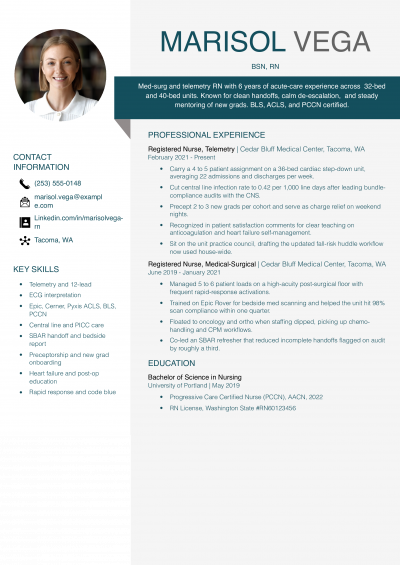
Registered Nurse Resume Examples
A state board lookup confirms you hold an active RN license. It does not show acuity, specialty, or the unit you actually staff. Lead the summary with the one signal that separates you from the…
Every resume example is written and reviewed by our team of Certified Professional Resume Writers to ensure top-quality content and formatting.
Most school nurse hires come down to clinical proof, not soft claims. Nursing supervisors and school principals look for your caseload size, chronic care plan counts, and screening program results. Your RN license and any NCSN credential should be easy to spot on the page.
The strongest resumes pair chronic care management with data, like asthma action plan compliance rates. They also show you can train staff on emergency response protocols. The examples below give you formats built for school nursing roles at every career stage. To compare layouts before you start, browse our resume templates.
A current RN license listed at the top, student-to-nurse ratios that show caseload scope, and documented NCSN certification are what separate the school nurse resumes that nursing supervisors and school principals schedule for interviews from the rest.
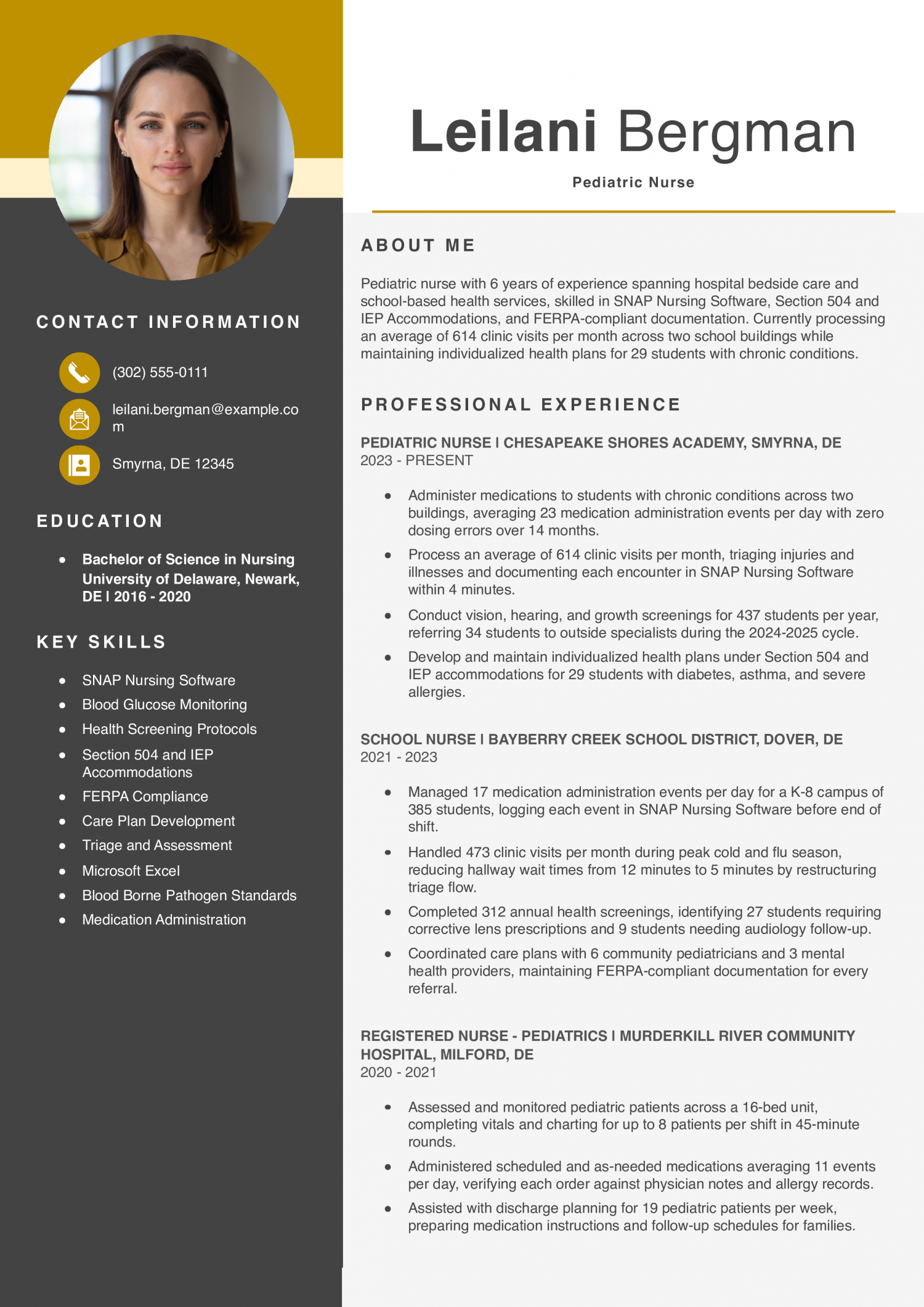
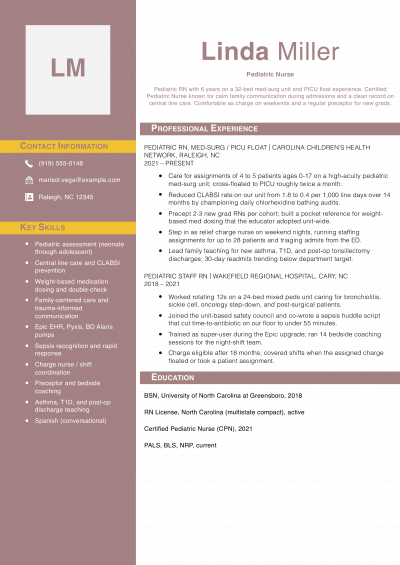
Consider this resume if you are a mid-level pediatric nurse moving between hospital and school settings and aiming for a larger campus assignment. Feature a clear volume progression from one role to the next so reviewers can trace your growing patient load at a glance.
Many pediatric nurse resumes describe triage work without showing how long each encounter takes. This resume writes “documenting each encounter in SNAP Nursing Software within 4 minutes” to attach a specific turnaround time to the charting step. On your own resume, time one repeatable clinical task you perform every day and state the per-encounter duration so readers can gauge your throughput.
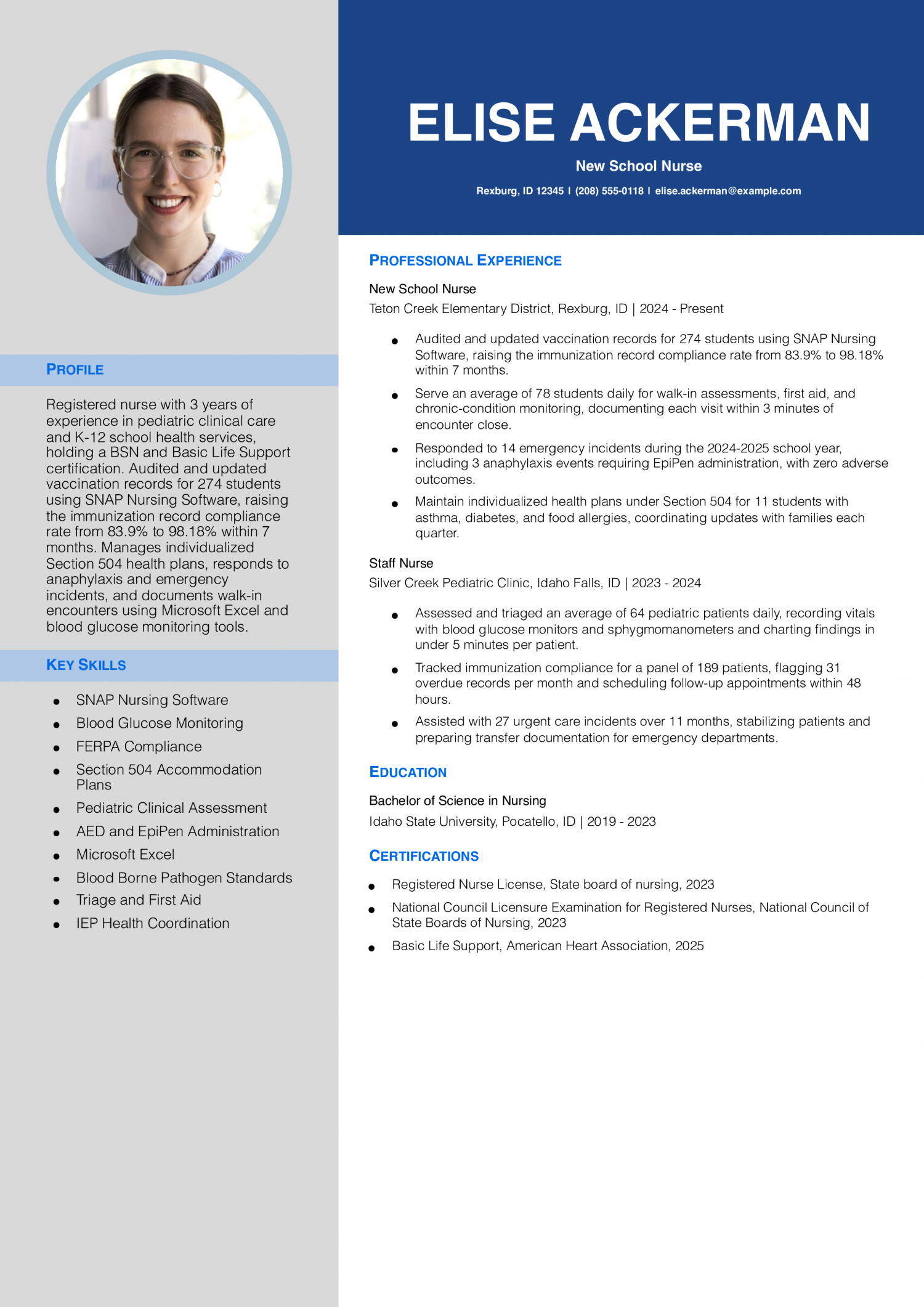
Start with this resume if you are an entry-level nurse transitioning from a pediatric clinic into your first school nursing position. Sequence your bullets so each one names the software or protocol used, the volume handled, and the time frame measured.
Many new school nurse resumes list emergency response as a general duty without specifying incident types or outcomes. This resume writes “14 emergency incidents during the 2024-2025 school year, including 3 anaphylaxis events requiring EpiPen administration, with zero adverse outcomes” to break one broad category into named scenarios and a concrete result. On your own resume, separate each emergency type you handled, state how many occurred in a defined school year, and close with the patient outcome.
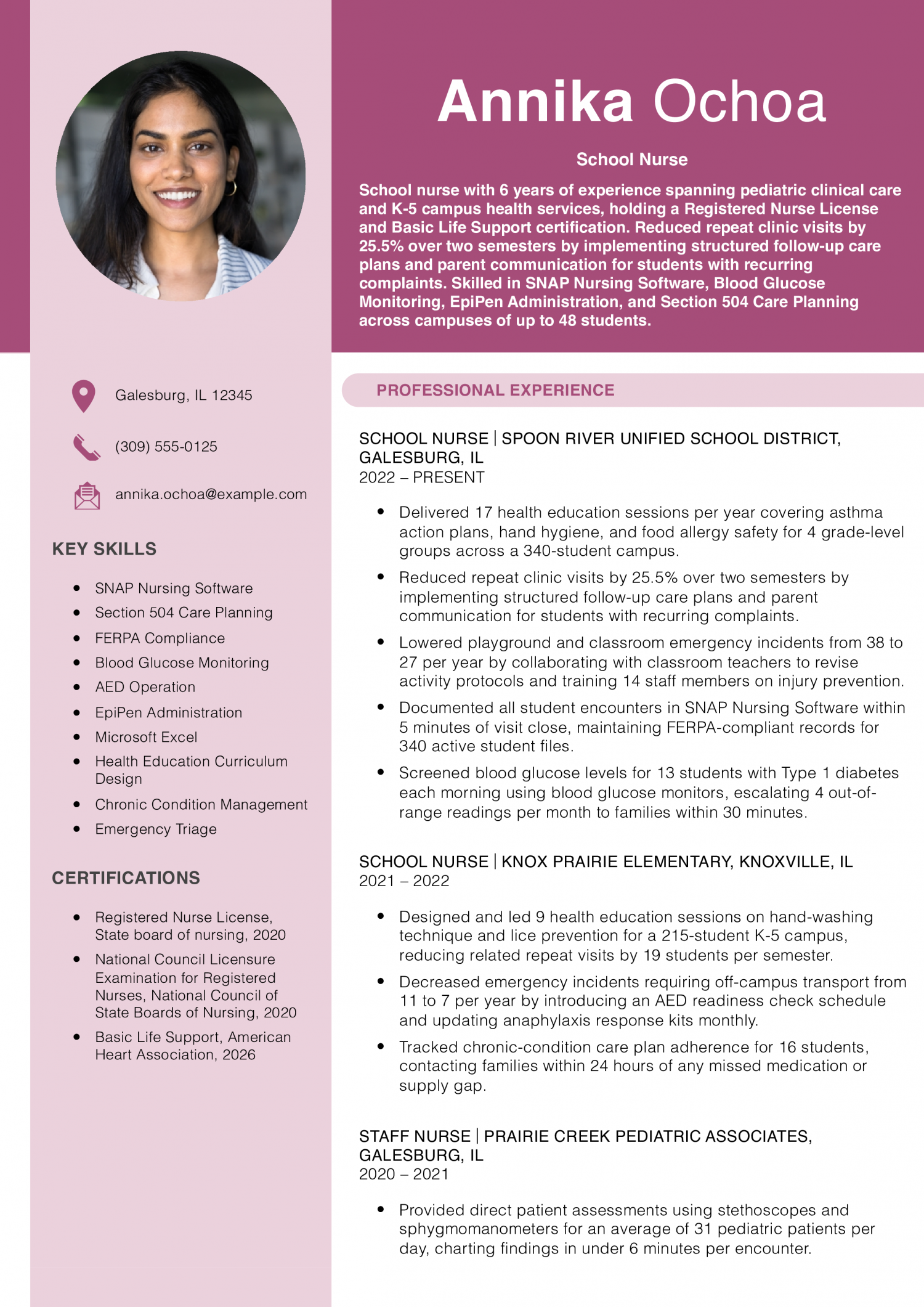
Try this resume if you are a mid-level school nurse with both pediatric clinic and campus health office experience. State the before-and-after incident counts for each safety protocol you changed so reviewers can measure your prevention results.
School nurse resumes often describe emergency response training as a checkbox duty without naming how many staff were trained or what changed afterward. This resume writes “collaborating with classroom teachers to revise activity protocols and training 14 staff members on injury prevention” to connect the training audience size with the protocol revision that drove the improvement. On your own resume, pair the number of colleagues you trained with the specific procedure you updated so reviewers see both the reach and the content of your intervention.
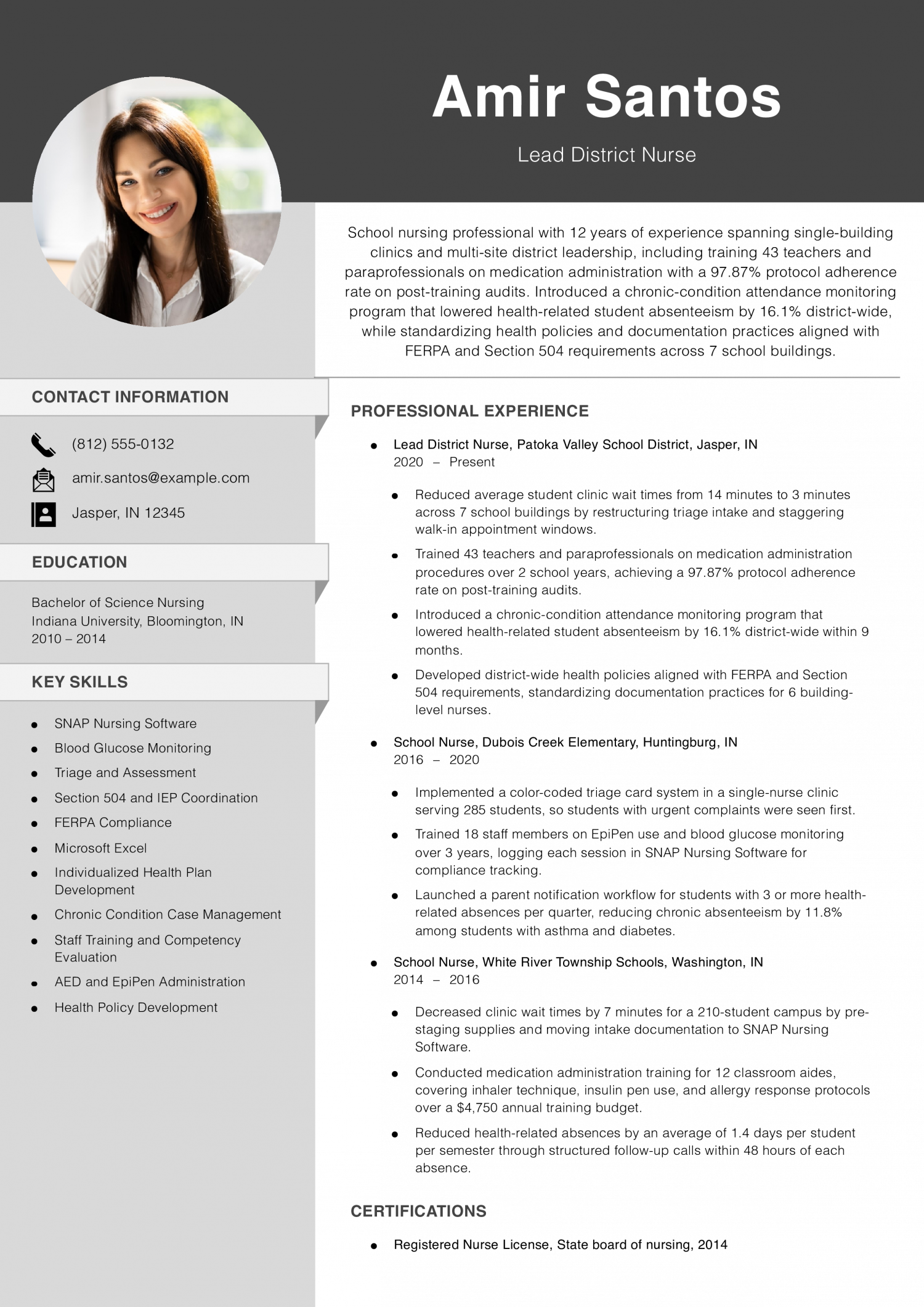
Turn to this resume if you are a senior-level district nurse ready to move from building-based care into multi-site leadership. Test how it threads one metric, clinic wait time, through three consecutive roles to show compounding improvement.
Many district nurse resumes describe staff training as a general responsibility without measuring whether trainees retained what they learned. This resume writes “achieving a 97.87% protocol adherence rate on post-training audits” to attach a compliance outcome directly to the training effort. On your own resume, follow each training bullet with the audit or observation score that proves the instruction changed behavior, not a count of sessions delivered.
Registered Nurse and Basic Life Support credential holder with 7 years of experience in vaccine administration, chronic-condition monitoring, and early intervention referrals across pediatric and school health settings. Managed a $9,830 annual supply budget for clinic equipment and first-aid materials across two K-8 buildings while administering 318 vaccines annually during immunization clinics. Skilled in SNAP Nursing Software, FERPA compliance, Blood Borne Pathogen Standards, and Section 504 Health Plans.
Your profile sits at the top of page one. It should state your years of nursing experience and your school setting. Name the grade levels you have served, such as elementary or high school.
Mention whether you worked in a single building or floated across a district. Include the student census you covered each day. Nursing supervisors and school principals scan this section in seconds.
A clear scope line tells them if your background fits their campus. State your Registered Nurse License status and any specialty credential here too. If you hold the National Certified School Nurse credential, place it beside your name.
School nursing is hard to measure with revenue or sales figures. You can still show scale in every bullet you write. State the number of students on your daily caseload.
Note how many health screenings you ran each semester. Mention the count of individualized health plans you wrote. A bullet without a number tends to read as a duty list.
Try framing results around trends, such as a drop in absentee rates. You might note a percent decrease in emergency room referrals. Nursing supervisors and school principals look for signs you improved student wellness.
Organize your bullets under the types of work you perform daily. Start with acute care, covering first aid and triage in the health office. Follow with chronic disease management for students with asthma or diabetes.
Add a group for screening programs, such as vision and hearing checks. Include a section for care coordination with families and pediatricians. A fifth group can cover health education, like classroom lessons on hygiene.
This structure helps principals see your full range at a glance. Use two to four bullets per group.
List your Registered Nurse License with state and current status on page one. Put it in a credentials block near your name or profile. Add your NCLEX-RN completion.
If you earned the NCSN, feature it in this block as well.
Basic Life Support certification belongs here too. Nursing supervisors and school principals often verify these before reading further. Do not bury them at the bottom of page two.
If your district uses an electronic health records system, name it in a tools line. Bold the abbreviations so reviewers can spot them during a quick scan.
Close your resume with an education section listing your nursing degree. Name the school, degree type, and graduation year. If you hold a Bachelor of Science in Nursing, place it above an associate degree.
Add any coursework in pediatric nursing or public health that fits the role. Include continuing education hours required for your state license renewal. Nursing supervisors and school principals value training in mental health first aid.
List that as a separate line if you have it. Keep each entry to one or two lines so the section stays tight.
Five years ago, a School Nurse resume read like a list of clinical tasks. The mix has shifted toward population health data and care coordination. Chronic disease tracking now appears on most strong resumes.
Nursing supervisors and school principals weigh hard skills to confirm your clinical range. They also look for soft skills like communication to judge parent and staff rapport. Soft skills prove you can run a health office on your own.
A strong resume pairs both types in each bullet. Cross-check each table against the job posting you are targeting. Pull exact phrases from the posting into your skills section.
Then back each soft skill with a short result in your bullet text. Add numbers where you can, such as students served per day. This approach helps your resume match the filters these roles use.
Treat the tables as a starting checklist, not a final list.
| Soft Skills | AI-estimated % |
|---|---|
| Calm under pressure | 73% |
| Parent communication | 64% |
| Empathy with students | 47% |
| Cross-team collaboration | 37% |
| Behavioral observation | 29% |
And here are the top hard skills showing up most often.
| Hard Skills | AI-estimated % |
|---|---|
| Student health assessment | 69% |
| Medication administration | 55% |
| Immunization management | 50% |
| First aid response | 40% |
| Health record documentation | 25% |
Skill names and rankings come from an AI model grounded in U.S. Department of Labor occupation data for school nurses, not from a count of school nurses’ resumes built on ResumeTemplates.com.
Before a school nurse resume gets a closer read, hiring teams check for a short list of essentials.
An active RN license is the baseline for most postings. You must pass the NCLEX-RN to earn that license. Requirements vary by state, so check your state board.
Some states also require a school nurse credential or permit. This is separate from your RN license. Contact your state education department for details.
The NCSN shows advanced school health knowledge. It is issued by the National Board for Certification of School Nurses. Adding it to your resume can set you apart from other candidates.
Your RN license requires ongoing education to stay active. Each state board of nursing sets its own renewal cycle. Track your hours and list recent courses on your resume.
The NCSN from the National Board for Certification of School Nurses also requires renewal. You must show continuing education tied to school health. Nursing supervisors and school principals value current training.
Focus on topics that match school health needs. Courses in asthma care or diabetes management stand out. Allergy and anaphylaxis training is useful too.
School nurses use electronic health record tools daily. These systems track immunizations, medications, and visits. Nursing supervisors and school principals expect accurate data logging.
Beyond your state RN license, the credentials below tell nursing supervisors and school principals how far your training goes. They signal whether you hold a national school nursing specialty or current emergency skills. Each line item helps sort your resume into a stronger tier.
List the full credential name, the issuing body, and the date it expires. Keep each entry on its own line so the reader can scan it fast. Drop any credential that has lapsed unless you plan to renew it before your start date.
The top-paying states for school nurses cluster in smaller, lower-supply markets, not the large metro areas most nurses target first. BLS wage data covers all registered nurses, a broader group that includes school nurses. The spread between the lowest and highest earners is wide.
Nurses at the top out-earn the median by roughly 41 percent. Those at the bottom sit about 29 percent below it. That gap stays wide across states, so where you practice matters.
If you are open to relocating, list your RN license portability and any multi-state compact eligibility near the top of your resume.
| # | State | Median Annual |
|---|---|---|
| 1 | California | $140,270 |
| 2 | Hawaii | $136,320 |
| 3 | Oregon | $129,010 |
| 4 | Washington | $124,200 |
| 5 | Alaska | $109,480 |
| 6 | New York | $109,440 |
| 7 | New Jersey | $106,500 |
| 8 | Massachusetts | $104,550 |
| 9 | Nevada | $103,670 |
| 10 | Connecticut | $102,740 |
| # | State | Workers | Median |
|---|---|---|---|
| 1 | California | 338,940 | $140,270 |
| 2 | Texas | 271,380 | $95,970 |
| 3 | Florida | 229,940 | $84,190 |
| 4 | New York | 205,810 | $109,440 |
| 5 | Pennsylvania | 146,520 | $96,430 |
Resume Templates offers HR approved resume templates to help you create a professional resume in minutes. Choose from several template options and even pre-populate a resume from your profile.
No, leave your high school diploma off once you hold a nursing degree. Nursing supervisors and school principals expect to see your nursing degree and your RN license. The high school line takes up space without adding any credential they need.
List each clinical rotation in a separate entry under a Clinical Experience heading. Name the facility, the unit or population, and the dates you were there. Add two or three bullets that show patient volume and the tasks you performed.
Yes, Basic Life Support from the American Heart Association is expected for most school nurse roles. List it in a Certifications section with the date it expires. Many districts treat a current BLS card as a condition of hire.
Include it if it is 3.5 or higher and you graduated within the past three years. That number signals strong clinical coursework to a principal reviewing your file. After a few years of work history, your on-the-job results carry more weight.
Lead with clinical roles that overlap with school health, such as pediatric or community nursing positions. Highlight skills you already use, like health screenings and chronic care coordination. A short profile at the top can explain your move into school-based practice.
State your RN license, your years of nursing experience, and the specific district you target. Keep the objective to two sentences so it reads clearly. Focus on the student population or health programs you want to support.
List your nursing degree first in the Education section, then place your earlier degree below it. Include the school name, degree title, and graduation year for each entry. This order shows nursing supervisors that your clinical training is current while still crediting your prior education.
For a school nurse, an ATS-friendly template is the safest pick, because it puts your certifications and experience where a hiring manager scans first. A basic template is a solid alternative. Whichever you choose, keep the formatting clean and easy to parse: clear section headings, a standard font, and no graphics a parser can choke on.
School Nurse Resume
4.9/5 stars with 158 reviews

Executive Resume Writer and Career Coach
Andrew Stoner is an executive career coach and resume writer with 17 years of experience as a hiring manager and operations leader at two Fortune 500 Financial Services companies, and as the career services director at two major university business schools.
© 2026 Resumetemplates.com All rights reserved.