Inventory Manager Resume Examples
Add one line a generic profile lookup cannot reveal: the ERP or WMS you configure yourself, a Six Sigma Green Belt with a closed shrinkage project, or multi-site control across a named geography. Supply chain…
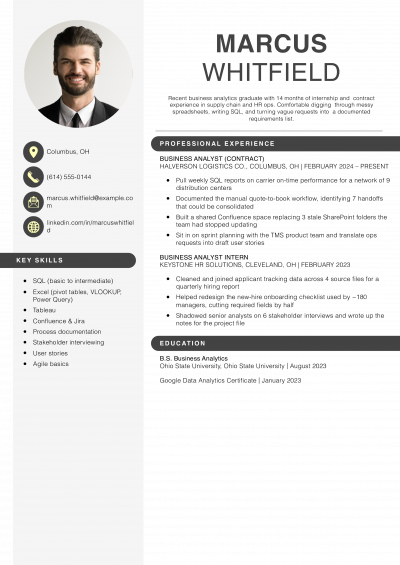
Supply chain managers and procurement directors look for named ERP systems, forecast accuracy figures, and inventory savings on the first page, because those signals show whether an analyst can move data into decisions the operations team will actually use.
This resume fits a new Supply Chain Analyst who runs demand reports and tracks vendors. Show clean data work in Excel or SQL, plus a project where your numbers moved a real stock or cost call.
A Senior Supply Chain Analyst owns forecasting models and leads sourcing reviews across categories. Prove you cut cost, shortened lead times or lifted service levels, and show that you guide junior analysts and brief category managers on tradeoffs.
A Supply Chain Manager owns the flow across planning, sourcing and logistics for a business unit. Show budget scope, staff led and gains in cost or service, with your CSCP or CPIM listed if you hold one.
Elena Vasquez-Petrov
Portland, OR | (503) 555-0194 | [email protected] | linkedin.com/in/elenavasquezpetrov
Supply chain analyst with nine years spanning industrial manufacturing, food and beverage, and 3PL operations. Deep experience in demand planning, inventory optimization, and freight analytics. Strong SQL and Python, advanced Excel, and hands-on with SAP APO, Oracle NetSuite, and Tableau. Known for turning fragmented operational data into clear recommendations planners and procurement leaders can act on the same week.
Lead Supply Chain Analyst
Cascade Valley Foods | Portland, OR | 2022-Present
Senior Supply Chain Analyst
Fremont Logistics Partners | Tacoma, WA | 2019-2022
Supply Chain Analyst
Meridian Industrial Group | Boise, ID | 2017-2019
Inventory Analyst
Harbor Point Distribution | Long Beach, CA | 2015-2017
Your profile should state your years of analyst experience and the supply chain function you cover. Name the segment you work in, such as inbound logistics, inventory planning, demand forecasting, or supplier performance. State the industry too, since a retail analyst reads different data than an aerospace or pharma analyst.
Include the scale you handle, such as item count, spend under management, or number of distribution nodes. Supply chain managers and procurement directors want to see the shape of your work in five seconds. A profile that says “Supply chain analyst with six years in retail replenishment across 400 stores” beats a generic summary.
Put this block at the top of page one, above your work history.
Analyst bullets without numbers tend to read as duties, not impact. Most strong resumes name two or three metrics per role, drawn from the outcomes you actually moved. Common ones include forecast accuracy, inventory turns, on-time in-full, days of supply, stockout rate, and freight cost per unit.
Name the baseline and the change, such as “raised forecast accuracy from 72 to 88 percent across 1,200 items.” Cost savings from sourcing analysis, network optimization, or carrier negotiation also read well when tied to annual spend. Recruiters scan for a dollar figure or a percentage on the first bullet of each role. If a project is confidential, use a range or an order of magnitude instead of the exact number.
Cluster your bullets into three or four categories so the reader can find each skill fast. Demand and inventory planning covers forecast models, safety stock policies, and reorder point tuning. Sourcing and supplier analytics covers spend cubes, supplier scorecards, and bid evaluation.
Network and logistics analytics covers lane analysis, mode selection, and DC slotting studies. Reporting and systems covers dashboards, data pipelines, and month-end operations reviews. Under each category, lead with the business question you answered, then the method, then the outcome.
Name the tools you used inline, such as Python, Power BI, Tableau, SAP IBP, Oracle SCM, Kinaxis, or Blue Yonder. Avoid a wall of software logos with no context around them.
Put certifications in a short credentials block on page one, near your name or under the profile. Certified Supply Chain Professional, issued by ASCM, signals end-to-end fluency and reads well for mid to senior roles. Certified in Production and Inventory Management, also issued by ASCM, signals depth in planning, scheduling, and inventory control.
List the full name and the issuing body once. Supply chain managers and procurement directors screen for these before reading bullets, since they shape which projects you can be trusted to lead. Create a separate technical skills block for platforms and languages, grouped by type.
Keep it to lines a reader can scan, not a paragraph of comma-separated tools.
Place education after your work history unless you are within two years of graduating. Name the degree, the school, and the graduation year, and add a supply chain, industrial engineering, or analytics concentration if you had one. Coursework in statistics, operations research, or optimization is worth listing early in your career.
Below education, add a skills section that mirrors the language in the job posting you are targeting. Include analytical methods, planning concepts, and named systems, but keep each line short. Skip generic traits like “team player” or “detail-oriented,” since supply chain managers and procurement directors weigh evidence in your bullets more than adjectives here.
One page is standard through about eight years, then move to two.
The Supply Chain Analyst resumes that get callbacks share a specific skill mix. Line up the lists below against the specific role you are targeting. Supply chain managers and procurement directors scan for these patterns first, not vague talk of process improvement.
Hard skills prove you can model the data and read the network. Soft skills tell your reader you can move a cross-functional room. Both matter, but hard skills carry the first screen and the ATS filter.
Read the posting, then mirror its exact terms in your skills block and bullets. Treat the soft skills as claims your work history must back with numbers. If the posting names demand forecasting or SAP, use those words verbatim once in the skills list.
Then show them again inside a bullet with a result attached. That is what pulls your file into the shortlist pile.
| Soft Skills | AI-estimated % |
|---|---|
| Cross-functional collaboration | 78% |
| Analytical problem-solving | 59% |
| Vendor communication | 41% |
| Process improvement mindset | 35% |
| Attention to detail | 29% |
And here are the top hard skills showing up most often.
| Hard Skills | AI-estimated % |
|---|---|
| Supply chain analysis | 68% |
| Logistics data interpretation | 61% |
| Shipment flow tracking | 40% |
| Carrier performance monitoring | 35% |
| Logistics reporting | 27% |
Skill names and rankings come from an AI model grounded in U.S. Department of Labor occupation data for supply chain analysts, not from a count of supply chain analysts’ resumes built on ResumeTemplates.com.
The items below are what separate a supply chain analyst resume from one that gets put back in the pile.
Supply chain managers and procurement directors read for depth, not breadth. They want to see the work you have done, in the words their team uses. The rows below map five common niches inside supply chain analyst work. Demand planning covers forecasting and the numbers behind it. Inventory analysis covers stock levels, safety stock, and turns. Procurement analytics covers spend, suppliers, and contract terms. Logistics analysis covers freight, routes, and carrier costs. S&OP work covers the monthly cycle that ties sales to supply. Pick the two or three rows that match your actual work. Write those terms into your bullets, your summary, and your skills list.
| Niche | Keywords ATS scans for |
|---|---|
| Demand Planning | demand forecasting, item-level forecasting, forecast accuracy |
| Inventory Analysis | safety stock, inventory turns, stockout analysis |
| Procurement Analytics | spend analysis, supplier scorecards, contract compliance |
| Logistics Analysis | freight cost analysis, carrier performance, route optimization |
| Sales and Operations Planning | planning cycle, SAP IBP, dashboard reporting |
AI use on a Supply Chain Analyst resume can go three ways. You can lead with a phrase like ‘AI-powered forecasting expert,’ which reads as hype. You can leave it off and answer the tool question in the interview. Or you can describe the workflow the way it actually runs at your desk. The third is what supply chain managers and procurement directors can validate against their own planning cycle. Name the model, the input data, and the human check on the output. That last part is what a CSCP or CPIM holder will look for on the page.
Machine learning models now blend point-of-sale data with promotions and weather, and you review the residuals.
Natural language models scan news and filings for supplier distress signals that you triage before escalation.
Solvers recompute safety stock nightly against live lead times, and you sign off on the parameter changes.
Carrier bid tools score lanes on cost and on-time history, and you approve the award recommendations.
Supply chain managers and procurement directors read this list as a map of where your work is heading. The certifications below tell them which track you have invested in, whether that is end-to-end network design or plant-level inventory and production control. Both signal that you have studied the field beyond your day job. They also show which problems you want to own next, from demand planning to supplier strategy to shop-floor flow. List each credential on its own line. Show the issuing body, the year you earned it, and the year it renews if the credential expires. Put the ones most tied to the posting at the top of the list.
The Bureau of Labor Statistics does not publish a wage code for Supply Chain Analyst specifically. The numbers below are a proxy: the closest published match is Logisticians (SOC 13-1081), so use them as an estimate for this role, not an exact figure.
The 90th-percentile Supply Chain Analyst out-earns the median by roughly 62 percent, while the 10th percentile sits about 38 percent below it. That spread is wider than years of experience alone can explain, and it tells you the market rewards network scope and category depth more than tenure in the title. The floor reflects entry roles at small shippers.
The ceiling reflects analysts who own multi-plant planning or high-spend categories. Supply chain managers and procurement directors read a resume for the size of the flow you touched, not the year count. Lead with the network you planned for, the spend or SKU count you owned, and the ERP you ran it in.
| # | State | Median Annual |
|---|---|---|
| 1 | Washington | $107,250 |
| 2 | District of Columbia | $104,770 |
| 3 | Maryland | $102,700 |
| 4 | Massachusetts | $100,360 |
| 5 | Hawaii | $100,340 |
| 6 | Virginia | $98,920 |
| 7 | Alabama | $98,450 |
| 8 | New Mexico | $98,430 |
| 9 | Colorado | $96,090 |
| 10 | Delaware | $96,090 |
| # | State | Workers | Median |
|---|---|---|---|
| 1 | California | 32,940 | $92,890 |
| 2 | Texas | 21,030 | $75,480 |
| 3 | Florida | 15,020 | $76,410 |
| 4 | Illinois | 14,170 | $80,100 |
| 5 | Georgia | 12,580 | $77,570 |
Resume Templates offers HR approved resume templates to help you create a professional resume in minutes. Choose from several template options and even pre-populate a resume from your profile.
Target an entry title like planning analyst, demand planner, or logistics coordinator, and take the role that lets you touch data. On your resume, show the ERP or planning tool you used, the volume you handled, and the report you owned.
Line up a CPIM within the first year to signal you plan to stay in the field.
Use a reverse-chronological format on one page for under 10 years of work, two pages beyond that. Lead each role with two lines of context on scope, then bullets that carry a number.
Save functional formats for a true career change, because reviewers read them as an attempt to hide gaps.
Name the ERP you actually used, such as SAP, Oracle, or NetSuite, and the planning suite next to it, such as Kinaxis, o9, or Blue Yonder. Add Excel with Power Query and a reporting tool you have built views in.
Skip the tool if you only sat in a training class, since a reviewer will ask about it on the call.
Convert the metric to a percent change, a rank, or a multiple, since those carry no confidential figure. Write "cut expedite freight 22 percent" rather than the dollar amount, or "reduced stockouts on the top 50 SKUs by half."
Reviewers accept relative figures, and they read a bullet with no number at all as filler.
Yes, list it under certifications with the phrase "in progress" and the exam month you are booked for. Reviewers count a booked exam as a real signal, and they discount a vague "studying for" line.
Move the entry up to a plain listing the week you pass, and add the ASCM issue date next to it.
Rewrite your current bullets around the analysis you already do, not the transactions you process. Lead with the report you built, the forecast you tuned, or the savings you modeled, and put order entry lower.
Add a project line that names the tool and the data set, so a reviewer sees analyst work before the old title.
Name the gap in one plain line on the resume, using the year range and a short reason like caregiving, layoff, or study. Fill the space with a certification, a Kaggle project on demand data, or contract work through a firm.
Reviewers accept a named gap and reject one they have to guess at from the dates.
For a supply chain analyst, an ATS-friendly template is the safest pick, because it puts your certifications and experience where a hiring manager scans first. A basic template is a solid alternative. Whichever you choose, keep the formatting clean and easy to parse: clear section headings, a standard font, and no graphics a parser can choke on.