Tip !

Named methods with sample sizes are what get UXR resumes past the recruiter screen; a product decision tied to the finding is what makes them readable enough to advance to the portfolio review.

Andrew Stoner , Executive Resume Writer and Career Coach

Why this resume works

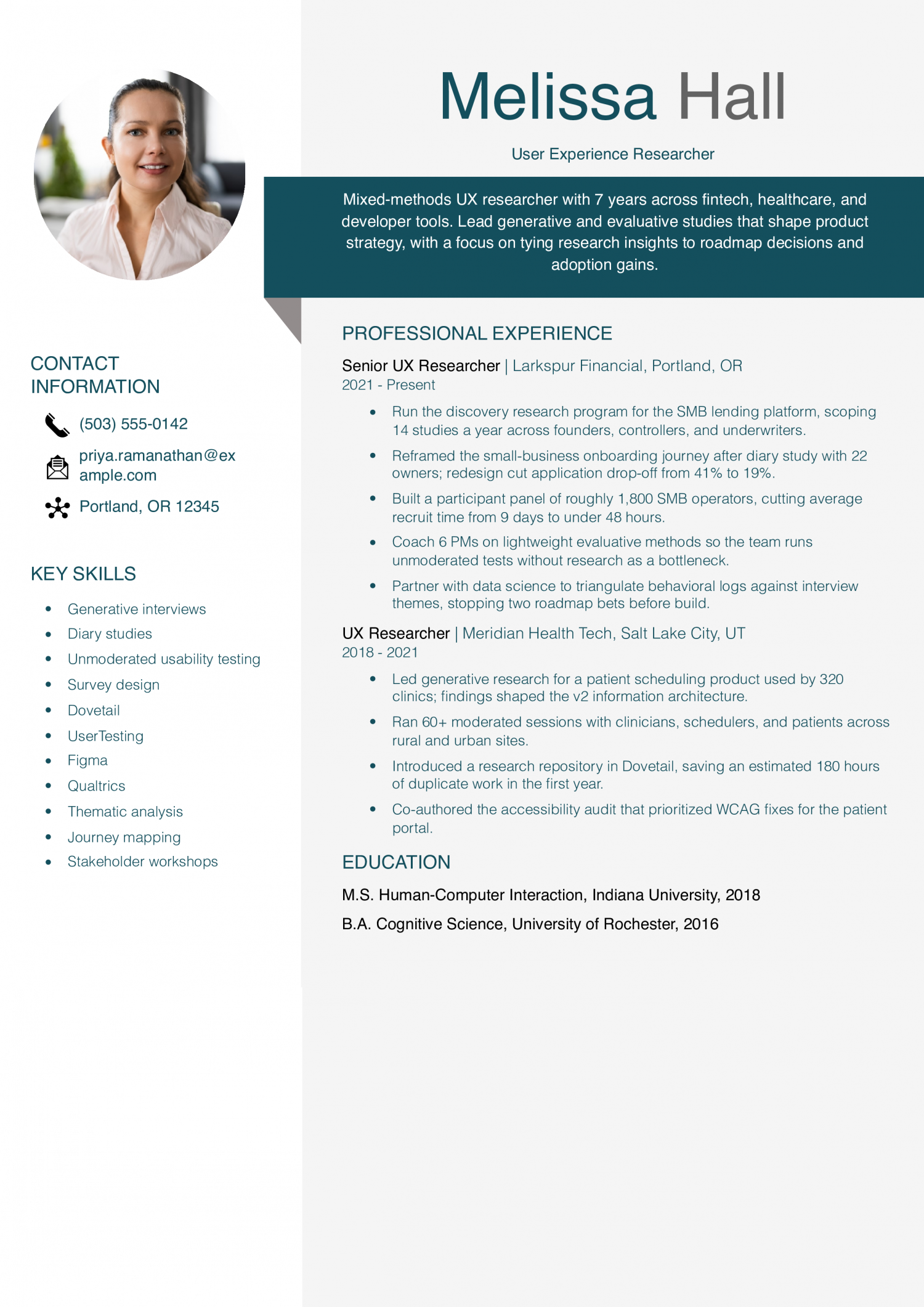
  • Shows research changed the product: The drop-off bullet ties a diary study to a redesign and a specific drop in abandonment, which is exactly what hiring managers want to see.
  • Names real tools and methods: Dovetail, UserTesting, diary studies, and unmoderated testing signal a working researcher, not a generic UX hire.
  • Stopped projects that would not pay off: Killing two roadmap bets after triangulating data shows judgment beyond just running studies.

Junior UXR Example

The Junior UXR archetype is one to three years in, often from a psychology, HCI, or design-research master's program. This resume needs to prove you can run usability tests end to end, recruit clean samples, and translate findings into product-team language.

Why this resume works

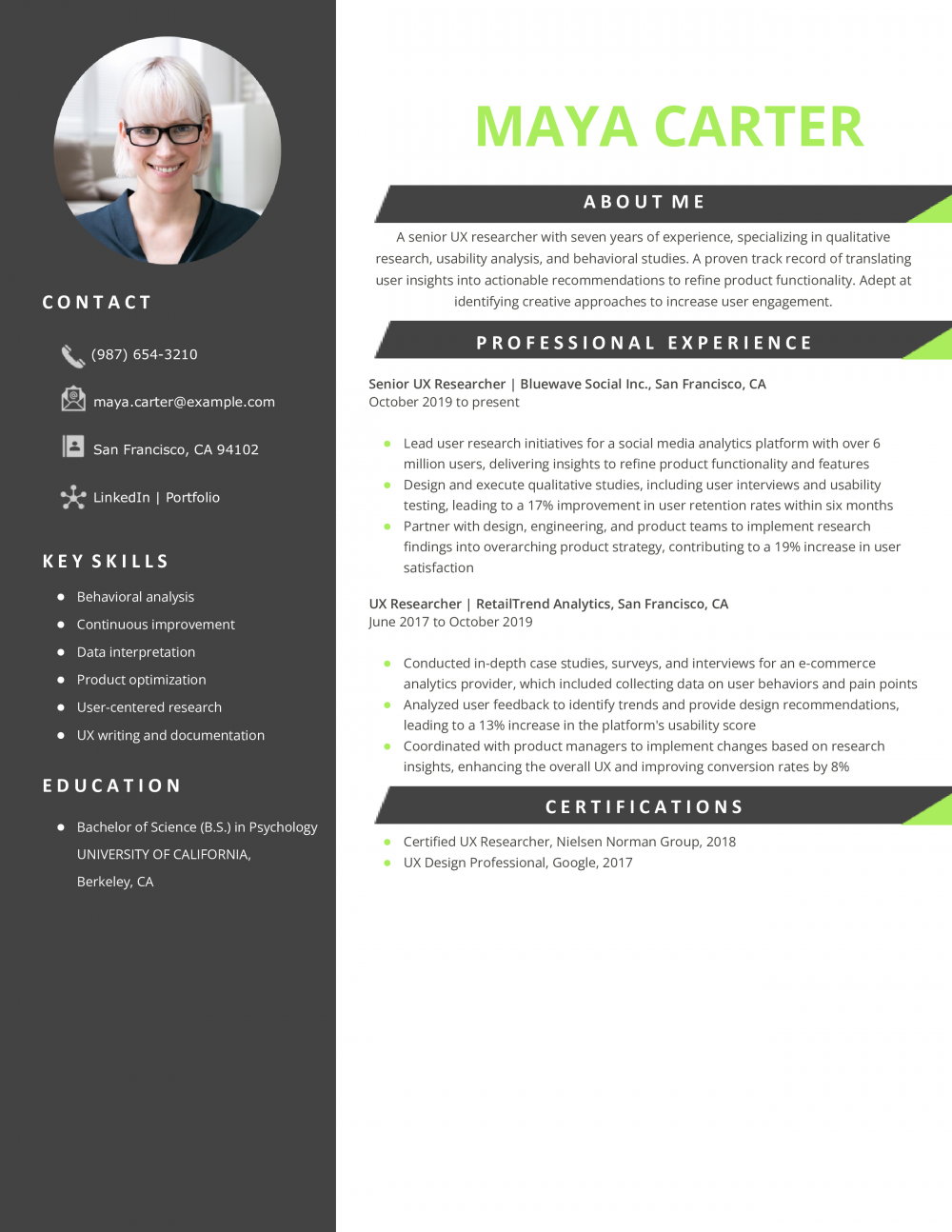
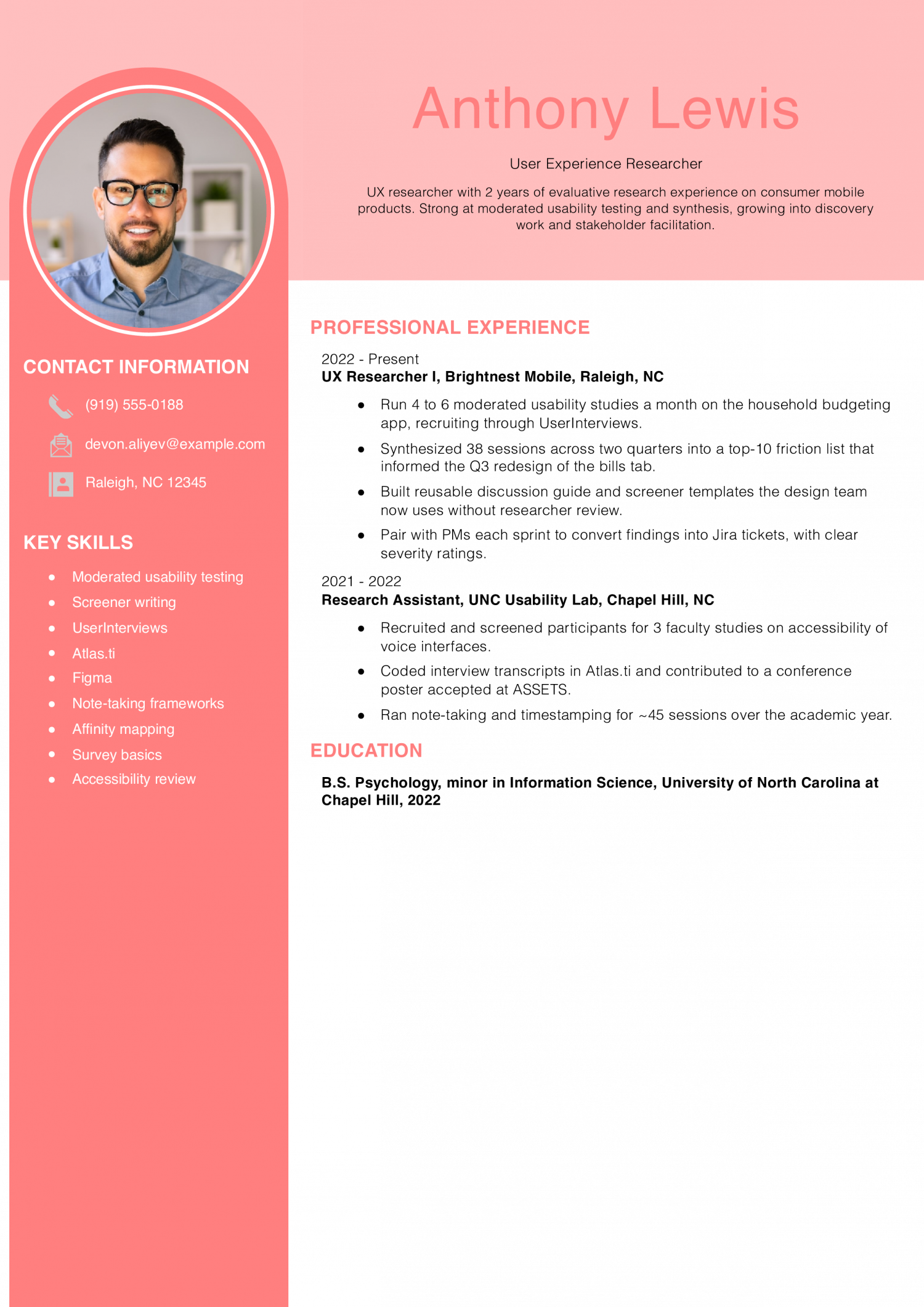
  • Counts the actual research output: Numbers like 4 to 6 studies a month and 38 sessions show real volume, not just job duties.
  • Tied findings to a release: The top-10 friction list feeding the Q3 redesign proves the research reached the product, not just a slide deck.
  • Honest about level: Lab work and reusable templates fit a junior, while the language stays specific and avoids overclaiming.

Senior UXR Example

The Senior UXR archetype owns research questions from intake through stakeholder readout, usually four to seven years in. This resume needs to prove mixed-methods range, the product decisions your studies shaped, and your skill at coaching PMs to scope better questions.

Why this resume works

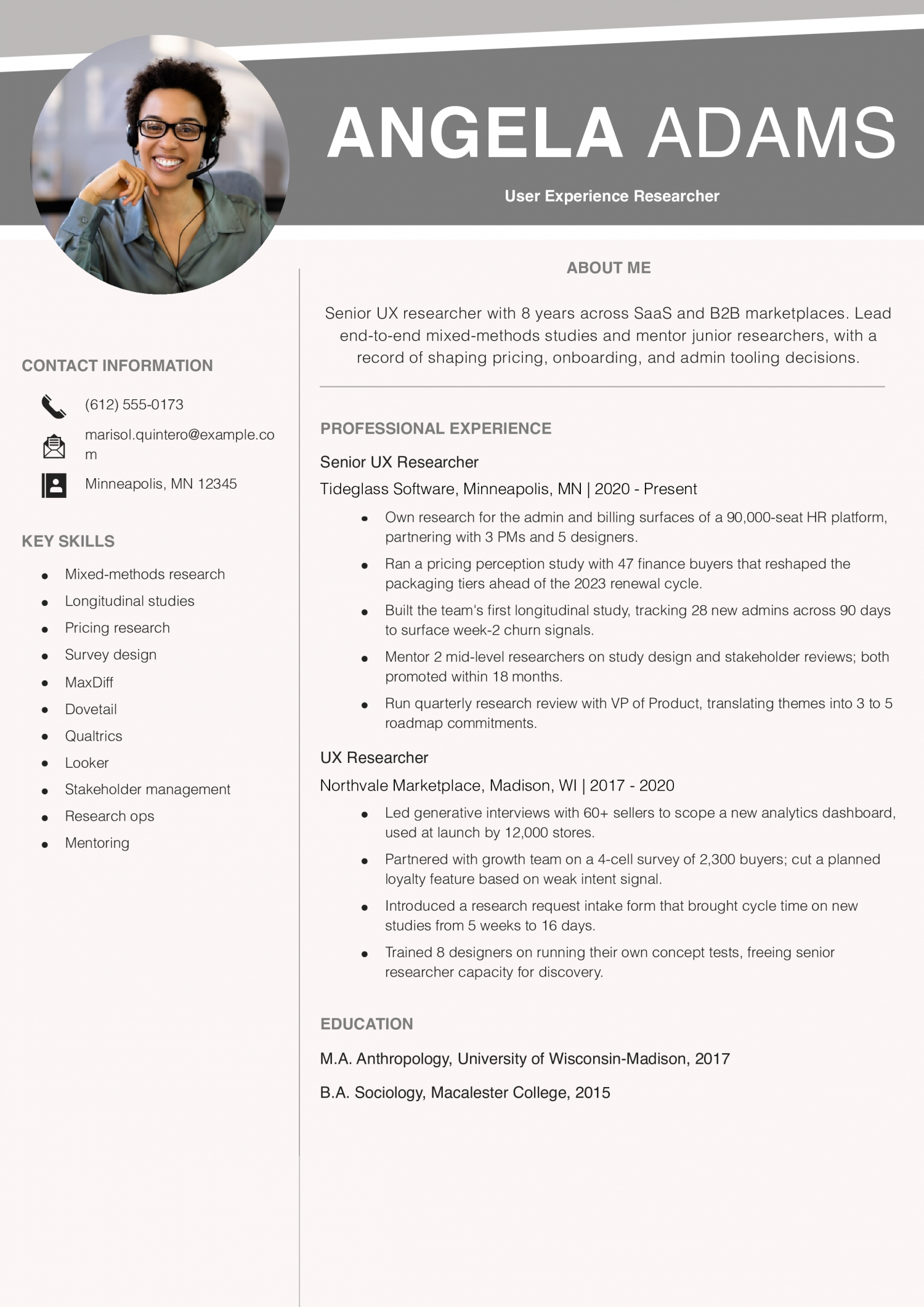
  • Research drove a pricing decision: Tying a 47-buyer study to a packaging change before renewal connects research to revenue, which senior roles expect.
  • Faster intake process: Cutting study cycle time from 5 weeks to 16 days shows ops thinking, not just study craft.
  • Grew other people: Two mentees promoted within 18 months is concrete evidence of senior-level impact on the team.

Lead UXR Example

The Lead UXR archetype runs a research function or pillar, mentors other researchers, and shapes ResearchOps. This resume needs to prove org-level influence: repository builds, roadmap inputs, hiring, and the business outcomes tied to research programs you ran.

Why this resume works

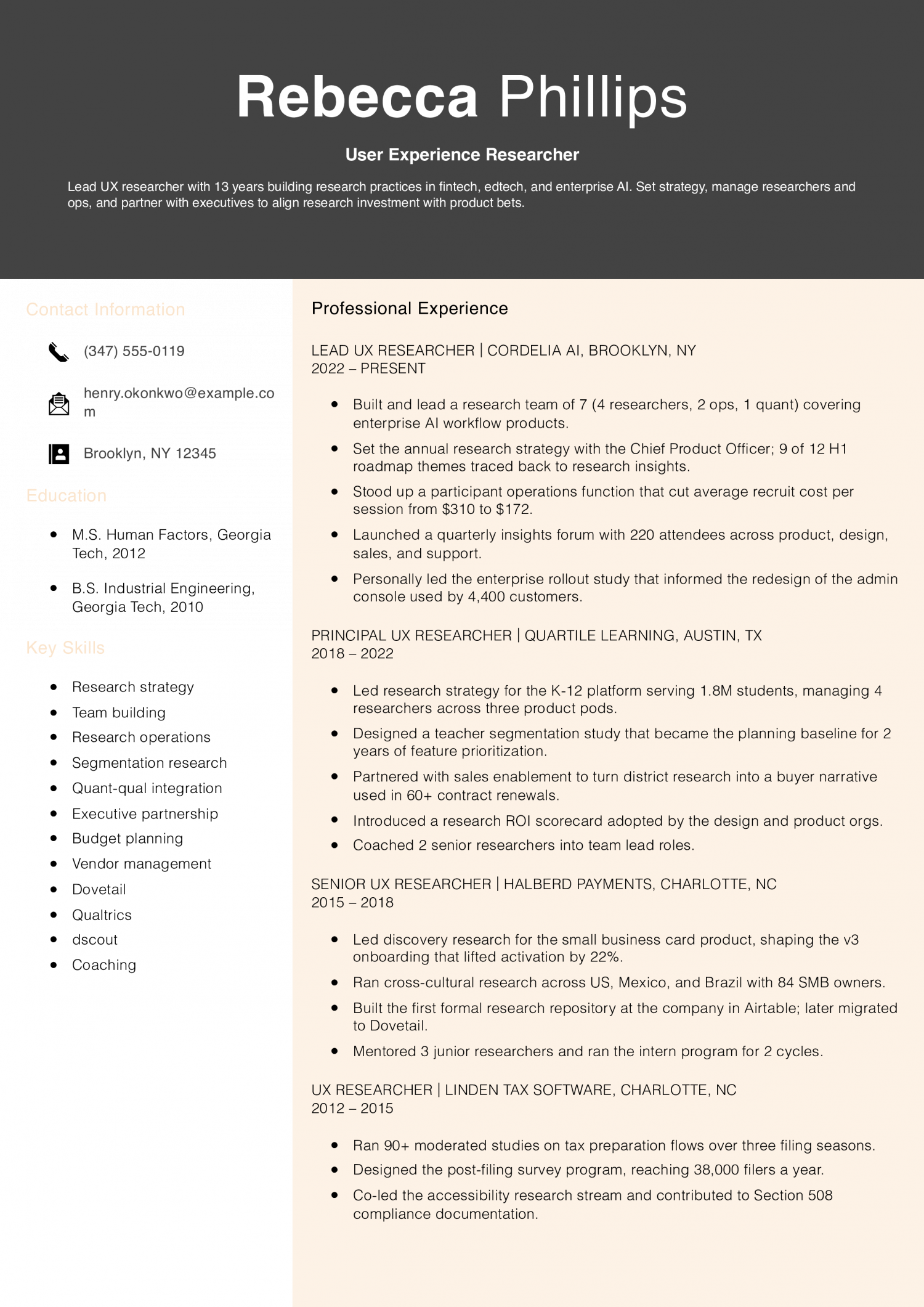
  • Built a team from scratch: Hiring and structuring a 7-person research org shows leadership scope a Lead role needs.
  • Cut a clear cost number: Recruit cost from $310 to $172 per session is the kind of operations metric executives respect.
  • Connected research to revenue: Tying district research to 60+ contract renewals shows the candidate can talk to sales and finance, not just product.

How to Write an User Experience Researcher Resume

01 Open with the metric a research manager would size you up by

The first line of your summary should name the studies you ran in the last year, the product surfaces they shaped, and the methods mix.

Research managers read that as proof you can scope, recruit, and ship findings. A line like “14 mixed-methods studies across checkout and onboarding, influencing two roadmap shifts” lands harder than “experienced UXR with passion for users.” Lead with the volume and the surface, then the method blend.

02 Quantify studies with sample sizes and shipped outcomes

Bullets without a number tend to read as duties. Strong UXR bullets name the method, the sample size, and the product decision the work shaped.

Three metrics most strong resumes lead with: participant count per study (n=12, n=480), study velocity per quarter, and the shipped change tied to a finding. If your work fed a roadmap kill or a redesign, name it. “Diary study (n=22) over four weeks surfaced trust gaps that killed a planned subscription tier” beats any soft claim about insight quality.

03 Group methods by generative, evaluative, and ResearchOps

Cluster bullets so a reader scanning for fit can find your range fast. Generative work covers interviews, diary studies, ethnography, and concept tests.

Evaluative work covers usability testing, tree tests, surveys, and benchmark studies. ResearchOps work covers repository builds in Dovetail or EnjoyHQ, participant panels, and intake processes. If you’ve shipped synthesis frameworks or democratized research, give that its own bullet rather than burying it under a generic “collaboration” line.

Research managers want to see your portfolio URL before they finish the summary. Put it next to your email, not at the bottom.

Name your toolset in a short skills line near the top: Dovetail, UserTesting, Maze, Figma, Qualtrics, dscout, Lookback, SPSS or R if you do quant. A research manager reads tool fluency as ramp-up speed. List the methods you’ve personally run, not every method you’ve heard of in a team setting.

05 Cut generic UX claims and dashboard padding

Drop lines about “advocating for the user” or “driving user-centered design.” Every UXR resume claims that, so it carries no signal.

Cut bullets that only describe deliverables (“created research reports”) without naming the decision they shaped. Trim coursework once you have two studies in industry. If a bullet would fit a product designer or PM resume unchanged, rewrite it to name the research craft: the question framing, the recruit, the synthesis move, the stakeholder readout.

The skills below come from UXR resumes our users built on ResumeTemplates.com. Research managers scan dozens of resumes a week, and these are the skills that show up most often. Hard skills like usability testing and Dovetail get you past the keyword parse.

Soft skills like stakeholder management back up your bullets when the research manager reads them. Match this list against your target job posting and treat the soft skills as evidence to weave into accomplishment bullets, not a standalone list.

Soft Skills % of resumes with this skill
Communication 73%
Critical thinking 57%
Empathy 40%
Collaboration 37%
Problem-solving 31%

And here are the top hard skills showing up most often.

Hard Skills % of resumes with this skill
Usability testing 76%
User research 66%
Data analysis 50%
User interviews 39%
Survey design 28%

Based on data from thousands of user experience researchers’ resumes built on ResumeTemplates.com, May 2026.

Must Have on an User Experience Researcher Resume

These are the must-haves hiring teams look for when scanning an user experience researcher resume.

Niche Keywords for ATS Checkers

Research managers expect a niche line that names your method depth and the product surfaces you’ve researched. Mirror the wording in the target posting.

Niche Keywords ATS scans for
Generative research user interviews, diary studies, ethnographic research, foundational research
Evaluative research usability testing, tree testing, benchmark studies, concept testing
Quantitative methods survey design, statistical analysis, max-diff, conjoint analysis
ResearchOps research repository, participant panel, Dovetail, EnjoyHQ
Tooling UserTesting, Maze, Qualtrics, dscout

AI Skills to Add

Research teams are split between leaders who want AI-assisted synthesis to raise study throughput and leaders who worry it flattens nuance and hallucinates themes. Name the tools you use, describe where they sit in your workflow, and avoid claiming “AI-driven insights” if your real practice is hand-coding after a first-pass cluster.

What AI is actually changing for this role
Transcript synthesis

Dovetail AI and Marvin draft theme clusters in minutes, shifting your time toward verification, recoding, and judgment on what to surface.

Survey and screener drafting

ChatGPT drafts screeners and survey items, but bias review and pilot testing still sit with the researcher.

Usability test moderation

Maze AI and UserTesting AI run unmoderated tests at higher volume, freeing researchers for moderated depth on harder questions.

Stakeholder readouts

AI tools draft summary decks from raw notes, but research managers expect you to rewrite the narrative before it ships.

AI tools to name
  • Dovetail AI: First-pass theme clustering on interview transcripts before hand-coding and synthesis review.
  • Maze AI: Unmoderated usability testing with AI follow-up probes and automated metric reporting.
How to phrase AI on your resume
Do
  • Used Dovetail AI for first-pass clustering across 32 interviews, hand-coded final themes, cut synthesis time by 40 percent.
  • Drafted screeners in ChatGPT, ran bias review with a senior researcher, piloted with five participants before launch.
Skip
  • AI-powered research synthesis driving deep user insights at scale.
  • Leveraged generative AI to revolutionize qualitative research workflows.

Portfolio Strategy

A UXR portfolio is a hiring requirement at almost every product company. Plan two or three case studies that show range across generative and evaluative work, and put the link in your resume header.

Best overall Custom site (Notion, Squarespace, or personal domain)

Gives you control over case-study depth and password protection for NDA work.

Best for speed Notion

Fast to set up, easy to password-protect individual case studies, low maintenance.

Best for design polish Squarespace or Webflow

Stronger visual presentation for case studies that lean on artifacts and synthesis maps.

Lead each case study with the research question, the constraints, and the decision the work shaped. Method, sample size, and outcome belong above the fold. Strip employer names where you need to, and replace screenshots with sanitized versions rather than dropping the artifact.

Pick two case studies that show range: one generative or foundational study and one evaluative or quant-leaning study. A third can showcase ResearchOps work or a hard stakeholder moment you navigated. Cap each case study around 800 to 1,200 words so research managers can read them in five minutes.

Tools and Tech Stack to List

Research managers read your tool list as a ramp-up estimate. List the platforms you’ve personally run studies in, not every tool your team had a license for.

  • Research platforms: UserTesting, Maze, Lookback, dscout, UserInterviews
  • Synthesis and repository: Dovetail, EnjoyHQ, Marvin, Condens
  • Survey and quant: Qualtrics, SurveyMonkey, Typeform, SPSS, R
  • Design and prototyping context: Figma, FigJam, Miro
  • Recruiting and panel: Respondent.io, User Interviews, internal panels

User Experience Research Credentials That Get You the Job

Beyond your degree in HCI, psychology, or a related field, the certifications below tell a research manager which methods you’ve trained on and which adjacent crafts you can pick up. List the issuing body and completion year next to each.

  • Nielsen Norman Group UX Certification: Signals formal training in usability, interaction design, and research methods, and is the credential most research managers recognize on sight.
  • Human Factors International CUA or CXA: Useful when targeting enterprise, healthcare, or regulated-industry roles where certified usability analysts are a procurement requirement.
  • Qualtrics XM Certification: Worth listing for roles that lean heavily on survey programs or CX research, since hiring teams use it as a quant-fluency proxy.
  • Interaction Design Foundation UX Research Course Series: Reasonable for career changers without an HCI degree, since it documents structured study of methods beyond self-taught Medium articles.

Latest BLS Statistics for User Experience Researchers

The 90th-percentile user experience researcher out-earns the median by a wide margin, which tells you the market rewards mixed-methods range and product-decision influence more than years on a research team. Pay also concentrates heavily in a handful of tech-hub states, so geography compresses the spread further at the top.

Lead the resume with the study types you’ve owned end to end and the roadmap decisions your findings shaped, not the volume of reports you produced.

$98,090 National median annual
$111,450 National mean annual
$47,840 Entry-tier floor (10th percentile)
$192,180 Top-decile ceiling (90th percentile)
111,400 User Experience Researchers in the U.S.
Where you stand

Entry tier

$47,840 to $98,090 At the entry tier, your resume needs to show two or three full studies you ran, named methods, and a portfolio link in the header.

Mid band

$98,090 to $192,180 At the mid band, lead with mixed-methods range, sample sizes per study, and the product decisions your readouts shaped over the last year.

Top decile

$192,180+ At the top decile, your resume needs to show ResearchOps builds, team you've grown, and roadmap-level outcomes tied to your research program.

Top-paying states

# State Avg. Annual
1 California $130,240
2 Washington $126,960
3 New York $121,700
4 Rhode Island $111,200
5 Massachusetts $107,560
6 Hawaii $105,560
7 Colorado $103,990
8 Georgia $100,530
9 Utah $99,300
10 Vermont $99,160

Highest-employment states

# State Workers Median
1 California 27,210 $130,240
2 New York 14,840 $121,700
3 Washington 7,840 $126,960
4 Texas 7,360 $89,630
5 Florida 4,140 $75,480
Source: U.S. Bureau of Labor Statistics, OEWS 2024 release (SOC 15-1255). View on bls.gov
Written by professional resume writers and loved by hiring managers

Resume Templates offers HR approved resume templates to help you create a professional resume in minutes. Choose from several template options and even pre-populate a resume from your profile.

Frequently Asked Questions

How do I show research impact when my findings didn't ship?

Name the decision your work shaped, even if that decision was a kill or a delay. Research that prevents a bad launch carries real value.

Write the bullet as "Diary study (n=18) surfaced trust gaps that delayed a planned billing redesign by one quarter for scope rework." Research managers read kill decisions as judgment signals.

Should I include a portfolio link if my case studies are under NDA?

Yes, include the link. A portfolio with two or three sanitized case studies signals you can write up research at all.

Strip company names, blur screenshots, and describe methods and decisions in general terms. Most research managers expect a walkthrough at the interview, not the resume stage.

I'm moving from market research or academic research into UXR. How do I reframe my resume?

Translate your methods into product vocabulary. Focus groups become generative interviews and lab studies become usability tests.

Tie each project to a product-shaped outcome: a feature direction, a content strategy change, a pricing tweak. Drop publication lists past two relevant pieces and surface the tooling you used.

Should I list AI tools like ChatGPT or Maze AI as skills?

Yes, but describe the workflow honestly. "Used Dovetail AI to cluster transcripts and hand-coded the top themes" reads better than "AI-powered research synthesis."

Research managers want to know where AI sits in your process and where your judgment overrides it. The honest workflow gets the callback.

Which resume template works best for a user experience researcher?

For a user experience researcher, a modern template is the safest pick, because it shows visual polish while keeping your work the focus. A creative template is a solid alternative. Whichever you choose, keep the formatting clean and easy to parse: clear section headings, a standard font, and no graphics a parser can choke on.

Rate this article

User Experience Researcher Resume

Average Rating

4.3/5 stars with 120 reviews

You have given 0 Star(s)
4.3/5 stars with 120 reviews
Andrew Stoner

Executive Resume Writer and Career Coach

Andrew Stoner is an executive career coach and resume writer with 17 years of experience as a hiring manager and operations leader at two Fortune 500 Financial Services companies, and as the career services director at two major university business schools.