Veterinary Technician Resume Examples
Your profile sits at the top of page one and tells the medical director three things in five lines. State your years of credentialed experience and your title (CVT, RVT, or LVT) with the state…
Every resume example is written and reviewed by our team of Certified Professional Resume Writers to ensure top-quality content and formatting.
A veterinarian resume works when it leads with clinical range. Practice owners and medical directors want to see the species you treat and the surgeries you perform. They also look for caseload volume and proof of outcomes, such as diagnostic accuracy or patient recovery rates.
List your state veterinary license, then anchor each role around the skills you used most. Soft-tissue surgery, dentistry, and ultrasonography carry more weight than broad claims about animal care. The examples below show you how to frame that proof on the page. To compare layouts before you start, browse our resume templates.
Practice owners and medical directors read the credentials block early, so list your NAVLE result and your state veterinary license there.
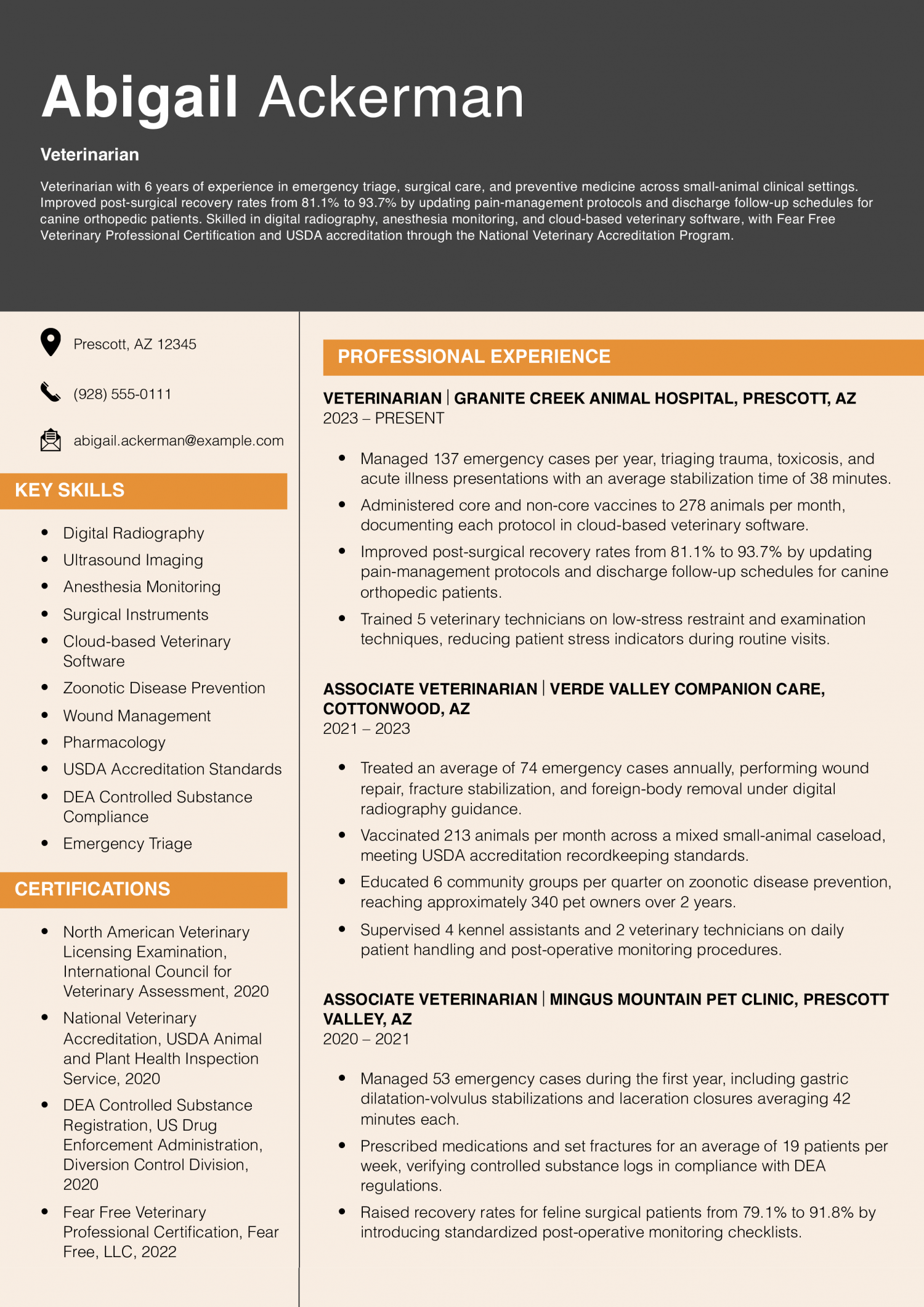
Pick this resume if you are a mid-level veterinarian with about six years of clinical experience aiming for a lead practitioner role. Lead with recovery-rate improvements that name the exact protocol change behind each gain.
Outreach work here includes a schedule and an audience: how often the vet spoke to community groups and roughly how many pet owners heard the message. A clinic owner can picture the reach right away. For your own community bullets, name the topic, the group, and how often you presented.
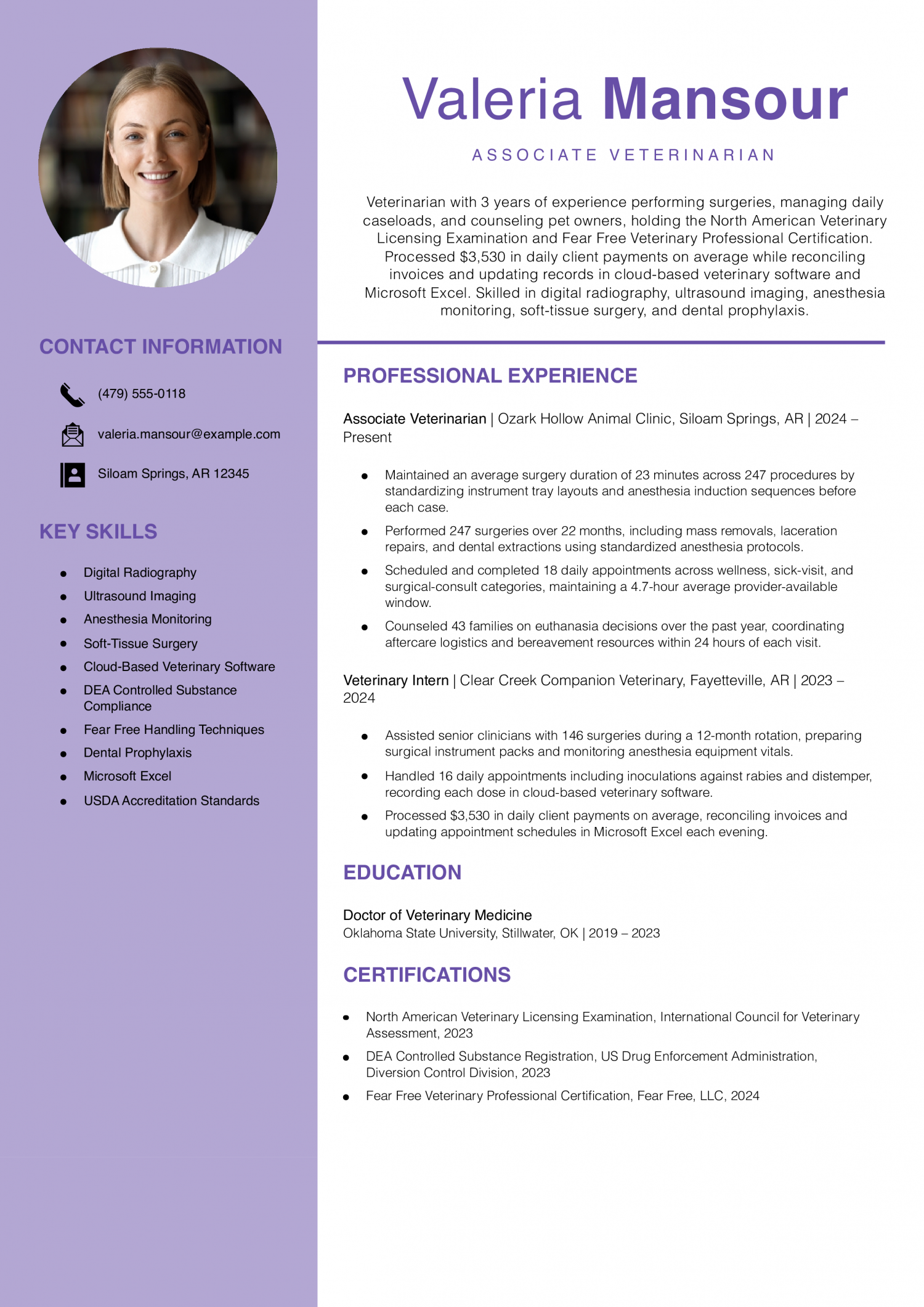
Use this resume if you are an entry-level veterinarian with about three years of clinical experience, including an internship year. Shorten each procedure description to a count and an average time so reviewers can gauge your surgical throughput at a glance.
This resume pairs surgical volume with the average time per case, giving a reviewer two facts in one line. A hiring vet can judge both speed and steadiness from that combination. For your own procedure bullets, pair the case count with the typical time and your reviewer can picture your pace.
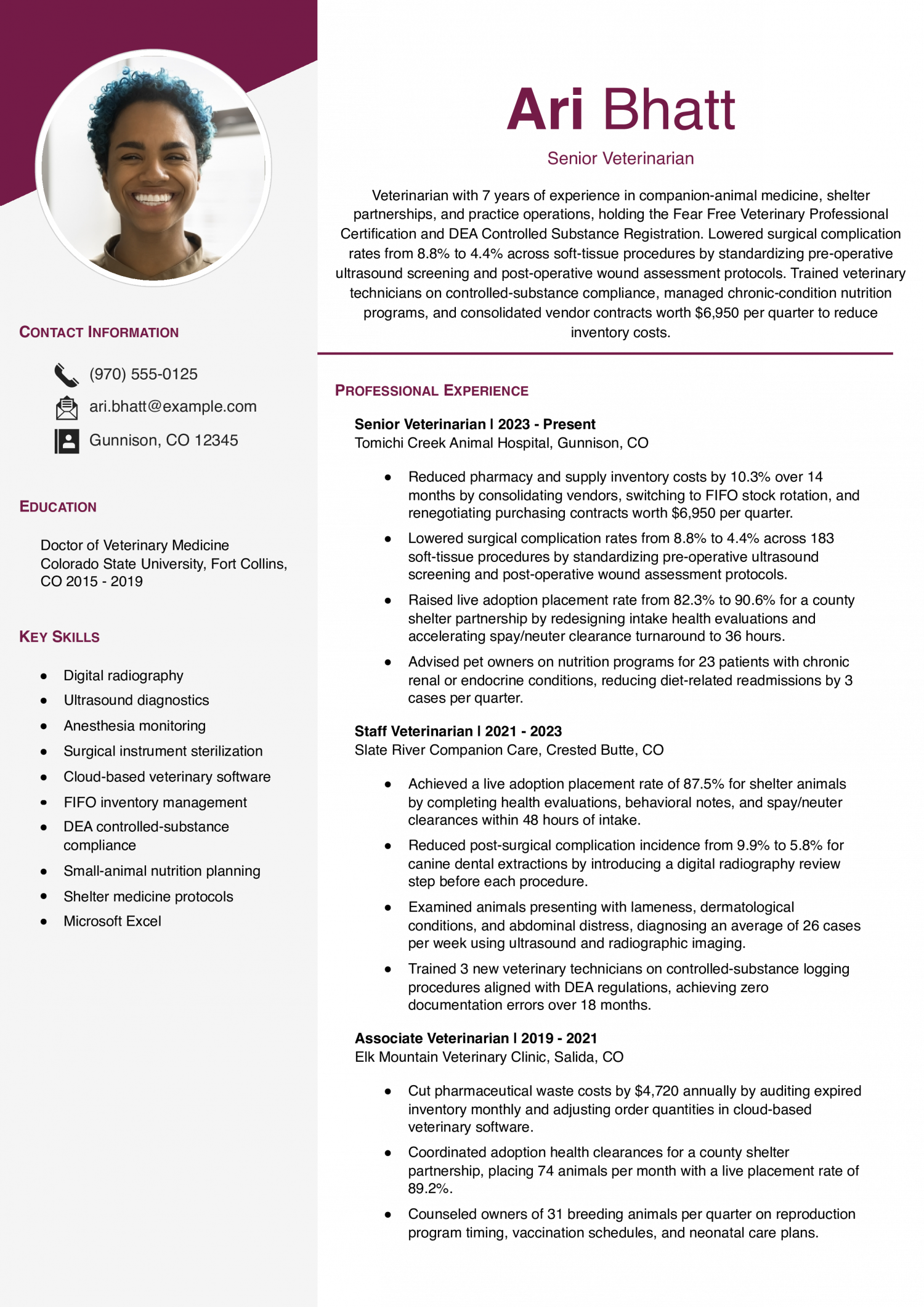
Try this resume if you are a mid-level senior veterinarian with shelter medicine and surgical protocol work across several companion-animal clinics. Sum up vendor consolidation and complication-rate reductions with exact before-and-after figures in every bullet.
A turnaround benchmark for spay/neuter clearance shows how fast animals move toward adoption. When you write about shelter work, tie your clearance time to the placement outcome it supported.
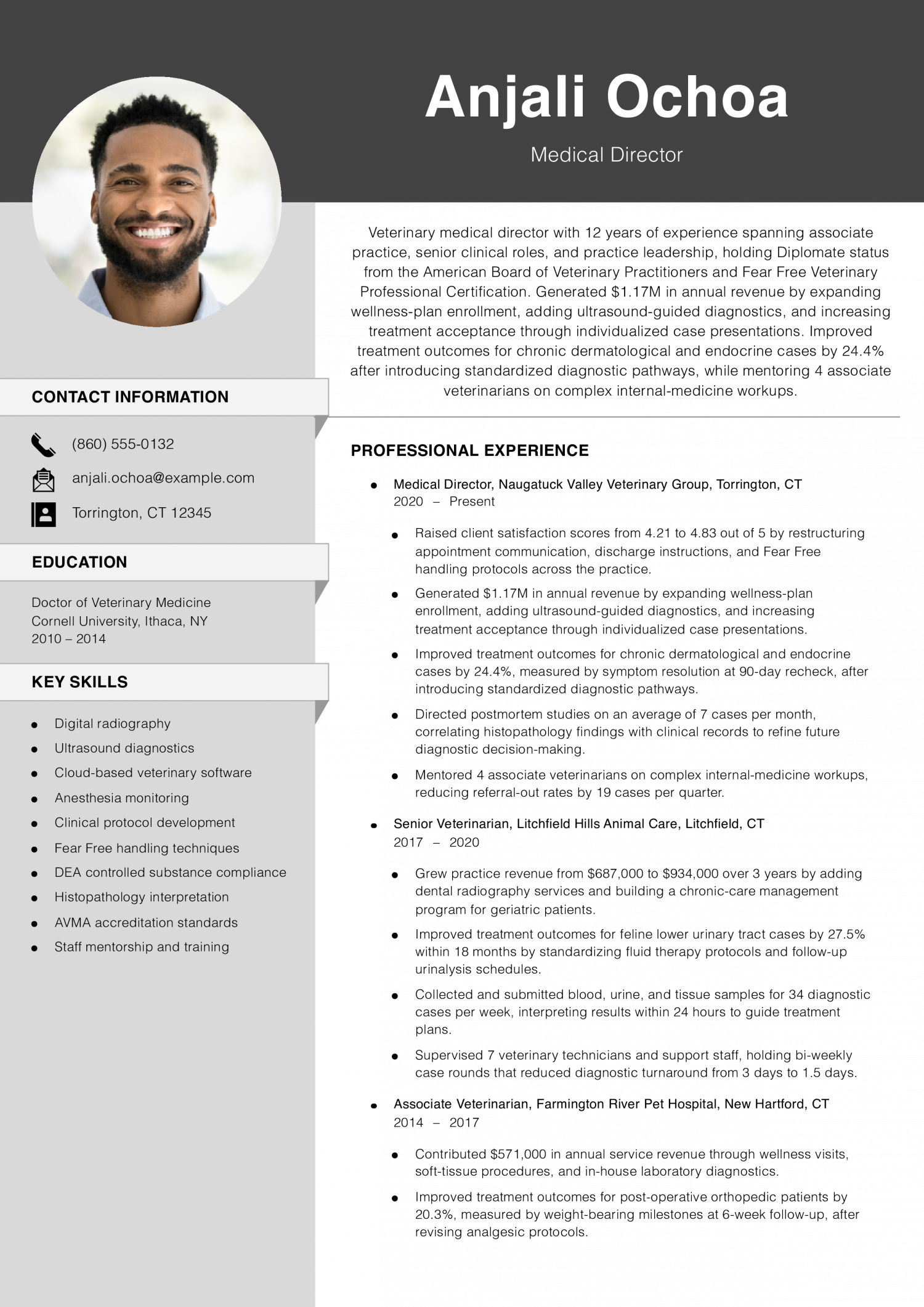
Turn to this resume if you are a senior veterinarian with over a decade of clinical and leadership experience pursuing a medical director position. Test how it credits revenue growth to specific service expansions rather than general management duties.
Mentoring work on this resume is connected to fewer cases sent to outside specialists. Mentoring helped associates handle more cases in the clinic. Pair your own mentoring bullets with what changed in the team’s clinical output after your guidance.
Experienced across six years of companion-animal clinical practice, including soft-tissue surgery, surgical dentistry, digital radiography, and ultrasound imaging. Reduced average treatment time by 6.5% by restructuring intake workflows to include digital radiography screening before consultation, cutting average treatment duration from 31 to 29 minutes per patient. Holds a VMD from the University of Pennsylvania, DEA Controlled Substance Registration, and Fear Free Veterinary Professional Certification.
Your summary should start with a number. State your average daily caseload and the species mix you treat. Practice owners and medical directors read this line first.
It tells them whether your pace fits their clinic volume. A line like “small-animal DVM averaging 22 patients per day” is clear. It beats a vague phrase about passion for animal care.
After the caseload figure, name your practice type. Note whether you work in general practice, urgent care, or emergency care. Add your state veterinary license status in the same sentence.
Mention any board certification or specialty focus right after the license. This opening block gives a medical director the three facts needed to keep reading: volume, setting, and license.
Strong veterinarian resumes pair clinical skill with real numbers. Most practice owners want to see patient outcomes and revenue. Cite your surgical success rate for common procedures.
Name your average appointment revenue per visit. You can also note how many dental cleanings you complete each month. Without a number, your bullets tend to read as duty lists.
A line like “reduced post-op infection rate to 1.2%” is stronger than “performed surgeries.” Revenue figures matter too. If you grew the wellness plan enrollment by a percent, state it. Shelter or public health vets can note spay and neuter volumes.
These numbers let a medical director compare your output to the role they need to fill.
Break your experience into clear groups so the resume scans fast. Start with diagnostics: list imaging, lab interpretation, and cytology skills. Next, cover surgery.
Name soft-tissue and orthopedic procedures you perform. Then add a preventive care section with wellness exams and vaccine protocols. If you handle emergency or critical care, give that its own group.
Exotic or large-animal work deserves a separate line too. Each group should hold two to four bullet points. Keep the bullets short and action-driven.
Use strong verbs like “diagnosed,” “performed,” or “managed” to open each bullet. This layout helps practice owners find the skills that match their caseload mix. It also shows range without forcing them to read a wall of text.
Create a credentials block near the top of page one. List your state veterinary license in good standing first. Follow it with your NAVLE completion.
If your state requires a jurisprudence exam, add that next. Practice owners and medical directors scan for these before reading any bullet point. Below the license block, note your USDA National Veterinary Accreditation if you hold it.
Fear Free Veterinary Professional Certification fits here too. Board-certified specialists should list the DABVP with their species category. For software, name the practice management system you use.
Name your digital radiography platform as well. Placing these items above your work history saves the reader from hunting through later pages.
Your Doctor of Veterinary Medicine degree anchors the education section. Name the school, graduation year, and any honors. If you finished a residency or internship, list the institution and focus area.
New graduates should add relevant rotations below the degree. Clinical rotations in surgery or internal medicine show hands-on training. Extern sites at specialty hospitals carry weight with medical directors.
Research or published case studies can appear here in a short line. If you hold a bachelor’s degree in a related science, include it. Keep the format consistent: school name, degree, and year on one line.
This section reassures practice owners that your training aligns with the role’s clinical demands.
Veterinary hiring has grown more selective in 2026. Clinics face rising costs and tighter staffing budgets. The bar to clear an initial screen is higher now.
Practice owners and medical directors weigh hard skills like surgery first. They also look for radiology and dental training. Soft skills such as empathy matter, but they rank after clinical ability.
Both types need to appear on your resume. The ATS scores your file by matching words to the posting. Missing a key term can drop your rank before a person reads it.
Scan the two tables below against the job ad you want. Pull exact phrases into your bullet points. Treat soft skills as proof points inside your work history.
Do not list them in a standalone section with no context. A line like “showed empathy during end-of-life consults” works better than the word alone.
| Soft Skills | AI-estimated % |
|---|---|
| Client communication | 78% |
| Compassionate patient care | 57% |
| Calm under pressure | 49% |
| Team collaboration | 39% |
| Diagnostic decision-making | 35% |
And here are the top hard skills showing up most often.
| Hard Skills | AI-estimated % |
|---|---|
| Clinical diagnosis | 78% |
| Surgical procedures | 67% |
| Vaccine administration | 47% |
| Treatment plan development | 38% |
| Medical recordkeeping | 33% |
Skill names and rankings come from an AI model grounded in U.S. Department of Labor occupation data for veterinarians, not from a count of veterinarians’ resumes built on ResumeTemplates.com.
These are the must-haves hiring teams look for when scanning a veterinarian resume.
You need a state veterinary license to practice legally. Each state board sets its own rules for licensure. The NAVLE is the standard licensing exam in North America.
Some states also require a jurisprudence examination. This test covers state-specific veterinary laws and regulations. Check your target state’s board for exact requirements.
List your state license and its status on your resume. Do not publish the license number on the document. Practice owners and medical directors verify status through the state board directly.
Most states require continuing education to renew your license. Hour totals and approved topics vary by state board. Listing recent courses signals current clinical knowledge.
Practice owners and medical directors look for courses the clinic needs. A surgery course matters more at a surgical referral practice. Match your listed courses to the role you want.
Include the course title, provider, and year completed. Group entries under a clear heading on your resume. This keeps your education section clean and easy to scan.
Practice owners and medical directors read your credentials list as a map of where your clinical work is heading. It tells them which species focus or practice area you have put real time into. These go past the base state license you need to practice.
They show added skill in a niche that matters to the clinic. Name each credential with the issuing organization and the year you earned it. Group them under a clear heading so they stand out on the page.
Place your state license first, then add any board or program credentials below it. If a board specialty is pending, note the expected date so the practice can plan around your timeline. A resume with a full credentials section often moves forward faster than one that stops at the state license.
The top-paying states for veterinarians cluster in smaller, lower-supply markets. They are not the large metro areas most graduates target first. Rural and suburban regions with fewer practices per capita tend to sit at the top of the pay tables.
The spread from the 10th percentile to the 90th is wide, with top earners pulling roughly two-thirds more than the median. That gap signals real room to grow over a career. If you are open to relocating, list multi-state license eligibility and any large-animal or mixed-practice scope on your resume to match what those markets need.
| # | State | Median Annual |
|---|---|---|
| 1 | California | $163,920 |
| 2 | Maryland | $163,170 |
| 3 | Washington | $160,510 |
| 4 | New Jersey | $160,140 |
| 5 | Arizona | $152,020 |
| 6 | Massachusetts | $140,260 |
| 7 | District of Columbia | $134,530 |
| 8 | Illinois | $133,580 |
| 9 | Pennsylvania | $133,520 |
| 10 | Minnesota | $133,110 |
| # | State | Workers | Median |
|---|---|---|---|
| 1 | California | 9,170 | $163,920 |
| 2 | Texas | 6,270 | $131,330 |
| 3 | Florida | 5,360 | $131,660 |
| 4 | Pennsylvania | 3,490 | $133,520 |
| 5 | Ohio | 3,430 | $125,060 |
Resume Templates offers HR approved resume templates to help you create a professional resume in minutes. Choose from several template options and even pre-populate a resume from your profile.
Most private practices and corporate clinics expect a one- to two-page resume. A CV is the better choice when you apply for academic positions or research roles. Check the job posting, and default to a resume if it does not specify.
List your Doctor of Veterinary Medicine degree, NAVLE passage, and state veterinary license first. Below that, feature clinical rotations and externships with species counts you handled. Even brief shelter or relief work adds case volume that practice owners want to see.
One page works well for a veterinarian with fewer than ten years of clinical experience. Two pages are appropriate when you hold board certifications or multiple state licenses. Anything beyond two pages belongs in a CV, not a resume.
Name the state, write "veterinary license in good standing," and add the year you received it. If you hold licenses in more than one state, list each one on its own line. Do not include the license number itself on the document.
Yes, because practice owners and medical directors hire for their patient mix. State whether your experience is in small animal, equine, mixed, or exotic practice near the top of your summary. Matching your species focus to the posting tells the reader you can step into their caseload.
Note any continuing education, relief shifts, or volunteer clinic hours you completed during the gap. A brief line in the experience section with dates and a short description keeps the timeline clear. Practice owners care more about current clinical skills than a perfect work history.
Create one entry titled "Relief Veterinarian" with the full date range you worked in that capacity. Underneath, list the practice types and the average weekly caseload you carried. This format shows steady clinical activity without cluttering the page with dozens of short entries.
Pick an ATS-friendly template with plain headings so your license and clinical experience are easy to find. A basic template works too.
Veterinarian Resume
4.1/5 stars with 222 reviews

Executive Resume Writer and Career Coach
Andrew Stoner is an executive career coach and resume writer with 17 years of experience as a hiring manager and operations leader at two Fortune 500 Financial Services companies, and as the career services director at two major university business schools.
© 2026 Resumetemplates.com All rights reserved.