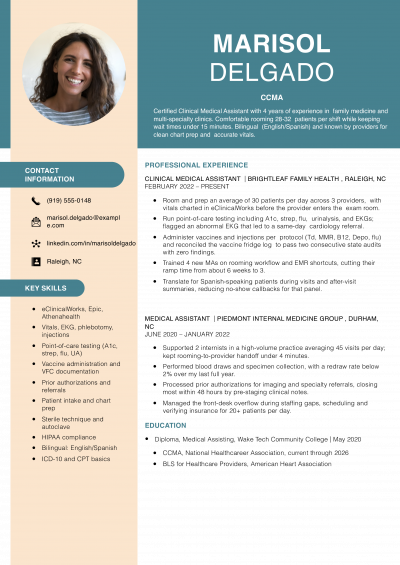
Medical Assistant Resume Examples
Start with a line a practice manager cannot pull from a CMA registry. Name the EHR you run, the specialty you trained in, or the patient volume you carry per shift. Bilingual Spanish or Vietnamese…
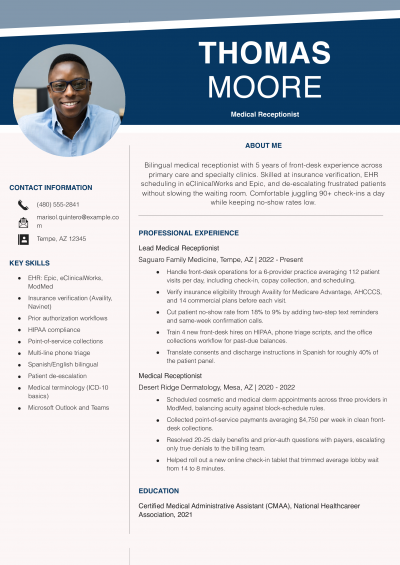
Every resume example is written and reviewed by our team of Certified Professional Resume Writers to ensure top-quality content and formatting.
Speed and accuracy in an EHR set you apart from other medical scribe candidates. Scribe program managers and physicians look for proven keystrokes per minute in Epic or Cerner. They also want to see that you can chart a patient visit in real time with few corrections.
Your resume should name the EHR platform you trained on and the clinical setting you worked in. A Certified Professional Medical Scribe credential from AAPC strengthens an entry-level application. The examples below show how to present these details on a clean, scannable page. To compare layouts before you start, browse our resume templates.
A visible CPMS credential or equivalent training is what gets medical scribe resumes past the program manager's first cut; documented EHR proficiency with charting speed metrics is what makes them readable enough to advance.
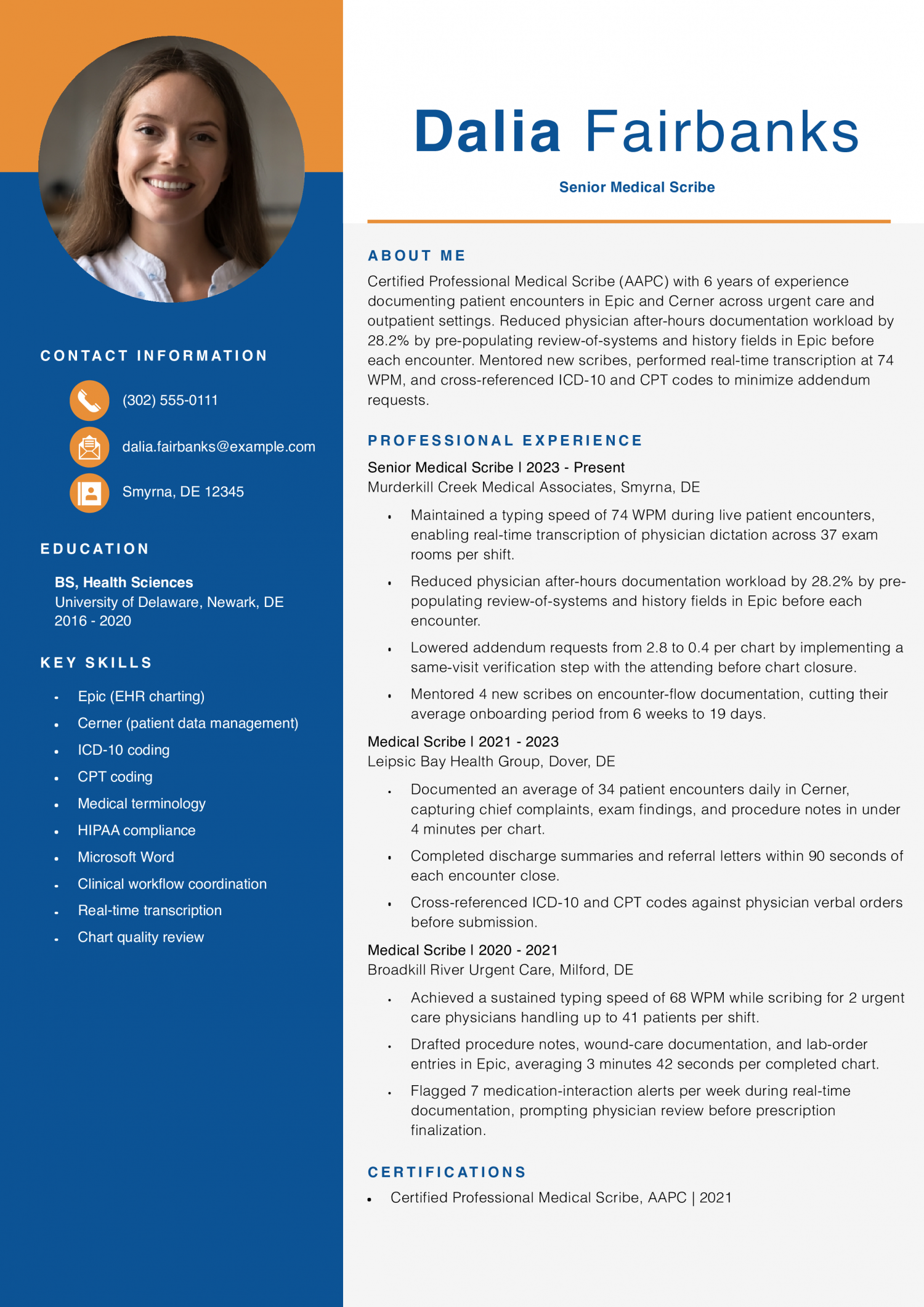
Pick this resume if you are a mid-level medical scribe with several years of multi-site clinical documentation work seeking a senior position. Lead with before-and-after addendum metrics to prove your chart accuracy improvements over time.
Many medical scribe resumes list duties like charting and transcription without showing how their accuracy affected physician workflows. This resume writes, “Lowered addendum requests from 2.8 to 0.4 per chart by implementing a same-visit verification step with the attending before chart closure.” On your own resume, identify a documentation quality metric you moved, then state the starting number, the ending number, and the specific process change you introduced to get there.
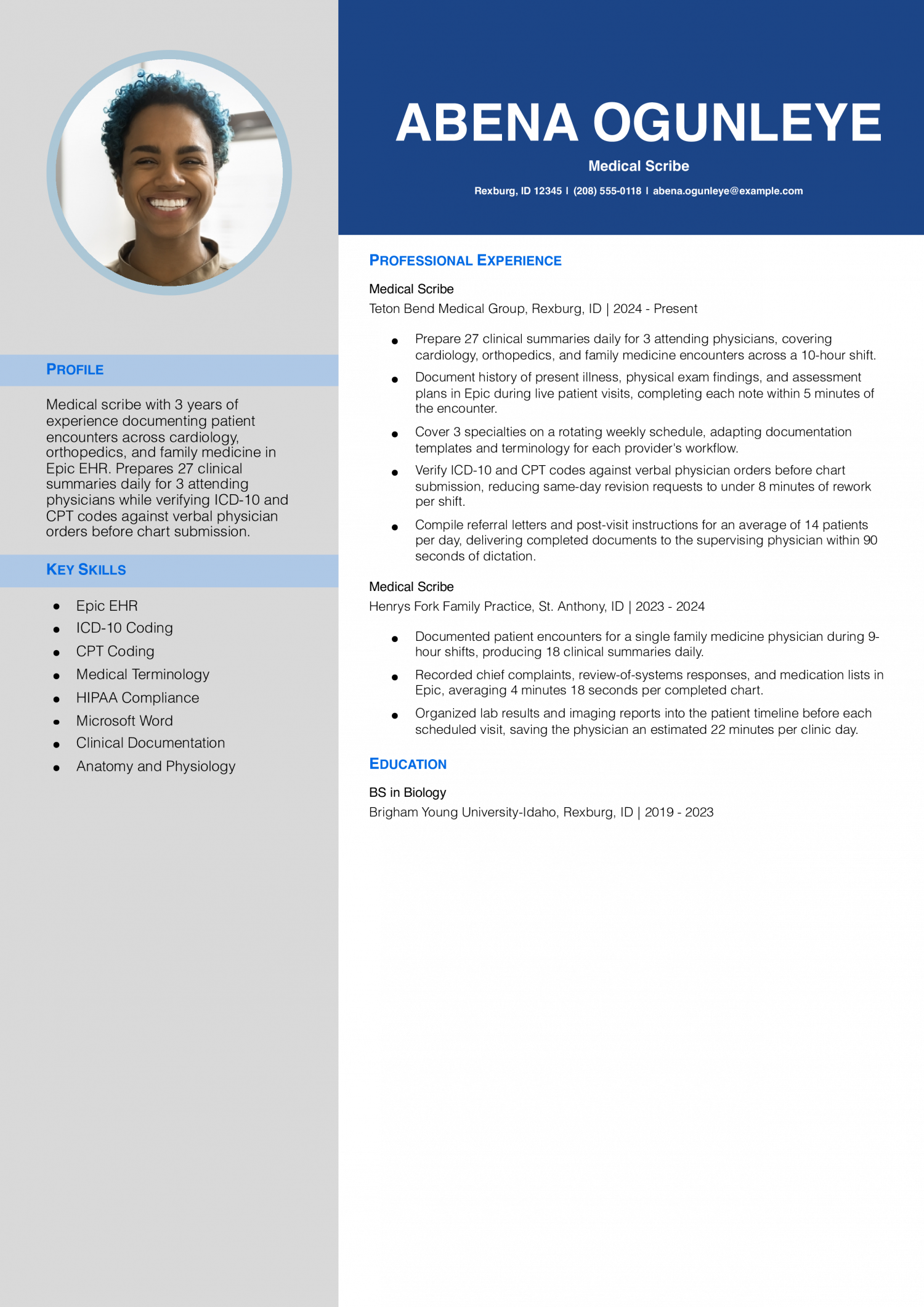
Start with this resume if you are an entry-level medical scribe building a career in clinical documentation. Update your bullets to show per-shift volume and time-per-chart figures the way this resume does.
Many entry-level medical scribe resumes list documentation duties without proving speed or accuracy. This resume writes, “completing each note within 5 minutes of the encounter,” giving a concrete charting pace that readers can verify. You can apply the same approach by timing your own documentation workflow and adding that per-chart figure to the matching bullet on your resume.
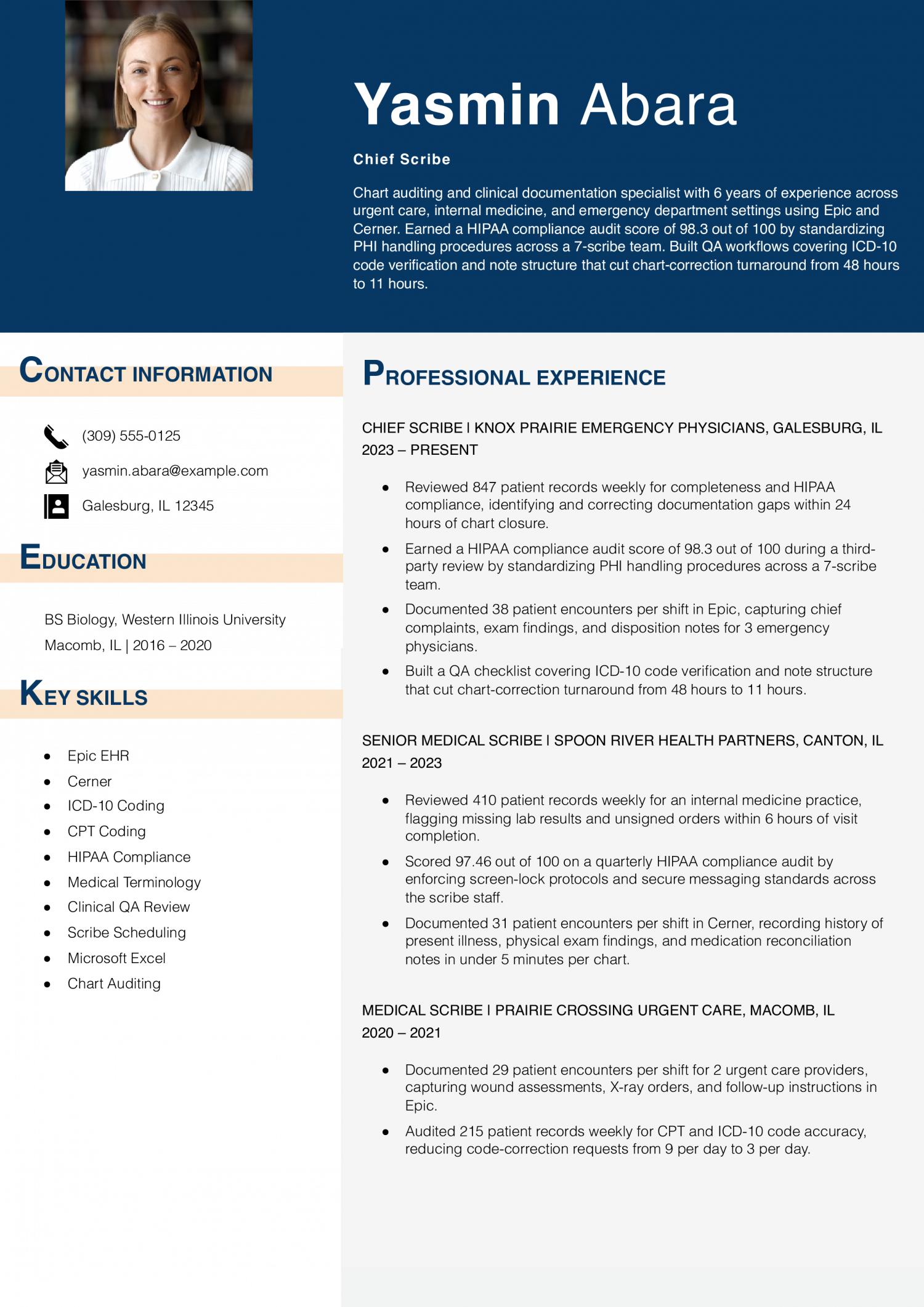
Try this format if you are a mid-level chief scribe with several years of team oversight and EHR documentation work. Word each accomplishment around a specific turnaround reduction or audit score to prove your QA impact with numbers.
Many scribes list daily tasks like charting or auditing without showing how their process changes affected outcomes. This resume avoids that by writing “cut chart-correction turnaround from 48 hours to 11 hours,” tying a QA checklist directly to a measurable time reduction. On your own resume, connect each process you built or revised to a before-and-after metric so reviewers can see the operational difference you made.
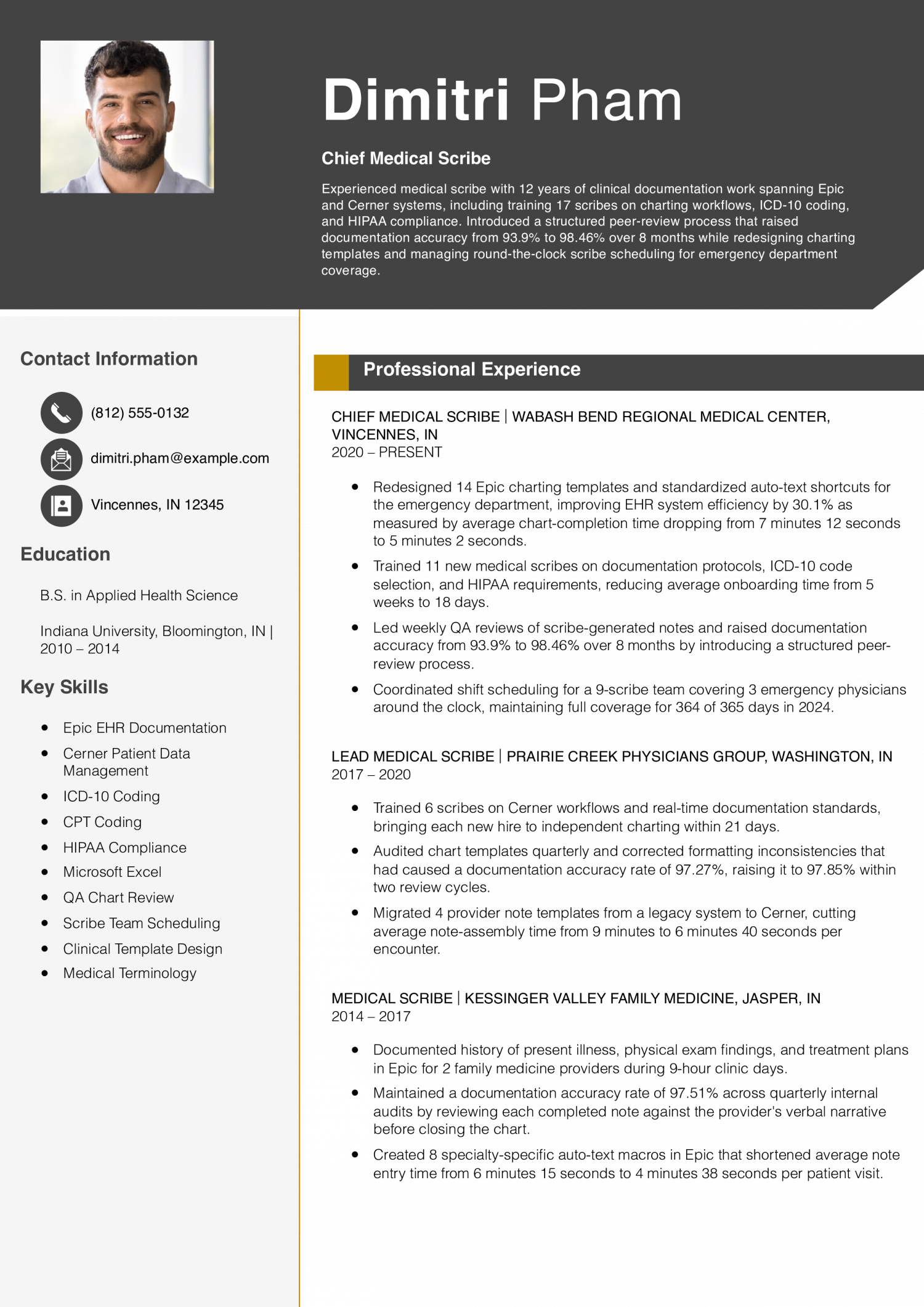
Lean on this resume if you are a senior chief medical scribe with over a decade of EHR documentation and team leadership experience. Lead with onboarding time reductions and documentation accuracy gains to show how your training programs produced measurable results.
Many chief scribe resumes describe scheduling responsibilities without proving reliability. This resume writes “maintaining full coverage for 364 of 365 days in 2024,” converting an operational duty into a near-perfect coverage record. On your own resume, pull your scheduling data for the past year and present the exact number of days your team provided uninterrupted coverage out of the total available.
Clinical documentation specialist with 6 years of experience in real-time encounter scribing, chart auditing, and clinical documentation improvement using Epic EHR. Reduced medical coding inaccuracies by 28.3% by auditing ICD-10 and CPT code selections against physician dictation before chart finalization. Skilled in physician workflow support, HIPAA compliance, and medical terminology across multi-provider outpatient settings.
Scribe program managers and physicians can verify your CPMS status in seconds. Your resume needs to lead with something they cannot look up. Start your summary with the EHR you know best, such as Epic or Cerner.
Then name the specialty setting where you logged the most charts.
Cardiology and emergency medicine read very differently on a resume. A scribe who can document a high-volume urgent visit stands apart from one trained in outpatient dermatology. If you speak a second language, add it on that same opening line.
Put the fact that sets you apart before any generic description of scribe duties.
Most strong scribe resumes include volume and accuracy data. State how many patient encounters you documented per shift. A count of 20 to 40 charts a day gives physicians a clear workload picture.
Note your turnaround time for completing each note after the visit ends.
If your charts passed quality audits at a high rate, list that percentage. You can also cite the number of physicians you supported at once. Bullets without a number tend to read as duties rather than results.
Pair each metric with the outcome it drove, such as faster physician sign-off.
Break your bullet points into clear task categories so the resume scans fast. The first group covers real-time charting: recording histories, exam findings, and physician orders. The second covers order entry, where you input labs and imaging requests into the EHR.
A third category is chart completion, such as adding referral letters or discharge instructions. You can also add a category for quality review, like flagging missing codes before the physician signs. Labels or bold subheads help when you have three or more groups.
List your Certified Professional Medical Scribe credential from AAPC in a credentials block right below your name. Physicians and scribe program managers scan the top third of a resume first. Burying the CPMS in a footer means they may miss it entirely.
Below the credential, name every EHR platform you have used. Epic, Cerner, and Athenahealth are the systems most scribe programs ask about. Add your typing speed in words per minute if it exceeds 70.
HIPAA training and medical terminology coursework also belong in this section.
Many scribes are pre-med or pre-PA students, so your education section matters. List your degree program, your expected graduation date, and relevant courses. Anatomy, physiology, and medical terminology are the classes physicians expect to see.
If you completed clinical observation hours, state the total and the setting. Note whether those hours were in a hospital or an outpatient clinic. Add any honors or GPA above 3.5 on a 4.0 scale.
For scribes still in school, place education near the top of the resume.
Medical scribe resumes that earn callbacks share a specific skill mix. Match the lists below against the posting you want. Scribe program managers and physicians scan for these patterns first.
Hard skills like EHR documentation prove you can keep charts accurate. Medical terminology shows you understand the language of each visit. ICD coding proves you can assign the right codes under pressure.
Soft skills matter for a different reason. Active listening shows you can track a fast exam in real time. Adaptability shows you can switch between providers or settings.
Physicians weigh both types because speed without accuracy creates liability. Compare each table to the job posting you are targeting. Weave soft skills into your bullet points as proof.
Show how you applied each hard skill during a real shift.
| Soft Skills | AI-estimated % |
|---|---|
| Active listening | 79% |
| Physician collaboration | 61% |
| Detail orientation | 49% |
| Discretion with PHI | 35% |
| Composure under pressure | 30% |
And here are the top hard skills showing up most often.
| Hard Skills | AI-estimated % |
|---|---|
| Real-time clinical documentation | 67% |
| EHR data entry | 57% |
| Medical terminology transcription | 46% |
| Encounter note formatting | 36% |
| Chart accuracy review | 27% |
Skill names and rankings come from an AI model grounded in U.S. Department of Labor occupation data for medical scribes, not from a count of medical scribes’ resumes built on ResumeTemplates.com.
These are the must-haves hiring teams look for when scanning a medical scribe resume.
Scribe program managers expect you to name each EMR you know. Listing systems by name shows you can start charting fast. Vague terms like “EMR proficient” do not help your case.
Physicians trust scribes with protected health information daily. Your resume should show you understand HIPAA rules. Even one compliance gap can end a scribe contract.
Note any HIPAA training you finished, with the date. If you hold the CPMS from AAPC, list it here too. That credential covers privacy standards scribes must follow.
Pair training details with real tasks you performed under HIPAA.
Scribe program managers and physicians read this list as a map of where your work is heading. The credential below tells them you have invested in clinical note quality. It signals that you can chart faster and with fewer errors.
Not every employer asks for it, but many prefer it. Some scribe companies require it before your first shift. Others let you earn it during training.
List the issuing body and the year you passed the exam. Place each entry on its own line so the reader finds it fast.
For Medical Scribes, the 10th-percentile floor and the top-decile ceiling sit far apart. The gap between them is roughly 59 percent above the median at the top and 28 percent below it at the bottom. These BLS figures cover all Medical Records Specialists, a broader group that includes medical scribes.
Geography, clinical setting, and credential status shape where you fall in that range. The spread is wide enough that two scribes in different states or specialties can earn very different pay. On your resume, list the EHR platforms you have used and any scribe certification you hold so scribe program managers can place you in the right tier.
| # | State | Median Annual |
|---|---|---|
| 1 | District of Columbia | $72,040 |
| 2 | Rhode Island | $63,960 |
| 3 | Hawaii | $63,180 |
| 4 | Washington | $62,270 |
| 5 | California | $61,810 |
| 6 | New York | $61,720 |
| 7 | Minnesota | $61,530 |
| 8 | Alaska | $61,090 |
| 9 | Connecticut | $60,940 |
| 10 | Massachusetts | $60,350 |
| # | State | Workers | Median |
|---|---|---|---|
| 1 | Florida | 21,490 | $45,760 |
| 2 | California | 18,700 | $61,810 |
| 3 | Texas | 17,210 | $48,860 |
| 4 | New York | 9,080 | $61,720 |
| 5 | Ohio | 7,440 | $50,990 |
Resume Templates offers HR approved resume templates to help you create a professional resume in minutes. Choose from several template options and even pre-populate a resume from your profile.
Most PA and medical school programs accept scribe work as clinical experience. You observe patient encounters and document findings in real time, which meets the standard.
List the specialty and the number of patient charts per shift. Include total clinical hours so admissions committees can verify your exposure.
Start each bullet with an action verb like documented, transcribed, or recorded. Follow it with the specific task and a measurable result.
For example, write "Documented history and physical exam findings for 25 or more patients per shift in Epic." Avoid vague phrases like "assisted with charting" because they hide what you produced.
Highlight transferable skills from coursework, volunteer work, or clinical rotations. Courses in anatomy, medical terminology, and physiology show physicians you know the charting language.
Add your typing speed in words per minute and any EHR training you have completed. These details strengthen your resume even without paid scribe hours.
Yes, include any current healthcare credential you hold. It proves you understand vital signs, patient assessment, and clinical terminology.
Place each credential in your certifications section with the issuing body and current status. Physicians will read it as evidence of hands-on clinical knowledge.
Focus on skills you use during live patient encounters, such as medical terminology and typing speed. Add EHR navigation as its own line item.
Include soft skills like active listening and attention to detail. Keep the full list to eight to ten items so scribe program managers can scan it fast.
Yes, relevant coursework helps when you have limited paid experience in the field. List courses like anatomy, physiology, and medical terminology under your education section.
Drop coursework once you have two or more scribe positions to show. At that point, your work history carries more weight with physicians.
Many scribe programs and physician offices request a cover letter with your application. Use it to explain why you chose that specialty and what you hope to gain.
A brief paragraph connecting your clinical goals to the practice's patient population gives context your resume cannot provide on its own.
For a medical scribe, an ATS-friendly template is the safest pick, because it puts your certifications and experience where a hiring manager scans first. A basic template is a solid alternative. Whichever you choose, keep the formatting clean and easy to parse: clear section headings, a standard font, and no graphics a parser can choke on.
Medical Scribe Resume
4.5/5 stars with 196 reviews

Executive Resume Writer and Career Coach
Andrew Stoner is an executive career coach and resume writer with 17 years of experience as a hiring manager and operations leader at two Fortune 500 Financial Services companies, and as the career services director at two major university business schools.
© 2026 Resumetemplates.com All rights reserved.