Financial Analyst Resume Examples
The first line of your summary should name your forecast accuracy, the P&L size you supported, or the budget you owned. FP&A managers read that opener as a proxy for whether your work survived an…
Every resume example is written and reviewed by our team of Certified Professional Resume Writers to ensure top-quality content and formatting.
Your published research and forecasting models carry weight. But your resume has to prove you can turn data into policy or strategy. Chief economists and research directors want to see applied econometrics, not coursework.
Lead with a specific output, like a pricing model or a labor market forecast. Show the tools you use, such as Stata, R, or Python. The examples below show how strong economist resumes present that proof. To compare layouts before you start, browse our resume templates.
Research directors decide whether to keep reading by the summary section; if a clear methodological focus and publication record aren't visible there, the resume moves to the bottom of the pile.
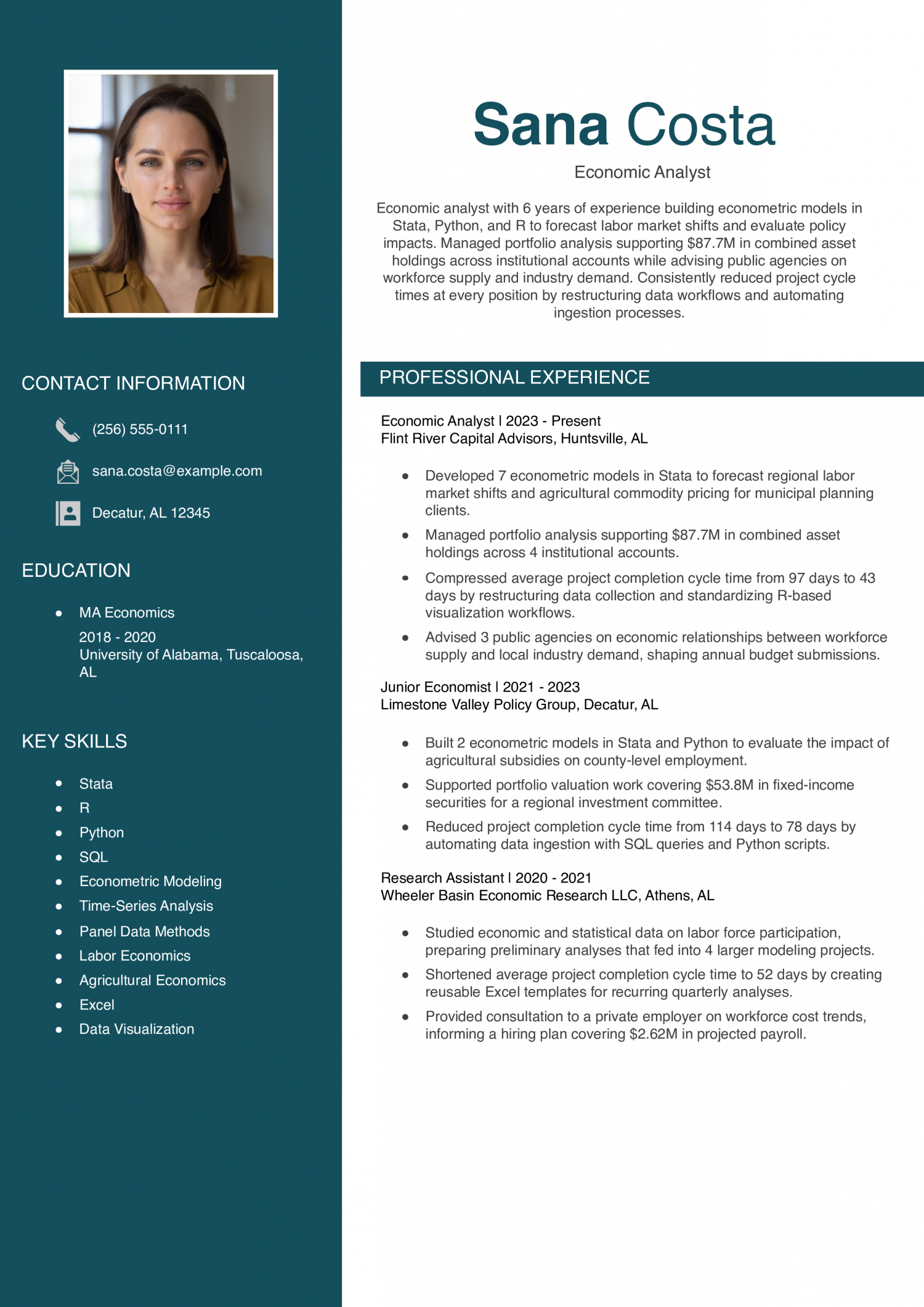
Pick this resume if you are a mid-level economic analyst with several years of forecasting and advisory work behind you. Lead with cycle-time compression figures that show how your process improvements shortened delivery across successive roles.
R-based workflows are named alongside the turnaround time they shortened. A research director sees the tool behind the improvement, not a vague process claim. For your data analysis, name the software you used and connect it to the time or cost change it produced.
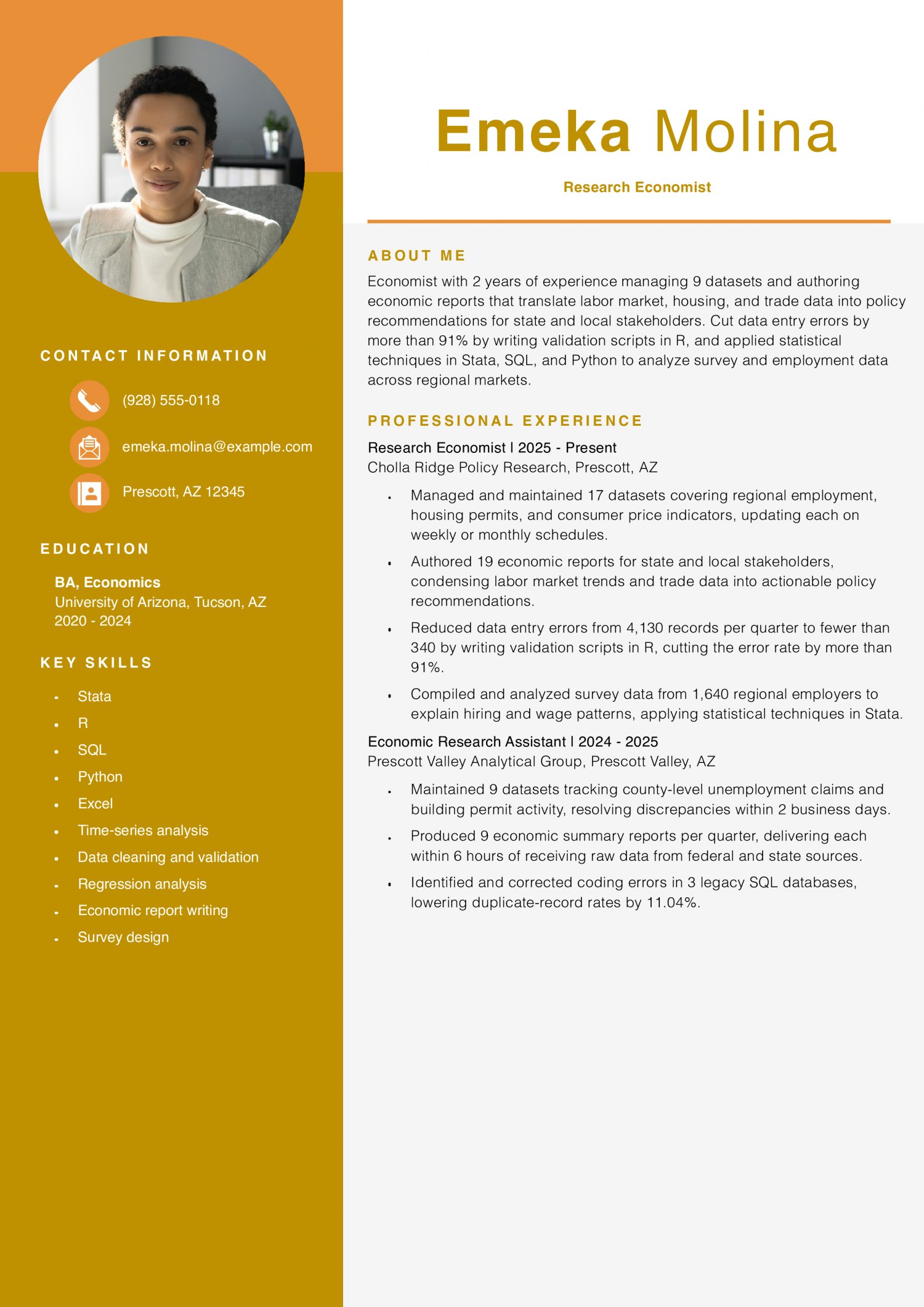
Start with this resume if you are an entry-level research economist building a career from assistant work into independent analysis. Lead with error-rate reductions and dataset counts that prove you already own your data pipeline.
Data errors dropped because validation scripts caught the bad entries earlier. Showing the error count before and after the scripts gives a reviewer something to measure. If you cleaned up a data process, state the old error volume, the new one, and the tool you wrote to fix it.
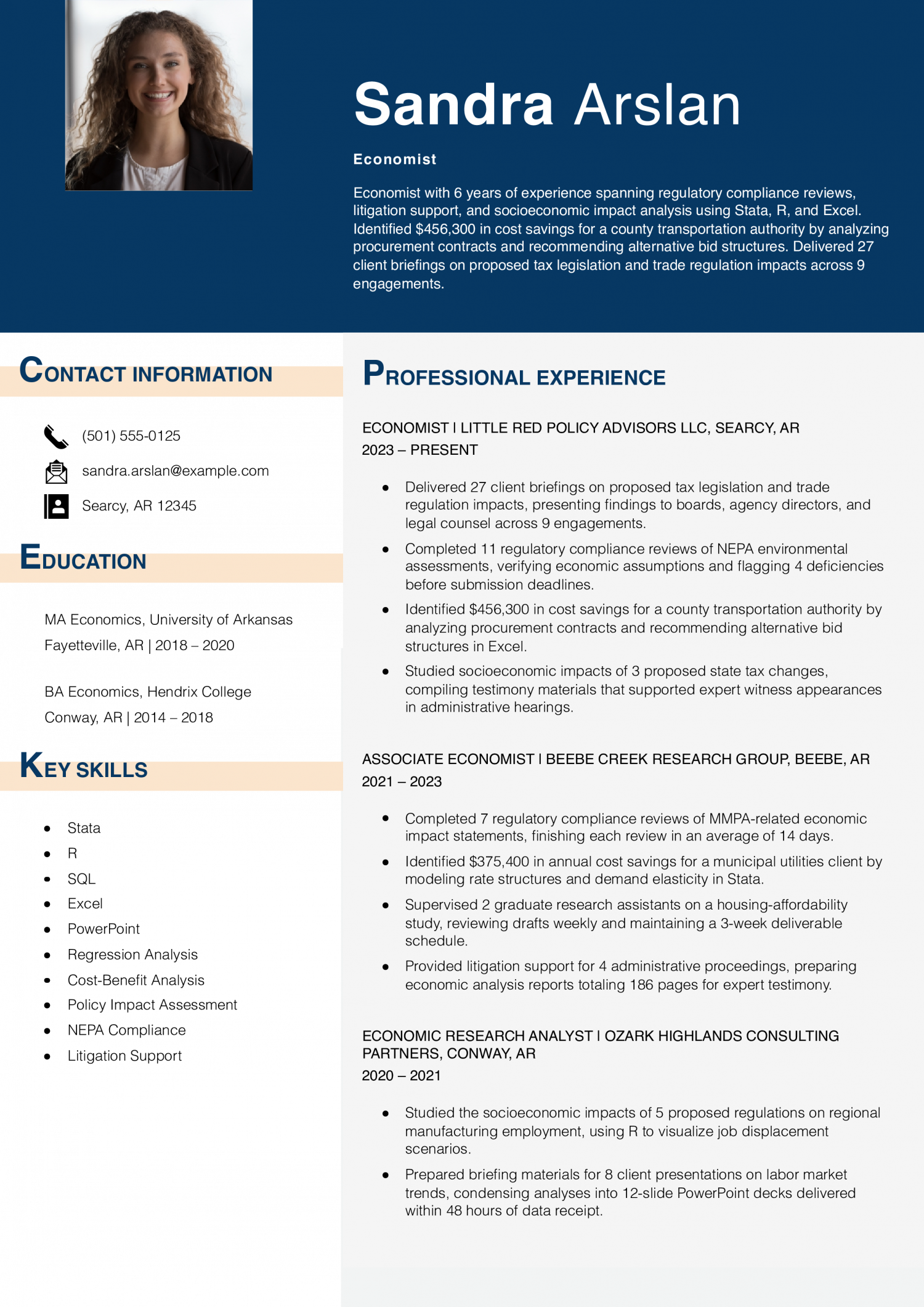
Try this resume if you are a mid-level economist balancing regulatory review work with client-facing policy advisory roles. Lead with litigation and compliance counts that show breadth across administrative and environmental proceedings.
Identifying cost savings for a municipal utilities client puts a face on the analysis. A partner at a consulting firm can see the client type and the dollar value in one read. When you describe analytical findings, say who received the results and what the work was worth to them.
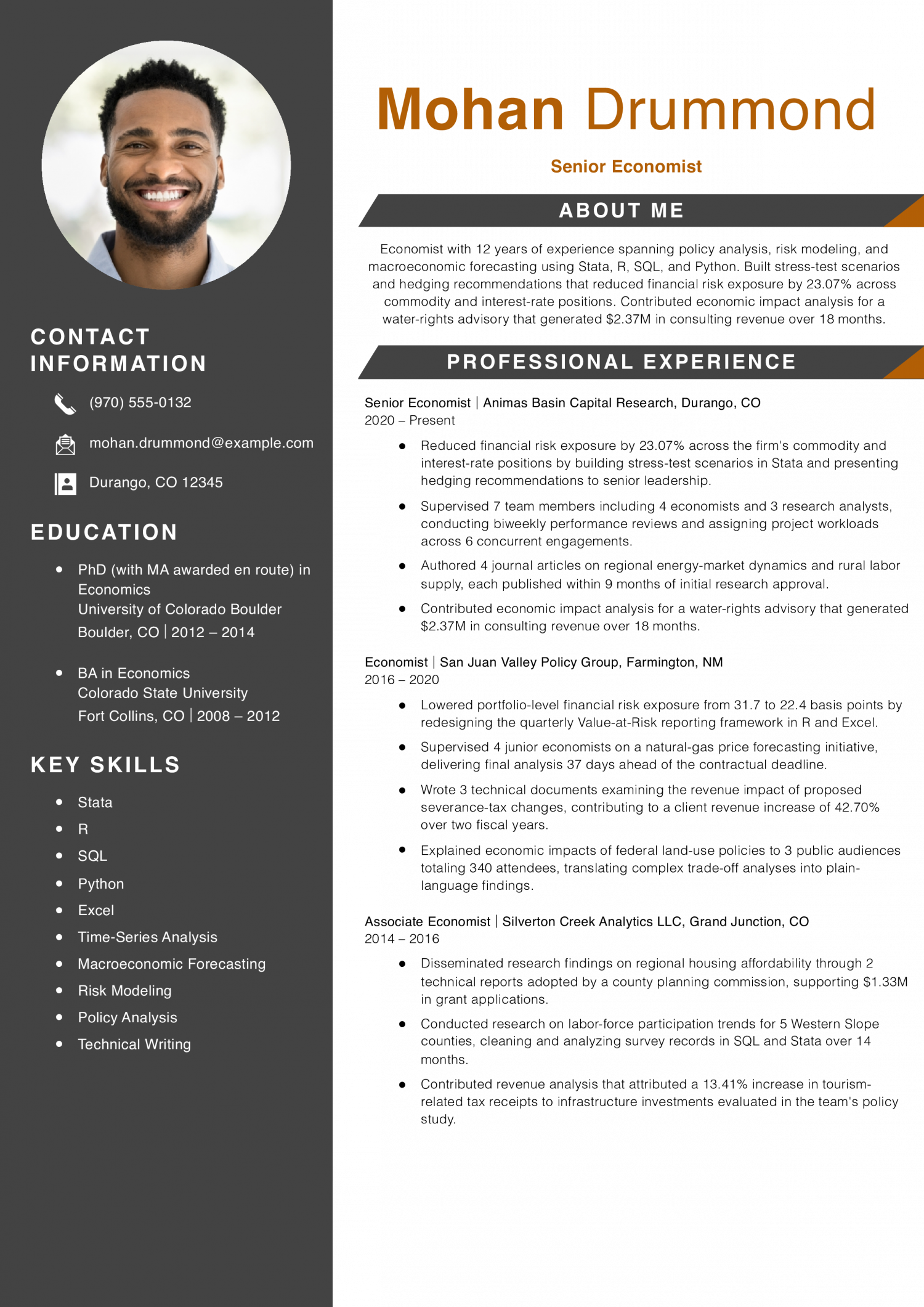
Lean on this resume if you are a senior economist with a research-to-advisory career arc and a PhD. Lead with revenue attribution and risk-reduction figures drawn from your own analytical models.
Biweekly reviews and workload assignments across several projects at once show a steady management routine, not one-off supervision. A department head sees someone who kept the work moving on schedule. State how often you reviewed your team and how many projects ran at the same time.
Forecasting and budget analysis specialist with 7 years of experience using Stata, R, SQL, and Excel to build models that guide municipal and private-sector investment decisions. Redesigned quarterly forecasting models that improved budget allocation accuracy by 43.2% for 6 municipal accounts, redirecting $289,100 toward underfunded infrastructure programs. Background spans environmental policy research, NEPA economic assessments, and client advisory work across multiple consulting firms.
Your profile sits at the top of page one and should state your years of experience in economics. Name the field you work in, such as labor economics or trade policy, and state the sector where you have spent the most time. That could be federal agencies, central banks, or private consulting.
Then name the type of analysis you do most often, whether forecasting or causal inference. Chief economists and research directors scan this block first because they want to know your specialty before they read any bullets. Keep it to three or four sentences and cut any line that does not name a skill or setting.
Match the language in the job posting when you can. If the posting says “macroeconomic modeling,” use that exact phrase so your profile reads as a direct fit.
Economics is built on quantitative evidence, so your resume should reflect that by pairing each bullet with a measurable outcome. You might cite the dollar value of a policy you evaluated. You could note how many data sets you cleaned per quarter.
Name the size of the sample in a major study. Mention the forecast accuracy you held over a set period. Bullets without a number tend to read as duties, and chief economists and research directors look for proof of tangible impact.
A figure gives them a reason to keep reading. Try to include at least one metric in every role on the page. Even rough estimates are better than vague claims.
Round to a clean number when the exact figure is sensitive.
Break your professional experience into the types of work you do, and one group could cover econometric modeling and statistical testing. Another might focus on policy analysis and brief writing. A third could address data collection and survey design.
If you build dashboards or visualizations, group those together too. This organizational structure helps readers find your strengths fast, so list the most relevant group first for each position. Use plain labels that match common job posting language.
Avoid stacking five or six methods into one bullet. Name two per line, then start a new line for the next pair. That keeps each bullet short and easy to scan.
Chief economists and research directors often skim resumes in under a minute. Clear groups make your strongest skills stand out.
Create a short credentials block on page one below your profile, listing the software you use most, such as Stata and R. Python and SQL belong here if you use them for analysis. Name any specialized platforms for data visualization or GIS.
If you hold a relevant license, note the state and its standing. Chief economists and research directors need to see your technical stack early. They often filter candidates by software proficiency before reading further, so keep this block to two or three lines to avoid crowding the page.
Order the tools by how often the posting mentions them. Move less common tools to a secondary skills section lower on the page. This layout ensures your core tools get noticed right away.
Most economist postings require a graduate degree in economics, so place your highest degree near the top of your education section. Name the school, the degree, and your field of concentration. If you wrote a thesis, add its title in one short line.
List published papers in a separate section called “Selected Publications.” Include the journal name, year, and your co-authors. Conference presentations can go in a similar block below that. For early-career candidates, this section carries extra weight.
It demonstrates depth when your work history is still short, and chief economists and research directors often value research output alongside professional experience. Keep each entry to one or two lines so the section stays tight. Drop older coursework that does not relate to the role you want.
Economics hiring is tight in 2026. Research teams run leaner than before. The bar to clear a screen is higher now. Match the lists below against the posting you want.
Chief economists and research directors weigh hard skills first. Econometrics and statistical modeling rank near the top. Forecasting and policy analysis also appear in most postings. Data visualization rounds out the core set.
Soft skills matter too. Critical thinking and communication show up in nearly every ad. Collaboration and problem solving signal you can work on a team. Adaptability tells readers you handle shifting project scopes.
Cross-check each table against the job posting. Mirror the exact phrasing you find there. Place each matched skill inside a bullet point with a measurable result.
| Soft Skills | AI-estimated % |
|---|---|
| Analytical thinking | 79% |
| Policy communication | 68% |
| Cross-sector collaboration | 45% |
| Client advisory skills | 40% |
| Attention to detail | 27% |
And here are the top hard skills showing up most often.
| Hard Skills | AI-estimated % |
|---|---|
| Econometric modeling | 77% |
| Statistical data analysis | 57% |
| Policy impact assessment | 50% |
| Economic forecasting | 37% |
| Research report writing | 33% |
Skill names and rankings come from an AI model grounded in U.S. Department of Labor occupation data for economists, not from a count of economists’ resumes built on ResumeTemplates.com.
These are the must-haves hiring teams look for when scanning an economist resume.
Chief economists and research directors are split on AI in economics work. Some teams want analysts who use large language models for data cleaning. Others insist on hand-coded models with full audit trails.
Name the tools you actually use in your workflow. Describe what you automate and what you still check by hand. Do not claim you build AI forecasting pipelines if your real practice is prompting a chatbot.
Be honest about where the model ends and your judgment starts. Reviewers test these claims in technical interviews. They ask you to walk through your code and your reasoning.
What AI is actually changing for this role
Data cleaning: Large language models now parse unstructured text into panel-ready variables, cutting hours of manual coding work.
Literature review: AI search tools surface relevant working papers faster, but you still assess methodology and validity.
Forecast drafting: Machine learning models generate baseline forecasts that you then adjust with structural economic reasoning.
Report writing: Generative tools draft summaries of regression output, though you must verify every coefficient and interpretation.
Policy simulation: AI-assisted microsimulation speeds scenario testing, yet the economist still sets assumptions and parameters.
AI tools to name
How to phrase AI on your resume
Do
Skip
Chief economists and research directors scan for specific tools. They want proof you can run models and handle data. List software you have used in real projects.
The 90th-percentile Economist out-earns the median by roughly 91 percent. That gap tells you the market pays a steep premium for deep specialization over generalist breadth. The 10th percentile sits about 46 percent below the median, so the floor-to-ceiling range is wide.
National employment is small, which means each opening draws tight competition from a focused talent pool. Geographic spread and sector choice shape where you land in that range. On your resume, lead with the research domain or policy area you own, not a count of years in the field.
| # | State | Median Annual |
|---|---|---|
| 1 | District of Columbia | $167,590 |
| 2 | New Jersey | $167,550 |
| 3 | Delaware | $159,120 |
| 4 | Maryland | $144,680 |
| 5 | Kansas | $138,790 |
| 6 | Virginia | $137,590 |
| 7 | New York | $136,660 |
| 8 | North Carolina | $136,150 |
| 9 | Idaho | $131,270 |
| 10 | Alabama | $129,960 |
| # | State | Workers | Median |
|---|---|---|---|
| 1 | District of Columbia | 3,000 | $167,590 |
| 2 | Maryland | 1,130 | $144,680 |
| 3 | Massachusetts | 1,030 | $106,380 |
| 4 | Virginia | 950 | $137,590 |
| 5 | New York | 910 | $136,660 |
Resume Templates offers HR approved resume templates to help you create a professional resume in minutes. Choose from several template options and even pre-populate a resume from your profile.
Start with a short profile that names your subfield, such as labor economics. Then list your experience in reverse order, attaching a metric to each role.
Follow with education, publications, and a skills section that pairs software with methods.
One page works well for economists with fewer than ten years of experience. If you have a long publication list or several senior roles, a second page is reasonable. Keep the second page at least half full so it does not look padded.
Yes, list published papers and working papers in a separate section below your work history. Chief economists and research directors often scan this section before reading anything else. Name the journal, your coauthors, and the year for each entry.
A resume is a targeted one-to-two-page document built for a specific job posting. A CV lists your full academic record, including every publication and grant. Private-sector roles at banks or consulting firms usually expect a resume.
State the forecast you built, the data it covered, and the outcome it produced. For example, write that your macro forecast cut projection error by 15 percent over two years.
A concrete figure tells a research director more than a vague claim about accuracy.
You will need to reframe your academic work around business outcomes. Replace course titles with the skills they used, such as causal inference or time-series modeling. Lead each bullet with the problem you solved and the decision your analysis informed.
List any research, freelance consulting, or policy writing you did during the gap period. Even an unpublished working paper shows that you stayed active in the field. Place the entry in your experience section with honest dates so the timeline reads clearly.
For an economist, an ATS-friendly template is the safest pick, because it puts your certifications and experience where a hiring manager scans first. A basic template is a solid alternative. Whichever you choose, keep the formatting clean and easy to parse: clear section headings, a standard font, and no graphics a parser can choke on.
Economist Resume
4.7/5 stars with 184 reviews

Executive Resume Writer and Career Coach
Andrew Stoner is an executive career coach and resume writer with 17 years of experience as a hiring manager and operations leader at two Fortune 500 Financial Services companies, and as the career services director at two major university business schools.
© 2026 Resumetemplates.com All rights reserved.