
Tip !

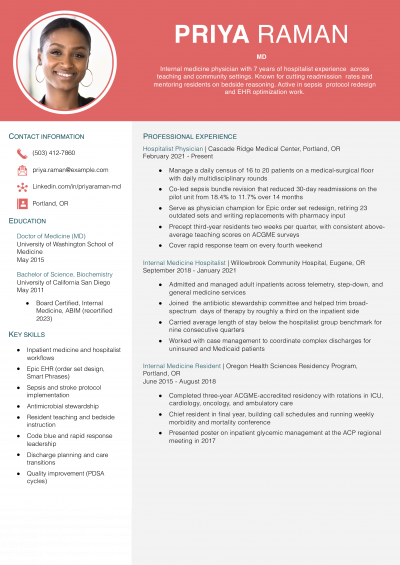
Hiring medical directors look for board status, specialty, and case volume on the first page of a physician resume, because those three signals show whether you can carry a panel without ramp time.

Andrew Stoner , Executive Resume Writer and Career Coach

Why this resume works

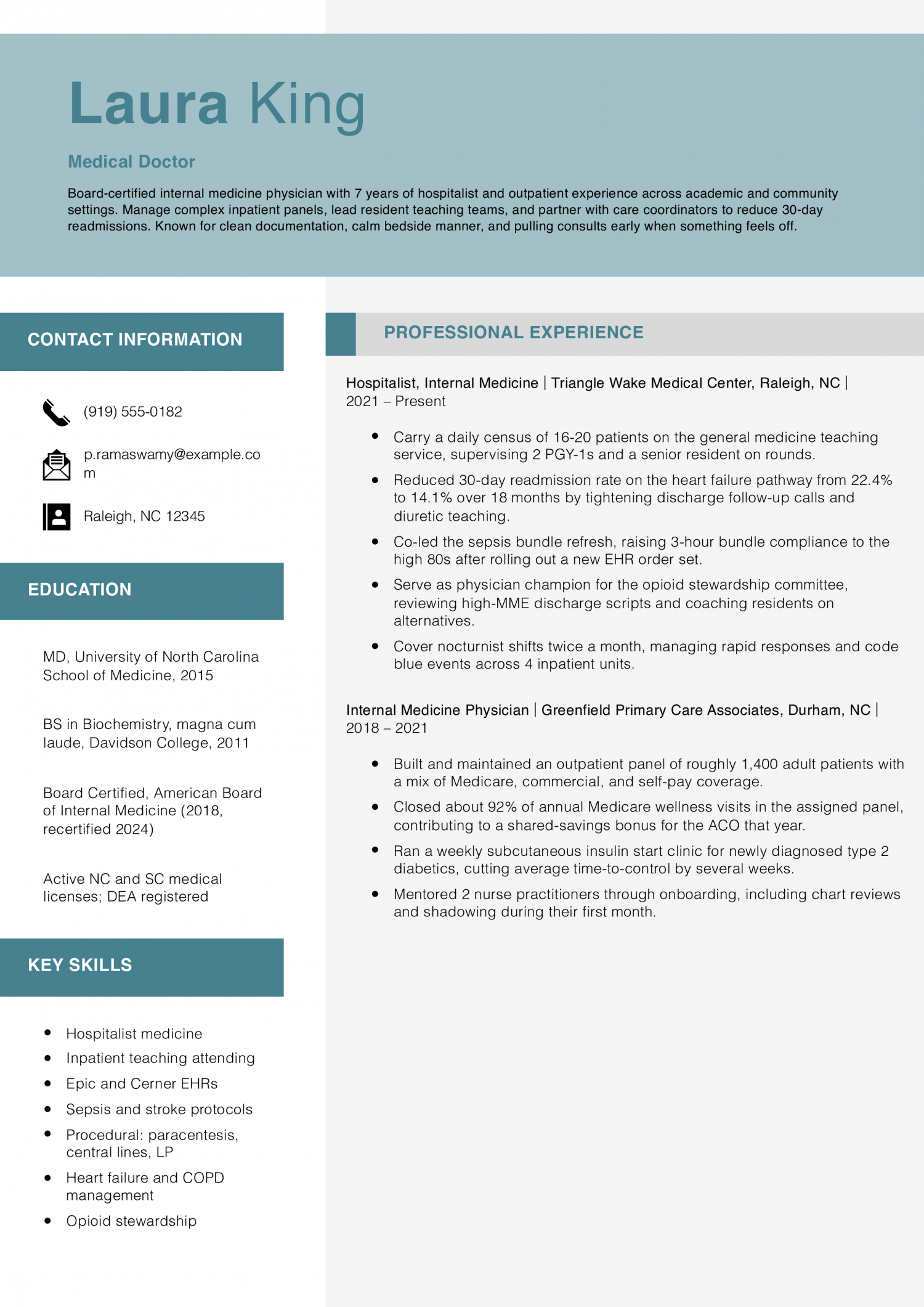
  • Clear patient volume: The daily census number tells hiring directors exactly how heavy a load this doctor is used to carrying.
  • Tied to readmission rates: Showing a drop from 22.4% to 14.1% on the heart failure pathway connects clinical work to a quality measure hospitals care about.
  • Mix of academic and community: Listing both a teaching hospital and a primary care group shows range without making the resume feel scattered.

Intern Example

The Intern resume is for an MD entering PGY-1 or applying to early residency slots. It needs to prove medical school standing, clerkship breadth, USMLE Step progress, and any research or volunteer clinical hours.

Why this resume works

  • Procedure counts spelled out: Listing 35 supervised procedures with specific types shows program directors exactly where this intern is on the learning curve.
  • Honest scope of role: Saying patients are managed under attending supervision is accurate for PGY-1 and signals self-awareness.
  • Shows interest in QI early: The handoff project tells fellowship reviewers later that this candidate gets involved beyond just clinical duties.

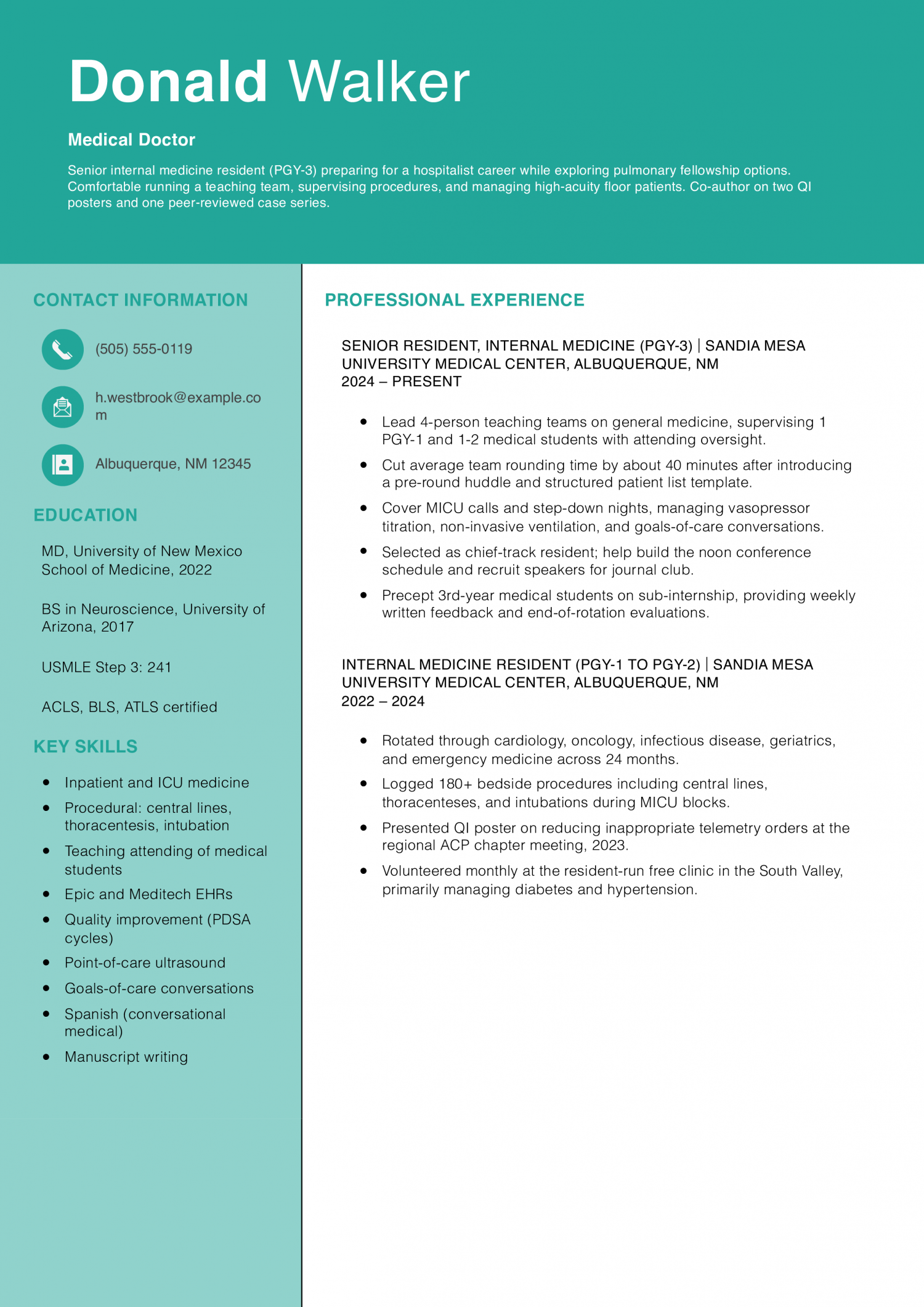
Resident Example

The Resident resume covers PGY-2 through chief resident years. It needs to prove rotation depth, procedure logs, patient census, and the academic output that signals you are tracking toward fellowship or attending roles.

Why this resume works

  • Shows leadership in the team: Leading a 4-person team with juniors and students proves this resident is ready for fellowship or attending roles.
  • Tracks procedure numbers: 180+ procedures with specifics helps fellowship directors see hands-on readiness.
  • Career direction is clear: Saying hospitalist with possible pulmonary fellowship gives recruiters a real sense of next steps.

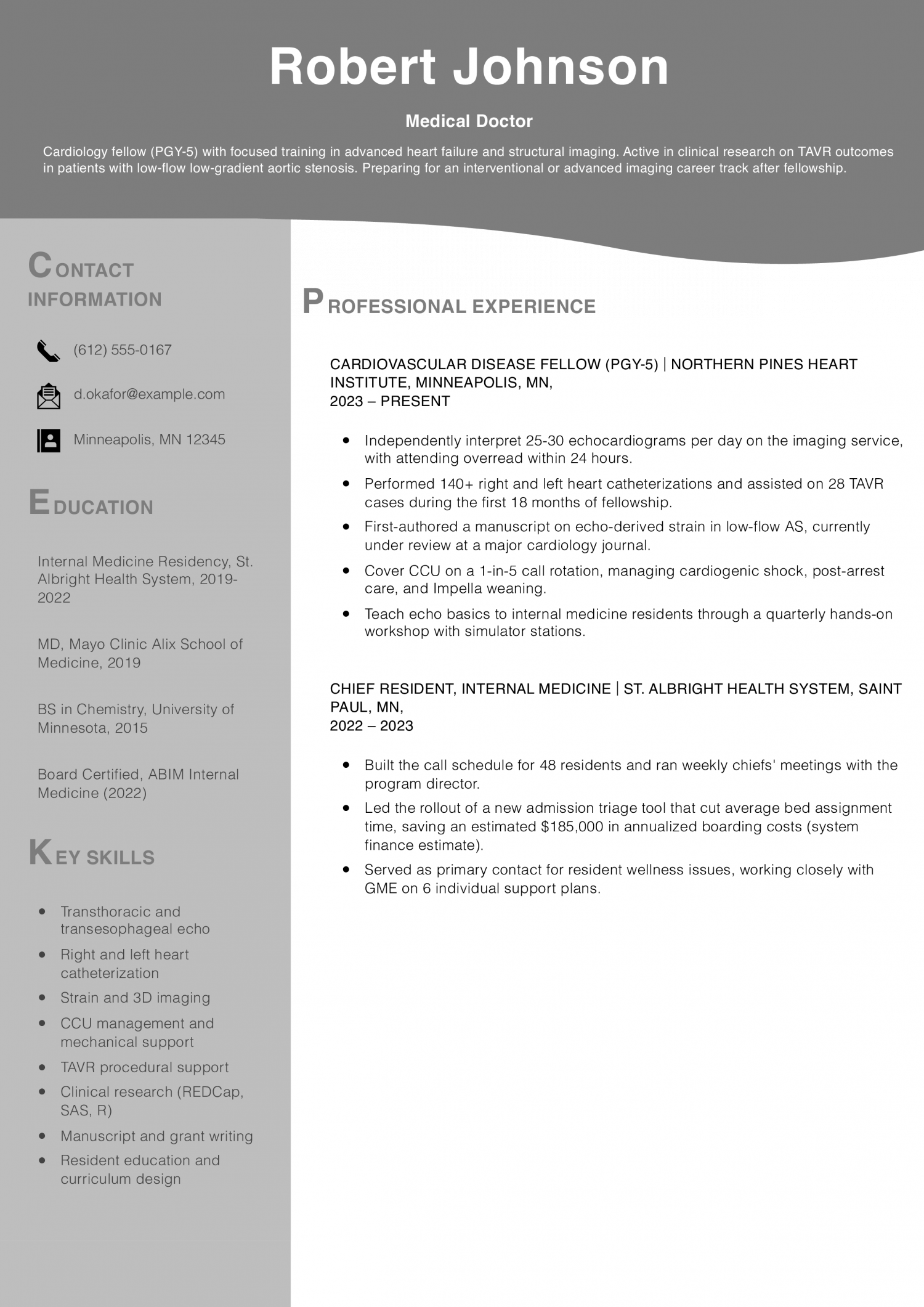
Fellow Example

The Fellow resume is for a subspecialist in training after residency. It needs to prove your fellowship program, sub-specialty case mix, supervised procedural volume, and the publications or grants that anchor your niche.

Why this resume works

  • Procedure numbers stand out: 140+ catheterizations plus TAVR assists gives a concrete read on procedural readiness for jobs or advanced fellowships.
  • Research is specific: Naming the topic and journal status is more useful than a vague mention of ongoing research.
  • Past chief role adds depth: Chief resident work shows leadership and operational skill, which matter for academic attending jobs.

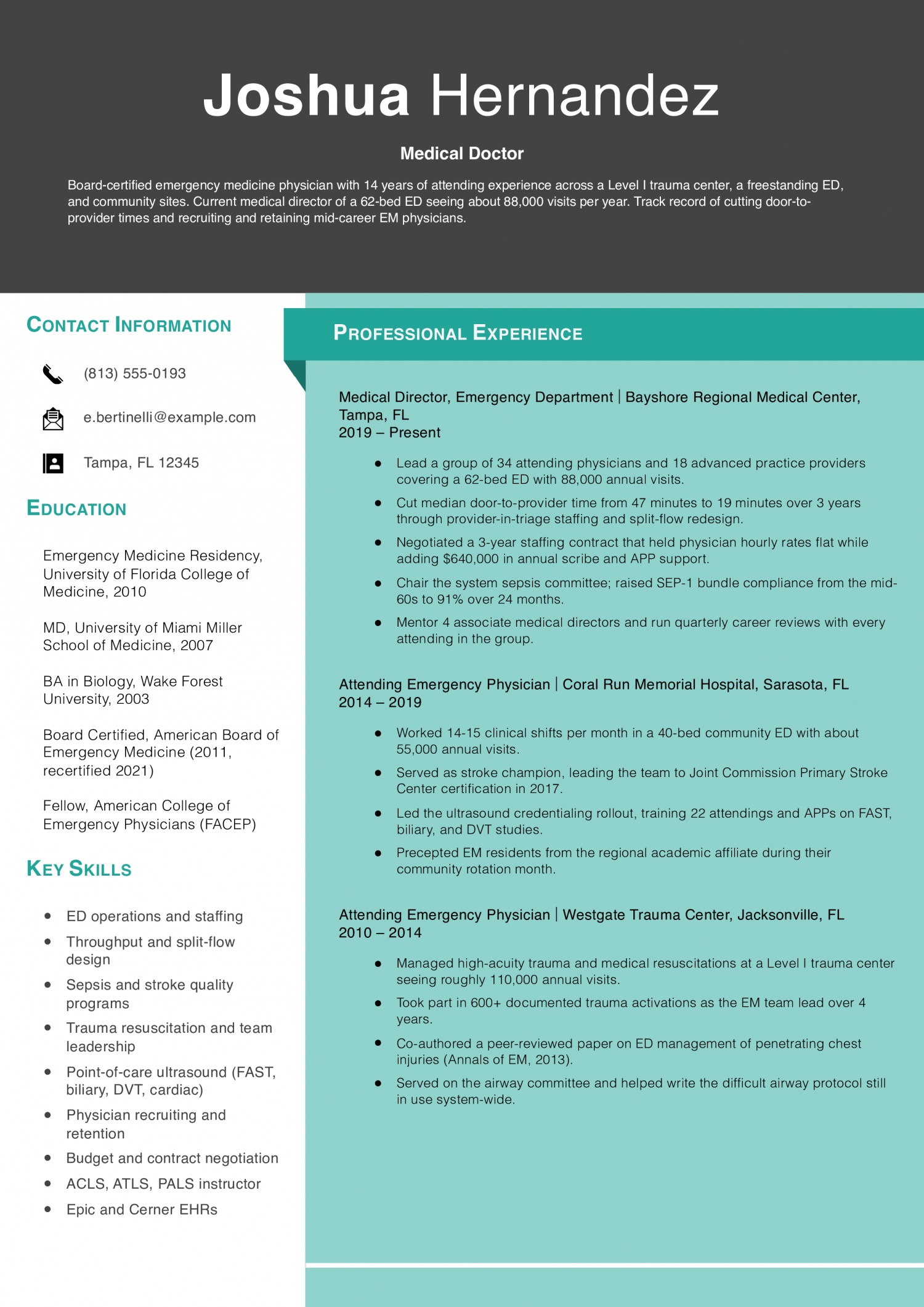
Attending Example

The Attending resume is for a board-certified physician in independent practice. It needs to prove ABMS certification, hospital privileges, panel size or RVU output, and the quality metrics that define your patient outcomes.

Why this resume works

  • Operational results, not just clinical: Cutting door-to-provider time from 47 to 19 minutes shows this director can move real metrics, which CMOs care about.
  • Team size is clear: Stating 34 attendings and 18 APPs across 88,000 visits sets the scope of leadership without exaggeration.
  • Career path makes sense: Going from trauma center to community ED to medical director reads as a logical climb instead of random job changes.

How to Write a Medical Doctor Resume

01 Open with what a credentialing lookup can't show

Add a single line a credentialing office cannot pull from your NPI record. Name your subspecialty focus, a procedural privilege, a second language used at the bedside, or a population you treat.

Examples include point-of-care ultrasound certification, bilingual Spanish-English patient encounters, addiction medicine focus within internal medicine, or fellowship-level robotic surgery volume. This line tells a medical director within five seconds whether your practice pattern fits the opening.

Place it directly under your name and credentials, above the summary. It carries more weight than a generic objective line.

02 Quantify volume, outcomes, and acuity

Medical directors and physician recruiters read numbers as proof of scope. Most strong physician resumes name patient panel size, daily census, annual procedure count, or RVU output.

Pick two or three metrics that match your specialty. A hospitalist names average daily census and length-of-stay reduction. A surgeon names annual case volume and complication rate.

A primary care attending names panel size and quality measure performance.

Bullets without a number tend to read as duties, not impact. Anchor each clinical bullet to a count, a rate, or a benchmark you moved.

03 Group your work by clinical category

Cluster bullets under three to five headings rather than running flat lists. Common categories include direct patient care, procedural volume, teaching and supervision, quality and committee work, and research output.

Under direct patient care, name acuity level, setting, and panel size. Under procedural volume, list the procedures you perform independently and the annual count.

Teaching covers medical student and resident supervision, lecture series, and simulation lab hours. Quality work covers committee roles, M&M leadership, and any measure you improved. Research lists publications, abstracts, and active grants.

04 Place credentials where recruiters scan first

Build a credentials block on page one, directly under your header. Include MD or DO, ABMS board certification with specialty and year, state license in good standing, DEA registration, NPI, and BLS or ACLS status.

Do not list the actual license number, DEA number, or NPI on the resume. Recruiters confirm those through primary source verification, and posting them publicly invites identity risk.

Epic, Cerner, or other EMR proficiency belongs in a short tools line below credentials. Medical directors need this block visible early because credentialing review starts before clinical fit review.

05 What to cut from your physician resume

Drop your medical school GPA once you have completed residency. Cut undergraduate honors, pre-clinical coursework, and rotations once you are board-certified.

Trim publications older than ten years unless they are still cited or define your niche. Remove every objective statement and any line that reads like a job description rather than your work.

Keep the CV under four pages for community roles and let it run longer for academic appointments where publications and grants matter. Lead with current practice, not training history.

Physician hiring is tight in 2026. Recruiting teams are running leaner and the bar to clear credentialing review is higher. The skills below come from our user-built medical doctor resumes.

Medical directors weigh hard skills, board status, EMR fluency, procedural volume, first, then read soft skills as evidence inside your bullets. Match the list against your target posting and back each soft skill with a clinical example.

Soft Skills % of resumes with this skill
Patient communication 77%
Empathy and compassion 58%
Critical thinking 46%
Active listening 36%
Time management 34%

And here are the top hard skills showing up most often.

Hard Skills % of resumes with this skill
Clinical diagnosis 80%
Electronic health records 68%
Treatment planning 40%
Diagnostic test interpretation 35%
Emergency and critical care 34%

Based on data from thousands of physicians’ resumes built on ResumeTemplates.com, May 2026.

Must Have on a Medical Doctor Resume

Before a medical doctor resume gets a closer read, hiring teams check for a short list of essentials.

Licensure Requirements

State medical boards license every practicing physician, and credentialing offices verify your status before a medical director reviews clinical fit. List each license cleanly without exposing the registration number.

Create a Licensure line in your credentials block under your header. Name each state where you hold an active license and add ‘in good standing.’

If you participate in the Interstate Medical Licensure Compact (IMLC), name that on a separate line. IMLC eligibility signals to telehealth and multi-state groups that you can be credentialed in additional states within weeks.

Keep license, DEA, and NPI numbers off the resume itself. Provide them on the credentialing application when requested.

  • State medical license, active and in good standing (list each state)
  • IMLC eligibility or Letter of Qualification status, if applicable
  • DEA registration, current (do not list the registration number)
  • Controlled substance state registration, where required
  • Hospital privileges by facility name and category

Continuing Medical Education (CME)

State medical boards set CME requirements in credit hours per cycle. Most boards require 50 AMA PRA Category 1 Credits per year, plus state-specific topics in pain management, opioid prescribing, or implicit bias.

Group CME under one heading near the end of the CV. Name the issuing institution, the topic, and the year, not every individual credit.

Highlight CME that aligns with the role you are applying to. A hospitalist role values sepsis, transitions of care, and antimicrobial stewardship. A primary care role values diabetes, behavioral health, and motivational interviewing.

List CME hours per state board requirements, but you do not need to itemize every webinar.

  • AMA PRA Category 1 Credits earned in the current cycle
  • State-mandated topics (opioid prescribing, pain management, implicit bias)
  • Specialty society annual meetings attended
  • Fellowship or mini-fellowship programs completed

EMR Systems on Your Resume

Most hospitals run Epic or Cerner, and ambulatory groups often layer in athenahealth, eClinicalWorks, or NextGen. Naming the EMR you have used cuts onboarding time and shows up in keyword screens.

  • Epic (Inpatient, Ambulatory, EpicCare Link)
  • Oracle Cerner Millennium
  • athenahealth, eClinicalWorks, or NextGen
  • Meditech or Allscripts, where applicable
  • Dragon Medical One or other voice documentation tools

HIPAA and OSHA Compliance

Every clinical bullet on a physician CV touches HIPAA. The rule is simple: report counts and outcomes, never identifiers.

Patient Privacy Quick Check

Acceptable bullets name annual case volume, average daily census, length of stay, readmission rate, or quality measure performance. None of these point to an individual patient.

Unacceptable bullets include case narratives with rare diagnoses, small populations, or location-specific timing that could identify a patient by inference.

  • Use ranges and annualized counts, not individual case stories
  • Avoid naming patient demographics tied to a small program
  • Do not attach scrubbed clinical notes or images as work samples
  • Confirm any outcomes data you cite is publicly reported or de-identified

Board Certification and Specialty Recognition

ABMS board certification is the single strongest credibility signal on a physician CV. Medical directors check it before they read a single clinical bullet.

  • Primary ABMS specialty board with year of initial certification
  • Subspecialty or CAQ with issuing board and year
  • Maintenance of Certification (MOC) cycle status
  • Board eligibility status, if not yet certified, with sitting date

Medicine Credentials That Get You the Job

Medical directors and physician recruiters read your certifications list as a map of where your practice is heading. The credentials below tell them which specialty track, procedural scope, or quality focus you have invested in. List the issuing board and the year earned, not the certificate number.

  • ABMS Board Certification: Lists your specialty and recertification cycle. Recruiters use this to confirm you can be credentialed at most hospitals.
  • Advanced Cardiac Life Support (ACLS): Required at most inpatient settings. List the issuing body, usually the American Heart Association, and the expiration year.
  • DEA Registration: Signals prescribing authority for controlled substances. Note registration status only, never the actual DEA number.
  • Subspecialty Certification (CAQ): A Certificate of Added Qualifications signals fellowship-level depth in areas like hospice, sports medicine, or interventional cardiology.

Latest BLS Statistics for Physicians

The top-paying states for medical doctors cluster in low-supply rural markets and select coastal academic centers, not the metros most residents target during match week. Compensation tracks specialty mix and call burden more than cost of living, which is why a hospitalist in a small state can out-earn one in a major city.

If you are geographically flexible, foreground multi-state licensure, IMLC eligibility, and the call structure you have carried.

$239,200 National median annual
$253,470 National mean annual
$66,860 Entry-tier floor (10th percentile)
$239,200 Top-decile ceiling (90th percentile)
315,360 Physicians in the U.S.
Where you stand

Entry tier

$66,860 to $239,200 At the entry tier, lead with your MD or DO, residency program, board eligibility, and the procedural log you built during training.

Mid band

$239,200 to $239,200 At the mid band, your resume needs to show panel size, RVU or case volume, quality measure performance, and any teaching role.

Top decile

$239,200+ At the top decile, lead with ABMS certification, hospital privileges across systems, leadership titles, and the outcomes data tied to your service line.

Top-paying states

# State Avg. Annual
1 Alabama $239,200
2 Alaska $239,200
3 Arkansas $239,200
4 Colorado $239,200
5 Florida $239,200
6 Georgia $239,200
7 Hawaii $239,200
8 Idaho $239,200
9 Indiana $239,200
10 Iowa $239,200

Highest-employment states

# State Workers Median
1 Texas 32,740 $239,200
2 Florida 22,370 $239,200
3 Ohio 21,770 $231,300
4 California 20,750 $201,510
5 Illinois 18,680 $218,880
Source: U.S. Bureau of Labor Statistics, OEWS 2024 release (SOC 29-1229).
Written by professional resume writers and loved by hiring managers

Resume Templates offers HR approved resume templates to help you create a professional resume in minutes. Choose from several template options and even pre-populate a resume from your profile.

Frequently Asked Questions

What is a doctor's resume actually called?

In medicine, the document is usually called a CV (curriculum vitae), not a resume. CVs run longer than a standard two-page resume.

Academic positions expect a full CV with every publication, presentation, and committee role. Community hospitals and locum agencies often accept a shorter physician resume of two to four pages.

Should I include my license and DEA numbers on the resume?

No. List the state and board certification status with the phrase 'license in good standing,' but leave the actual numbers off.

Hospital credentialing offices verify your license, DEA, and NPI through primary source databases. Putting full numbers on a public document invites identity and prescribing fraud risk.

How do I handle a gap between residency and my first attending role?

Name the gap honestly in your cover letter and account for it on the CV with a short line.

Acceptable framings include locum coverage, board study, parental leave, research, or visa processing. Medical directors care more about active license status and recent clinical hours than the gap itself.

If the gap exceeds two years, plan for a refresher course or a structured re-entry program.

How do I show procedural volume without violating patient privacy?

Report annual counts, ranges, and outcome rates without any patient identifiers, dates of service, or facility-specific case details.

Phrases like '200 colonoscopies per year' or 'managed average daily census of 18' are standard. Avoid case narratives that could identify a patient even by inference.

What's the best resume template for a physician?

For a physician, an ATS-friendly template is the safest pick, because it puts your certifications and experience where a hiring manager scans first. A basic template is a solid alternative. Whichever you choose, keep the formatting clean and easy to parse: clear section headings, a standard font, and no graphics a parser can choke on.

Rate this article

Medical Doctor Resume

Average Rating

4.5/5 stars with 185 reviews

You have given 0 Star(s)
4.5/5 stars with 185 reviews
Andrew Stoner

Executive Resume Writer and Career Coach

Andrew Stoner is an executive career coach and resume writer with 17 years of experience as a hiring manager and operations leader at two Fortune 500 Financial Services companies, and as the career services director at two major university business schools.