



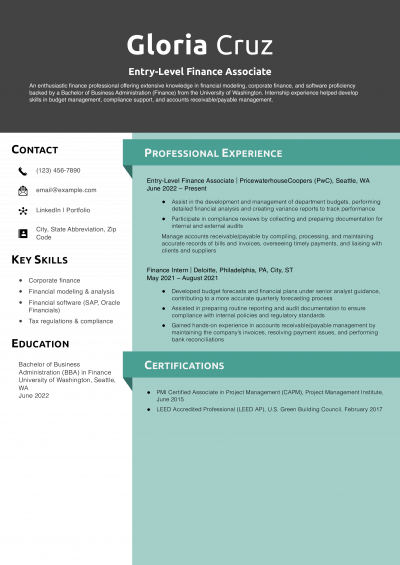
Finance Resume Examples and Templates




Writing a financial analyst resume can seem hard if you don’t have direct work experience yet. But remember, you still have valuable skills and knowledge from your education and training. Consider including relevant business coursework you’ve done or finance certifications you’ve earned. Also, describe volunteer roles or internships you’ve completed in your field, and emphasize your work ethic and willingness to learn. By focusing on these traits and experiences, you can show you’d be an asset to any team.
The guide below provides expert tips to help you create a persuasive resume showing your best entry-level financial analyst skills.
Key takeaways:
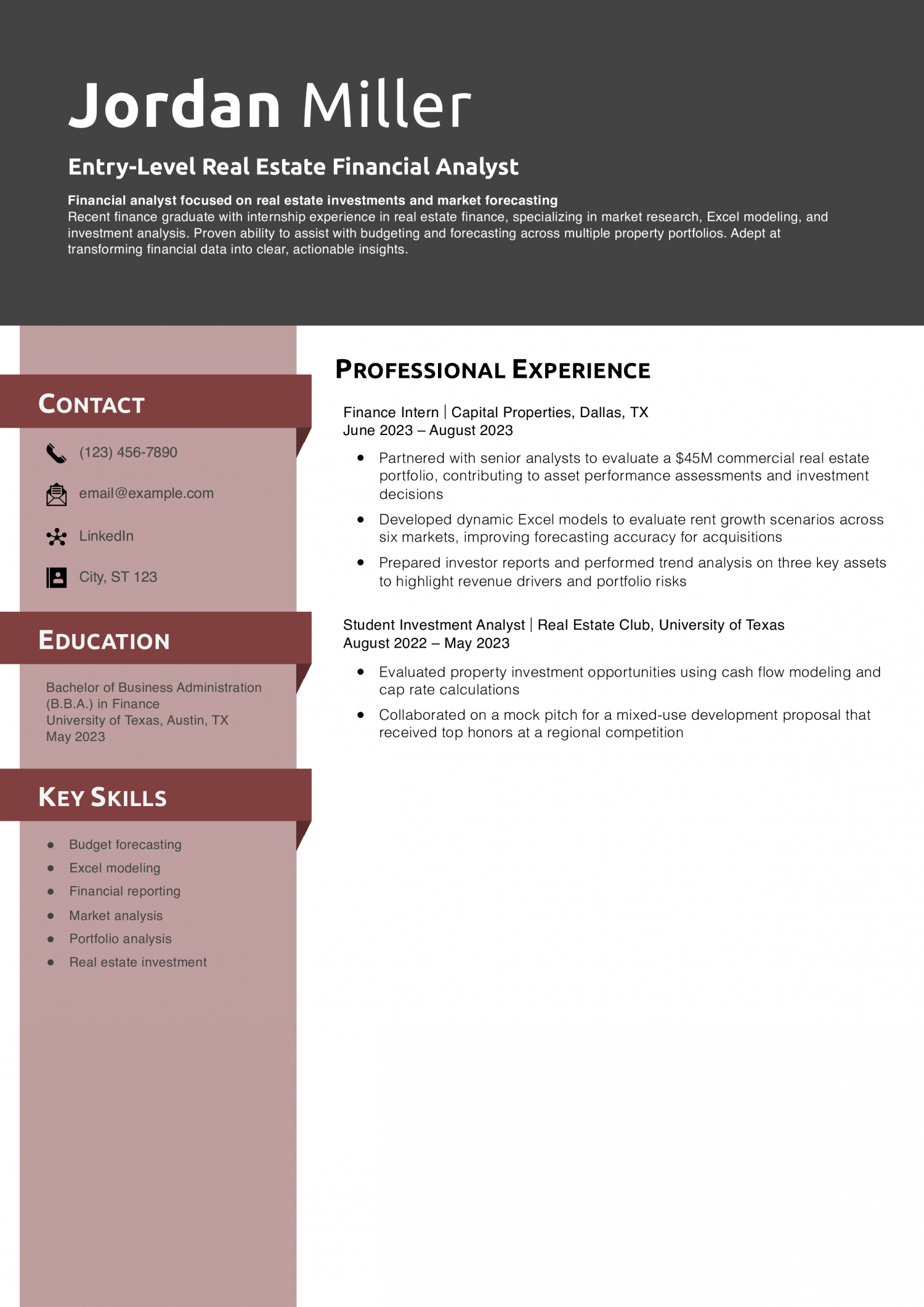
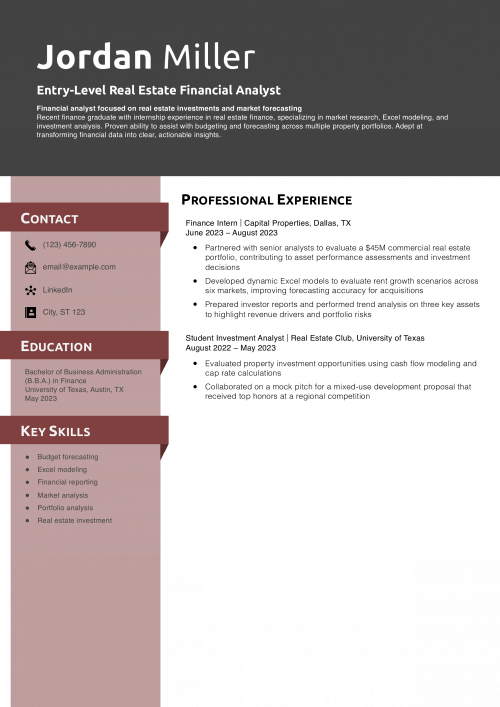
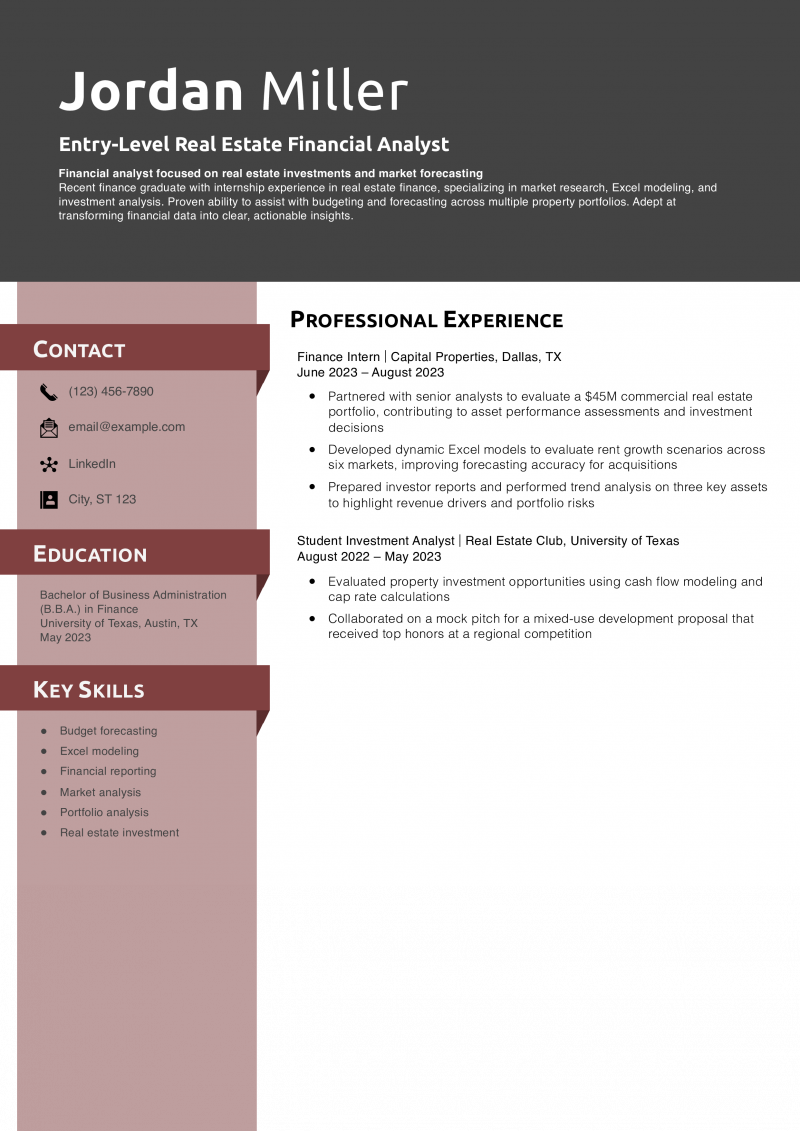
Jordan’s resume shows hands-on experience through an internship and student-led projects. Their ability to apply core financial principles to real estate scenarios is clear, and the use of metrics such as portfolio size builds credibility.
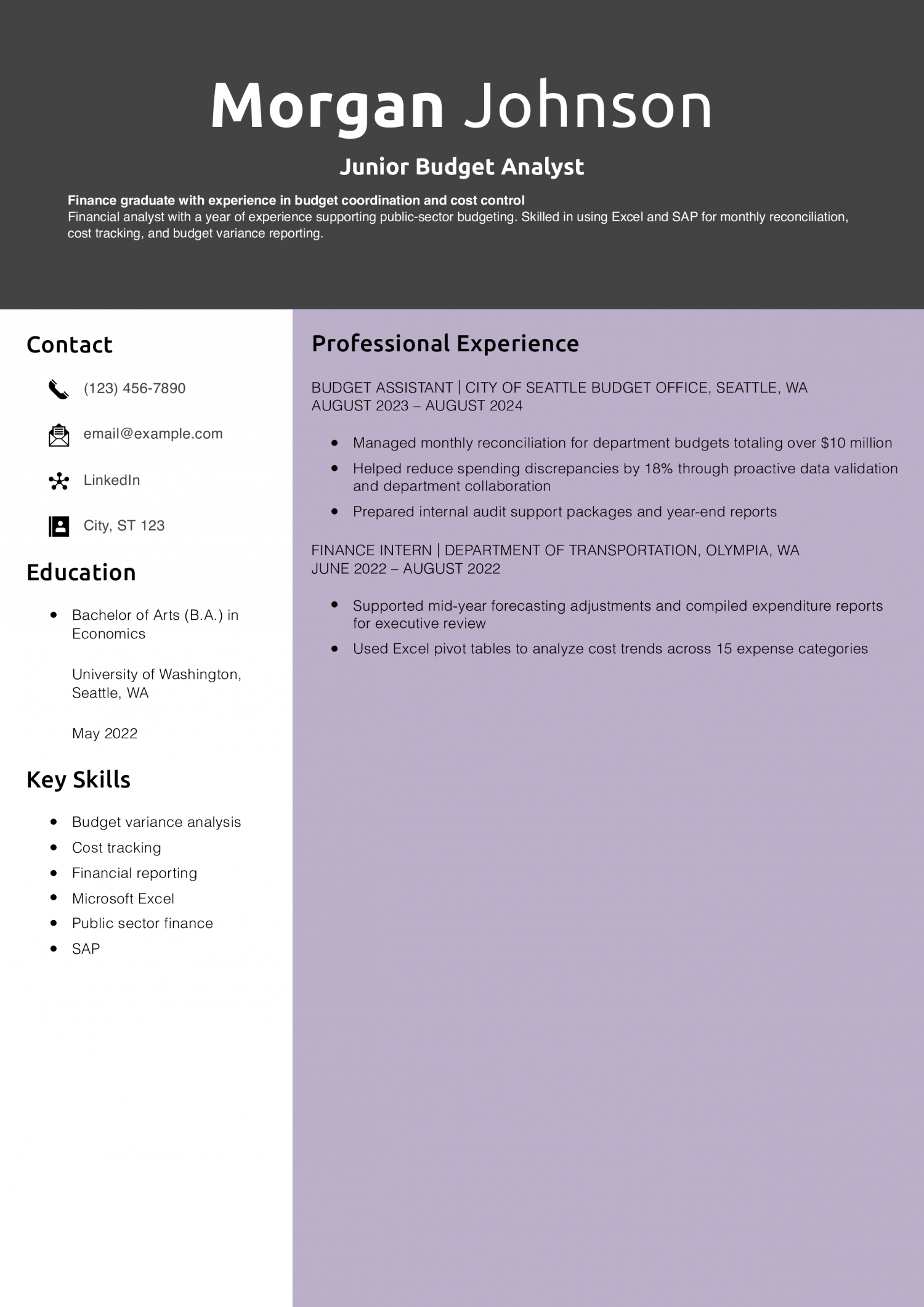
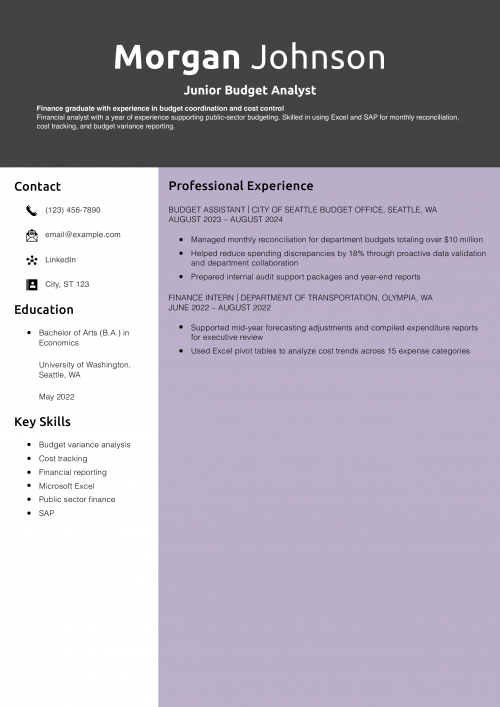
Morgan combines real-world financial experience in a government setting with technical tools like SAP. The bullet points highlight quantifiable achievements, such as reducing discrepancies — a key outcome for budgeting roles.
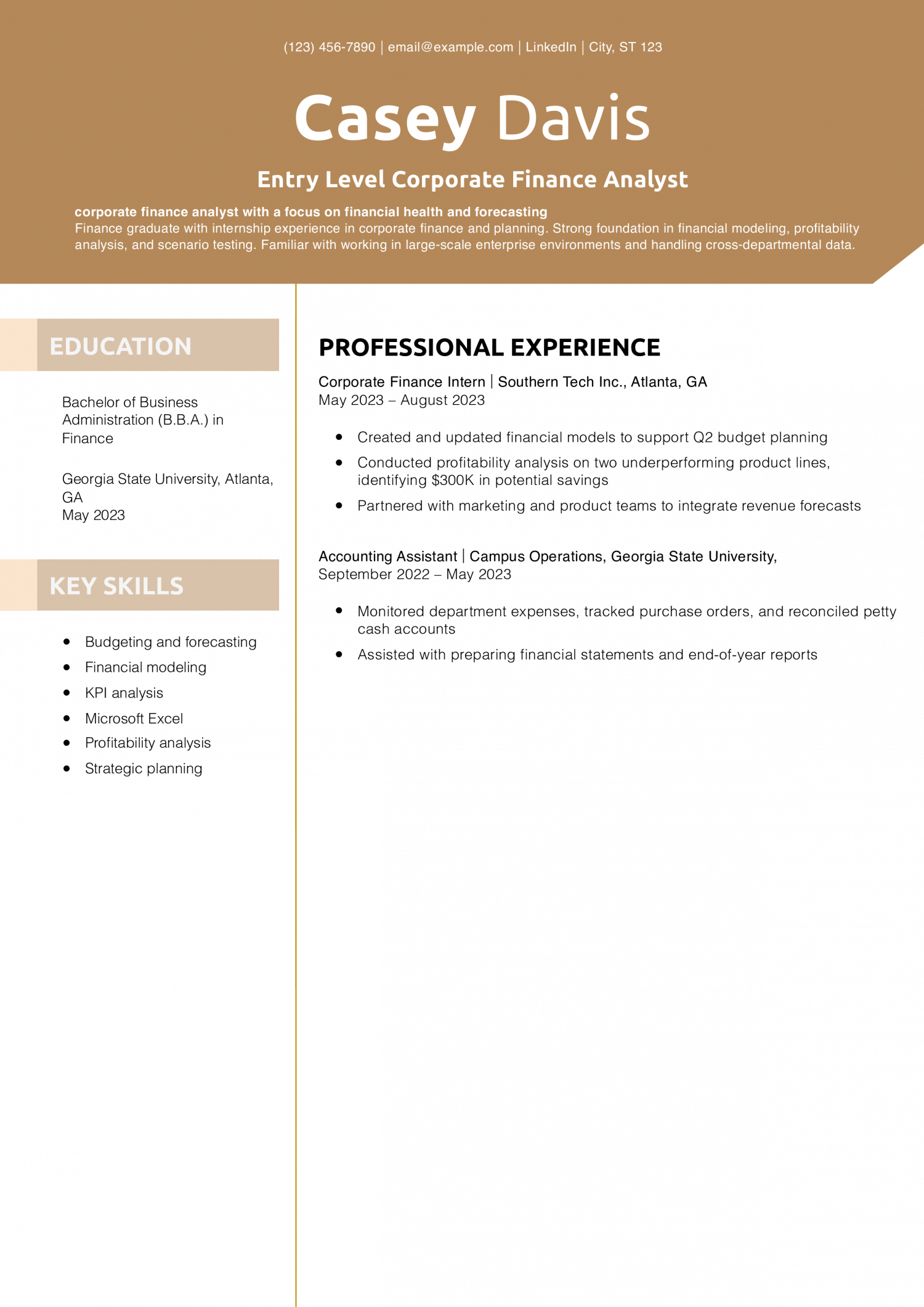
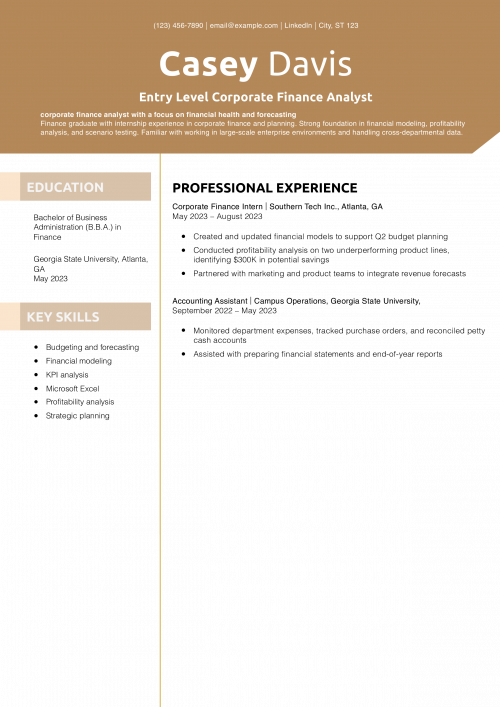
Casey’s resume demonstrates initiative and analytical thinking by emphasizing savings and cross-functional collaboration. The bullet points show not just tasks, but measurable outcomes — especially the $300K cost-saving discovery.
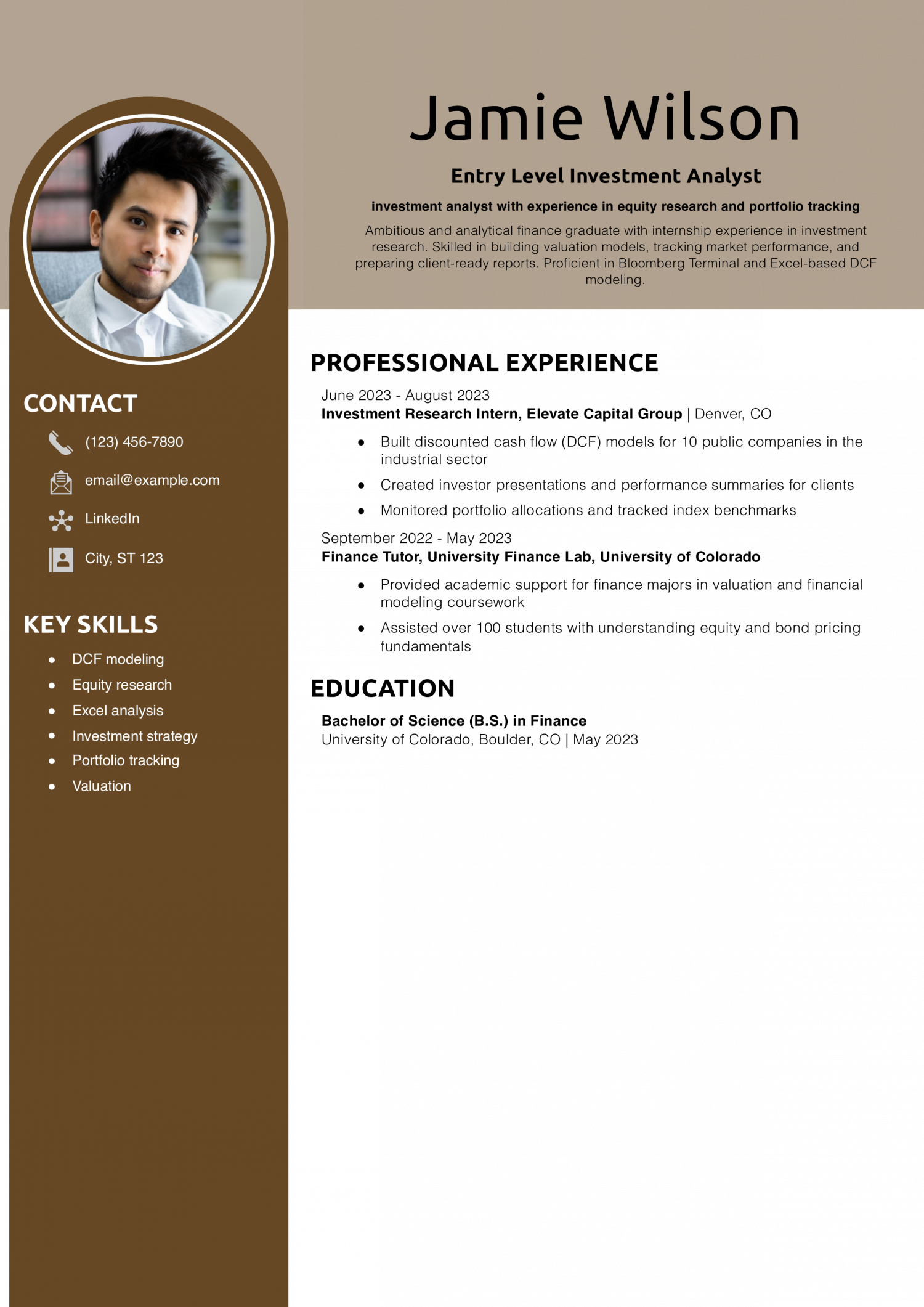
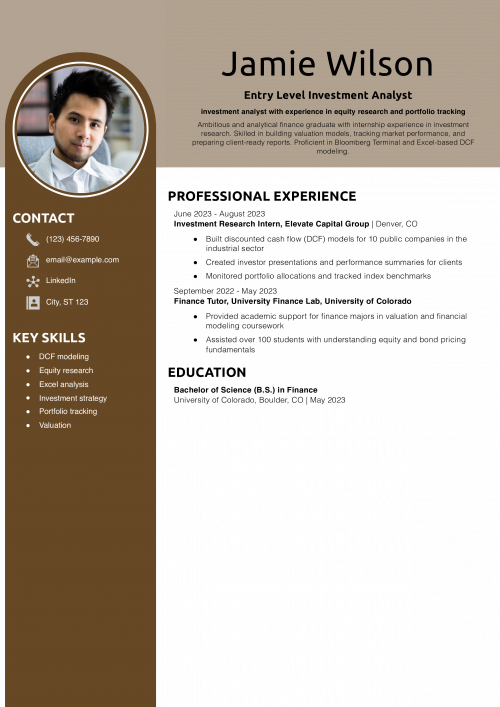
Jamie highlights technical skills and practical applications of investment concepts through internships and tutoring. The use of real tools like Bloomberg and DCF models shows job readiness in a high-stakes field.
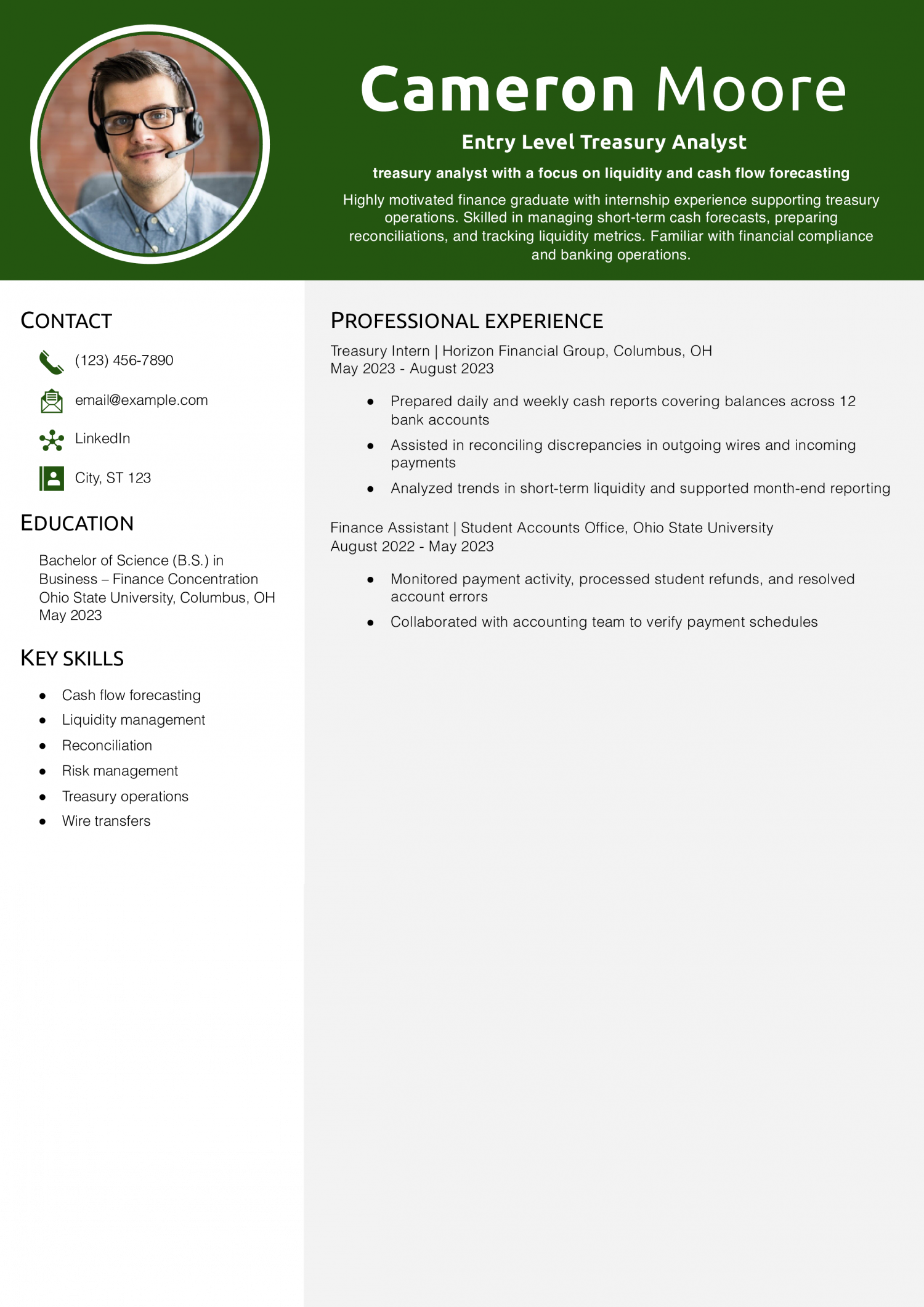
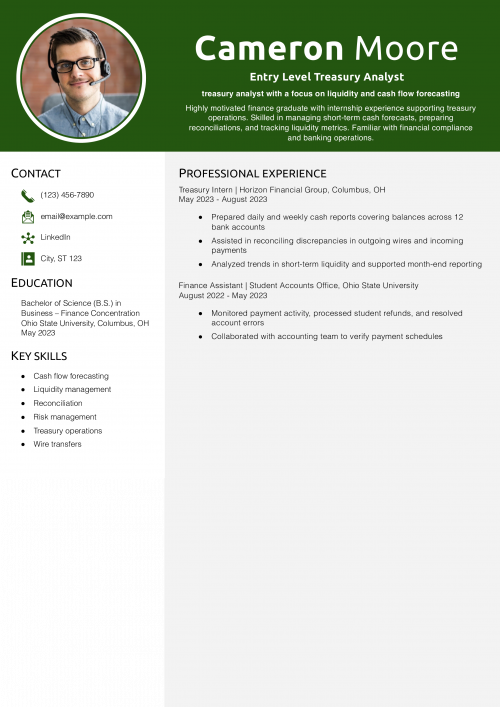
Cameron’s resume highlights attention to detail and responsibility over high-volume transactions. Treasury-specific duties like wire processing and short-term forecasting are clear, making the resume highly relevant to the role.

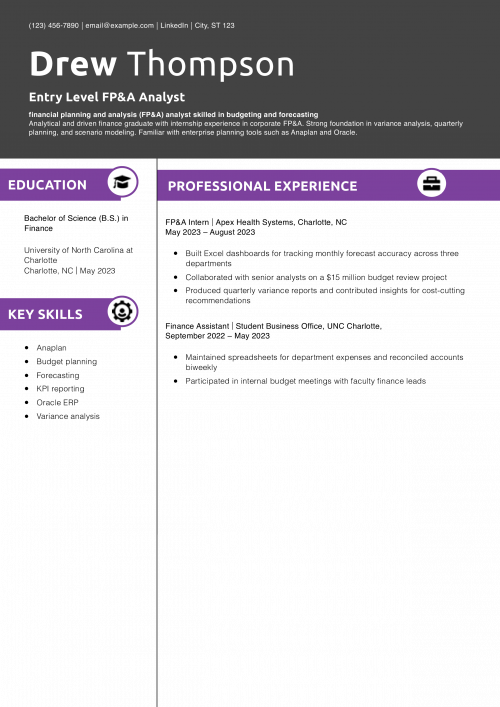
Drew’s resume directly connects to FP&A-specific processes like planning and analysis. Their work with enterprise tools like Anaplan and Oracle stands out, and the focus on cross-functional collaboration prepares them for real-world FP&A teams.
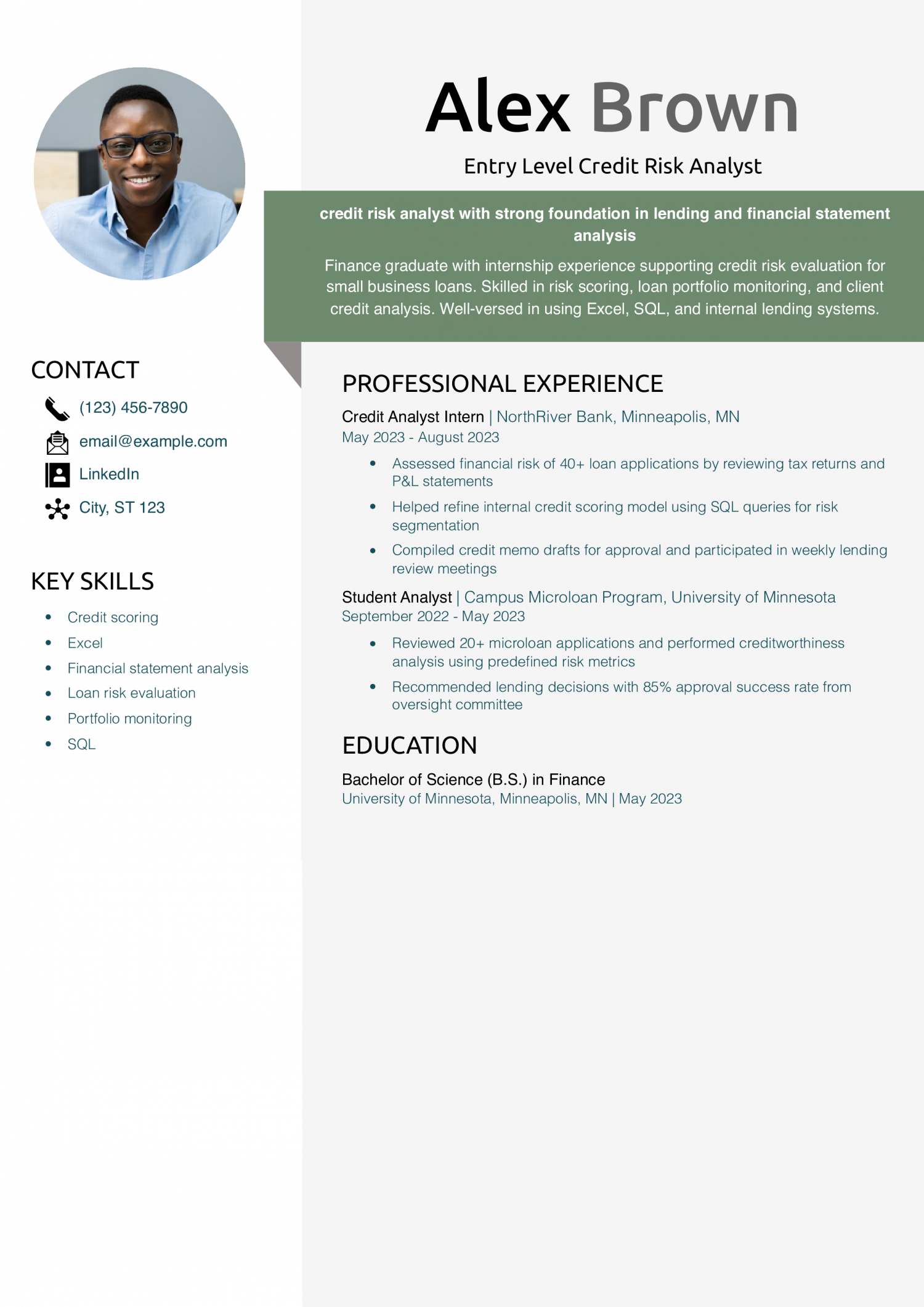
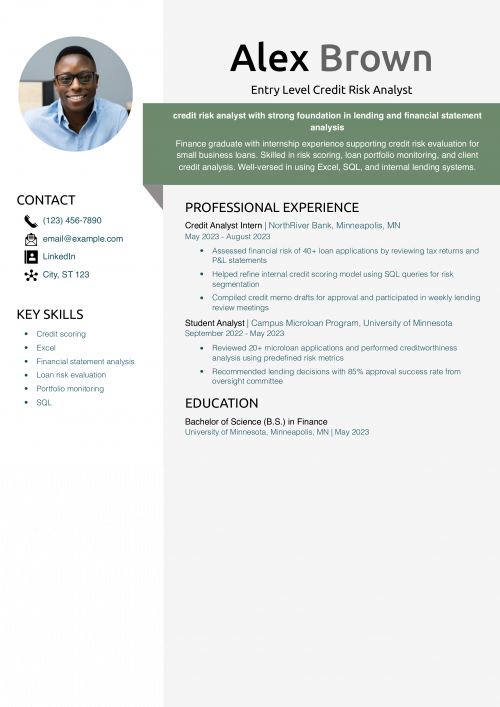
Alex’s resume shows exposure to real lending operations and direct involvement in risk analysis. The use of SQL, coupled with the ability to analyze financials and communicate recommendations, sets them apart from other entry-level candidates.
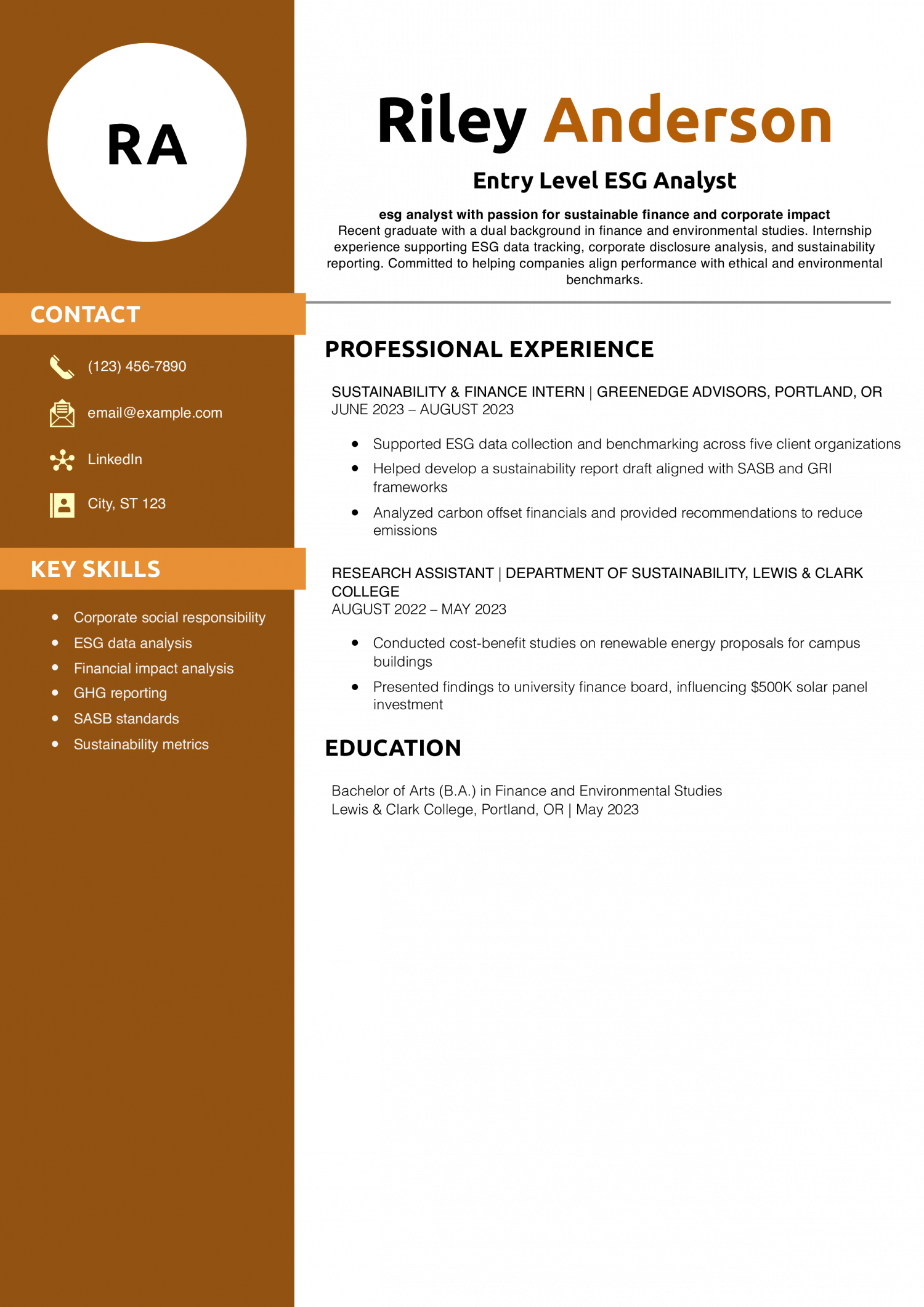
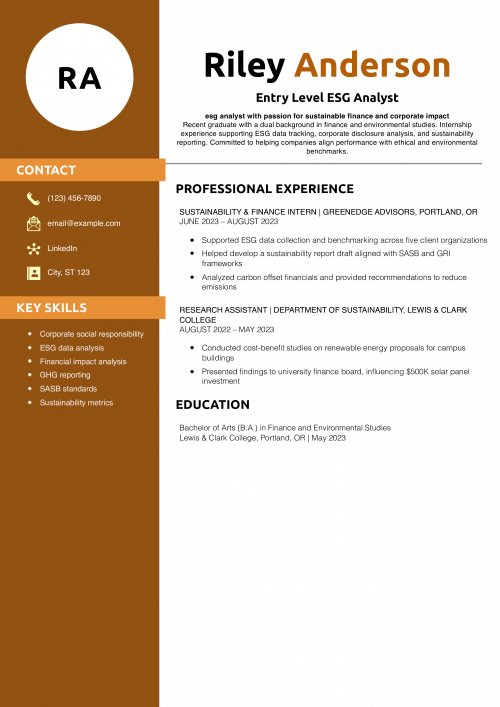
Riley’s dual major and real ESG reporting experience give them an edge in this growing field. The resume highlights both financial skills and ethical awareness — a key combination for environmental, social, and governance (ESG) roles.
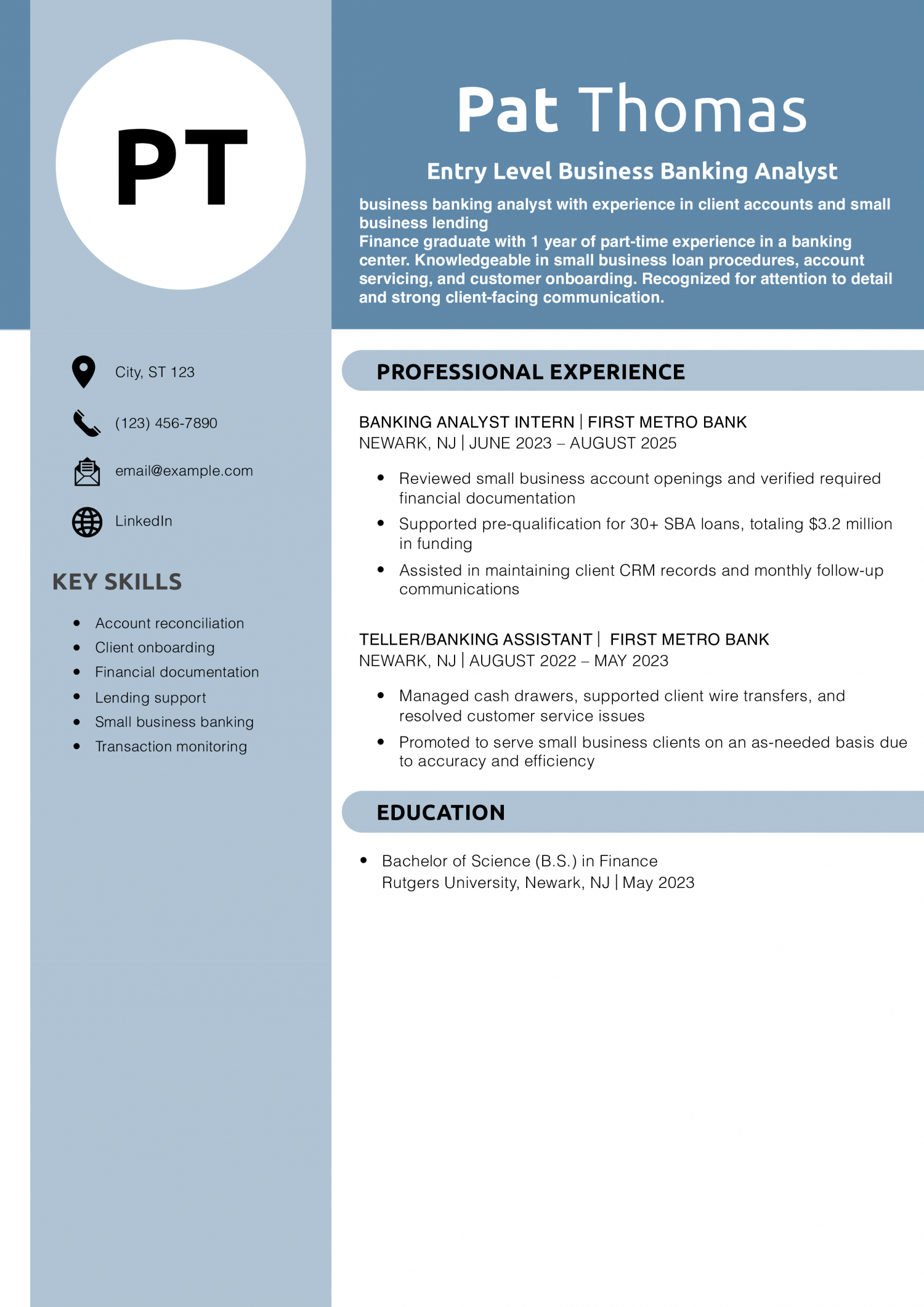
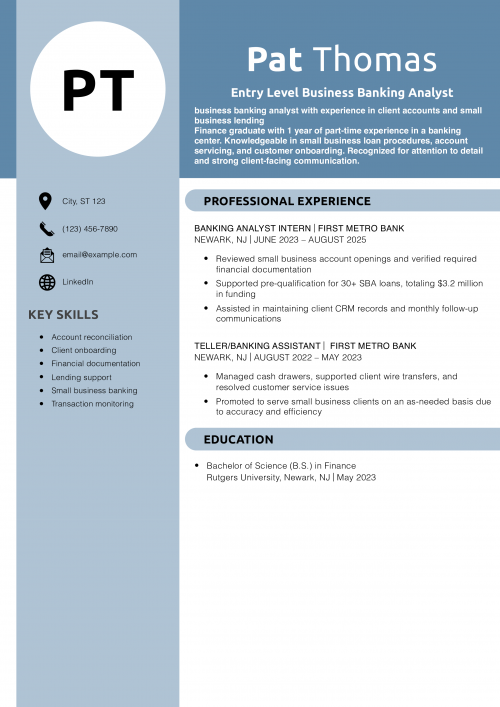
Pat’s blend of customer-facing and financial support experience makes them a great fit for business banking. Showing progression from teller to analyst intern demonstrates trust and reliability — two key traits for working with client funds.
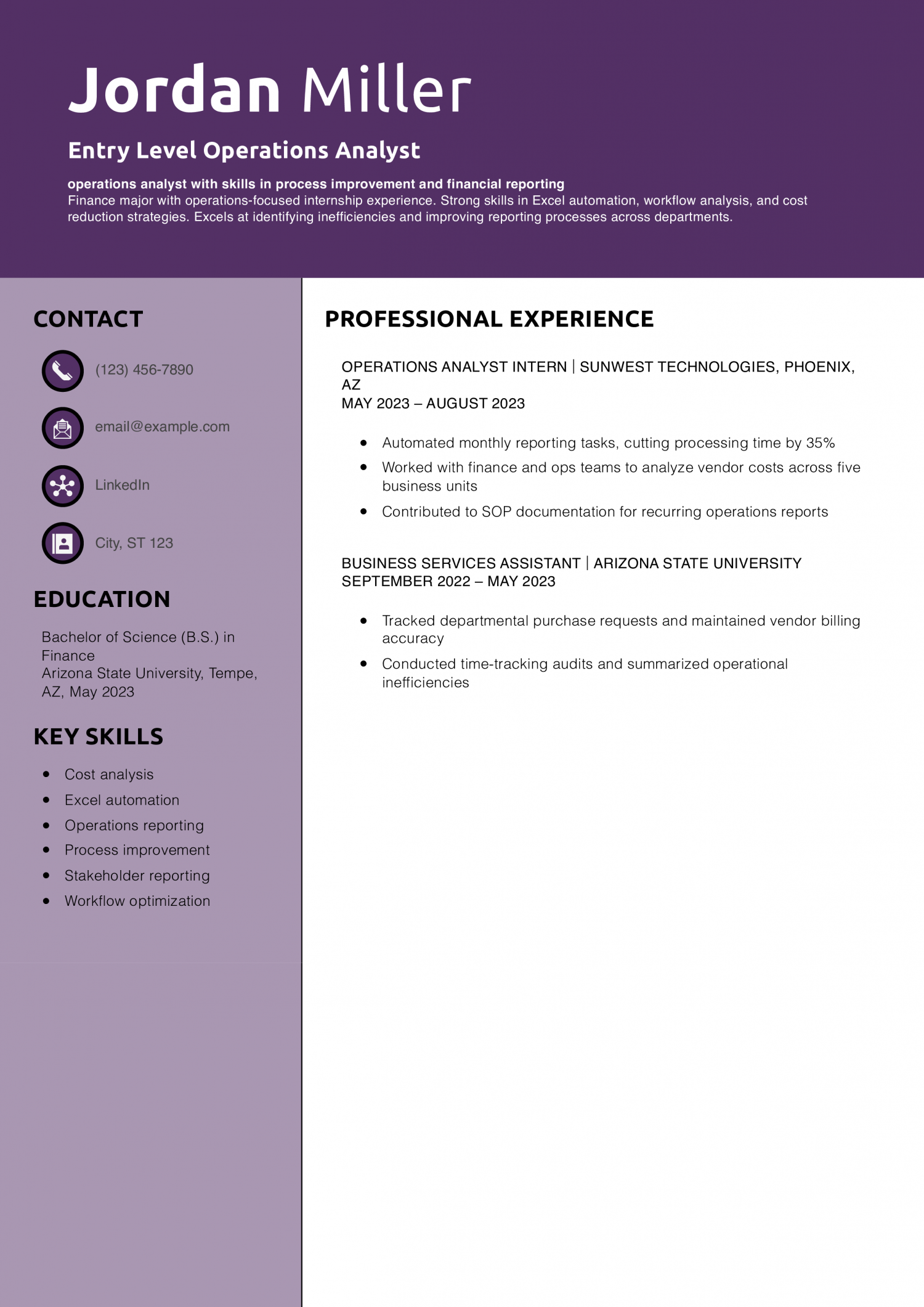
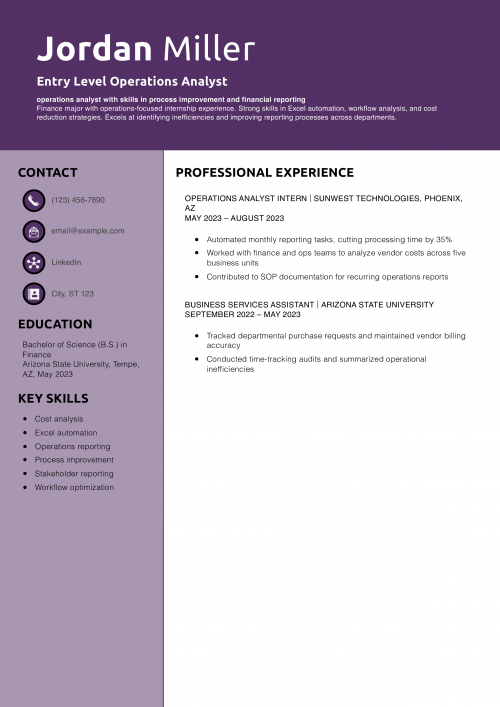
Jordan’s resume ties financial knowledge with operational improvements. Their ability to automate and optimize processes is especially appealing for roles that need both financial acumen and efficiency.

Morgan’s resume communicates industry-relevant modeling and research skills while emphasizing familiarity with real tools like Bloomberg and CCA frameworks. These are essentials for success in equity analysis.
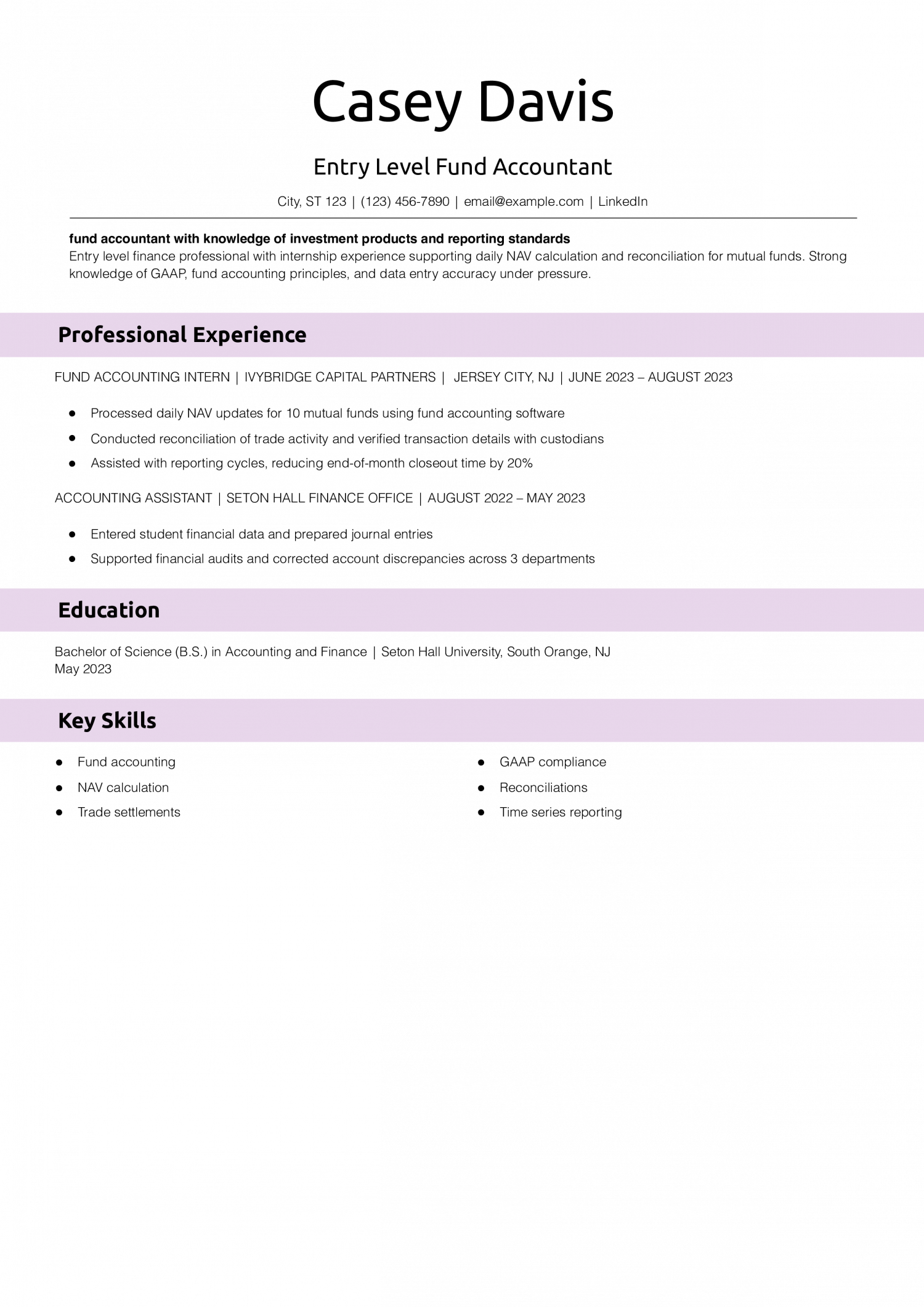
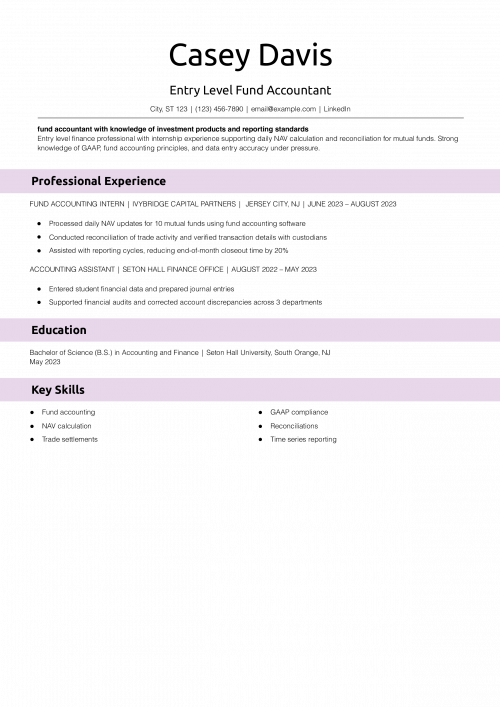
Casey’s resume focuses on accuracy, compliance, and daily fund operations — all critical in fund accounting. Their familiarity with accounting software and reconciliation practices makes them job-ready.
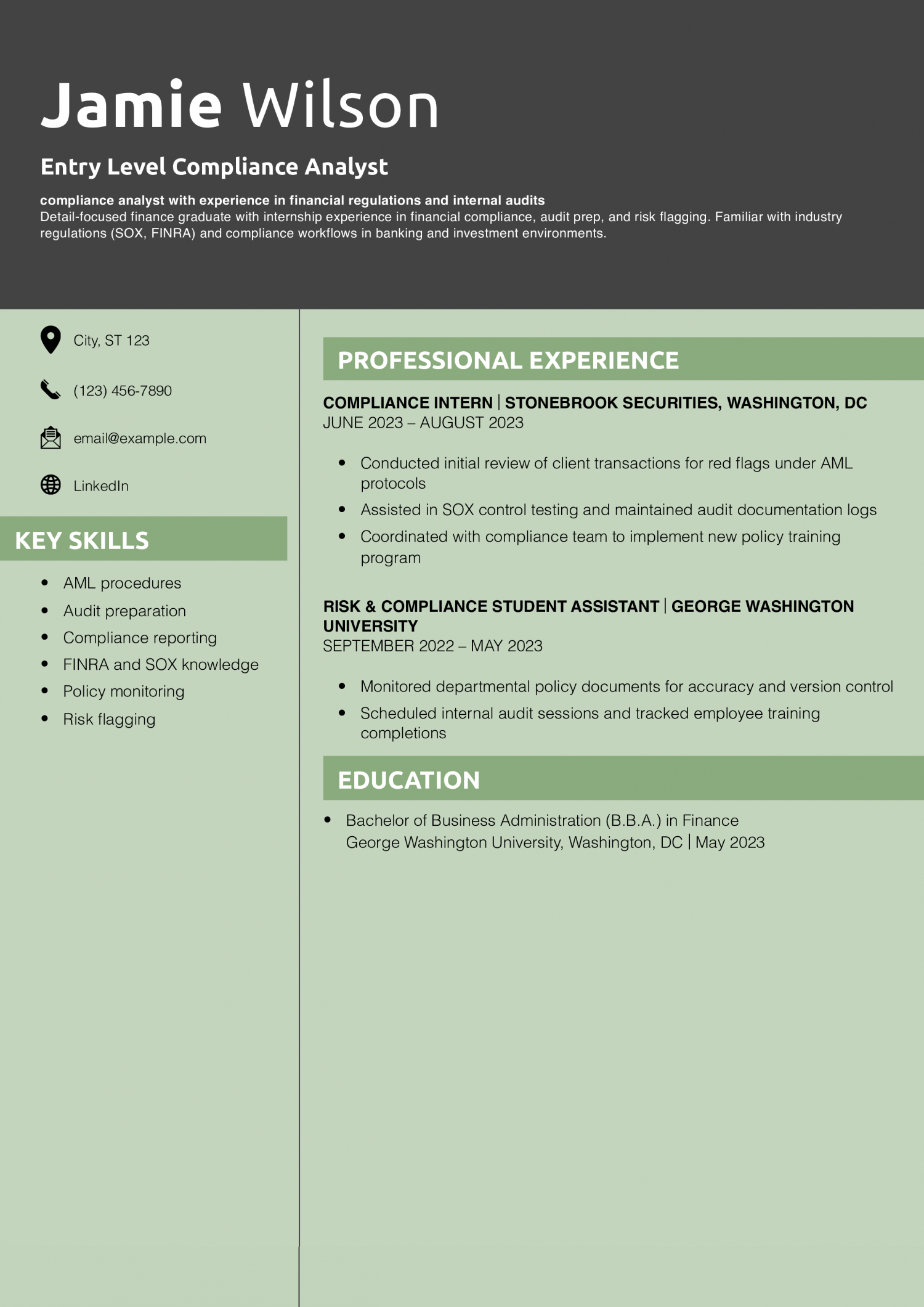
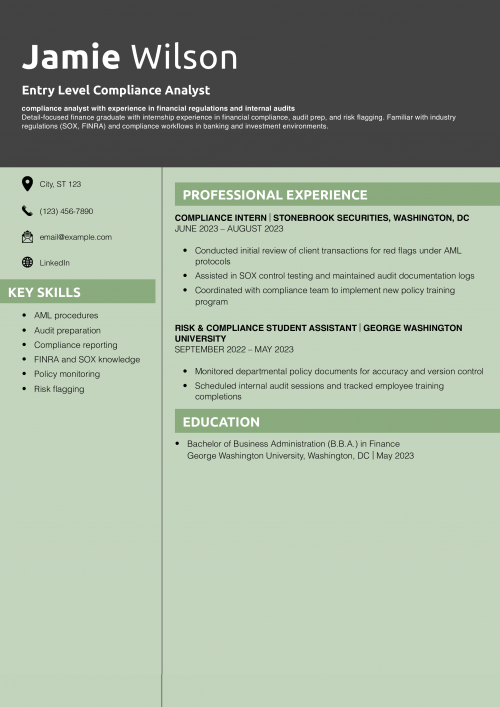
Jamie’s resume shines with regulatory familiarity and hands-on work with audits and policy implementation. These experiences are crucial for an entry level compliance analyst role, especially in financial services.
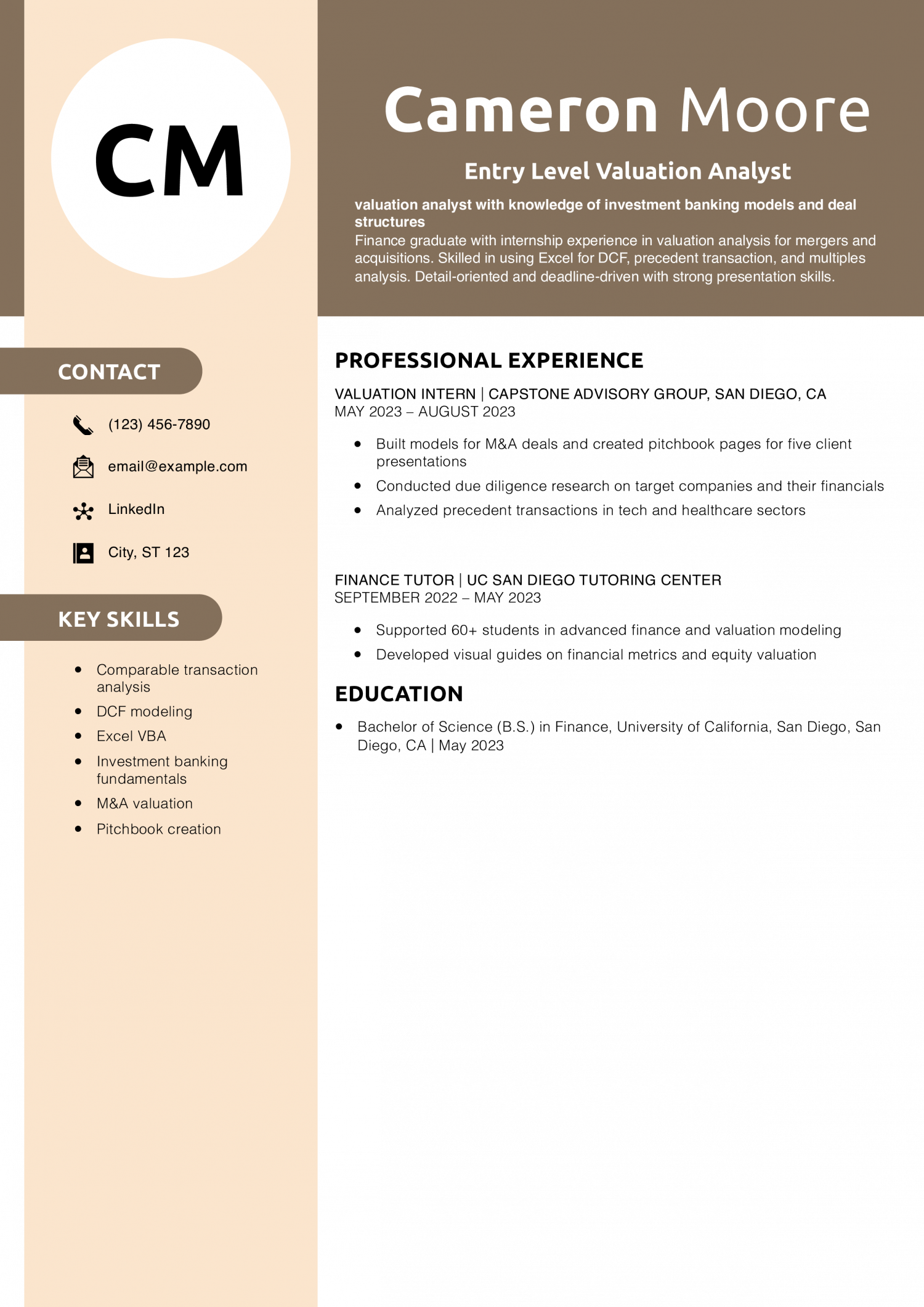
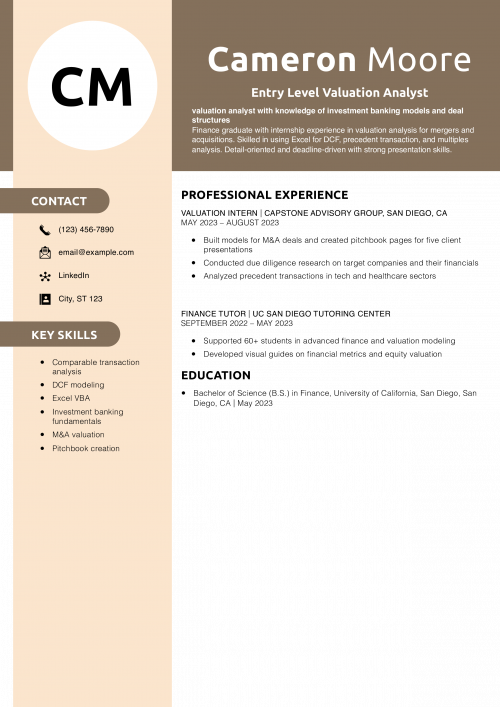
Cameron’s resume is highly targeted to M&A and valuation work, with clear use of deal-related terms and skills. Their internship directly aligns with the responsibilities of junior valuation roles in investment banking and advisory firms.
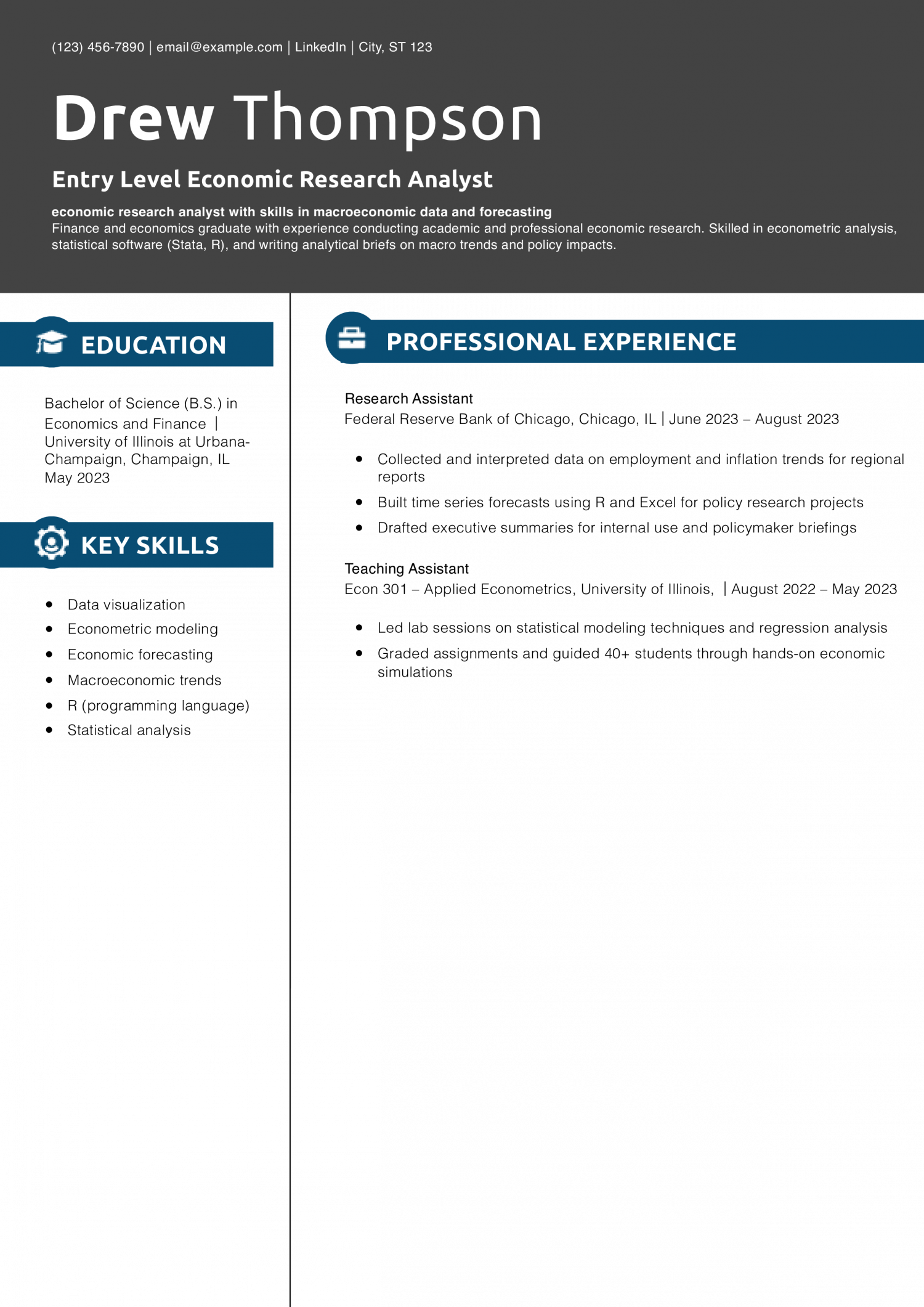
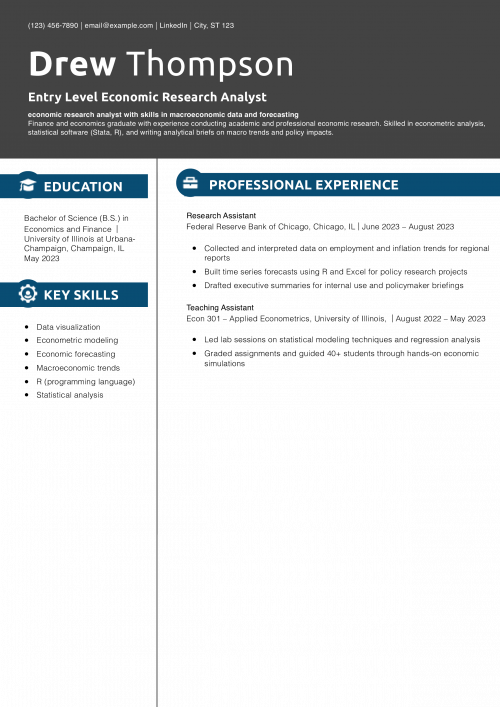
Drew’s resume showcases both research experience and technical fluency with statistical tools — essential for economic analyst roles. Contributions to policymaker briefings and time series modeling demonstrate real impact.
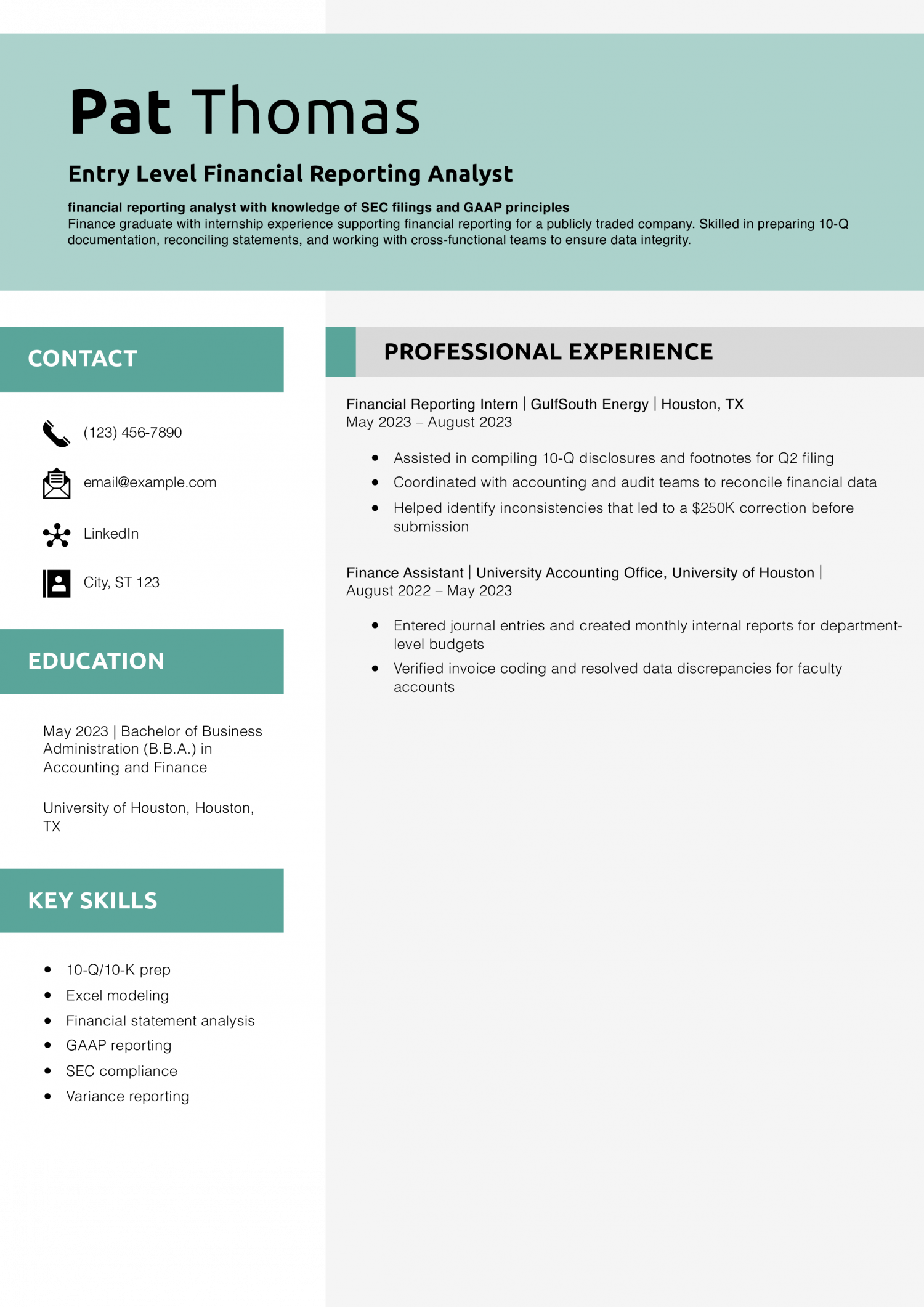
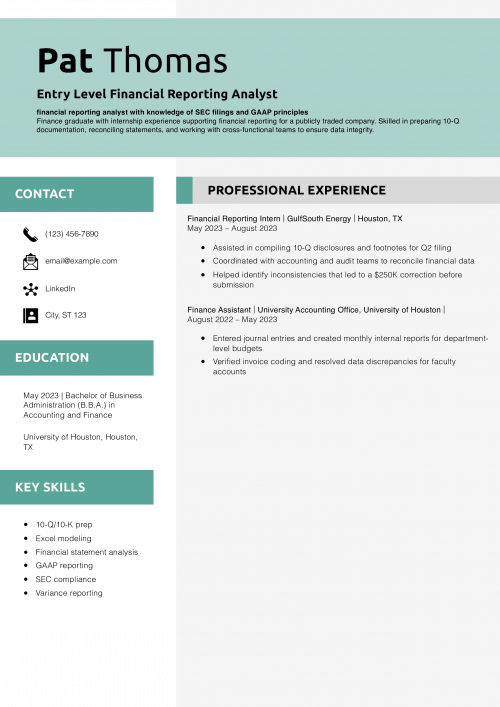
Pat’s resume clearly aligns with reporting-specific tasks and demonstrates familiarity with high-stakes deliverables like SEC filings. The quantified correction adds a powerful result to their accomplishments.
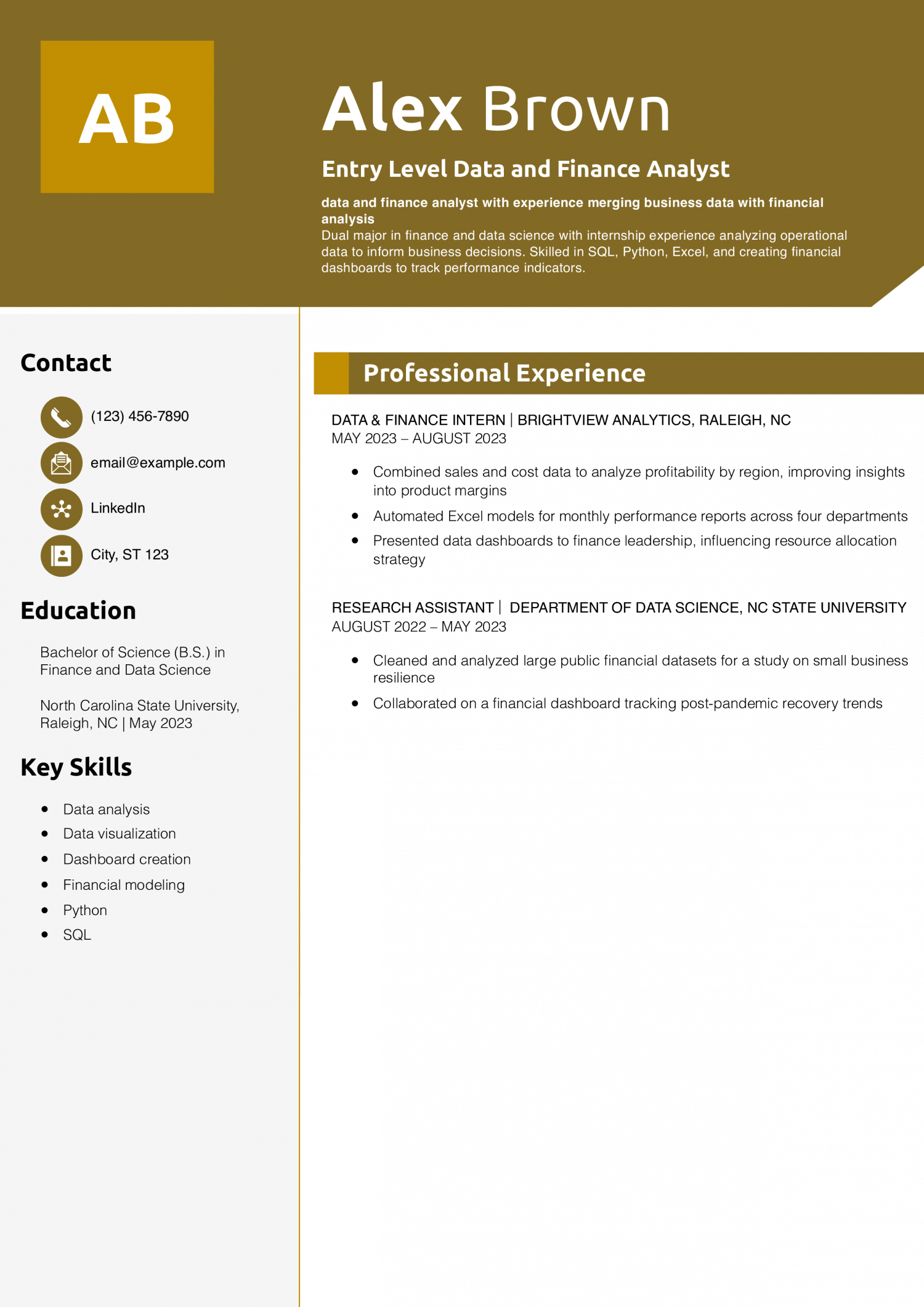
Alex merges technical data analysis with finance acumen, an in-demand combo. Their ability to apply SQL and Python to financial models demonstrates modern versatility and problem-solving skills.
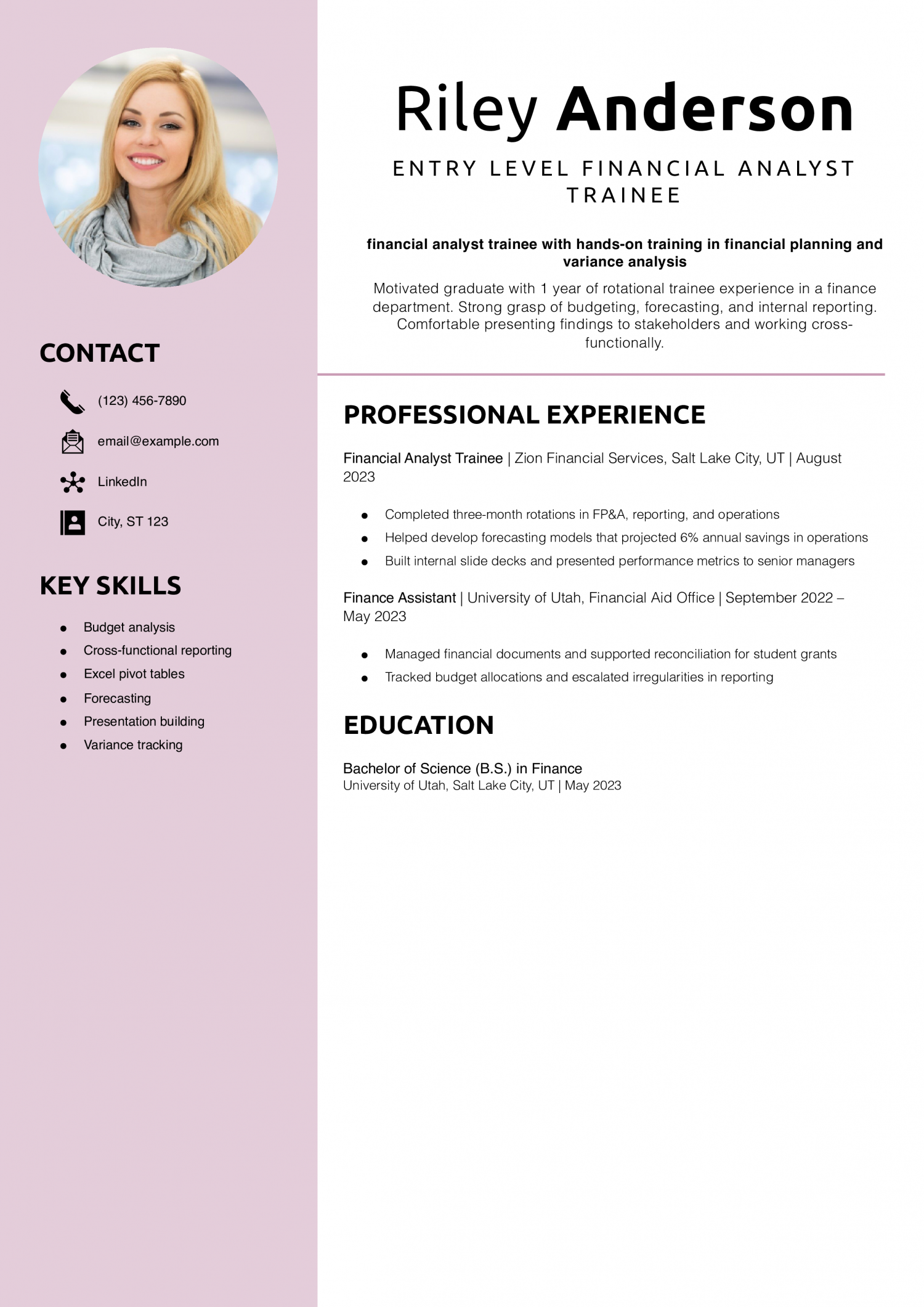
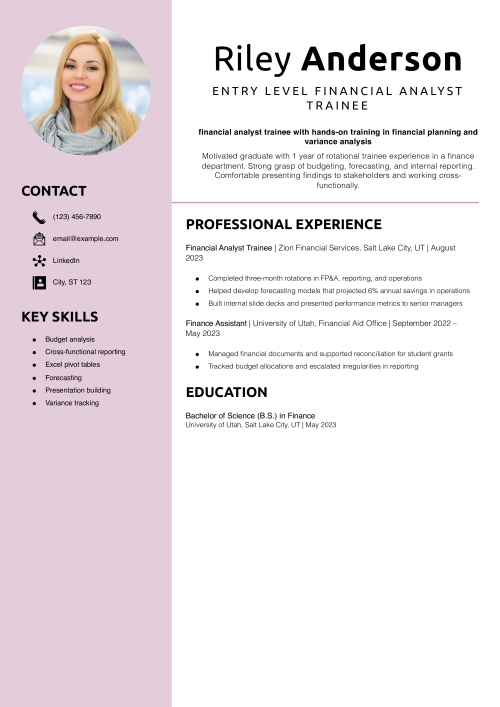
Riley’s rotational experience shows exposure to multiple functions within finance. Their ability to build forecasting models and present findings makes them ideal for future analyst positions.
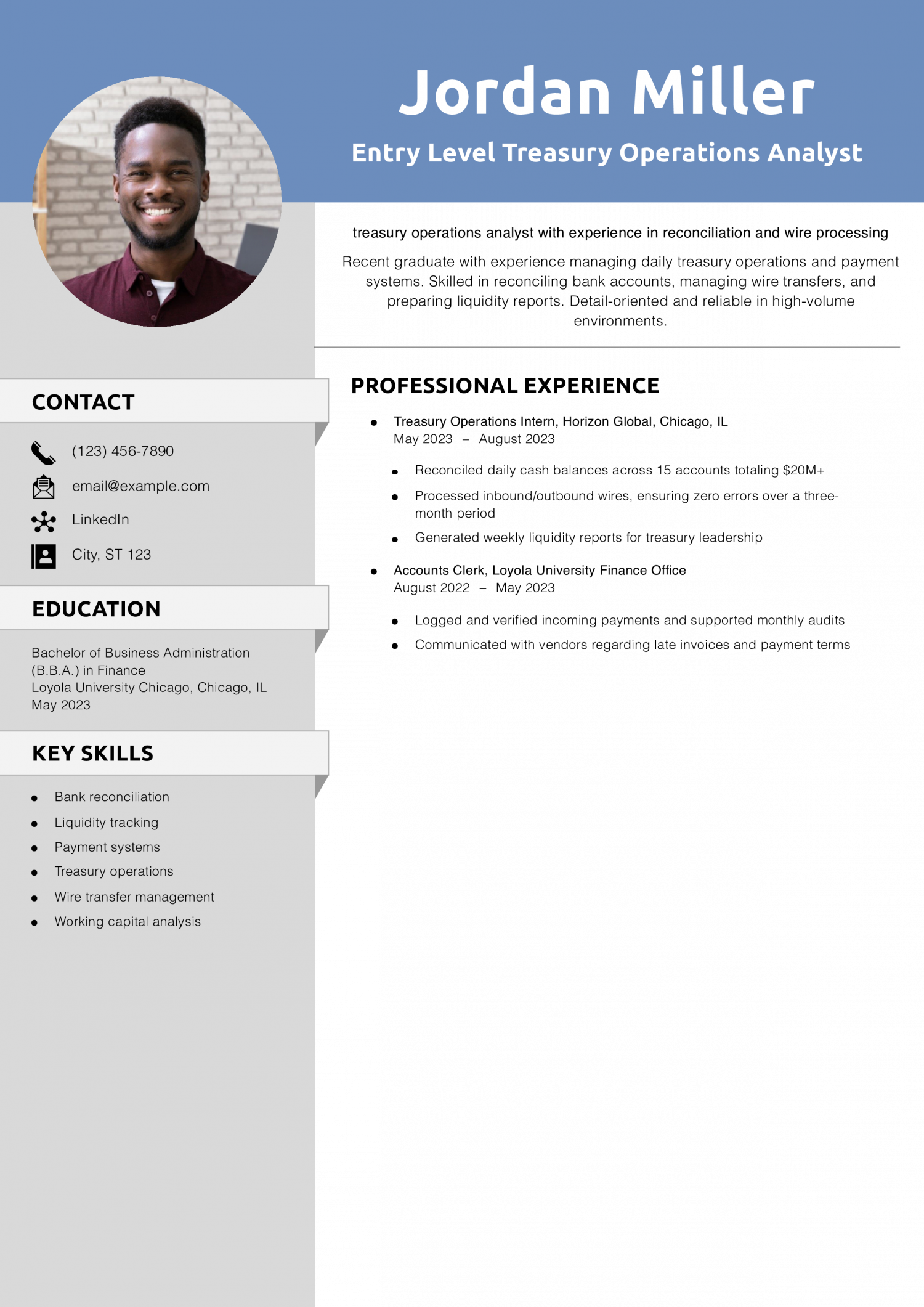
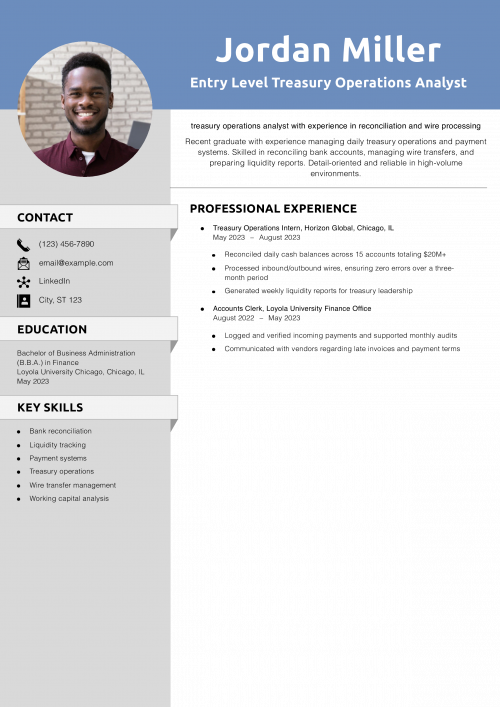
Jordan demonstrates precision and consistency in treasury tasks. Their zero-error wire record and $20M account reconciliation experience builds instant credibility in finance operations.

Jamie’s resume links finance to operations by showing cost analysis tied to real production outcomes. Tools like SAP and Power BI add weight to their technical skills for manufacturing-focused analyst roles.
Your resume should usually include these sections:
Before starting work on your resume, jot down any preferences you have for your target finance job duties, industry, company size, or work culture. These notes will help you determine and emphasize your best career details as you develop each section.
Give your full name, phone number, email address, location, and links to any online professional profiles. When applying to jobs, double-check your contact info for accuracy – it’s as important as anything else on your resume.
Your Name
(123) 456-7890 | [email protected] | City, ST | LinkedIn
Impress hiring managers at the top of your resume by giving the three to five main reasons you can excel as their next hire. Consider what sets you apart from other candidates, such as your:
When writing this section, use simple, direct phrases like “skilled in” or “focused on,” and avoid more elevated language like “outstanding” or “exceptional.”
(Note: Most job seekers find it easier to write their profile last.)
Financial analyst with hands-on internship experience in forecasting, cost modeling, and investment analysis for corporate finance teams. Skilled in leveraging Excel, SQL, and Tableau to evaluate financial performance and deliver actionable, data-driven insights. Strong foundation in financial statement analysis, budgeting, and strategic planning developed through both academic coursework and real-world projects.
For any job you’ve held so far, brainstorm your duties and achievements on a separate document or sheet of paper. Then, review your notes in light of your target financial analyst job, and choose the most relevant ones to feature as bullet points in your resume. Follow the same brainstorming process for any internships or volunteer roles you’ve had. By filtering your information this way, you can create an experience section that’s both detailed and focused.
Finance Intern, Lakeview Manufacturing, Dallas, TX | May 2024 to August 2024
When possible, cite relevant performance data and metrics to show the results you’ve achieved in each position. Hard numbers put your work in context and give recruiters a better sense of your impact.
Before sending your resume, review it carefully against the job posting. Delete any details that don’t speak to the requirements, and consider using that space for more information about your relevant experience. This process takes extra time, obviously. But it can shorten your overall job search by giving you an edge over the many applicants who send a more general, less convincing resume.
With the education and certifications sections, you can show you have a strong knowledge base in your field. Cite any credentials you’ve earned that speak to your abilities as a financial analyst. Below are templates and examples to help you organize this information on your resume (note, years are optional).
Template:
[Degree Name], [School Name], [City, ST] | [Graduation Year]
[Relevant honors, coursework, or activities]
Example:
Bachelor of Business Administration (B.B.A.) in Finance, University of Texas, Austin, TX
Template:
[Certification Name], [Awarding Organization] | [Completion Year]
[Description if the credential is lesser-known but relevant]
Example:
Bloomberg Market Concepts (BMC), Bloomberg | 2024
A skills section lets you quickly show the different ways you can contribute and excel as a financial analyst. It also helps your resume perform well on applicant tracking systems (ATS) used by employers to screen candidates. Below, you’ll find some key terms and skills to consider for this section:
| Key skills | |
|---|---|
| Budget forecasting | Business intelligence (BI) |
| Client relations | Cost reduction and elimination |
| Data analysis | Data visualization |
| Excel modeling | Financial modeling |
| Financial reporting | Investment analysis |
| Legal and corporate compliance | Regression analysis |
| Risk analysis and management | SQL |
| Tableau | |
Start each bullet point with a strong action verb. Dynamic verbs help you keep the hiring manager’s attention and tell a compelling story about your experience so far.
The following list can help you find a good mix of action verbs for your entry-level financial analyst resume:
| Action verbs | |
|---|---|
| Advised | Analyzed |
| Clarified | Created |
| Decreased | Earned |
| Encouraged | Enhanced |
| Evaluated | Forecasted |
| Fostered | Generated |
| Grew | Guided |
| Improved | Increased |
| Introduced | Lowered |
| Managed | Modeled |
| Presented | Prevented |
| Projected | Ranked |
| Recommended | Reduced |
| Researched | Reversed |
| Streamlined | Supported |
| Tracked | Updated |
| Visualized | Won |
Choose a template that’s clear and straightforward, and avoid any template with elaborate graphics or various colors and font styles. Simple resume design helps a hiring manager scan for relevant information. It also helps you tailor the document to each job application and update your work history going forward. (Tip: When you can, save and submit your resume as a pdf file to preserve formatting across screens and systems.)
First, look closely at the job post text and note any words that are repeated or emphasized. Compare these phrases with the language in your resume, particularly the profile and key skills sections. Then, seek ways to align your resume language with the job post while not copying phrases or misstating your background.
For example, if the organization seeks someone collaborative, call out that aspect of your experience in your profile. Or say the firm has many non-English speaking clients. Cite your foreign language skills both in your profile and as a separate section farther down the document. With adjustments like these, you can make your resume more relevant to each opportunity.
Most entry-level financial analysts should use the combination (or hybrid) format. True to its name, this format combines two important features of other resume formats: the chronological format's experience section and the functional format's profile section. (The resume examples on this page all use combination format.)
A combination resume offers the best of both worlds by fusing these two features. The experience section lets you outline your recent career activities - essential information for most employers. At the same time, the profile section enables you to display your career highlights at the top, whether they're from that recent experience or another part of your background.
As a result, you can present yourself both clearly and strategically. With this format you give hiring managers the best view of your experience and relevant strengths so they can decide to call you for an interview.
A good cover letter sharpens your job application by saying directly why you’re interested in the organization or job opening at hand. When possible, quote or paraphrase text from the job posting and explain why it caught your attention.
For example, if a job posting says, “We seek a team player to help analyze financial trends and develop key insights,” you might write: “I’m excited to apply for the financial analyst position at your company because I’m passionate about analyzing financial data while collaborating on a team. Your emphasis on developing key insights aligns perfectly with my academic background and internship experience in financial analysis.”
Executive Resume Writer and Career Coach
Andrew Stoner is an executive career coach and resume writer with 17 years of experience as a hiring manager and operations leader at two Fortune 500 Financial Services companies, and as the career services director at two major university business schools.
Resume Templates offers HR approved resume templates to help you create a professional resume in minutes. Choose from several template options and even pre-populate a resume from your profile.